


Algorithms for predicting postprandial insulinemia: a review of the evidence
The study of 147 foods indicates that, individually, glycemic load is a better predictor of insulin response than available carbohydrates; however, it is not sufficient on its own. Integrating glycemic response, sugars, and proteins explains more variability. Independent studies confirm the role of carbohydrate quality and quantity, with limitations in complex meals.
- Published 10/11/2026
- Updated 13/11/2026
- Article history
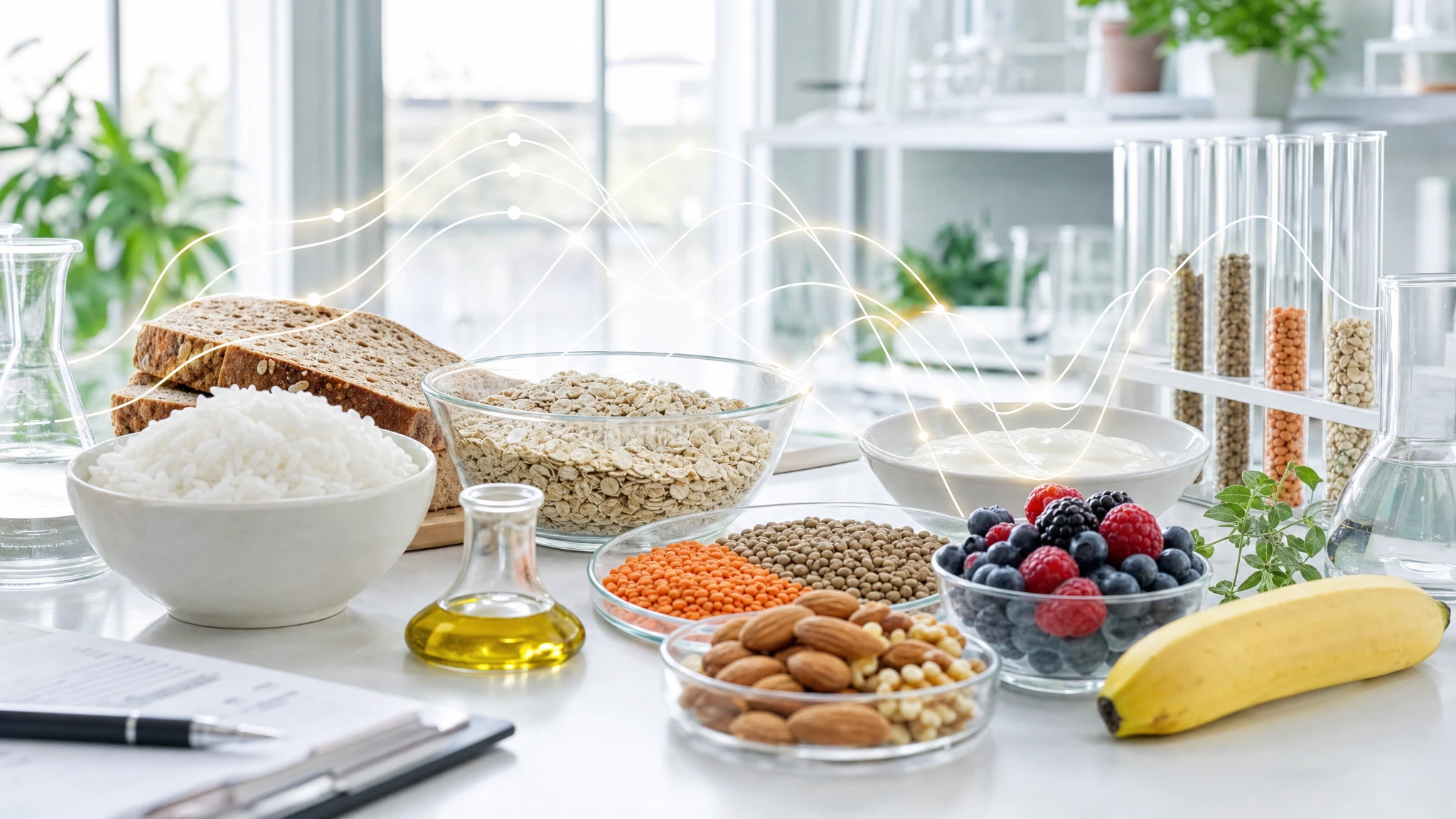
ABSTRACT
The analyzed study evaluated whether nutritional composition, glycemic index, and glycemic load can predict the rise in insulin after the consumption of common foods. Using data from 147 foods tested in healthy, normal-weight young adults, the authors observed that glycemic load was the best individual predictor of the food insulin index. However, no single nutrient fully explained the variability of the response.
In "The Choice to Live in Health or Illness" by Dr. A. Colonnese and R. Panzironi, the study contributes to the narrative that post-meal insulin depends on the interaction between the quality and quantity of carbohydrates, proteins, fats, and the overall characteristics of the food. Independent studies on mixed meals confirm that reducing glycemic load generally reduces postprandial glycemia and insulinemia. However, significant limitations remain: the results are primarily derived from acute studies with small sample sizes and do not allow for the precise estimation of individual responses to every real-world meal.
Analyzed study
Algorithms to Improve the Prediction of Postprandial Insulinaemia in Response to Common Foods
DOI: 10.3390/nu8040210
PMID: 27070641
PMCID: PMC4848679
The research question was whether the nutritional data of a food, its glycemic index, and its glycemic load could estimate more accurately how much insulin is secreted after a meal. The hypothesis was that the amount of carbohydrates alone was insufficient and that the insulin response also depended on the speed at which glucose enters the blood and on the other components of the food.
The research is relevant to this section of the book because it documents the central segment of its narrative: glycemic load, which combines the quality and quantity of carbohydrates, is a more informative predictor than the amount of carbohydrates alone; furthermore, the overall composition of the food adds information, but does not allow for a complete prediction. The study describes acute physiological responses in healthy volunteers. It does not demonstrate that a specific insulin response causes insulin resistance, type 2 diabetes, or other long-term clinical outcomes.
Materials and methods of the original study
The authors analyzed a database of 147 common foods. For each food, the Food Insulin Index (FII) was measured; this index expresses the insulin response triggered by a 1000 kJ portion compared to the response generated by an equal-energy portion of glucose. The final FII for each food corresponded to the average observed in 10 young, lean, and healthy volunteers.
The insulin response was calculated as the incremental area under the curve, which is the sum of the increase in blood insulin levels in the two hours following the consumption of the food. The authors applied linear regressions to verify how much FII was associated with available carbohydrates, proteins, fats, sugars, fiber, glycemic index, glycemic load, and glucose score. The glucose score indicates the relative increase in glycemia produced by a 1000 kJ portion of the food.
The capacity of previous predictive equations was also verified, and new statistical models were constructed. For 37 foods, data on specific amino acids were available. Detailed information on average age, sex distribution, inclusion criteria, and the exact data collection period is not reported in the available material.
Results
In simple terms, seemingly similar foods could produce very different insulin responses. The glycemic load proved to be the best individual predictor of the FII: it explained 55% of the observed variability, with high statistical significance. The glycemic index explained 51% and available carbohydrates 47%; all relationships had P < 0.0001. This means that the quality and quantity of carbohydrates described the insulin response better than their quantity alone, but still left a large portion of the variability unexplained.
Sugars were associated with an increase in FII, with a correlation of r = 0.36 and P < 0.0001. Fat content was associated with a lower FII, with r = −0.56 and P < 0.0001, while the overall relationship with protein was inverse but weaker, r = −0.27 and P = 0.01. These associations do not prove that adding fat or protein directly reduces insulin: in individual foods, nutrients tend to replace each other, and the food structure can modify digestion and absorption.
When the authors considered only 29 foods with less than 10 g of carbohydrates per 1000 kJ, protein was instead associated with an increase in FII and explained 54% of the variability. In this subgroup, some branched-chain amino acids, such as isoleucine, leucine, and valine, were associated with a greater insulin response. The result indicates that the effect of protein becomes more visible when it is not masked by the predominant effect of carbohydrates.
Previous predictive equations illustrated only 14% and 10% of the variability of the new observations. The new model, which combined glucose score, sugars, and protein, explained 78% of the FII variability. A model based solely on nutritional composition, especially carbohydrates and protein, explained about 49% instead. Fiber did not show a significant association with FII in the overall database, with r = 0.08 and P = 0.361.
Interpretation
The main takeaway is that the insulin secreted after a meal cannot be reliably estimated by counting only the grams of carbohydrates. The glycemic load provides a better prediction because it considers both the quantity of carbohydrates and their ability to increase glycemia. However, even the glycemic load remains an incomplete indicator: in the analyzed study, it accounted for just over half of the differences observed between foods.
The finding specifically documented by the publication subject to this Evidence Review is therefore: the quality and quantity of carbohydrates are important determinants of the insulin response, but the overall characteristics of the food contribute to the final response. The model using glucose score, sugars, and proteins explained a larger share of the variability, equal to 78%, but the glucose score itself requires measurement in humans. It is therefore not a simple tool for predicting insulinemia for every person in daily life.
The inverse associations between fats or proteins and FII in the general analysis should not be interpreted as proof that these nutrients always lower insulin. In the low carb subgroup, in fact, a higher amount of protein was associated with a greater insulin response. This apparent contrast shows why the response to a meal depends on the nutritional context and not on a single isolated macronutrient.
Independent confirming evidence
Direct confirmation of the role of glycemic load in mixed meals comes from an experimental study by Galgani and colleagues. In healthy adults, meals with a similar glycemic load but different in the quantity and type of carbohydrates produced very similar glycemic and insulin responses. Furthermore, the calculated glycemic load was associated with the areas under the glucose and insulin curves at both two and five hours, with r = 0.58 and r = 0.54 respectively, both with P < 0.01. This supports the passage in the book stating that glycemic load maintains a significant relationship with insulinemia even in mixed meals. However, the small sample size and acute assessment limit generalizability [1].
A second randomized crossover study extended the verification to an entire day of eating in 26 adults who were overweight or had obesity. Compared to a high-glycemic index and high-carbohydrate diet, both reducing the glycemic index and reducing carbohydrates decreased the area under the insulin curve. The reduction was 20% with a high-glycemic index and low carbohydrates, 20% with a low-glycemic index and high carbohydrates, and 29% with a low-glycemic index and low carbohydrates; for all comparisons P < 0.0001. The study confirms that the quality and quantity of carbohydrates contribute to the direction of the insulin response in complex meals, without demonstrating long-term clinical effects [2].
A further trial directly showed that other nutrients can modify the postprandial response. In four randomized experiments conducted in groups of 20-22 adults aged 50-80, the addition of carbohydrates to white bread increased incremental glycemia, measured glycemic load, and the insulin response. The addition of 50 g of protein reduced incremental glycemia but increased the area under the insulin curve or the insulin index; the addition of 11.1 g of fat also increased the insulin response or the insulin index. Added fiber did not significantly modify these indicators in the studied protocol. These data confirm that glucose and insulin do not always vary in the same direction and that meal composition matters, even under very simplified experimental conditions [3].
Conflicting evidence
A small crossover study by Wolever and Bolognesi introduces a significant limitation. Eight healthy adults consumed five mixed meals with varying amounts of energy, carbohydrates, fats, and proteins. The amount of carbohydrates alone was not significantly associated with the mean glucose or insulin response; however, the amount of carbohydrates and the glycemic index together explained about 90% of the variability in mean responses, with P = 0.01. Within the specific range tested, the variation in protein and fat appeared to have a negligible effect on postprandial responses [4].
This result does not contradict the idea that a food is more than just the sum of its carbohydrates, but it scales back the claim that proteins and fats always contribute to a relevant extent. Their effect may depend on the quantities, the type of food, the timing of the measurement, and the population studied. No directly conflicting evidence sufficiently relevant to the fact that the quality and quantity of carbohydrates influence the insulin response has been identified; this does not prove the absence of contrary results.
Summary table of evidence
The table distinguishes the publication subject to the review from the independent research used to verify the steps of the book's narrative.
| Reference | Study type | Population or model | Main result | Direction of evidence | Strength of evidence |
|---|---|---|---|---|---|
| Original study | Experimental analysis and modeling | 147 foods tested in healthy young adults | Glycemic load explained 55% of FII variability; glucose score, sugars, and proteins explained 78% | biologically consistent evidence | moderate |
| [1] | Acute experimental study | Healthy adults, mixed meals of varying size and composition | Glycemic load was associated with glucose and insulin areas under the curve; meals with similar glycemic load produced similar responses | direct confirmation | moderate |
| [2] | Crossover RCT | 26 adults who are overweight or have obesity | Reducing glycemic index or carbohydrates decreased the insulin area under the curve over 12 hours | direct confirmation | moderate |
| [3] | Crossover RCT | Four groups of 20-22 healthy adults or those without significant pathologies | Carbohydrates, proteins, and fats modified glycemia and insulin response differently; added fiber showed no significant effects | indirect confirmation | moderate |
| [4] | Crossover study | 8 healthy adults | Glycemic index and carbohydrate quantity explained about 90% of the variability; proteins and fats appeared negligible in the tested range | discordant evidence | preliminary |
Confirmation of the evidence
Claim in the book
In section 2.1.1, “The Choice to Live in Health or Illness” by Dr. A. Colonnese and R. Panzironi, it is stated that glycemic load is the best individual predictor of the food insulin index and that insulin secretion depends on the interaction between multiple food characteristics, not just the amount of carbohydrates.
amount of carbohydrates + glycemic index → glycemic load → greater or lesser glycemic response → greater or lesser insulin response, modulated by the composition of the meal
The publication subject to the Evidence Review was used in the book to support the following passage: glycemic load predicts the insulin response better than simple carbohydrate content, but the final response also reflects the interaction with sugars, proteins, fats, and the food matrix.
The scientific correspondence is precise. The original study shows that, in its database of 147 foods, the glycemic load explained a greater portion of the variability of the insulin index compared to available carbohydrates taken in isolation. It also shows that nutritional composition alone explained about half of the variability, while the integration of glycemic response, sugars, and proteins reached 78%.
Independent evidence confirms the main finding in different contexts. In mixed meals, glycemic load was found to be associated with increased insulin, and meals with similar glycemic load caused similar insulin responses [1]. In a full-day trial, decreasing the glycemic index, the amount of carbohydrates, or both reduced postprandial insulin exposure compared to a high-glycemic index and high-carbohydrate diet [2]. A further experiment shows that proteins and fats can increase the insulin response even when the effect on glycemia does not proceed in the same direction, confirming that prediction based on carbohydrates alone is incomplete [3].
However, the literature calls for caution. In the small study by Wolever and Bolognesi, glycemic index and carbohydrate quantity explained most of the response, while variations in fats and proteins appeared negligible within the analyzed range [4]. Therefore, the narrative proposed in the paragraph of “The Choice to Live in Health or Illness” by Dr. A. Colonnese and R. Panzironi is well supported regarding the combined role of carbohydrate quality and quantity; the contribution of other nutrients is real but dependent on the experimental context and the type of meal.
Overall level of confirmation
STRONG CONFIRMATION
The central point is supported by the original study and multiple independent human studies, including mixed meals and a 12-hour crossover trial. The evidence is strong regarding the combined importance of glycemic index and carbohydrate quantity; it is more moderate regarding the effect size attributable to proteins, fats, and fiber.
Conclusions
The analyzed study convincingly argues that postprandial insulinemia cannot be predicted by the amount of carbohydrates alone. The glycemic load proved to be the best individual predictor among those examined, but it does not account for all the variability between foods. Independent evidence confirms that the combination of carbohydrate quality and quantity influences the insulin response, even in mixed meals and throughout the entire day.
The contribution of proteins, fats, and fiber is supported experimentally, but it is dependent on the composition of the meal and cannot be reduced to a single rule. The results do not demonstrate long-term clinical consequences, nor do they allow for the precise estimation of an individual's insulin response. The book's narrative is therefore well-supported, though further validation in larger populations and under habitual dietary conditions is needed.
Overall assessment
The narrative is fairly well supported by acute human studies: glycemic load and, more generally, the quality and quantity of carbohydrates are associated with higher or lower insulin responses. The additional role of proteins, fats, and fiber is biologically plausible and moderately supported, but depends on the meal and the context.
References
[1] Acute effect of meal glycemic index and glycemic load on blood glucose and insulin responses in humans
[2] Reducing the Glycemic Index or Carbohydrate Content of Mixed Meals Reduces Postprandial Glycemia and Insulinemia Over the Entire Day but Does Not Affect Satiety
[3] Effect of macronutrients and fiber on postprandial glycemic responses and meal glycemic index and glycemic load value determinations
Editorial note
Artificial Intelligence was used solely as a tool to support editorial and documentary work. All content, interpretations, bibliographic citations and conclusions have been verified, reviewed and approved by the author, who assumes full scientific responsibility for them.
The manuscript was also subject to independent peer review prior to publication.
To ensure maximum transparency, the article's complete history — including the dates of submission, review, acceptance and publication, as well as information on the peer review process — is available on the dedicated Article History page.