


Carbohydrate load and postprandial glycemia - Evidence review
In the five adults with type 1 diabetes studied, keeping the carbohydrate-to-insulin ratio fixed while increasing the meal size increased glycemic exposure exponentially. Independent studies confirm that meal quantity and composition influence control, but they do not define a universal rule: further large, long-term controlled studies are needed.
- Published 11/11/2026
- Updated 13/11/2026
- Article history
ABSTRACT
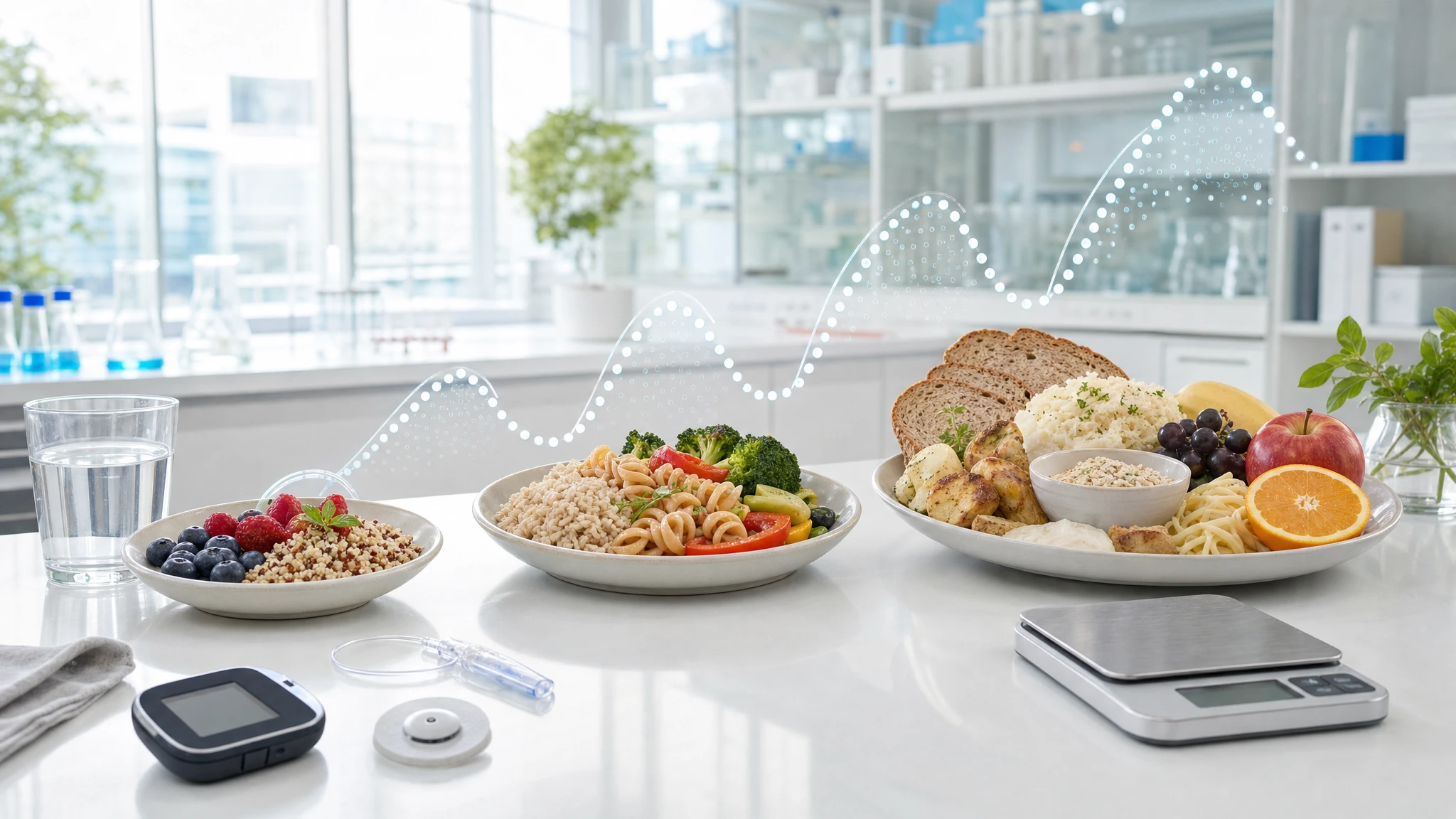
The analyzed study evaluated whether, in people with type 1 diabetes treated with an insulin pump, a fixed carbohydrate-to-insulin ratio maintains proportional glycemic control when the amount of carbohydrates consumed increases. Five participants consumed standardized meals with increasing carbohydrate loads over five days of continuous glucose monitoring. Post-meal glycemic exposure increased in an exponential, non-linear fashion; after meals exceeding 60 g of carbohydrates, late hypoglycemia was also observed, often followed by prolonged rebound hyperglycemia.
In the narrative of “The Choice to Live in Health or Illness” by Dr. A. Colonnese and R. Panzironi, the research contributes to the passage stating that very high-carbohydrate meals can produce marked glycemic spikes and make insulin coverage more complex. Independent studies confirm that the quantity of carbohydrates and other meal components modify post-meal glycemia; however, they do not demonstrate a universal threshold or a one-size-fits-all formula. The confirmation of the narrative is therefore moderate and primarily applicable to type 1 diabetes under intensive insulin therapy.
Analyzed study
Exponential increase in postprandial blood-glucose exposure with increasing carbohydrate loads using a linear carbohydrate-to-insulin ratio
DOI: 10.7196/samj.6382
PMID: 23802208
The research question was simple yet clinically relevant: if a person with type 1 diabetes significantly increases the carbohydrates in a meal and calculates insulin using the same carbohydrate-to-insulin ratio, does post-meal glycemia increase proportionally or more markedly?
The authors' hypothesis was that the relationship was not linear. In other words, doubling the grams of carbohydrates would not necessarily require only double the insulin to maintain a comparable glycemic response. This aspect is relevant to section 2.3 of the book because it directly addresses the idea that a very high-carbohydrate meal can generate a glycemic spike that is disproportionate to the amount added.
The study can document how glycemia behaved in the five participants observed under controlled experimental conditions. However, it cannot establish a general therapeutic rule, identify the best insulin dosage for every meal, or demonstrate that the same trend occurs in all people with type 1 diabetes, in type 2 diabetes, or in people without diabetes.
Materials and methods of the original study
The available publication contains only the abstract. Five subjects with type 1 diabetes, in good glycemic control and treated with an insulin pump, were recruited. The insulin pump is a device that delivers insulin continuously and allows for the administration of additional doses at meals.
Morning basal rates, i.e., the insulin delivered between meals, and carbohydrate-to-insulin ratios were optimized before the evaluation. For five days, participants used a Medtronic sensor for continuous glucose monitoring and consumed standardized meals with increasing amounts of carbohydrates. The primary outcome was the area under the glycemic curve, or AUC, a measure that integrates the intensity and duration of the increase in glycemia after a meal.
The detailed study design, the age and sex of the participants, the complete inclusion and exclusion criteria, the composition of the meals, the individual carbohydrate loads, the insulin doses, the type of bolus, the absolute AUC values, the P-values, and the statistical procedures are not reported in the available material.
Results
The key finding is that increasing carbohydrate intake, while keeping the carbohydrate-to-insulin ratio constant, increased the postprandial glycemic AUC. In practical terms, meals richer in carbohydrates resulted in a greater overall exposure to elevated blood glucose levels.
The authors described this relationship as exponential rather than linear. This means that, within the narrow range of meals and conditions studied, the increase in glycemic exposure became progressively more rapid as the carbohydrate load increased. The abstract does not provide the equation, individual AUCs, or the numerical magnitude of the increase; therefore, it does not allow for the calculation of a precise threshold applicable in practice.
After loads exceeding 60 g of carbohydrates, late postprandial hypoglycemia occurred, meaning a drop in blood glucose levels that took place after the initial phase of the meal. This episode was often followed by rebound hyperglycemia lasting over six hours. The phenomenon is therefore twofold: first, blood glucose levels that are too low in the late phase, followed by elevated and prolonged blood glucose levels. This data suggests that, in the participants studied, a simple fixed ratio did not always effectively synchronize insulin action with glucose absorption.
Interpretation
For the reader, the main takeaway is that the amount of carbohydrates matters significantly for post-meal glycemia, but insulin calculation does not necessarily behave like a simple multiplication. As the glycemic load increases, the response can become more difficult to predict and cover with a single fixed regimen.
The segment of the chain directly supported by the publication subject to the Evidence Review is: increased carbohydrate load in people with type 1 diabetes treated with an insulin pump, at an unchanged insulin-to-carbohydrate ratio, → a more than proportional increase in postprandial glycemic exposure. The study also supports the observation of late glycemic fluctuations following loads exceeding 60 g.
The data do not demonstrate that the pancreas of people without diabetes produces insulin according to an exponential law. Nor do they directly measure biological insulin requirements: they observe the resulting glycemia from meals with increasing carbohydrates and a pre-set dosage ratio. The most prudent interpretation is therefore that a pre-established linear ratio may prove inadequate, in some circumstances, to cover larger meals in people with type 1 diabetes.
Independent supporting evidence
Direct confirmation of the idea that carbohydrates are not the only useful element for estimating the insulin required for a meal comes from the NIDDA study. Twenty-eight adults with type 1 diabetes using insulin pumps consumed experimental breakfasts, and two calculation methods were compared: carbohydrate counting and an algorithm based on the food insulin index—that is, the insulin demand elicited by foods in people without diabetes. For two meals with the same estimated insulin demand but different amounts of carbohydrates, the alternative algorithm increased the time spent in the optimal glycemic range by 31% compared to carbohydrate counting and reduced incremental glycemic exposure. The study does not prove an exponential trend for carbohydrates, but it confirms that a dose based solely on grams of carbohydrates may not fully describe the meal's response [1].
A second randomized, crossover study evaluated 50 adults with type 1 diabetes and an initial glycated hemoglobin of at least 7.5%. Each participant followed a diet with 30% of energy from carbohydrates for four weeks and, in another period, a diet with 50%, with a four-week washout period between the two phases. The lower-carbohydrate diet reduced mean glycemia by 0.6 mmol/L and reduced time above 10 mmol/L by 5.9%, increasing time in the 3.9-10 mmol/L range by 4.7%. Time in hypoglycemia did not increase. This result does not evaluate a single meal or a fixed carbohydrate-to-insulin ratio, but it confirms clinically that lower overall carbohydrate exposure can be associated with fewer periods of hyperglycemia in people with type 1 diabetes [2].
Further observational evidence concerns the accuracy of carbohydrate counting. In 30 children and adolescents with type 1 diabetes treated with an insulin pump, 247 meals recorded in daily life were analyzed. When carbohydrates were underestimated, 55 out of 63 meals were followed by glycemia above target; when they were overestimated, 12 out of 19 meals were followed by low glycemia. The study confirms the expected direction: an amount of carbohydrates not sufficiently covered by insulin is associated with postprandial hyperglycemia, while an overestimation can be associated with hypoglycemia. The limitation is that these are non-randomized observations, with real-world meals of variable composition and glycemia measured two hours after the meal [3].
Taken together, these studies support a consistent chain: more carbohydrates not covered adequately increase the probability of high glycemia after a meal; furthermore, meal characteristics other than just the amount of carbohydrates can change the necessary insulin coverage. None of them, however, exactly replicates the protocol of the original small study or defines a universal mathematical relationship between grams of carbohydrates and insulin.
Conflicting evidence
A result that tempers an overly absolute interpretation comes from a randomized crossover study on 20 adults with type 1 diabetes on intensive insulin therapy. Participants consumed six mixed meals, with insulin calculated via carbohydrate counting. At 120 minutes, for all experimental conditions, approximately 80% of participants were below the glycemic value of 180 mg/dL; the method was therefore generally effective for up to three hours. The addition of a small amount of extra virgin olive oil increased glycemia in a prolonged manner only after the most energy-dense meal, without, however, causing relevant differences after the other meals [4].
This study does not directly refute the original observation, because it did not test increasing carbohydrate loads at a fixed ratio nor meals exceeding 60 g of carbohydrates as an experimental threshold. However, it shows that carbohydrate counting can work satisfactorily for many mixed meals and for a short observation window, when the personal ratio is correctly set. No directly conflicting evidence sufficiently relevant to the exponential trend described in the original study has been identified; this does not prove the absence of contrary results.
Summary table of evidence
The table distinguishes the publication subject to the Evidence Review from the independent research used to confirm or contextualize the book's specific narrative.
| Reference | Study type | Population or model | Main result | Direction of evidence | Strength of evidence |
|---|---|---|---|---|---|
| Original study | Acute experimental study | Five people with type 1 diabetes on insulin pump therapy | With a fixed carbohydrate-to-insulin ratio, increasing carbohydrate loads increased glycemic AUC with a trend described as exponential; beyond 60 g, late hypoglycemia occurred, often followed by hyperglycemia. | direct confirmation | preliminary |
| [1] | Controlled crossover study | 28 adults with type 1 diabetes on insulin pump therapy | An algorithm that accounted for the insulin demand of foods increased time in glycemic range compared to carbohydrate counting alone. | indirect confirmation | moderate |
| [2] | Multicenter crossover RCT | 50 adults with type 1 diabetes and HbA1c at least 7.5% | A diet with 30% of energy from carbohydrates reduced mean glycemia and time in hyperglycemia compared to a 50% diet. | biologically consistent evidence | moderate |
| [3] | Prospective observational | 30 children and adolescents with type 1 diabetes; 247 meals | Underestimation of carbohydrates was more often followed by high glycemia; overestimation more often by low glycemia. | indirect confirmation | low |
| [4] | Crossover RCT | 20 adults with type 1 diabetes on intensive insulin therapy | Carbohydrate counting kept approximately 80% of participants below 180 mg/dL at 120 minutes in the tested meals. | discordant evidence | moderate |
Confirmation of the evidence
Claim in the book
In section 2.3 of “The Choice to Live in Health or Illness” by Dr. A. Colonnese and R. Panzironi, the relevant statement is that when the carbohydrate load increases significantly, postprandial glycemic exposure can grow more rapidly than the increase in food ingested. The text links this phenomenon to marked glycemic spikes and a high, prolonged insulin demand.
Increased carbohydrate load → fixed carbohydrate-to-insulin ratio → higher postprandial glycemic exposure → late glycemic fluctuations → more complex insulin coverage
The publication subject to the Evidence Review was used in the book to support the following passage: in subjects with type 1 diabetes treated with an insulin pump, increasing carbohydrates while maintaining a linear and fixed carbohydrate-to-insulin ratio can produce a non-linear increase in postprandial glycemic exposure, with control difficulties especially after high loads.
The correspondence between the original study and the paragraph is direct regarding the first segment of the chain. The publication observes that, in the five participants studied, the glycemic AUC increased exponentially as carbohydrate intake rose if the carbohydrate-to-insulin ratio remained unchanged. It also documents late hypoglycemia and subsequent prolonged hyperglycemia after loads exceeding 60 g.
Independent research reinforces this narrative at different levels. The NIDDA study indicates that the quantity of carbohydrates alone does not provide all the information needed to estimate mealtime insulin: considering the overall insulin demand of foods improved time in range [1]. The crossover trial on diets with varying carbohydrate content shows that a lower carbohydrate intake can reduce mean glycemia and time spent above target in adults with type 2 diabetes [2]. The study on real-world meals in children and adolescents confirms the essential direction of the relationship: underestimating carbohydrates is more often associated with hyperglycemia, while overestimating them is more often associated with hypoglycemia [3].
The available literature nevertheless dictates caution. A small trial on mixed meals shows that carbohydrate counting can yield satisfactory results for many meals and up to three hours of observation [4]. Therefore, the book's narrative is supported when it refers to the possibility of spikes and greater complexity with high loads, but it should not be interpreted as a universal law for every individual or every meal.
Overall level of confirmation
MODERATE CONFIRMATION
The original publication directly documents the central step but includes only five people, and many methodological and quantitative details cannot be verified from the available material. Independent studies confirm that quantity, counting accuracy, and meal composition influence postprandial glycemia; however, a large-scale replication of the specific exponential trend at increasing loads is missing.
Conclusions
The analyzed study directly supports the idea that, in type 1 diabetes treated with an insulin pump, significantly increasing carbohydrates while maintaining a fixed carbohydrate-to-insulin ratio can increase post-meal glycemic exposure in a non-linear way. This finding is consistent with independent evidence showing that carbohydrate quantity, estimation accuracy, and meal composition influence glycemic control.
However, the evidence remains moderate. The original sample was very small, and the full text was not available. It is not possible to automatically apply the 60g threshold or the exponential trend to all individuals and all meals. The narrative is well-supported as a principle regarding the complexity of insulin coverage for large meals, but it requires validation in larger studies with detailed protocols.
Overall assessment
The consistency with the book's section is good: the original study documents precisely the greater glycemic exposure with increasing carbohydrate loads at a fixed ratio. The narrative is moderately supported by independent studies, but the exponential trend and a universal practical threshold remain preliminary.
References
[1] Improving the Estimation of Mealtime Insulin Dose in Adults With Type 1 Diabetes
[2] The effect of carbohydrate intake on glycaemic control in individuals with type 1 diabetes: a randomised, open-label, crossover trial
[3] Accurate Carbohydrate Counting Is an Important Determinant of Postprandial Glycemia in Children and Adolescents With Type 1 Diabetes on Insulin Pump Therapy
Editorial note
Artificial Intelligence was used solely as a tool to support editorial and documentary work. All content, interpretations, bibliographic citations and conclusions have been verified, reviewed and approved by the author, who assumes full scientific responsibility for them.
The manuscript was also subject to independent peer review prior to publication.
To ensure maximum transparency, the article's complete history — including the dates of submission, review, acceptance and publication, as well as information on the peer review process — is available on the dedicated Article History page.