


Evaluation of morphological traits and fruit metabolites in eleven fig varieties (Ficus carica L.) - Review of evidence
The analyzed study, which lacks accessible text, concerns fruit metabolites in eleven fig varieties. It argues that some native varieties may have more phenols than commercial counterparts. Independent studies confirm differences linked to the genotype, but do not allow for generalizing every comparison between varieties under different cultivation conditions.
- Published 09/11/2026
- Updated 11/11/2026
- Article history
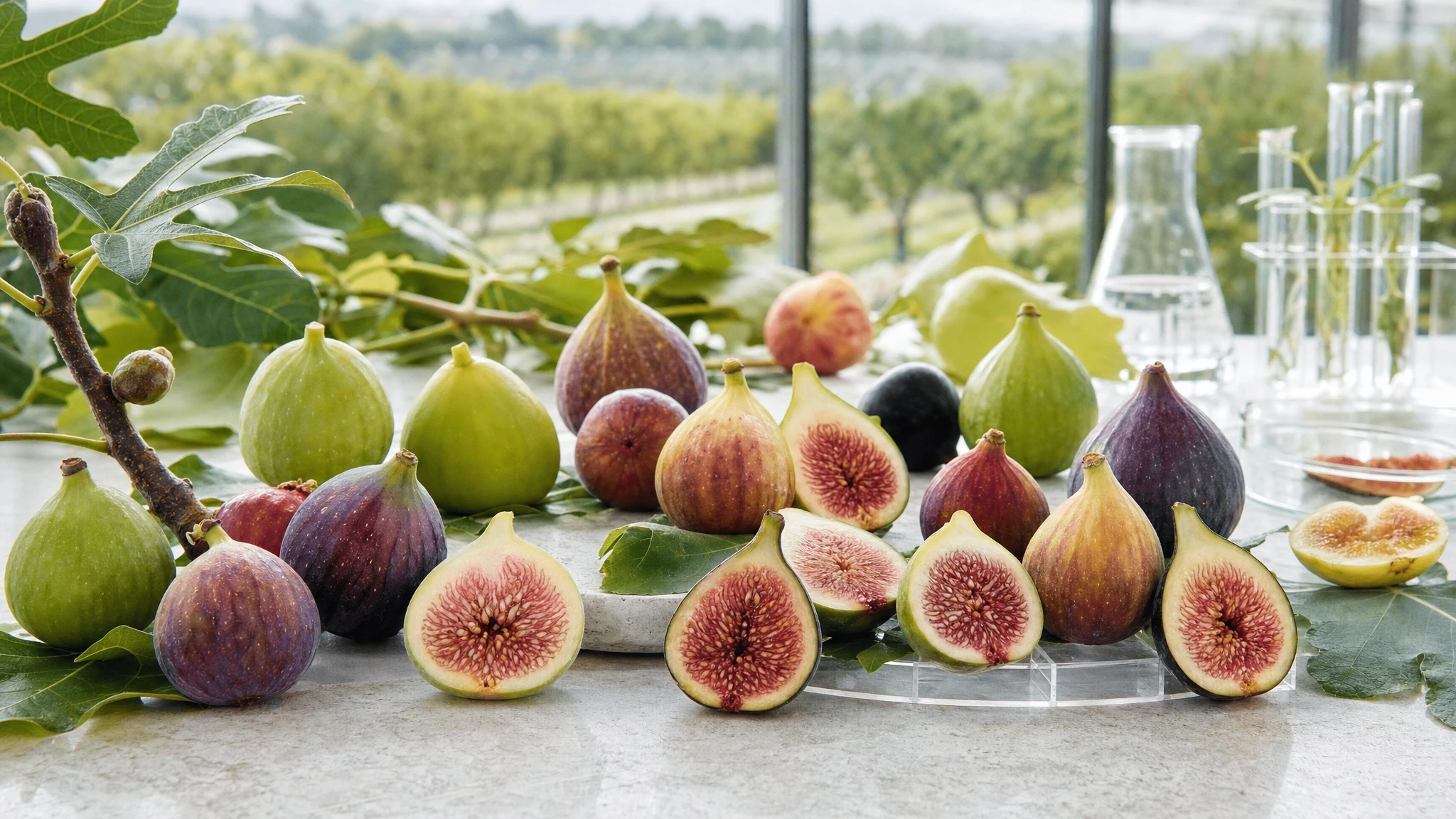
ABSTRACT
The analyzed publication evaluates morphological traits and fruit metabolites in eleven fig varieties. Since neither the full text nor the abstract is available in the provided material, it is not possible to accurately reconstruct the design, sampling, analytical methods, or quantitative results of the original study. However, the title indicates that the subject of the research is the variability among Ficus carica varieties.
In "The Choice to Live in Health or Illness" by Dr. A. Colonnese and R. Panzironi, the publication contributes to the statement that some native fig varieties show higher phenol levels than commercial counterparts. Independent evidence confirms that phenolic content and antioxidant capacity vary greatly among fig genotypes and that, in some regional comparisons, local genotypes have shown higher antioxidant values than well-known cultivars. However, the comparison cannot be automatically extended to all native or commercial varieties: peel color, part of the fruit, harvest season, and cultivation conditions significantly alter the results. The narrative is therefore moderately supported as a statement on varietal variability, not as a universal rule regarding the nutritional superiority of local varieties.
Analyzed study
Assessment of Morphological Traits and Fruit Metabolites in Eleven Fig Varieties (Ficus Carica L.)
The research question identified by the title is whether eleven fig varieties differ in terms of visible fruit characteristics and metabolites—that is, substances naturally present in the fruit, including those of nutritional and technological interest. The implicit hypothesis is that the genetic makeup of the variety influences the composition of the fig.
This research is relevant to the section because the passage in the book specifically concerns the possibility that different varieties of Ficus carica, including local varieties, have different contents of phenolic compounds. Phenols are a very broad family of plant molecules; their quantity is often measured as an overall indicator of phytochemical composition, but it does not, by itself, demonstrate a clinical benefit in humans.
The analyzed study can help document the metabolic variability among fig varieties. However, it cannot, by itself, prove that all native varieties are richer in phenols than commercial varieties, nor that a higher phenol content automatically produces health effects in people.
Materials and methods of the original study
The available material contains neither the full text nor the abstract of the publication. From the title, it can only be verified that the analysis covered eleven varieties of figs and included morphological characteristics and fruit metabolites.
The detailed design, the origin of the varieties, the number of fruits sampled per variety, the harvest period, the degree of ripeness, the agronomic conditions, any comparison groups, laboratory techniques, units of measurement, and statistical analyses are not reported in the available material. Furthermore, inclusion or exclusion criteria, statistical significance values, variability ranges, or analytical quality control procedures are not provided in the available material.
This information is essential because the phenolic content of figs can change not only with the genotype, but also with the peel or pulp analyzed, the color, the vintage, the ripening, the environment, and the time of harvest.
Results
The available material does not report numerical results from the original study. Therefore, it is not possible to indicate which of the eleven varieties showed the highest or lowest values of phenols, flavonoids, anthocyanins, or other metabolites; nor are percentage differences, P-values, or confidence intervals available.
The only result that can be reconstructed with certainty from the title is that the publication carried out a comparative evaluation of morphological and metabolic characteristics across eleven varieties. This is consistent with its use in the book's paragraph: the composition of figs is not uniform and can differ between varieties.
It is not possible to verify, based on the material received, whether the original study directly compared native varieties with specific commercial varieties, what the exact direction of the observed differences was, or whether these differences were statistically significant.
Interpretation
In simple terms, different varieties of figs can produce fruits with a different chemical composition. This is biologically plausible because genetic differences can influence the formation and accumulation of phenols, flavonoids, and anthocyanins, which are plant pigments that primarily contribute to red-purple and dark colors.
For the narrative of the paragraph, the segment supported by the publication subject to the Evidence Review is: different fig varieties → different metabolic profiles → possible difference in phenol content. However, the connection with the "native" label requires caution. A local origin is not in itself a biological mechanism that increases phenols: what is actually measured is the composition of specific genotypes under specific growing and harvesting conditions.
A higher phenolic content may indicate a greater presence of certain phytochemicals in the fruit. However, it does not prove that a specific variety prevents diseases, is overall better in every nutritional aspect, or produces a superior clinical effect after human consumption.
Independent supporting evidence
Particularly relevant confirmation comes from a comparison between local genotypes and fig cultivars grown in northeastern Turkey. The study measured total phenols, anthocyanins, and antioxidant capacity—that is, the ability of an extract to react with oxidizing molecules in chemical tests. Total phenols ranged from 24 to 237 mg of gallic acid equivalents per 100 g of fresh weight. In general, local genotypes showed a higher antioxidant capacity compared to the cultivars tested. This directly confirms the book's statement in terms of composition and laboratory tests, although it does not prove that the result applies to all local or commercial varieties [1].
A second study examined 76 fig accessions from the eastern Mediterranean region of Turkey. Black-fruited accessions showed, on average, higher total phenolic content, anthocyanins, and antioxidant capacity than green and yellow accessions. In particular, the average phenolic content of the black accessions was approximately 2.5 times higher than that of the green and yellow accessions. This result confirms that the genotype and its associated characteristics, such as skin color, can be accompanied by significant differences in phenols; however, it does not clearly separate the concept of an indigenous variety from that of a commercial variety [2].
A further analysis of six commercial varieties demonstrates that significant variability exists even within cultivars widely available on the market. Darker varieties presented more polyphenols, flavonoids, and anthocyanins compared to lighter ones; the Mission cultivar showed the highest values among those examined. This data confirms varietal variability but downplays the idea of an absolute contrast between "local" and "commercial": some commercial cultivars can have high levels of phenolic compounds [3].
Conflicting evidence
No directly conflicting evidence of sufficient relevance has been identified; this does not prove the absence of contrary results. However, the available evidence points to important factors that limit an overly simplistic interpretation of the comparison between local and commercial varieties.
In an analysis of eighteen fig cultivars grown in southeastern Spain and harvested over two seasonal productions, the first harvest generally showed higher phenolic values than the second. Furthermore, the peel contained more phenols than the pulp. These results do not deny that some local genotypes may be rich in phenols, but they show that the season and the part of the fruit can alter the ranking between varieties [4].
The study on the six commercial cultivars also requires clarification: the higher polyphenol content in dark cultivars indicates that color and genotype may be more informative than the commercial or native category alone [3]. Therefore, the statement in the book is sustainable as an observation referring to certain varieties, but not as a general rule applicable without specifying which figs, where they were grown, and when they were harvested.
Summary table of evidence
The table distinguishes the study subject of the Evidence Review from the independent publications used to verify the specific narrative of the paragraph.
| Reference | Study type | Population or model | Main result | Direction of evidence | Strength of evidence |
|---|---|---|---|---|---|
| Original study | Comparative study on plant varieties | Eleven fig varieties; further details not available | The title documents an assessment of morphological traits and metabolites; quantitative results not available. | biologically consistent evidence | preliminary |
| [1] | Comparative laboratory observational study | Local genotypes and fig cultivars from northeastern Turkey | Local genotypes generally showed higher antioxidant capacity; total phenols from 24 to 237 mg GAE/100 g. | direct confirmation | moderate |
| [2] | Comparative laboratory observational study | 76 fig accessions from the eastern Mediterranean region of Turkey | Black accessions showed average total phenols approximately 2.5 times higher than green and yellow accessions. | indirect confirmation | moderate |
| [3], [4] | Comparative laboratory studies | Six commercial cultivars; eighteen Spanish cultivars across two harvests | Dark commercial cultivars can be rich in phenols; season and peel significantly alter measured levels. | discordant evidence | moderate |
Confirmation of the evidence
Claim in the book
In the section of “The Choice to Live in Health or Illness” by Dr. A. Colonnese and R. Panzironi, it is stated that some native types of figs show higher levels of phenols compared to commercial counterparts.
Genotype or fig variety → different synthesis and accumulation of phenols → different antioxidant capacity measured in the laboratory → possible difference in the phytochemical quality of the fruit
The publication subject to the Evidence Review was used in the book to support the following passage: Ficus carica varieties can differ in the profile of fruit metabolites, including phenolic compounds, and some local varieties may present higher values compared to specific commercial cultivars.
The correspondence between the original study and the paragraph is the comparative evaluation of the metabolic composition in different fig varieties. Since the text of the publication is not available, it is not possible to verify whether the original comparison was precisely between native and commercial varieties, nor to report their values. However, independent literature confirms the core of the narrative: in a regional comparison, local genotypes generally showed a higher antioxidant capacity than the cultivars considered [1]. Studies on numerous accessions also confirm that the phenolic content varies significantly between genotypes and tends to be higher in black fruits compared to green or yellow ones [2].
The same literature imposes an important limitation on the formulation. Even dark commercial cultivars can present high polyphenol contents [3], while seasonal harvest and the distribution of phenols between the peel and the pulp can modify the result [4]. For “The Choice to Live in Health or Illness” by Dr. A. Colonnese and R. Panzironi, the most accurate conclusion is therefore that some local varieties may be richer in phenols in specific comparisons, not that native origin in itself guarantees constant superiority.
Overall level of confirmation
MODERATE CONFIRMATION
The connection is supported by independent studies that document phenolic differences between genotypes, including a comparison in which local genotypes showed generally higher antioxidant values than the cultivars. The confirmation remains moderate because it depends on specific agronomic and analytical comparisons, not on clinical studies in humans, and because color, season, and the part of the fruit influence the result.
Conclusions
Overall assessment
The variability of phenols among fig varieties is quite well supported by independent analytical comparisons. The claim regarding native varieties is moderately supported in specific contexts, but it does not represent a universal rule. The consistency with the book's section is good at a phytochemical level, but not at a clinical one.
References
[1] Color and Antioxidant Characteristics of Some Fresh Fig (Ficus carica L.) Genotypes from Northeastern Turkey
[2] Phytochemical and antioxidant properties of selected fig (Ficus carica L.) accessions from the eastern Mediterranean region of Turkey
[3] Antioxidant Activities and Anthocyanin Content of Fresh Fruits of Common Fig (Ficus carica L.)
[4] Phenolic compound content of fresh and dried figs (Ficus carica L.)
Editorial note
Artificial Intelligence was used solely as a tool to support editorial and documentary work. All content, interpretations, bibliographic citations and conclusions have been verified, reviewed and approved by the author, who assumes full scientific responsibility for them.
The manuscript was also subject to independent peer review prior to publication.
To ensure maximum transparency, the article's complete history — including the dates of submission, review, acceptance and publication, as well as information on the peer review process — is available on the dedicated Article History page.