


Hepatic insulin clearance: mechanism and physiology - Evidence review
The study analyzed explains that the liver regulates circulating insulin by eliminating a portion of it after pancreatic secretion. This clearance depends on the hormone's entry into hepatocytes and its subsequent degradation. Independent studies confirm the integration between secretion and removal, but the causality and clinical sequence in humans remain partially defined across different metabolic and experimental contexts.
- Published 11/11/2026
- Updated 13/11/2026
- Article history
ABSTRACT
The publication analyzed is a narrative review dedicated to hepatic insulin clearance, i.e., the liver's ability to capture and degrade a portion of the hormone just secreted by the pancreas. Its objective is to describe the mechanisms that regulate this process and the possible consequences of its reduction. The available material is only the abstract; therefore, complete details on the selection of studies included in the review are not available.
In the narrative of "The Choice to Live in Health or Illness" by Dr. A. Colonnese and R. Panzironi, the study contributes to the passage stating that the amount of insulin in the blood depends both on secretion by pancreatic beta cells and on its elimination, primarily hepatic. Independent studies in humans indicate that reduced clearance can accompany insulin resistance and contribute to higher circulating insulin concentrations; experimental data in mice support a cellular mechanism based on the endocytosis of the insulin-receptor complex. However, the causal direction and temporal order of events may vary between populations and metabolic conditions.
Analyzed study
Hepatic Insulin Clearance: Mechanism and Physiology
DOI: 10.1152/physiol.00048.2018
PMID: 30968756
PMCID: PMC6734066
The question addressed by the publication is how the liver contributes to determining the amount of insulin that remains available in the blood after secretion by pancreatic beta cells. The hypothesis discussed is that the circulating concentration of the hormone results from the balance between two processes: how much insulin is secreted by the pancreas and how much is removed, primarily by the liver.
This point is directly relevant to section 2.2 of "The Choice to Live in Health or Illness" by Dr. A. Colonnese and R. Panzironi. The section does not present hyperinsulinemia solely as the result of increased pancreatic production, but as the outcome of the coordinated regulation of secretion and insulin clearance. The publication subject to the Evidence Review was cited precisely to support this general physiological level.
The study analyzed is a review and not a single clinical trial. It can therefore integrate already available mechanistic and physiological knowledge, but it cannot establish on its own that a specific reduction in clearance causes type 2 diabetes in a human population. Furthermore, since only the abstract is available, the procedures adopted by the authors to search for, select, and evaluate the included studies are not reported in the available material.
Materials and methods of the original study
The publication is described as a review of the physiology and mechanisms of hepatic insulin clearance. Based on the available material, it does not present a new sample of participants, a control group, a therapeutic intervention, or a follow-up. The total number of studies discussed, the inclusion and exclusion criteria for sources, the databases consulted, the search period, and a structured assessment of methodological quality are not reported in the available material.
The abstract reports that the review discusses the role of insulin uptake mediated by its receptor and its subsequent degradation in hepatocytes, the primary cells of the liver. It also describes CEACAM1, a protein that, following the activation of the insulin receptor, promotes the internalization of the complex formed by the hormone and the receptor. Internalization means transferring this complex from the outside to the inside of the cell, where the insulin can be directed toward degradation.
The publication also considers the possible relationship between reduced clearance, chronic hyperinsulinemia, hepatic insulin resistance, and hepatic steatosis. However, the abstract alone does not report experimental protocols, dosages, statistical analyses, significance values, or quantitative results of the primary studies discussed.
Results
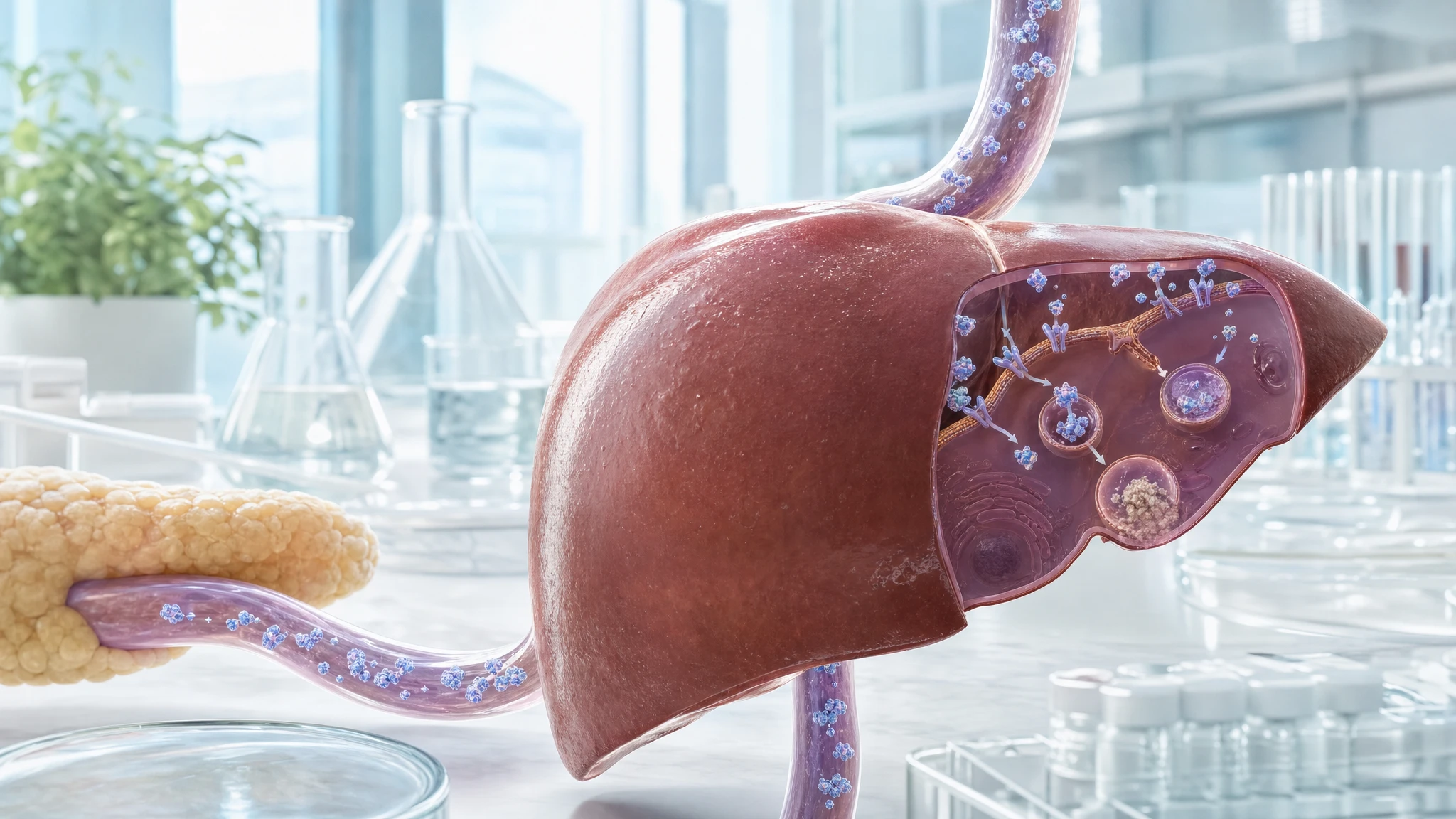
The main message is that insulin secreted by the pancreas initially reaches the liver through the portal circulation. Here, a portion of the hormone is taken up by hepatocytes and degraded. Consequently, the concentration of insulin that reaches the muscles, adipose tissue, and other organs does not reflect only pancreatic secretion, but also the efficiency with which the liver removes the hormone.
The abstract indicates that clearance occurs primarily through insulin receptor-mediated uptake and subsequent degradation. In simple terms, the receptor recognizes insulin on the surface of the hepatocyte; the complex is then brought inside the cell and directed toward systems that degrade the hormone. CEACAM1 participates in this process: after being phosphorylated—that is, chemically modified by the activation of the receptor—it increases the rate of endocytosis of the insulin-receptor complex.
The review also reports that reduced clearance may work in tandem with increased secretion to compensate for insulin resistance. Insulin resistance is a condition in which tissues respond less effectively to insulin. Reducing the removal of the hormone can therefore keep its concentration in the blood higher without immediately requiring an increase in pancreatic production.
The abstract also links chronic reduction in clearance to hepatic insulin resistance and hepatic steatosis—that is, the accumulation of fat in the liver—through persistent hyperinsulinemia and hepatic de novo lipogenesis, the synthesis of new fats in the liver. This link is presented as a pathophysiological interpretation of the discussed literature; the available material does not report quantitative values or direct clinical demonstrations of this chain.
Interpretation
For the reader, the most important takeaway is that the amount of insulin in the blood is not a direct counter of how much hormone the pancreas has produced. It is the result of a balance: production on one side, removal on the other. The liver is particularly relevant because it is the first to receive the newly secreted insulin.
The process documented by the publication subject to the Evidence Review is therefore: pancreatic secretion → arrival of insulin at the liver → receptor-mediated uptake and degradation in hepatocytes → regulation of the amount of hormone reaching systemic circulation. This is the scientific basis for the book's claim that secretion and clearance are complementary mechanisms.
The proposed molecular detail is biologically consistent: activation of the insulin receptor promotes the phosphorylation of CEACAM1, and CEACAM1 promotes the endocytosis of the insulin-receptor complex. However, a narrative review does not allow for assigning a single weight to all available studies, nor for automatically transferring results obtained in cells or animals to humans. Furthermore, the publication does not prove that every case of hyperinsulinemia depends primarily on reduced clearance: secretion, tissue sensitivity to insulin, liver function, and clinical conditions can all contribute to varying degrees.
Independent supporting evidence
Experimental confirmation of the cellular mechanism comes from a study on transgenic mice in which the liver expressed a form of CEACAM1 that could not be properly phosphorylated. The animals developed hyperinsulinemia due to reduced insulin clearance. They also showed insulin resistance, reduced glucose tolerance, increased visceral fat, and an increase in blood and liver triglycerides. This experiment provides causal support, in the mouse model, for the step in which hepatic insulin uptake contributes to the regulation of its circulating concentration [1]. The limitation is clear: the animal model clarifies the mechanism but does not quantify how much CEACAM1 determines clearance in humans.
A second study analyzed 91 adults with obesity and without diabetes, divided into three groups based on the degree of insulin resistance measured with an insulin suppression test. The authors estimated both the insulin secretion rate and clearance. Moving from the most insulin-sensitive group to the one with intermediate resistance, clearance decreased without a statistically significant increase in secretion. In the group with the most marked insulin resistance, clearance decreased further and secretion also increased. The data confirms in humans that the two components can adapt in a coordinated manner and that the reduction in clearance can precede the increase in secretion in this population [2]. However, as it is a cross-sectional study, it does not demonstrate the individual causal sequence over time.
A further clinical investigation studied 368 people with normal glucose tolerance, impaired glucose tolerance, or type 2 diabetes, with and without obesity. During the euglycemic-hyperinsulinemic clamp, a technique that keeps glycemia controlled while evaluating the response to insulin, metabolic insulin clearance was lower in obese individuals with normal glucose tolerance compared to non-obese individuals with normal tolerance: 0.60 versus 0.73 L/min per square meter, with P less than 0.001. Clearance was also inversely correlated with insulin resistance, with r equal to −0.52 and P less than 0.0001: greater insulin resistance was associated with lower clearance. During an oral glucose load, clearance was reduced within 15-30 minutes in subjects with normal or impaired tolerance, while this suppression was minimal in type 2 diabetes [3]. The study reinforces the idea that clearance is dynamic and integrated with metabolic demands; however, the estimates remain model-based and do not equate to a direct measurement of hepatic clearance alone.
Conflicting evidence
The available evidence does not justify considering reduced hepatic clearance as the sole or inevitable cause of insulin resistance, steatosis, or diabetes. In a cohort of 3,311 individuals, hepatic clearance estimated via oral glucose tolerance test was inversely associated with both liver fat and insulin sensitivity. However, Mendelian randomization analysis—a method that uses genetic variants as proxies to explore potentially causal relationships—did not support a causal effect of liver fat on clearance. Furthermore, certain components of the lipid profile, such as higher C-reactive protein and lower HDL cholesterol, were genetically associated with increased hepatic insulin extraction [4].
These findings do not negate the regulatory role of clearance. Rather, they indicate that the relationships between the liver, the amount of liver fat, inflammation, insulin sensitivity, and hormone removal are bidirectional and context-dependent. Regarding the statement in the book, which concerns the integration between pancreatic secretion and hepatic clearance, the conflicting evidence primarily reduces the certainty of causal extensions toward specific metabolic complications.
Summary table of evidence
The table distinguishes the publication subject to the Evidence Review from the independent research used to confirm or define the narrative passage in the book.
| Reference | Study type | Population or model | Main result | Direction of evidence | Strength of evidence |
|---|---|---|---|---|---|
| Original study | Narrative review | Literature on physiology and mechanisms of insulin clearance | Describes hepatic clearance as a complementary component of insulin secretion and the role of receptor-mediated endocytosis. | biologically consistent evidence | moderate |
| [1] | Transgenic animal | Mice with mutated hepatic CEACAM1 expression | Reduced CEACAM1 function decreased clearance and increased circulating insulin, with insulin resistance. | direct confirmation | moderate |
| [2] | Cross-sectional observational | 91 adults with obesity without diabetes | Clearance decreased as insulin resistance increased; increased secretion appeared primarily in the most resistant group. | direct confirmation | moderate |
| [3] | Clinical physiological study | 368 adults with varying glucose tolerance and degrees of obesity | Lower clearance associated with higher insulin resistance; postprandial clearance suppression attenuated in type 2 diabetes. | direct confirmation | moderate |
| [4] | Observational with Mendelian randomization | Up to 3,311 participants, with subgroups for MRI and genetics | Associations between clearance, liver fat, and insulin sensitivity did not demonstrate a causal effect of liver fat on clearance. | discordant evidence | moderate |
Confirmation of the evidence
Claim in the book
In section 2.2, “The Choice to Live in Health or Illness” by Dr. A. Colonnese and R. Panzironi, it is stated that insulin availability depends on the dynamic balance between pancreatic beta-cell secretion and hepatic clearance, that is, the liver's ability to take up, internalize, and degrade the hormone.
Pancreatic secretion → portal arrival at the liver → hepatic uptake and degradation of insulin → amount of insulin in systemic circulation
The publication subject to the Evidence Review was used in the book to support the following point: the concentration of insulin in the blood depends not only on the amount secreted by the pancreas, but also on the efficiency with which the liver removes the hormone from circulation through cellular uptake and degradation.
The correspondence between the publication and the paragraph is precise. The analyzed study describes the liver as the first organ reached by secreted insulin and explains that hepatic clearance regulates the amount of the hormone that proceeds into the systemic circulation. Its central contribution is not to demonstrate every clinical consequence of hyperinsulinemia, but to define the physiological principle according to which secretion and removal are complementary processes.
Independent evidence reinforces this narrative at different levels. In mice, the alteration of the CEACAM1 protein reduces clearance and increases circulating insulin, providing a causal demonstration of the hepatic uptake mechanism [1]. In adults with obesity without diabetes, reduced clearance was found to be part of the adaptation to insulin resistance and preceded the detectable increase in secretion when comparing groups [2]. In a broader physiological analysis in humans, lower clearance was associated with greater insulin resistance, and its modulation after glucose intake was attenuated in type 2 diabetes [3].
Independent literature therefore confirms that clearance is a measurable and dynamic component of insulin regulation, in accordance with the formulation in "The Choice to Live in Health or Illness" by Dr. A. Colonnese and R. Panzironi. However, it remains prudent not to transform this physiological integration into a universal causal sequence: genetic analyses have not confirmed that liver fat causes reduced clearance, and some metabolic characteristics may be associated with greater hepatic insulin extraction [4].
Overall level of confirmation
STRONG CONFIRMATION
The central physiological pathway is supported by the analyzed publication and converging independent studies: an animal model documents the uptake mechanism, while clinical studies show that insulin clearance, secretion, and sensitivity vary interdependently. The causality of downstream metabolic complications, however, remains incompletely defined.
Conclusions
The publication analyzed consistently supports the idea that the liver is not merely a target organ for insulin, but also participates in regulating its availability in the blood. The section of the book regarding the balance between pancreatic secretion and hepatic clearance is quite well supported by independent experimental and clinical evidence.
The most robust conclusion is physiological: reduced clearance can contribute to increasing or prolonging tissue exposure to insulin. However, greater rigor is needed to define, for each individual and at every stage of the disease, whether reduced clearance is a cause, a compensation, or a consequence of insulin resistance. The implications for steatosis and diabetes require further causal validation in humans.
Overall assessment
The narrative is well-supported physiologically and moderately strong clinically: pancreatic secretion and hepatic clearance both contribute to determining circulating insulin. The cellular mechanism is confirmed primarily in animal models, while the causal relationships with steatosis, insulin resistance, and diabetes in humans remain context-dependent.
References
[2] Adapting to insulin resistance in obesity: role of insulin secretion and clearance
[3] Adaptation of Insulin Clearance to Metabolic Demand Is a Key Determinant of Glucose Tolerance
Editorial note
Artificial Intelligence was used solely as a tool to support editorial and documentary work. All content, interpretations, bibliographic citations and conclusions have been verified, reviewed and approved by the author, who assumes full scientific responsibility for them.
The manuscript was also subject to independent peer review prior to publication.
To ensure maximum transparency, the article's complete history — including the dates of submission, review, acceptance and publication, as well as information on the peer review process — is available on the dedicated Article History page.