


Sorghum domestication and genomic selection of storage starch biosynthesis
The study on sorghum shows that domestication has modified many genes involved in starch synthesis, leaving genetic traces in cultivated varieties. This is consistent with the importance of starch in cereals, but it does not prove that every crop was selected exclusively to accumulate more of it. Further independent functional and nutritional comparisons are needed.
- Published 09/11/2026
- Updated 11/11/2026
- Article history
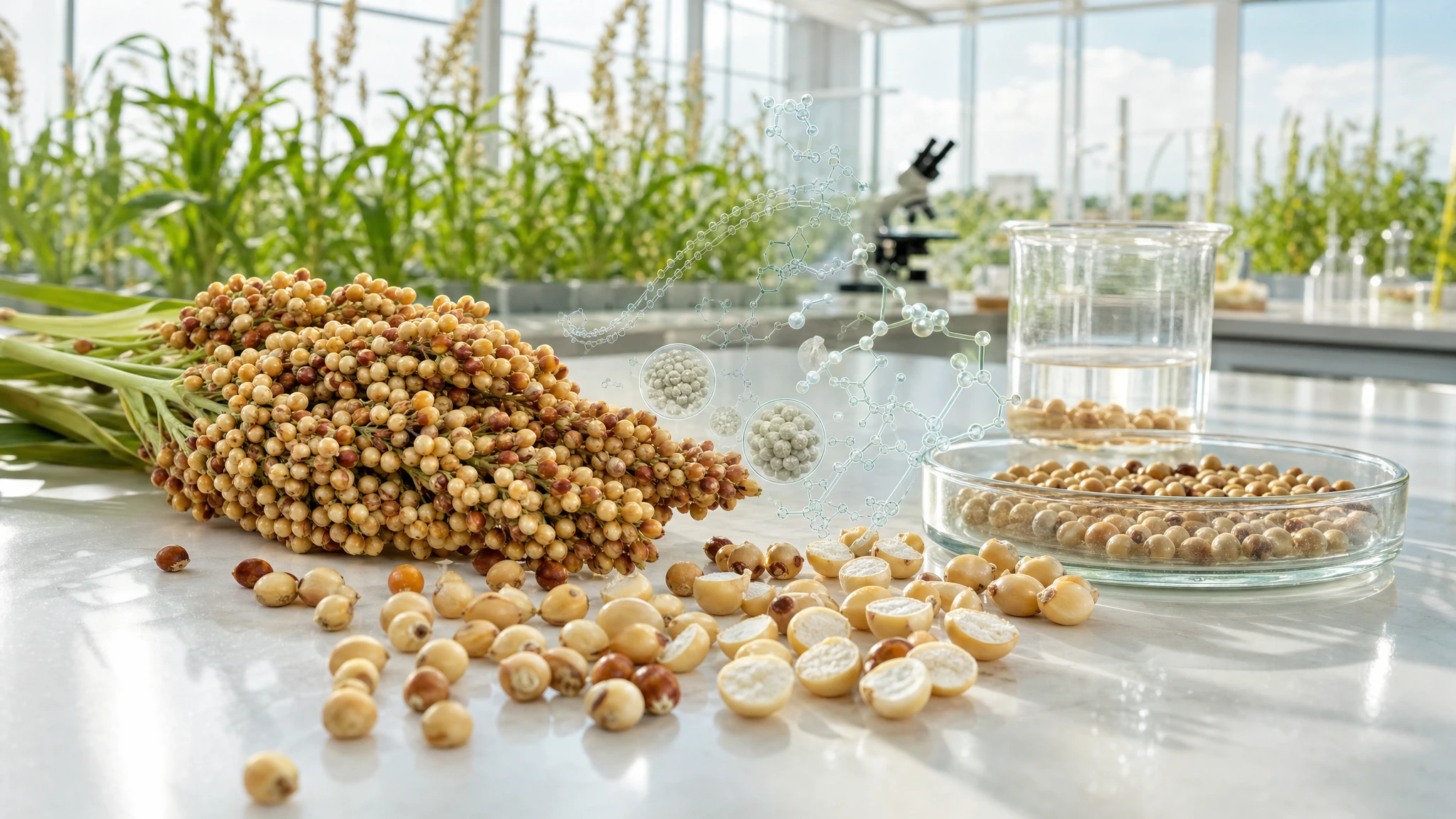
ABSTRACT
The analyzed study examined how domestication modified the genes involved in the production of storage starch in sorghum, a cultivated cereal. Through genomic sequencing data and genetic diversity analysis, the authors compared traditional cultivated varieties with wild or weedy lines. Many genes in the main starch synthesis pathway showed lower genetic variability in cultivated varieties, a sign consistent with selective pressures that occurred during domestication.
In the section "The Choice to Live in Health or Illness" by Dr. A. Colonnese and R. Panzironi, the publication contributes to the narrative that major agricultural crops have a dietary role closely linked to their starch content. Independent studies on corn, sorghum, and rice confirm that genes in the starch pathway can retain signs of selection associated with domestication. However, the evidence does not prove that selection always directly increased the amount of starch, nor that this explanation applies identically to every crop. The confirmation is therefore indirect and concerns above all the relationship between domestication, cereals, and starch genes.
Analyzed study
Domestication and the storage starch biosynthesis pathway: signatures of selection from a whole sorghum genome sequencing strategy
DOI: 10.1111/pbi.12578
PMID: 27155090
PMCID: PMC5103234
The research question was whether the domestication of sorghum left recognizable traces in the genes that allow the grain to produce and accumulate starch. The hypothesis was that cultivated varieties, compared to wild or weedy relatives, had undergone selective pressures at specific points in the starch metabolic pathway.
The relevance to the book's section concerns a precise point: starch is not just a component of the grain, but a central reserve product in cereals and a biological trait relevant to the history of their cultivation. The study does not measure human cereal consumption, does not compare the protein or mineral content of foods, and does not demonstrate that the increase in starch was the sole objective of agricultural selection. Instead, it documents genetic signals compatible with selection in a network of genes involved in starch synthesis in sorghum.
Materials and methods of the original study
The authors analyzed 114 genes identified as being involved in starch metabolism and synthesis in sorghum. The main comparison concerned accessions classified as Landraces, i.e., traditional cultivated varieties, and wild or weedy genotypes. The exact number of accessions belonging to each group is not reported in the available material, as the relevant supplementary table is not included in the provided text.
The genomes had undergone next-generation sequencing, with an average effective read depth of approximately 22 times per line, ranging from 16 to 45 times. The authors also analyzed gene expression in the immature grain, harvested 16 days after flowering, using RNA-seq (a technique that measures which genes are transcribed into RNA).
To evaluate selection, they calculated nucleotide diversity, i.e., how much DNA sequences differ between individuals; the FST value, an index of genetic differentiation between populations; Tajima's test, which compares the observed pattern of variation with that expected in the absence of selection; and the Ka/Ks ratio, which compares mutations capable of altering a protein with mutations that do not change its sequence. A Ka/Ks ratio of less than 1 is generally compatible with purifying selection, i.e., the elimination of potentially harmful variants.
Results
The central finding is that many genes in the main starch synthesis pathway showed differences between cultivated sorghum and wild or weedy sorghum. In traditional cultivated varieties, the average nucleotide diversity of the primary pathway genes was 0.0009933, compared to 0.00119 in wild or weedy lines: an average reduction of approximately 1.4-fold. Simply put, in cultivated varieties, certain genetic regions had become more uniform, a trend consistent with a domestication bottleneck and, at specific loci, with selection.
The reduction in diversity was particularly significant in some genes important for carbon flux toward starch. For example, diversity was reduced by 92.4% for SbSH2, a gene encoding a subunit of ADP-glucose pyrophosphorylase, an enzyme involved in the formation of the direct precursor of starch. Reductions were also observed for the SbBT1 transporter and for genes of starch synthases, enzymes that elongate starch glucose chains.
Among the 114 genes examined, 71 showed at least one signal of purifying selection and 62 at least one signal of balancing selection, a process that can maintain different variants in the population. Forty-three genes had different signals in different regions of their sequence. These results indicate a complex evolutionary history: not all starch genes changed in the same way, nor does a single genetic signal allow for the determination of the final effect on starch content in the grain.
In the main pathway, traditional varieties also showed a significant correlation between the gene's position in the metabolic pathway and the Ka/Ks ratio, with a Kendall coefficient of 0.338 and a P-value of 0.023 or less. This data is consistent with greater conservation of the steps located further upstream in the pathway. The correlation was not significant in wild or weedy lines, nor in the secondary pathways considered by the authors.
Interpretation
To produce starch, the grain transforms sugars from the plant into long chains of glucose. Some initial steps in this sequence are essential: any alteration to them can influence many subsequent functions. The study indicates that, in cultivated sorghum, several genes in this network have retained signals consistent with domestication.
The sequence documented by the publication is therefore: cultivation and selection of sorghum → modifications in the genetic variability of starch synthesis genes. This is consistent with the fact that cereals are food sources in which starch constitutes an important energy reserve. However, the further step of “genetic selection → higher starch content” remains a plausible interpretation but is not directly proven by these data, because the authors did not systematically measure the amounts of starch, yield, proteins, or minerals in the same plants.
It is also necessary to distinguish between a selection signature and functional proof. A selection signature indicates that a genetic region has followed a non-random trend over time; it does not automatically demonstrate which visible characteristic of the plant has changed, nor which agricultural or environmental pressure determined it.
Independent supporting evidence
Independent confirmation comes from maize, another major cultivated cereal. Whitt and colleagues examined six genes relevant to starch metabolism in maize and its wild relative, teosinte. They observed unusually low genetic diversity in starch genes and strong signals of selection. The result supports the general premise that domestication can act on genes in the starch pathway in a cereal, without, however, establishing that the effect is necessarily a quantitative increase in starch in every variety [1].
Further confirmation directly concerns sorghum. In a phylogeographic analysis of cultivars from different areas, de Alencar Figueiredo and colleagues studied six candidate genes for grain quality, including Sh2, Bt2, SssI, Wx, and Ae1. The Sh2, Bt2, and SssI genes showed a loss of diversity outside the sorghum's area of origin, while other loci maintained or developed new variants after domestication. This observation confirms that human selection does not act uniformly on the entire starch pathway [2].
In rice as well, Yu and colleagues compared six major genes of starch synthesis in 99 cultivated accessions and 70 accessions of the wild progenitor Oryza rufipogon. They detected signals of positive selection for the GBSSI gene in japonica groups and for GBSSI and SBEIIb in the aromatic group. The data show that, in a third cereal, specific starch genes were involved in the history of domestication and grain quality. The confirmation remains partial because other examined genes were compatible with neutral evolution [3].
Conflicting evidence
No directly conflicting evidence of sufficient relevance has been identified; this does not prove the absence of contrary results.
However, there are significant limitations to generalization. In rice, the independent study observed selective signals only for some genes and not for all those in the analyzed pathway. Furthermore, it did not detect a significant association between the position of the genes in the starch pathway and the levels or patterns of diversity in the wild progenitor. This scales back the idea that every step of the pathway necessarily follows the same evolutionary model across different cereals [3].
In sorghum, the same publication that is the subject of the Evidence Review points out that some genetic variants have increased, rather than decreased, in cultivated varieties. Therefore, domestication does not equate to a simple generalized loss of diversity, nor does it, on its own, demonstrate a linear increase in starch, yield, or nutritional value.
Summary table of evidence
The table distinguishes the analyzed study from the independent research used to evaluate the narrative in the book's paragraph.
| Reference | Study type | Population or model | Main result | Direction of evidence | Strength of evidence |
|---|---|---|---|---|---|
| Original study | Population genomics and RNA-seq | Cultivated, wild, and weedy sorghum; 114 starch genes | Many genes in the starch pathway show variations in diversity and signals consistent with selection during domestication. | biologically consistent evidence | moderate |
| [1] | Genetic observational | Cultivated maize and teosinte; six starch metabolism genes | Starch genes showed low genetic diversity and signals of selection. | direct confirmation | moderate |
| [2] | Genetic observational | 194 cultivated sorghum accessions; six candidate grain quality genes | Some starch genes lost diversity, while others maintained new post-domestication variants. | direct confirmation | moderate |
| [3] | Genetic observational | 99 cultivated rice accessions and 70 wild rice accessions; six starch genes | Signals of positive selection in some genes, but not all; no significant relationship with the position in the pathway in the wild progenitor. | indirect confirmation | moderate |
Confirmation of the evidence
Claim in the book
In section 1.2.3, “The role of cereals in nutrition,” from “The Choice to Live in Health or Illness” by Dr. A. Colonnese and R. Panzironi, the relevant statement is that, with the exception of soy, the main agricultural crops were grown and consumed primarily for their starch content. The section also links agricultural selection to starch accumulation and more abundant harvests.
Cultivated cereals → starch synthesis genes → selection during domestication → modification of genetic diversity → importance of starch in the grain
The publication subject to the Evidence Review was used in the book to support the following passage: in cereal crops, storage starch is biologically and agronomically central, and domestication can leave selection signals in the genes that regulate its synthesis.
The publication subject to the Evidence Review documents a reduction in genetic diversity and other signs of selection in numerous genes of the starch pathway in sorghum. Its contribution to the sentence in the book does not lie in statistically proving that all major global crops are consumed primarily as sources of starch; rather, it lies in providing a detailed genomic example of the relevance of the starch pathway in a domesticated cereal.
Independent evidence makes this narrative more robust. In maize, more starch pathway genes showed low diversity and signatures of selection compared to teosinte [1]. In sorghum, a separate study identified both a loss of diversity and new post-domestication variants in several genes associated with grain quality, including starch genes [2]. In rice, some starch genes showed positive selection in specific cultivated groups, but others were consistent with neutral evolution [3].
Overall, the literature confirms that starch genes may have been targets of selection in multiple cereals. However, it does not uniformly confirm that selection increased starch in every species, variety, or agricultural context. The sentence from “The Choice to Live in Health or Illness” by Dr. A. Colonnese and R. Panzironi is therefore supported primarily on a biological-evolutionary level, with caution regarding the quantitative and nutritional consequences.
Overall level of confirmation
INDIRECT CONFIRMATION
The original study directly documents selection signals in sorghum starch genes. Independent studies in maize, sorghum, and rice confirm that domestication can involve genes from the same pathway. However, there remains a gap between these genomic signatures and the quantitative claim that selection has increased starch content in major crops.
Conclusions
The study analyzed convincingly argues that the domestication of sorghum has left genetic traces in numerous genes involved in starch synthesis. Independent evidence shows a consistent pattern in maize, sorghum, and rice: certain starch genes were subjected to selection throughout the history of these crops.
The narrative is well-supported at the biological and evolutionary level. However, the idea that agricultural selection has always produced more starch or that this has necessarily reduced proteins and minerals is only indirectly supported. For these conclusions, studies that integrate genetics, grain composition, yield, and cultivation conditions would be necessary.
Overall assessment
The relationship between cereal domestication and the selection of starch synthesis genes is fairly well supported by independent studies in sorghum, maize, and rice. The consistency with the book's paragraph is good in terms of mechanistic and evolutionary aspects, while the quantitative effects on starch and nutritional quality remain to be directly demonstrated.
References
[1] Genetic diversity and selection in the maize starch pathway
[2] Phylogeographic Evidence of Crop Neodiversity in Sorghum
Editorial note
Artificial Intelligence was used solely as a tool to support editorial and documentary work. All content, interpretations, bibliographic citations and conclusions have been verified, reviewed and approved by the author, who assumes full scientific responsibility for them.
The manuscript was also subject to independent peer review prior to publication.
To ensure maximum transparency, the article's complete history — including the dates of submission, review, acceptance and publication, as well as information on the peer review process — is available on the dedicated Article History page.