
LIFE Science Hub — evidence-based science communication

In this Hub you can search for scientific articles created by professionals on topics concerning nutrition, nutraceuticals, health and lifestyles in general.
The authors of the editorial team are qualified biologists, each identified by an ORCID profile and with proven editorial experience in the relevant sector. Every article published on the Hub is identified by a DOI and accompanied by a complete and rigorously structured bibliography, with authors, year of publication, original title, scientific journal and clickable DOI, to guarantee transparency and traceability of sources.

LIFE Science Hub was born to spread medical-scientific knowledge to the general public without compromising its rigor and authoritativeness: through the innovative EFV (Easy Friendly Version) format our Hub indeed translates scientific research into clear and understandable content, also with the new support of video articles by the authors.
An independent editorial organization, free from public funding and from the interests of large industrial groups.

This content is for informational purposes only and does not replace medical advice — see the scientific method

Latest articles

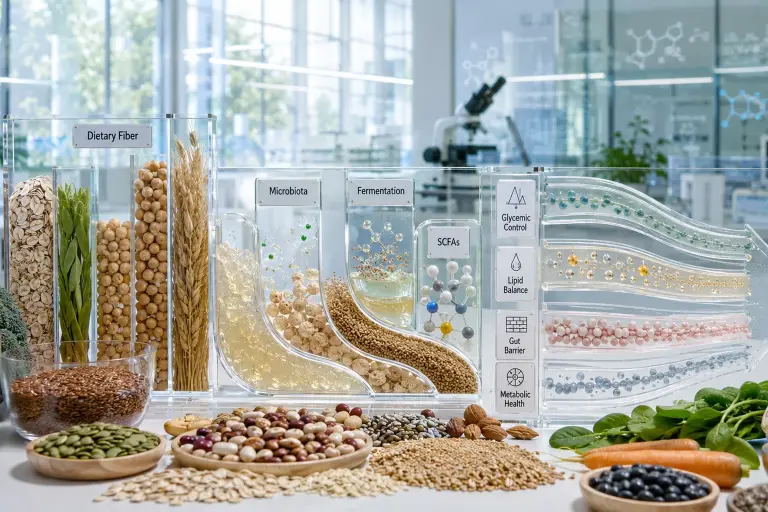
Dietary Fiber Benefits: What It Is, How It Works, and Why It Matters for Metabolism, Gut Health, and Prevention

Dietary fiber benefits: metabolism, intestines, blood sugar and prevention

Dott. Armando Colonnese; Last updated: June 2026

In brief: Dietary fiber is a component of plant-derived carbohydrates that the small intestine does not fully digest. Precisely because of this, it exerts important effects throughout the gastrointestinal tract and across metabolic regulation. The available literature consistently shows that adequate fiber intake, especially when it comes from minimally refined plant foods, is associated with better post-meal glycemic response, a more favorable lipid profile, more regular bowel function, and a generally more stable metabolic environment. At the same time, fiber does not behave as a single, uniform entity. Its physicochemical properties shape distinct effects on digestion, intestinal fermentation, and the signaling pathways that connect the gut, liver, energy metabolism, and satiety. The scientific evidence suggests that its effectiveness depends on at least three main factors. The first is the type of fiber, because some fibers form viscous gels, some increase stool bulk, and others are fermented by the gut microbiota, that is, the community of microorganisms that inhabit the colon. The second is daily dose, since the effects observed tend to follow a dose-response pattern, although with considerable individual variability. The third is the food matrix, meaning the nutritional context in which the fiber is found, because the metabolic behavior of fiber changes depending on whether it comes from a legume, a whole grain, a vegetable, or a fortified product. Taken together, the evidence shows that fiber should not be seen only as a tool for bowel regularity, but as a nutritional lever involved in regulating multiple interconnected processes. This helps explain why it now plays a central role in cardiometabolic prevention, in the management of carbohydrate quality, and in the broader relationship between diet, gut function, and overall health. A few key points are worth highlighting from the outset: Not all fibers act in the same way, and their effects depend on their functional properties. The amount consumed each day has a major influence on the likelihood of achieving measurable benefits. The food matrix matters, because fiber in minimally refined foods is not the same as isolated fiber. Gut function and metabolism are closely linked, so digestive effects are also reflected in the metabolic profile. Increasing fiber too quickly can cause bloating, especially in more sensitive individuals.

Cinnamon sticks and powder with natural elements and metabolic metaphors, to illustrate possible support for glycemia, insulin, and lipids.

Cinnamon: properties, metabolic mechanisms, and possible uses in human health

Dott. Armando Colonnese and Roberto Panzironi; Last updated: June 2026

In brief: Cinnamon is one of the most well-known and widely used spices in the world, but its scientific interest extends far beyond its intense aroma and use in baking. In recent years, it has been studied as a possible nutritional support in the metabolic field, especially in relation to glycemia, insulin, lipid profile, inflammation, and oxidative stress. This attention stems from a simple fact: many people want to understand if a common spice can play a concrete role in daily health, especially when it comes to glycemic control or cardiometabolic well-being. At the same time, however, cinnamon is not a single, uniform ingredient. Different species exist, with varying chemical compositions, aromas, and safety profiles; furthermore, the product form, dose, and frequency of use profoundly change the biological significance of what is consumed. For this reason, discussing cinnamon seriously requires considering botany, chemistry, physiology, and food safety together. Ceylon cinnamon, for example, is often preferred for more regular use, while cassia is more common but can contain higher amounts of coumarin, a natural substance that warrants attention with frequent consumption. Biologically, the most studied compounds include cinnamaldehyde and various polyphenols, molecules that in experimental models appear to interact with cellular pathways involved in energy metabolism and inflammatory response. However, this does not mean that every benefit observed in the laboratory automatically translates into a robust clinical effect in humans. Available studies are interesting but heterogeneous: some show modest improvements, others null or inconclusive results, which calls for a cautious but not prejudiced interpretation. In this article, we will explore what makes cinnamon different from other spices, what mechanisms might explain its effects, what clinical evidence truly exists, what limitations need to be considered, and how to incorporate it into the diet realistically and safely. Specifically, the article will address: