


A tonoplast sugar transporter is the basis of a sugar accumulation QTL in watermelon - Evidence review
The analyzed study links the increased sweetness of cultivated watermelon to a transporter that stores sugars in the fruit's cells. Independent research also clearly confirms that selection has favored higher sugar content. However, they do not demonstrate the claimed 15% increase in water, nor do they support nutritional conclusions regarding the human diet.
- Published 10/11/2026
- Updated 11/11/2026
- Article history
ABSTRACT
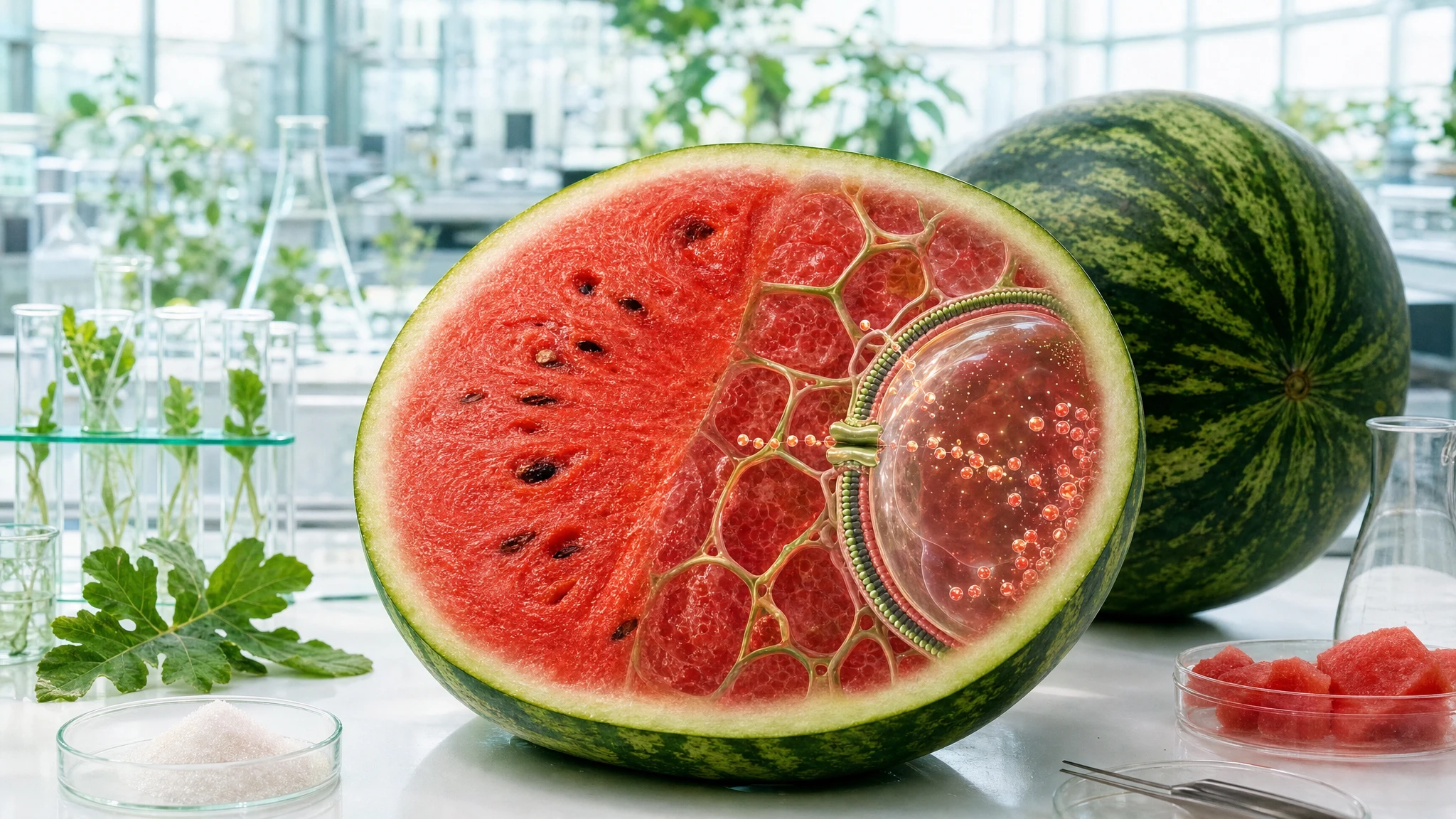
The analyzed study sought to clarify why some watermelons accumulate significantly more sugar in their flesh than others. The authors linked this trait to ClTST2, a gene that encodes a transporter located in the tonoplast, which is the membrane that delimits the vacuole: the large internal compartment where plant cells can store water and dissolved substances. 96 recombinant lines obtained from a cross between a sweet and a non-sweet watermelon were analyzed, in addition to 400 watermelon accessions for the genetic analysis of the region containing the gene.
In the narrative of “The Choice to Live in Health or Illness” by Dr. A. Colonnese and R. Panzironi, the publication contributes to the passage stating that domestication has favored sweeter watermelons compared to ancestral African forms. Independent evidence consistently confirms that the sweetness of the flesh has increased during domestication and varietal improvement and that genes involved in the transport and storage of sugars have been selected. However, the available material from the original study does not report data demonstrating a 15% increase in water, nor does it directly quantify a triple increase in sugars compared to a specific wild progenitor. The confirmation therefore concerns above all the biological mechanism and the direction of evolution towards sweeter fruits.
Analyzed study
A Tonoplast Sugar Transporter Underlies a Sugar Accumulation QTL in Watermelon
DOI: 10.1104/pp.17.01290
PMID: 29118248
PMCID: PMC5761790
The research question was whether a specific genetic trait could explain a significant portion of the sugar differences between cultivated sweet watermelons and non-sweet watermelons. The hypothesis was that ClTST2, a gene located in a genomic region identified as a QTL (a DNA region statistically associated with a quantitative trait), regulates sugar accumulation in the flesh.
The reason for its relevance to this section is specific: the study describes a possible mechanism by which the selection pressure exerted during domestication may have favored sweeter fruits. In simple terms, increased activity of a transporter can help flesh cells import and retain more sugars in their vacuole. The study does not evaluate the overall nutritional value of watermelon, its effects on human health, or the modern diet as a whole. Furthermore, it cannot prove on its own that every difference between domestic and wild watermelons depends solely on this gene.
Materials and methods of the original study
Since the available material consists only of the abstract, only the reported elements can be described. The authors re-sequenced the DNA of 96 recombinant inbred lines, derived from the cross between sweet and non-sweet accessions, to narrow down a genetic region previously associated with sugar content. The candidate gene ClTST2 was present in this region.
The study also measured the sugar content of the fruits and re-examined the genomic region around ClTST2 in 400 watermelon accessions. Molecular and biochemical analyses were used to study the protein localization, gene expression, and the binding of a transcription factor, named SUSIWM1, to the promoter region of ClTST2. The promoter is the stretch of DNA that helps regulate how much a gene is activated.
The cultivation period, detailed inclusion criteria for the accessions, complete laboratory protocols, concentrations used, complete statistical procedures, and all quantitative values are not reported in the available material.
Results
The main finding is that ClTST2 encodes a vacuolar membrane protein. This data is biologically relevant because the vacuole can function as a cellular storage site: if sugars enter and remain accumulated there, the fruit pulp can become sweeter. The authors report that ClTST2 expression was associated with uptake across the tonoplast and sugar accumulation in pulp cells.
In the 400 accessions examined, the genetic variants most closely associated with sugar content were located in the ClTST2 promoter. Population analyses also indicated a selection signature around this promoter, consistent with the selection, during domestication, of variants capable of increasing gene expression.
The authors also explored the control of the promoter region by SUSIWM1, a sugar-induced transcription factor. In other words, the study proposes a regulation in which sugar-related signals contribute to increasing ClTST2 activity, promoting further sugar storage in the vacuole. The abstract does not report absolute sugar values, water percentages, P-values, or confidence intervals for the main comparisons. It also does not report a measurement directly demonstrating that the domesticated watermelon contains three times the sugar or 15% more water than a specific wild ancestor.
Interpretation
The most robust significance of the study is mechanistic. Controlled cultivation does not act solely by selecting fruits perceived as sweeter: it can also favor genetic variants that make the transfer and storage of sugars in the pulp more efficient. The segment documented by the publication subject to the Evidence Review is therefore: increased ClTST2 activity → greater entry and accumulation of sugars in the pulp cell vacuole → greater fruit sweetness.
This interpretation is consistent with the passage in the paragraph dedicated to the higher quantity of sugars in domesticated watermelons. However, an association between genetic variants, gene expression, and sugar content does not equate to proof that the gene explains the entire difference observed between cultivated and wild populations. Sweetness also depends on other genes, the stage of ripening, the cultivation environment, and the method used to measure it. The statement regarding water also requires separate data on water content, which are not available in the provided abstract.
Independent confirmatory evidence
Genomic research on 414 accessions representing existing species of the Citrullus genus has confirmed that selection for flesh sweetness began in the evolutionary history of the sweet watermelon lineage and continued with modern breeding. The work identified a genetic signal associated with sweetness in the region containing ClTST2. In the same study, the average soluble solids content, a practical measure of sweetness expressed in Brix degrees, was approximately 3.4 in C. mucosospermus accessions, 8.3 in traditional C. lanatus varieties, and 10.1 in cultivars. The comparison of 10.1 versus 3.4 is close to a threefold ratio, but it concerns botanical groups and samples defined by the authors; it does not demonstrate a universal value for any African progenitor, nor does it directly measure all sugars using the same chemical method [1].
A subsequent experimental study analyzed the pathway through which carbohydrates reach the flesh and are retained. Researchers obtained ClTST2 mutants using CRISPR/Cas9, a technique that allows for the selective inactivation of a gene. 30 days after pollination, the mutant fruits had a sugar content approximately 35% lower than that of unmodified plants; the data was based on three independent fruits per condition. This experiment directly supports the function of ClTST2 in the final storage of sugars in the flesh vacuoles. It is a strong experimental confirmation of the mechanism, but it remains a controlled plant model and not a direct historical measure of the overall effect of controlled cultivation [2].
An analysis based on a super-pangenome—that is, a comparison between numerous genomes belonging to wild and cultivated forms—found that a duplication of ClTST2 was rare or absent in many ancestral forms and became very frequent in cultivated varieties. The duplication was present in 81.4% of landraces and 97.1% of the cultivars considered; the accessions that possessed it showed significantly higher levels of soluble solids compared to those with only a single copy. The result is consistent with a selection of variants that increase sweetness, but it is observational: it does not prove on its own that the duplication is the sole cause of the difference [3].
Taken together, these studies form a convergent chain: cultivated populations are sweeter on average; the ClTST2 genetic region has been selected; experimental reduction of the gene's function decreases sugars; and variants with multiple copies of the gene are associated with greater sweetness. None of these studies, however, establishes that the water content of the cultivated watermelon has increased by exactly 15%.
Conflicting evidence
No directly conflicting evidence of sufficient relevance has been identified; this does not prove the absence of contrary results. The main caveats stem from the definition of the groups compared and the measures used. African wild watermelons include different species and populations, while sweetness can be expressed as specific sugars or as total soluble solids in Brix degrees. For this reason, the ratio close to three observed between specific groups in a population study [1] cannot be automatically transferred to all cultivated watermelons and all ancestral African forms.
Furthermore, the available evidence is much more robust for the increase in sweetness than for the increase in water content. The publication subject to the Evidence Review, in the accessible material, does not provide a comparative quantification of water. Consequently, the claim regarding 15% more water must be considered unverified by this specific evidence base, not as a refuted result.
Summary table of evidence
The table separates the publication subject to the Evidence Review from subsequent research used to confirm the specific narrative on the selection of sweeter watermelons.
| Reference | Study type | Population or model | Main result | Direction of evidence | Strength of evidence |
|---|---|---|---|---|---|
| Original study | Quantitative genetics, molecular and biochemical analysis | 96 recombinant lines and 400 watermelon accessions | ClTST2 expression is associated with sugar accumulation in the flesh; promoter variants are associated with sugar content. | direct confirmation | moderate |
| [1] | Genomic observational and genome-wide association | 414 accessions from seven Citrullus species | Average sweetness increases from ancestral groups to landraces and cultivars; the ClTST2 region is associated with sweetness. | direct confirmation | moderate |
| [2] | Plant experimental with CRISPR/Cas9 mutants | Cultivated watermelon and cltst2 mutants | Inactivation of ClTST2 reduces fruit sugar content by approximately 35% at 30 days post-pollination. | direct confirmation | moderate |
| [3] | Observational comparative genomics | Super-pangenome of wild, landrace, and cultivated Citrullus forms | ClTST2 duplication is frequent in cultivars and is associated with higher flesh soluble solids. | indirect confirmation | moderate |
Confirmation of the evidence
Claim in the book
In “The Choice to Live in Health or Illness” by Dr. A. Colonnese and R. Panzironi, the analyzed passage states that the domestic watermelon stores up to 15% more water and three times more sugar than its wild African ancestor. This statement is included in the narrative that controlled cultivation can modify the composition of crops, primarily by increasing carbohydrates.
Selection during domestication → variants that increase the activity or copy number of ClTST2 → greater vacuolar storage of sugars in the flesh → watermelons that are sweeter on average
The publication subject to the Evidence Review was used in the book to support the following passage: the controlled cultivation of the watermelon has favored greater sugar accumulation in the flesh through genetic modifications that increase the activity of a tonoplast transporter.
The scientific evidence is clear regarding the sugar segment. The original study identifies ClTST2 as an element associated with the transport and storage of sugars in pulp cells and describes selection signals in its regulatory region. Independent research reinforces this narrative on multiple levels. An analysis of 414 accessions documents that cultivated and improved forms have, on average, higher soluble solids compared to the ancestral groups considered and links the ClTST2 region to sweetness [1]. Experimental inactivation of ClTST2 reduces the sugar content in the fruit, making the transition functionally plausible [2]. The super-pangenome also shows that a gene duplication was favored in cultivated forms and is associated with greater sweetness [3].
Regarding "The Choice to Live in Health or Illness" by Dr. A. Colonnese and R. Panzironi, the most accurate formulation is therefore that the literature supports an increase in the sweetness of cultivated watermelon and a role for vacuolar sugar transport in its evolution. The literature analyzed here does not confirm with the same degree of precision the "up to 15%" value regarding water content. The ratio close to three for sweetness is compatible with specific comparisons of soluble solids reported in the population study, but it cannot be generalized without specifying populations, species, and measurement methods.
Overall level of confirmation
STRONG CONFIRMATION
The link between controlled cultivation and increased sweetness is supported by population genetics, genomic associations, and experimental gene inactivation. The evidence is strong for the pathway leading to greater sugar accumulation, but remains incomplete regarding the universal quantification of the threefold increase and does not verify the increase in water content.
Conclusions
The analyzed publication convincingly supports a specific transition: variants that increase the activity of the vacuolar transporter ClTST2 can promote sugar accumulation in watermelon pulp. Subsequent studies confirm that selection and varietal improvement have favored, on average, sweeter watermelons and that the loss of ClTST2 function reduces sugar in the fruit.
The narrative is therefore well-supported regarding the increase in sweetness and the mechanism of cellular sugar storage. However, it is necessary to distinguish this conclusion from broader quantitative claims: the available material does not directly demonstrate a 15% increase in water content and does not allow for the attribution of a threefold increase in sugar to all domestic watermelons compared to a single wild African ancestor.
Overall assessment
The narrative regarding the selection of sweeter watermelons is well-supported by converging genomic and experimental evidence. The mechanism of vacuolar sugar accumulation is confirmed at the plant level. However, the quantification of a threefold increase in sugars depends on the groups compared, while the increase in water content is not verified by the analyzed publication.
References
[1] Resequencing of 414 cultivated and wild watermelon accessions identifies selection for fruit quality traits
[2] Evolutionary gain of oligosaccharide hydrolysis and sugar transport enhanced carbohydrate partitioning in sweet watermelon fruits
[3] A Citrullus genus super‐pangenome reveals extensive variations in wild and cultivated watermelons and sheds light on watermelon evolution and domestication
Editorial note
Artificial Intelligence was used solely as a tool to support editorial and documentary work. All content, interpretations, bibliographic citations and conclusions have been verified, reviewed and approved by the author, who assumes full scientific responsibility for them.
The manuscript was also subject to independent peer review prior to publication.
To ensure maximum transparency, the article's complete history — including the dates of submission, review, acceptance and publication, as well as information on the peer review process — is available on the dedicated Article History page.