


Acute effect of the glycemic index and glycemic load of a meal on blood glucose and insulin responses in humans - Evidence review
In a crossover study on twelve women with obesity, meals with a similar glycemic load produced similar glycemic and insulin responses despite different glycemic indices and compositions. Independent studies confirm that both the quantity and quality of carbohydrates matter, but results depend on portions, the dietary context, and the specific population studied over time.
- Published 10/11/2026
- Updated 11/11/2026
- Article history
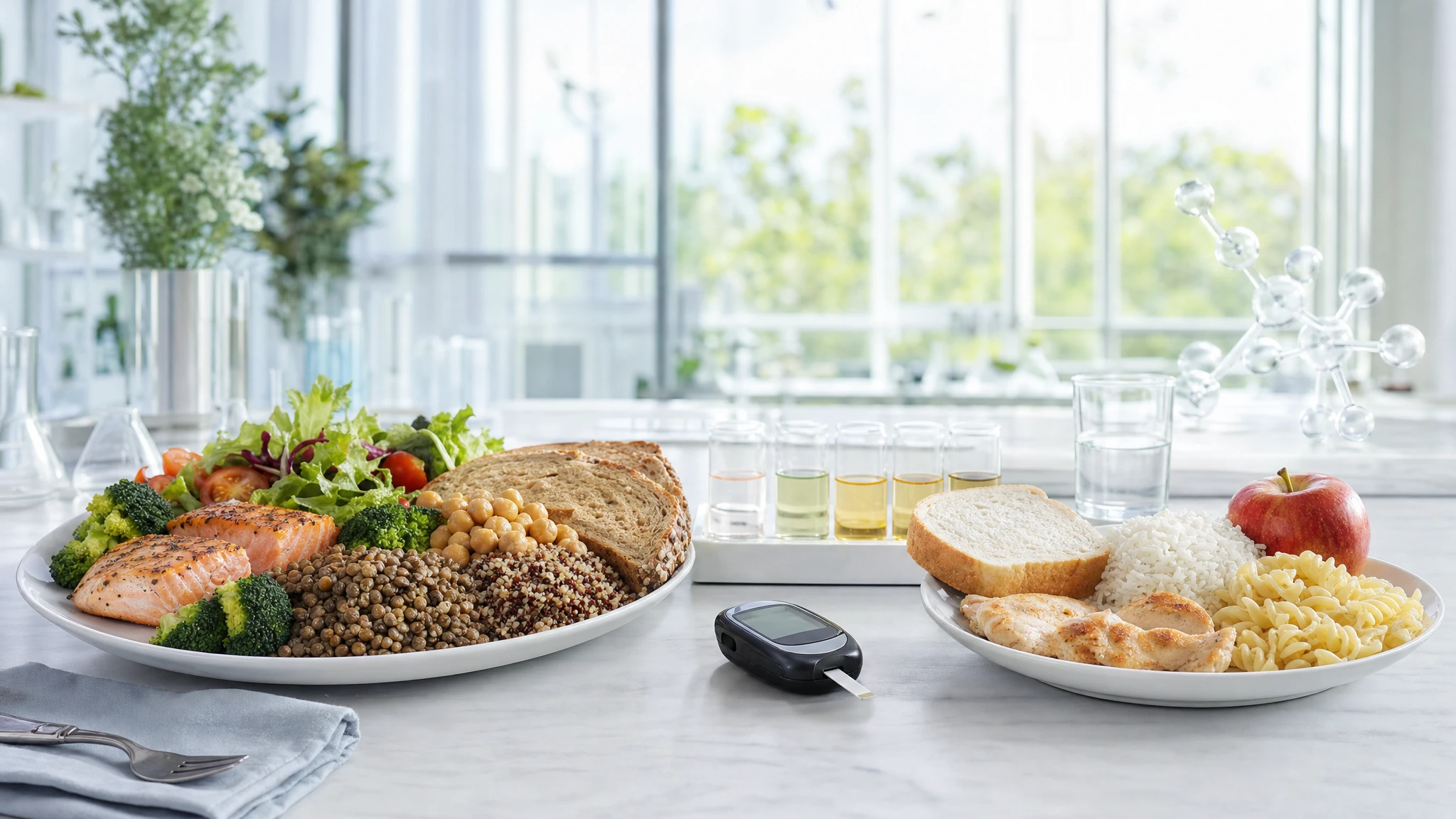
ABSTRACT
The original study compared four mixed meals, differing in glycemic index, carbohydrate quantity, and portion size, in twelve women with obesity but without diabetes. High-glycemic index meals generally induced greater glucose and insulin responses compared to low-glycemic index meals of the same size. However, the most relevant finding is another: two different meals, but with similar glycemic load, produced very similar glycemic and insulin responses.
In the narrative of “The Choice to Live in Health or Illness” by Dr. A. Colonnese and R. Panzironi, the study helps explain why the metabolic effect of a meal depends both on the speed with which carbohydrates influence glycemia and on the quantity actually consumed. Independent studies on mixed meals confirm this relationship, while a longer-term experiment with ad libitum food intake did not detect any differences. Overall, the narrative is moderately supported for acute effects, but it does not allow for predicting individual response or long-term clinical effects on its own.
Analyzed study
Acute effect of meal glycemic index and glycemic load on blood glucose and insulin responses in humans
PMID: 16953881
PMCID: PMC1569855
The research question was whether the glycemic index (GI, a measure of the relative speed at which carbohydrates in a food increase glycemia) maintains the same effect regardless of whether a meal is small or large, and whether the glycemic load (GL, a value that combines GI and the grams of available carbohydrates in a portion) better predicts the post-meal response.
The hypothesis was that the quality of carbohydrates, expressed by the GI, and the quantity of carbohydrates act together. This is precisely the part of the narrative in paragraph 2.1 of “The Choice to Live in Health or Illness” by Dr. A. Colonnese and R. Panzironi to which this study contributes: a meal is not metabolically defined by GI alone, because a small portion of a high-GI food can have a GL similar to a larger portion of a low-GI food.
The study can document acute glucose and insulin responses in the participants examined. However, it cannot demonstrate that GL predicts the response with identical precision in all people, in subjects with diabetes, in children, in men, or during habitual dietary patterns sustained over time.
Materials and methods of the original study
A randomized crossover study was conducted: the same participants received all experimental meals in random order. This design reduces the influence of individual differences because each person serves as their own control. Twelve women with obesity were recruited, with an average age of 33.2 years, an average body mass index of 33.7 kg/m², who were sedentary, free of overt chronic diseases, and had normal glucose tolerance.
After a standardized dinner and 12 hours of Fasting, each participant consumed four mixed meals: large high-GI, small high-GI, large low-GI, and small low-GI. The large meals provided 49% of the estimated basal metabolic rate, while the small meals provided 23%. The energy share from carbohydrates, fats, and proteins was maintained at 55%, 30%, and 15%, respectively.
The high-GI meals had a GI of 85 and a GL of 95 g or 48 g; the low-GI meals had a GI of 43 and a GL of 45 g or 22 g. Two meals—the small high-GI meal and the large low-GI meal—therefore had nearly identical GL, at 48 g and 45 g respectively, despite differing in the quantity and type of carbohydrates.
Blood was drawn before the Meal, every 15 minutes during the first hour, and then every 30 minutes for up to five hours. Glucose, insulin, free fatty acids, and glucagon were measured. Integrated responses were calculated as the area under the curve, which is a measure of the overall exposure to glucose or insulin over time. Statistical analyses used non-parametric tests for repeated comparisons. All participants completed the protocol.
Results
The main finding is that large, high-GI meals produced a greater increase in glucose and insulin compared to large, low-GI meals. In the first two hours, the incremental glucose area was 267 mmol·l−1·2 h−1 after the large high-GI meal and 149 after the large low-GI meal. For insulin, in the same interval, the corresponding values were 84 and 38 nmol·l−1·2 h−1. Simply put, for the same large meal size, the high-GI meal required an insulin response approximately twice as high.
For small meals, the difference in insulin remained evident: the incremental insulin area in the first two hours was 46 after the high-GI meal and 22 after the low-GI meal. For glucose, however, the difference between small meals did not reach statistical significance. This means that, with this small sample size, it cannot be ruled out that part of the observed difference in glucose after small meals is due to random variability.
The calculated GL was found to be directly associated with glucose and insulin responses. For glucose, the correlation with the incremental area was r=0.58 in the first two hours and r=0.59 over five hours; for insulin, it was r=0.60. A positive correlation indicates that, in the meals tested, a higher GL corresponded to a higher average response. However, it does not prove that the GL is the sole cause of the response.
The data point closest to the book's claim concerns the two meals with similar GL, 45 and 48 g. Although one was large and low-GI and the other was small and high-GI, their respective integrated glucose and insulin responses were very similar. No overall differences attributable to the GI emerged in the glucagon profiles; for free fatty acids, the late differences varied according to meal size and do not constitute the core of the citation in the book.
Interpretation
The practical significance is that the GI primarily describes the relative speed at which carbohydrates tend to affect glycemia, while the GL adds a second essential piece of information: how many carbohydrates are present in the portion. A meal with faster carbohydrates but a smaller quantity may therefore have an overall impact similar to a meal with slower carbohydrates but a larger portion size.
The specific segment documented by the publication subject to the Evidence Review is: carbohydrate quality, expressed by the GI, plus the quantity of carbohydrates in the portion determine the GL; at a similar GL, in the meals tested here, similar acute glucose and insulin responses are observed. The result does not imply that meals with the same GL are identical in every nutritional aspect, nor that they produce the same response in every individual.
The interpretative strength is limited by the small sample size of 12 participants, the absence of men and people with diabetes, the duration of only five hours, and the fact that the meals differed in multiple ingredients, despite maintaining a constant macronutrient distribution. Furthermore, the GL is a calculated estimate: it is useful for describing the average acute effect of a meal, but it does not replace the direct measurement of an individual's response.
Independent confirming evidence
Particularly relevant independent confirmation comes from a controlled study on healthy young adults that evaluated 121 individual foods and 13 isoenergetic mixed meals. In mixed meals, the GL was the strongest predictor of the postprandial response: it explained 58% of glucose variability and 46% of insulin variability, whereas the amount of carbohydrates alone did not significantly predict the responses to mixed meals. This confirms the passage in the book stating that the quality and quantity of carbohydrates must be considered together, not separately [1]. The limitation is that the subjects were young, lean, and healthy, and the result concerns immediate responses, not long-term clinical outcomes.
A second randomized crossover study extended the observation to an entire day of eating in 26 adults with overweight or obesity. Compared to a high-GI, high-carbohydrate diet, both reducing the GI while maintaining a high carbohydrate intake and reducing carbohydrates while maintaining a high GI decreased the area under the glucose and insulin curve. Specifically, the glucose area decreased by 33% with low GI and high carbohydrates, and by 24% with high GI and reduced carbohydrates; insulin decreased by 20% in both comparisons. The most favorable profile was observed with low GI and a lower carbohydrate intake, which also corresponded to the lowest GL [2]. This reinforces the idea that both components contribute to the metabolic response.
These two studies are independent of the research analyzed and converge in the same direction of effect: a higher GL, resulting from a higher GI, a greater carbohydrate intake, or a combination of both, tends to be associated with greater postprandial exposure to glucose and insulin. However, the prediction is not perfect and does not eliminate the role of food structure, meal composition, and individual characteristics.
Conflicting evidence
An experiment conducted on 39 healthy adults provided an important limitation to the result. For eight days, participants consumed foods in the laboratory that were selected to have either high or low GI and GL, with comparable macronutrient composition and palatability. No significant differences were observed in glucose or insulin responses measured after breakfast and lunch, nor in energy intake [3].
This result does not directly refute the acute effect observed in the original study, because the context was different: ad libitum feeding over several days, variable meals, portions that were not strictly imposed, and measurements taken only at certain times. However, it shows that the difference between theoretical GI or GL values and biological response can diminish when people choose how much to eat and consume repeated complex meals. Consequently, GL is more robustly supported as an average physiological indicator for standardized meals than as a precise and universal prediction of individual daily response.
Summary table of evidence
The table distinguishes the publication that is the subject of the Evidence Review from the independent research used to confirm or define the book's narrative.
| Reference | Study type | Population or model | Main result | Direction of evidence | Strength of evidence |
|---|---|---|---|---|---|
| Original study | Acute randomized crossover | 12 women with obesity, without diabetes | Meals with similar GL produced very similar glucose and insulin responses despite different GI and carbohydrate amounts. | direct confirmation | moderate |
| [1] | Controlled study on single foods and mixed meals | Healthy young adults; 121 foods and 13 mixed meals | In mixed meals, GL explained 58% of glucose variability and 46% of insulin variability. | direct confirmation | moderate |
| [2] | RCT crossover | 26 adults with overweight or obesity | Reducing GI or carbohydrate amount reduced daily glucose and insulin responses compared to high GI and high carbohydrate. | indirect confirmation | moderate |
| [3] | Controlled experimental study | 39 healthy adults, ad libitum feeding for eight days | No significant differences in glucose or insulin responses emerged between high and low GI/GL treatments. | discordant evidence | moderate |
Confirmation of the evidence
Claim in the book
In section 2.1 of “The Choice to Live in Health or Illness” by Dr. A. Colonnese and R. Panzironi, the central claim is that the overall effect of a meal does not depend exclusively on the speed of carbohydrate absorption, but also on their total quantity. The text also indicates that different meals with similar GL can produce overlapping glycemic and insulin responses.
Glycemic index + amount of carbohydrates in the portion → glycemic load → greater or lesser postprandial glucose and insulin response
The publication subject to the Evidence Review was used in the book to support the following passage: glycemic load, which integrates the quality and quantity of carbohydrates, describes the acute impact of a mixed meal on glycemia and insulin better than the glycemic index alone; two meals with similar glycemic load can generate similar responses even if they differ in glycemic index, quantity, and composition of carbohydrates.
The correlation is direct. In the original study, the small high-GI meal and the large low-GI meal had almost identical GL and induced very similar integrated glucose and insulin responses. The publication does not demonstrate every determinant of postprandial glycemia, but it documents the precise point in the chain cited in the book: the combined effect of carbohydrate quality and quantity.
Independent evidence confirms this narrative on two levels. The study by Bao and colleagues shows, across many foods and mixed meals, that GL predicts glycemic and insulinemic response better than the quantity of carbohydrates alone [1]. The study by Liu and colleagues shows that, in people who are overweight or obese, reducing the GI or the quantity of carbohydrates reduces daily glucose and insulin exposure compared to a diet with high GI and high carbohydrate content [2].
The discordant evidence from Alfenas and Mattes indicates that this relationship is not invariable under conditions of ad libitum feeding over several days: in that context, no significant differences in glucose and insulin responses emerged [3]. The literature therefore supports GL as a useful physiological indicator for standardized meals, but requires caution in translating it into an absolute individual prediction.
Overall level of confirmation
MODERATE CONFIRMATION
The claim supported by the original publication is directly documented and confirmed by independent human studies, including mixed meals and a full-day protocol. The confirmation remains moderate because the samples are small or selected, the effects are acute, and one experiment under free-living conditions did not replicate significant metabolic differences.
Conclusions
The analyzed study directly supports the idea that the post-meal response depends on the interaction between the glycemic index and the amount of carbohydrates. In the tested meals, a similar glycemic load was accompanied by similar glycemic and insulin responses, even in the presence of differences in the glycemic index and portion size.
Independent evidence makes this narrative moderately supported for acute metabolic responses to mixed meals. Glycemic load appears more informative than carbohydrate counting alone and complements the information provided by the glycemic index. Broader validation is still needed in diverse populations, during habitual eating, and in relation to long-term clinical outcomes.
Overall assessment
The narrative of the paragraph is moderately supported. The physiological mechanism is consistent, and the central result is replicated in independent human studies: the quality and quantity of carbohydrates together contribute to the postprandial response. However, selected samples, short protocols, and less clear results in free-living conditions necessitate caution.
References
[1] Prediction of postprandial glycemia and insulinemia in lean, young, healthy adults: glycemic load compared with carbohydrate content alone
[2] Reducing the Glycemic Index or Carbohydrate Content of Mixed Meals Reduces Postprandial Glycemia and Insulinemia Over the Entire Day but Does Not Affect Satiety
Editorial note
Artificial Intelligence was used solely as a tool to support editorial and documentary work. All content, interpretations, bibliographic citations and conclusions have been verified, reviewed and approved by the author, who assumes full scientific responsibility for them.
The manuscript was also subject to independent peer review prior to publication.
To ensure maximum transparency, the article's complete history — including the dates of submission, review, acceptance and publication, as well as information on the peer review process — is available on the dedicated Article History page.