


AKT-AS160-GLUT4 isoforms: the determining axis of insulin resistance - Review of the evidence
The analyzed study proposes that AKT, AS160, and GLUT4 constitute a decisive axis through which insulin promotes glucose entry into cells. Independent experiments confirm this mechanism primarily in adipocytes and mice; human genetic evidence is limited. The axis is central, but not exclusive, and requires further direct clinical confirmation in humans.
- Published 17/11/2026
- Updated 17/11/2026
- Article history
ABSTRACT
The analyzed publication is a narrative review describing the AKT-AS160-GLUT4 axis as a central step in the insulin response: the activation of AKT promotes the phosphorylation of AS160 and, consequently, the translocation of GLUT4 to the cell membrane, where it can facilitate glucose entry. Since only the abstract is available, no bibliographic research criteria, study selection, or quantitative analysis are reported.
In section 4.4 and section 22.5 of "The Choice to Live in Health or Illness" by Dr. A. Colonnese and R. Panzironi, the publication helps support the functional sequence that links insulin signaling to glucose transport in insulin-sensitive tissues. Independent studies in adipocytes and mice confirm that AKT activation can increase GLUT4 translocation and that AS160 phosphorylation contributes to insulin sensitivity. However, research shows that there are also GLUT4 trafficking components that are independent of AS160. Overall, the narrative is well-supported at a mechanistic level, while its clinical quantification in humans remains limited.
Analyzed study
AKT ISOFORMS-AS160-GLUT4: The defining axis of insulin resistance
DOI: 10.1007/s11154-021-09652-2
PMID: 33928491
The question addressed by the publication is how a signal initiated by insulin manages to translate into the actual entry of glucose into the cell. The proposed hypothesis is that three elements act in sequence: AKT, a protein that transmits signals within the cell; AS160, a protein that regulates the movement of intracellular vesicles; and GLUT4, the transporter that allows glucose to cross the cell membrane.
The biological relevance is immediate. In skeletal muscle and adipose tissue, a significant portion of the glucose circulating after a meal is removed from the blood thanks to the appearance of GLUT4 on the cell surface. The publication is relevant to the sections of the book because it identifies the AKT → AS160 → GLUT4 pathway as the link between the insulin signal and the increase in glucose uptake.
The study analyzed, however, is a review and not a single clinical or animal experiment. It can therefore integrate previously published results and propose an overall biological interpretation, but it does not by itself demonstrate a causal relationship in humans, nor does it establish how much each component of the axis contributes to insulin resistance in each tissue.
Materials and methods of the original study
The available material consists exclusively of the publication's abstract. From this text, it appears that the authors conducted a review on the role of AKT isoforms, AS160, and GLUT4 in insulin signaling and insulin resistance. The publication describes this axis as a biological model in which alterations in the expression, phosphorylation, or correct cellular localization of AKT can impair the regulation of AS160 and, subsequently, the translocation of GLUT4.
The available material does not report the number of databases consulted, the time frame of the search, the keywords, the inclusion or exclusion criteria for the studies, the method for assessing methodological quality, the number of selected publications, or a meta-analysis. Furthermore, no participants, biological samples, dosages, quantitative endpoints, or follow-ups are reported, as the publication does not present a single original experimental protocol.
This distinction is important: the review proposes a plausible mechanistic synthesis, but the robustness of the individual steps must be evaluated through independent primary studies that have tested AKT, AS160, and GLUT4 in cellular, animal, or human models.
Results
According to the abstract, the first possible step toward insulin resistance is an altered regulation of AKT isoforms. In simple terms, AKT may be present in inappropriate amounts, activated insufficiently, or fail to reach the cell membrane correctly. The authors indicate that these defects can impair insulin signaling across various tissues.
The second step concerns AS160. When AS160 is regulated correctly, it can facilitate the trafficking of vesicles containing GLUT4. The abstract notes, however, that an altered amount of AS160, inadequate phosphorylation, incorrect dissociation from glucose storage vesicles, or inefficient binding to 14-3-3 proteins can prevent the protein from performing its regulatory function.
The final result proposed by the publication is insufficient GLUT4 translocation and, consequently, reduced cellular glucose uptake. The point particularly relevant to the book's sections is therefore functional rather than merely descriptive: AKT does not represent an abstract signal, but rather helps control, via AS160, the exposure of GLUT4 on the cell membrane.
The abstract does not report quantitative values, effect sizes, P-values, confidence intervals, or separate results for muscle, adipose tissue, and the heart. These data are not provided in the available material. It is therefore not possible to derive from the publication a numerical estimate of the loss of glucose uptake associated with each individual alteration of the axis.
Interpretation
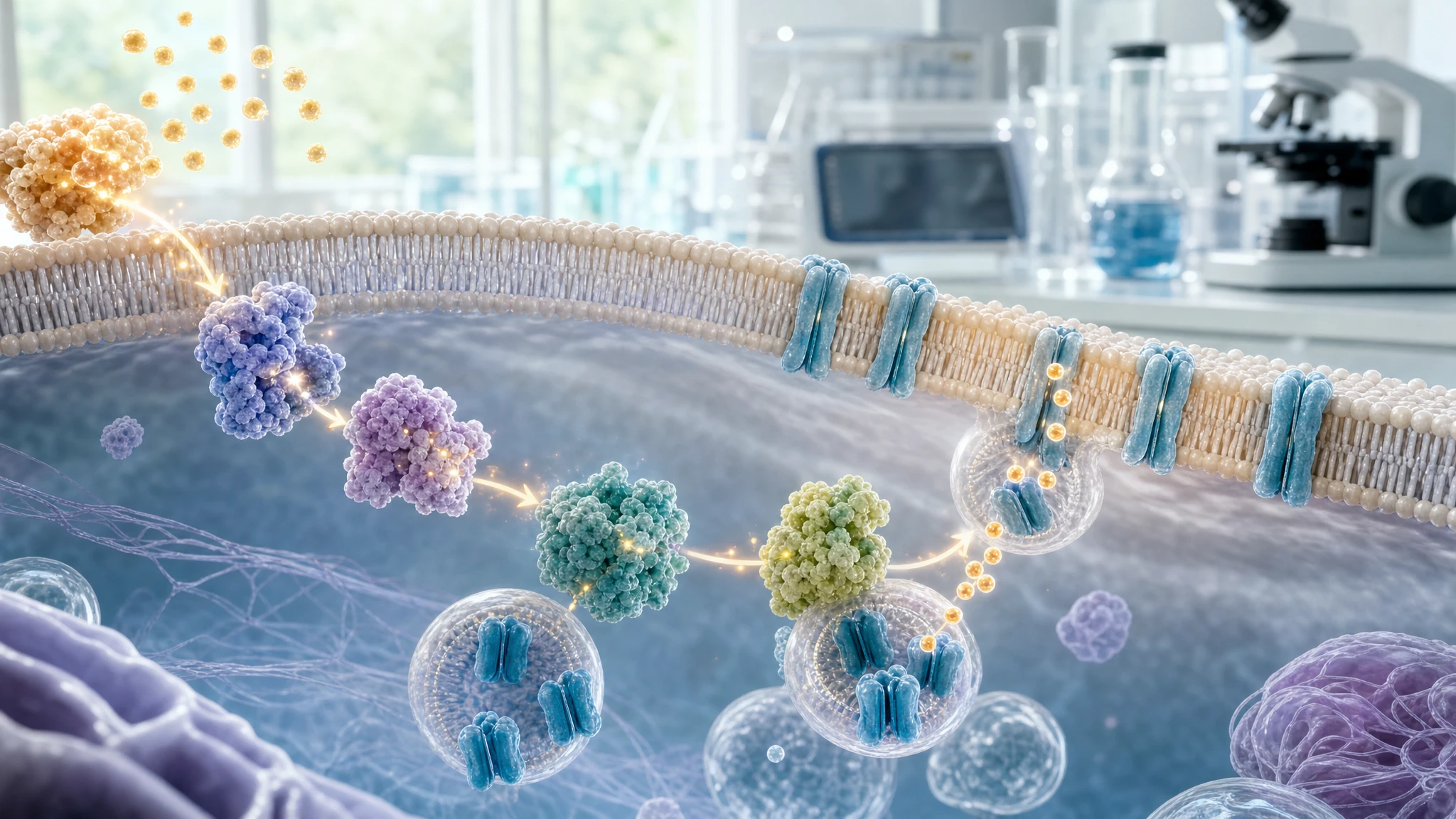
The biological significance of this axis is that insulin must do more than just activate a receptor: it must make the transporters that allow glucose to enter available on the cell membrane. In this sequence, AKT acts as a signal transmitter, AS160 as a regulator of vesicle movement, and GLUT4 as the final gateway through which glucose can be taken up.
In technical terms, the phosphorylation of AKT and AS160 consists of the addition of phosphate groups that can modify protein activity. The phosphorylation of AS160 reduces its "brake" on vesicular trafficking and promotes the exposure of GLUT4 to the cell surface. When GLUT4 increases on the membrane, the cell's ability to transfer glucose from the outside to the inside increases.
This interpretation corresponds to the narrative in the book's paragraphs: the pathway supported by the publication is primarily AKT → AS160 → GLUT4 translocation → increased glucose uptake. However, the review does not demonstrate that every case of insulin resistance depends primarily on this axis, nor that the defect has identical importance in all organs. Furthermore, GLUT4 transport can also be regulated by signals other than insulin and by mechanisms that do not entirely coincide with AS160.
Independent supporting evidence
Initial experimental confirmation of the AKT → GLUT4 segment comes from 3T3-L1 adipocytes, murine cells used as a model for adipose tissue. Kohn and colleagues made AKT constitutively active, meaning it remained active even without the normal insulin stimulus. In these cells, AKT activation increased glucose uptake and promoted the translocation of GLUT4 to the membrane in the absence of insulin. The result supports the book's premise that AKT is not an accessory node, but can directly promote the availability of GLUT4 on the cell surface [1]. The limitation is that artificially active AKT in cultured cells does not entirely reproduce physiological regulation in the organism.
Ng and colleagues addressed a more precise question: is the rapid activation of AKT2, one of the AKT isoforms particularly relevant in insulin-sensitive tissues, sufficient to mobilize GLUT4? In genetically modified 3T3-L1 adipocytes, a pharmacological system activated AKT2 within five minutes. This activation was accompanied by the phosphorylation of AS160, an increase in GLUT4 translocation, and an increase in glucose transport. The authors observed an effect comparable to that of insulin in their cell model [2]. This study directly supports the central segment of the chain proposed in the book, AKT → AS160 → GLUT4, but it remains an experiment on cultured murine adipocytes.
Confirmation closer to whole-organism physiology comes from mice carrying a targeted mutation of AS160/TBC1D4. The mutation prevented the phosphorylation of an AS160 site important for binding with 14-3-3 proteins, without reducing the total amount of the protein. The mutant mice showed lower glucose tolerance, lower insulin sensitivity, and lower glucose uptake. In isolated muscles, insulin produced a reduction in glucose transport and in the proportion of GLUT4 present on the cell surface [3]. This result is relevant because it separates the quantity of AS160 from its functional regulation: it is not enough for the protein to be present; it must be correctly modified by the insulin signal. The main limitation is that transferability from mouse to human is not automatic.
Taken together, these independent pieces of evidence reconstruct a convergent chain. AKT activation can increase GLUT4 translocation [1]; acute activation of AKT2 can be accompanied by AS160 phosphorylation and increased glucose transport [2]; and defective AS160 phosphorylation can reduce GLUT4 trafficking and insulin sensitivity in vivo [3]. The convergence is strong at the molecular and cellular levels, with relevant animal validation, but it does not equate to a direct clinical demonstration in humans.
Conflicting evidence
No directly conflicting evidence of sufficient relevance has been identified that denies the role of AKT, AS160, or GLUT4 in the insulin response. However, there is significant contextual evidence that limits an overly exclusive interpretation of this axis.
In 3T3-L1 adipocytes, the experimental reduction of AS160 increased the basal presence of GLUT4 on the membrane and increased basal GLUT4 exocytosis—that is, the release of vesicles toward the cell surface—by approximately threefold. However, the loss of AS160 only partially released GLUT4 from its intracellular retention, and insulin was still able to produce further mobilization of the transporter [4]. This finding does not contradict the role of AS160, but it indicates that insulin signaling toward GLUT4 also includes AS160-independent mechanisms.
The interpretive limit for the book's narrative is therefore clear: the AKT-AS160-GLUT4 axis is a central and well-documented connection, but it should not be considered the sole determinant of GLUT4 trafficking in every cell, metabolic condition, or tissue. The available conclusions are derived primarily from adipocytes and muscle, while other tissues may have a different relative weight for individual mechanisms.
Summary table of evidence
The table distinguishes the publication subject to the review from the independent studies used to confirm or define the book's narrative passage.
| Reference | Study type | Population or model | Main result | Direction of evidence | Strength of evidence |
|---|---|---|---|---|---|
| Original study | Narrative review | Literature synthesis on AKT, AS160, and GLUT4 | Proposes that alterations in AKT, AS160, or GLUT4 may reduce glucose uptake and promote insulin resistance. | biologically consistent evidence | moderate |
| [1] | Cellular | 3T3-L1 murine adipocytes | Constitutively active AKT increased GLUT4 translocation and glucose entry without insulin. | direct confirmation | moderate |
| [2] | Cellular | 3T3-L1 murine adipocytes with inducible AKT2 | Rapid activation of AKT2 increased AS160 phosphorylation, GLUT4 translocation, and glucose transport. | direct confirmation | moderate |
| [3] | Animal | Knock-in mice with non-phosphorylatable AS160/TBC1D4 | The mutation reduced insulin sensitivity, muscle glucose uptake, and cell-surface GLUT4. | direct confirmation | moderate |
| [4] | Cellular | 3T3-L1 murine adipocytes with AS160 knockdown | AS160 regulates basal GLUT4 retention, but insulin retains an additional mobilization component. | discordant evidence | moderate |
Confirmation of the evidence
Claim in the book
In the analyzed paragraphs of "The Choice to Live in Health or Illness" by Dr. A. Colonnese and R. Panzironi, the central claim is that insulin activation of AKT leads to the phosphorylation of AS160, allows for the mobilization of vesicles containing GLUT4 toward the cell membrane, and thus increases glucose entry into peripheral tissues. The text further links defects in AKT, AS160, or GLUT4 mobilization to a progressive reduction in insulin sensitivity.
Insulin → AKT → phosphorylation of AS160 → translocation of GLUT4 to the membrane → increased glucose uptake; alterations of the axis → reduced uptake → insulin resistance
The publication subject to the Evidence Review was used in the book to support the following passage: AKT translates the insulin signal into the regulation of AS160 and the movement of GLUT4 to the membrane; if this part of the cascade functions inefficiently, the cell absorbs less glucose and can contribute to insulin resistance.
The correspondence between the analyzed publication and the book is specific. The review is not used to demonstrate every component of insulin signaling, but to define the AKT-AS160-GLUT4 operational pathway that leads to glucose uptake. Independent studies confirm that active AKT can increase GLUT4 translocation and glucose transport in adipocytes [1]. An experiment with controlled activation of AKT2 also placed AS160 between AKT and GLUT4: the activation of AKT2 was followed by phosphorylation of AS160, a greater presence of GLUT4 at the membrane, and increased glucose transport [2].
The part of the chain related to AS160 is also supported in vivo. In mice with an AS160 phosphorylation site rendered unmodifiable, the total amount of the protein was normal, but insulin produced less muscle glucose transport and lower GLUT4 content on the cell surface, along with reduced insulin sensitivity [3]. This confirms the concept expressed in the book that the localization and regulation of proteins, not just their overall quantity, are decisive for the metabolic effect.
The confirmation, however, requires a clarification. The loss of AS160 does not make GLUT4 completely independent of insulin: in adipocytes, the transporter remained further mobilizable by the hormone, suggesting additional regulatory pathways [4]. Therefore, the literature confirms the central role of the axis, but does not allow it to be described as the sole regulator of GLUT4 trafficking in all biological contexts.
Overall level of confirmation
MECHANISTIC CONFIRMATION
The AKT → AS160 → GLUT4 pathway is supported by independent cellular experiments and a murine genetic model that links defective AS160 phosphorylation to reduced GLUT4 trafficking and insulin sensitivity. However, direct and quantitative demonstration of the entire chain in humans remains limited; furthermore, AS160 does not account for all GLUT4 control mechanisms.
Conclusions
The analyzed publication provides a coherent summary of the role of the AKT-AS160-GLUT4 axis in the metabolic response to insulin. The pathway linking AKT activation to the regulation of AS160, the translocation of GLUT4, and the increase in glucose uptake is well-supported by independent experimental studies.
The most direct evidence comes from cultured adipocytes and genetically modified mice. They show a consistent direction: AKT activation increases the availability of GLUT4 on the membrane, while defective regulation of AS160 reduces glucose transport and insulin sensitivity. However, these results do not allow us to attribute the entire complexity of human insulin resistance to this axis alone.
The book's narrative is therefore confirmed at a mechanistic level: the AKT-AS160-GLUT4 axis represents an important link between insulin signaling and cellular glucose utilization. It remains necessary to validate, with greater breadth in humans, the relative weight of this axis in different tissues and in different forms of insulin resistance.
Overall assessment
The narrative is confirmed at a mechanistic level. The AKT-AS160-GLUT4 axis is fairly well supported by cellular experiments and a targeted murine genetic model, with a consistent direction of effects. Its role is central to insulin signaling, but not exclusive; direct and quantitative clinical confirmation in humans remains limited.
References
[1] Expression of a Constitutively Active Akt Ser/Thr Kinase in 3T3-L1 Adipocytes Stimulates Glucose Uptake and Glucose Transporter 4 Translocation
[2] Rapid Activation of Akt2 Is Sufficient to Stimulate GLUT4 Translocation in 3T3-L1 Adipocytes
[3] Mice with AS160/TBC1D4-Thr649Ala Knockin Mutation Are Glucose Intolerant with Reduced Insulin Sensitivity and Altered GLUT4 Trafficking
Editorial note
Artificial Intelligence was used solely as a tool to support editorial and documentary work. All content, interpretations, bibliographic citations and conclusions have been verified, reviewed and approved by the author, who assumes full scientific responsibility for them.
The manuscript was also subject to independent peer review prior to publication.
To ensure maximum transparency, the article's complete history — including the dates of submission, review, acceptance and publication, as well as information on the peer review process — is available on the dedicated Article History page.