


Alterations in basal and postprandial insulin secretion and clearance in obese patients with type 2 diabetes mellitus - A review of the evidence
In 348 obese patients with type 2 diabetes, the study finds that late insulin secretion may increase, while higher clearance reduces the insulin measured in the blood. Independent studies confirm that secretion and clearance change with diabetes, obesity, and glycemic control; however, results depend on the context and require further confirmation.
- Published 16/11/2026
- Updated 17/11/2026
- Article history
ABSTRACT
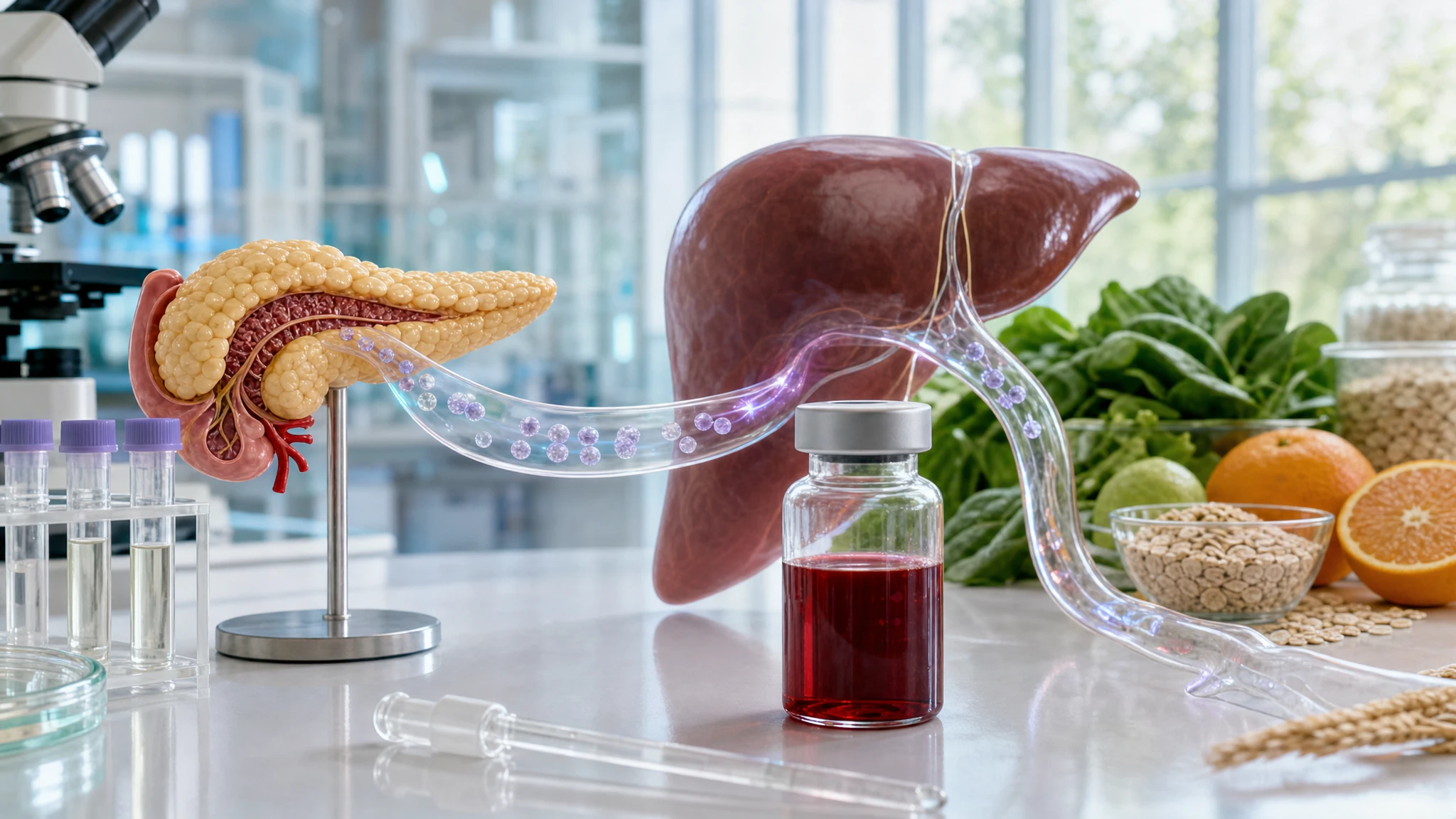
The analyzed study examined 348 people with type 2 diabetes mellitus who were overweight or obese, comparing them with matched non-diabetic controls. The goal was to distinguish the amount of insulin produced by the pancreas from insulin clearance, i.e., the rate at which the hormone is removed from the blood. The results indicate that, in diabetes, higher basal insulin levels are primarily due to reduced clearance. After a meal, however, the early response worsens with the duration of the disease; in later stages, secretion may be much higher, but increased clearance can keep peripheral insulin relatively contained.
This observation contributes to the narrative of “The Choice to Live in Health or Illness” by Dr. A. Colonnese and R. Panzironi: the value of insulin in the blood does not necessarily coincide with the amount secreted by the pancreas. Independent studies confirm that in type 2 diabetes, secretion, insulin sensitivity, and clearance change together, but they also show that the direction of postprandial clearance varies based on obesity, stage of diabetes, glycemia, and measurement method. The confirmation is therefore moderate and contextual.
Analyzed study
Disturbances of basal and postprandial insulin secretion and clearance in obese patients with type 2 diabetes mellitus
PMID: 22205571
The research question was whether the insulin alterations observed in people with overweight or obesity without diabetes were also present in type 2 diabetes. The authors separately evaluated insulin secretion, i.e., the release of the hormone into the circulation by pancreatic beta cells, and insulin clearance, i.e., its removal from the blood, primarily by the liver.
The point relevant to paragraph 3.4 of “The Choice to Live in Health or Illness” by Dr. A. Colonnese and R. Panzironi concerns the post-meal period. The study suggests that, in people with longer-standing diabetes, a delayed and even very high secretion may not translate into proportionally high peripheral insulin concentrations because the elimination of the hormone increases. In simple terms, what is measured in peripheral blood may be lower than what the pancreas has actually released.
The study can describe differences between people with diabetes and controls and relate these differences to the duration of the disease. However, it cannot prove that increased clearance is the cause of beta-cell deterioration, nor can it establish an individual causal sequence, as the available material does not report a prospective design.
Materials and methods of the original study
The available material consists only of the abstract. The study analyzed a random sample of 348 patients with type 2 diabetes, described as overweight or obese, and compared them with matched non-diabetic controls. Participants were considered in relation to body mass index (BMI) classes (the ratio of weight to height used to classify body weight) and the duration of diabetes.
The authors evaluated fasting and post-meal plasma insulin concentrations, insulin secretion, and insulin clearance. They also distinguished between an early and a late postprandial response, defining the latter as the area under the curve between 90 and 180 minutes. The area under the curve summarizes the overall exposure to a substance over time.
The number of non-diabetic controls, the type of meal or test used, the inclusion and exclusion criteria, the data collection period, the analytical techniques, the BMI class values, the formulas for calculating secretion and clearance, the detailed statistical analyses, and the P-values are not reported in the available material.
Results
In a fasting state, plasma insulin concentrations were significantly higher in most BMI classes of people with diabetes compared to matched non-diabetic controls. According to the authors, the weight-associated increase in basal insulin was primarily due to reduced clearance rather than increased secretion. In other words, a significant portion of insulin remained in circulation for longer.
After a meal, however, insulin concentrations were lower in patients with diabetes and did not increase with BMI as they did in non-diabetic controls. The reduction in postprandial clearance associated with weight gain, observed in subjects without diabetes, was not present in people with type 2 diabetes.
At the time of diagnosis, basal insulin was higher compared to controls, while basal secretion was comparable; according to the abstract, this pattern did not change with the duration of diabetes. The early insulin response after a meal was initially comparable to controls but decreased as the disease progressed. This is consistent with a progressive worsening of beta-cell function, i.e., the pancreatic cells that produce insulin.
The central finding for the book's section concerns the late postprandial phase. At diagnosis, between 90 and 180 minutes, insulin secretion and concentration were significantly higher compared to controls. With a longer duration of diabetes, a roughly threefold late secretion was instead associated with comparable peripheral concentrations, because postprandial clearance was significantly higher. The abstract does not report the absolute values, confidence intervals, or P-values for these differences.
Interpretation
The main result indicates that insulin measured in an arm vein is not a direct snapshot of pancreatic secretion. The circulating amount depends on two processes: how much hormone is released and how quickly it is extracted and degraded. If clearance increases, high secretion may produce only a moderate blood value; if clearance decreases, a high value may appear even without a corresponding increase in secretion.
In the specific segment supported by the study, the chain is: longer duration of diabetes → deterioration of the early beta-cell response → compensatory or late increase in secretion → greater postprandial clearance → peripheral concentration that underestimates actual secretion. The directly observed data is the association between longer duration of diabetes, impaired early response, and the dissociation between high late secretion and comparable peripheral insulin.
This interpretation is consistent with the passage from “The Choice to Live in Health or Illness” by Dr. A. Colonnese and R. Panzironi, but it does not imply that every person with diabetes presents the same profile. Clearance depends on the liver, kidneys, the amount of insulin reaching the tissues, insulin sensitivity, and the method used to estimate it. Therefore, the plasma insulin value alone does not allow for a certain reconstruction of individual pancreatic secretion.
Independent supporting evidence
Independent confirmation of the loss of early insulin response in type 2 diabetes comes from an experimental study on 14 people with diabetes and 11 non-diabetic controls matched for age and BMI. During a mixed meal, the peak of insulin secretion was delayed and lower in people with diabetes, while the total integrated postprandial insulin response did not differ significantly between the groups. The result confirms that the problem does not concern only the total amount of insulin, but also the timing of its secretion [1].
A second clinical study compared lean normoglycemic individuals and people with obesity at different stages of glycemic impairment, including type 2 diabetes. In people with diabetes, glucose-stimulated insulin secretion was reduced compared to obese groups with normal or impaired glycemia; insulin clearance was also directly associated with insulin sensitivity and inversely associated with the postprandial increase in secretion and plasma insulin. This confirms that secretion, clearance, and peripheral insulin must be interpreted together [2].
The temporal component of the narrative is also supported by a prospective study of 732 people with newly diagnosed type 2 diabetes followed for three years. An increase in estimated insulin clearance during meal tests was independently associated with a more rapid worsening of glycated hemoglobin, along with the deterioration of insulin sensitivity and beta-cell function. The study does not prove that increased clearance causes glycemic worsening, but it confirms that its trend can change over time and accompany the progression of the disease [3].
Taken together, these independent studies support the central part of the narrative: in type 2 diabetes, the postprandial insulin response cannot be read from blood concentration alone. The confirmation is more robust for the deterioration of early secretion and for the interdependence between secretion and clearance; it is less direct for the exact late increase in clearance reported in the original study.
Conflicting evidence
A secondary analysis of two randomized controlled trials investigated a standardized breakfast in 19 people with type 2 diabetes, 11 normoglycemic people with central obesity, and 12 lean normoglycemic people. After the meal, the mean insulin clearance was approximately 40% lower in both the group with diabetes and the group with obesity compared to the lean subjects. In the group with diabetes, clearance decreased slightly compared to pre-meal values [4].
This result does not replicate the increase in late postprandial clearance observed in the original study. However, it is not a complete refutation, because the populations, duration of diabetes, the meal, the method of estimating clearance, and the time window analyzed were different. The original study emphasizes a late response associated with the duration of the disease; the subsequent study primarily describes the mean clearance and its immediate profile during a single meal.
The available evidence therefore shows that postprandial clearance in type 2 diabetes is context-dependent. It may be lower compared to lean subjects in some cross-sectional comparisons, but increase over time or during specific phases of the disease and the postprandial response. This heterogeneity requires caution when turning a single metabolic profile into a general rule.
Summary table of evidence
The table distinguishes the study under review from independent publications and shows that the direction of postprandial insulin clearance varies according to population, disease stage, and method of analysis.
| Reference | Study type | Population or model | Main result | Direction of evidence | Strength of evidence |
|---|---|---|---|---|---|
| Original study | Comparative observational | 348 patients with type 2 diabetes and matched non-diabetic controls | With longer diabetes duration, late secretion is approximately tripled and peripheral insulin is comparable due to higher postprandial clearance | direct confirmation | moderate |
| [1] | Clinical experimental study | 14 people with type 2 diabetes and 11 matched controls | Postprandial secretory peak delayed and reduced in diabetes; total integrated response not different | indirect confirmation | moderate |
| [2] | Physiological clinical study | 19 lean people and 87 people with obesity, including 18 with type 2 diabetes | In diabetes, glucose-stimulated secretion decreases; clearance correlates with sensitivity, secretion, and plasma insulin | indirect confirmation | moderate |
| [3] | Prospective observational study | 732 people with newly diagnosed type 2 diabetes followed for three years | Increased estimated clearance during meal tests associated with more rapid worsening of glycated hemoglobin | indirect confirmation | moderate |
| [4] | Secondary analysis of randomized controlled trials | 19 people with type 2 diabetes, 11 with central obesity, and 12 normoglycemic lean subjects | Mean postprandial clearance approximately 40% lower in diabetes compared to lean subjects | discordant evidence | moderate |
Confirmation of the evidence
Claim in the book
In section 3.4, "The Choice to Live in Health or Illness" by Dr. A. Colonnese and R. Panzironi, it is stated that, in type 2 diabetes, the early insulin response deteriorates with the duration of the disease and that a very high late secretion can be counterbalanced by increased clearance. Consequently, peripheral insulin may not fully reflect the amount actually secreted by the pancreas.
Diabetes duration → reduced early beta-cell response → relatively high late secretion → increased postprandial clearance → peripheral insulin not proportional to secretion
The publication subject to the Evidence Review was used in the book to support the following passage: in type 2 diabetes, especially with longer disease duration, high late insulin secretion can be accompanied by increased postprandial clearance, meaning the concentration of insulin in peripheral blood does not necessarily represent the amount actually secreted.
The publication subject to the Evidence Review directly documents the dissociation between late secretion and peripheral insulin concentration in its sample of 348 patients. Independent evidence reinforces the contiguous steps of the same chain. The study by Basu and colleagues shows a later and lower postprandial secretory peak in diabetes, supporting the deterioration of the early phase [1]. The study by Mittendorfer and colleagues confirms that, as one progresses toward diabetes, beta-cell function decreases and that clearance, secretion, and plasma insulin are closely interdependent [2].
The prospective IMI DIRECT study also shows that the increase in estimated clearance during meal tests accompanies glycemic worsening over time [3]. However, a more recent analysis observed lower average postprandial clearance in people with diabetes compared to lean subjects [4]. Therefore, the direction of clearance does not appear uniform across all time phases or in all clinical comparisons. In the context of “The Choice to Live in Health or Illness” by Dr. A. Colonnese and R. Panzironi, the fundamental idea that peripheral insulin cannot be interpreted as a simple equivalent of pancreatic secretion remains well-supported.
Overall level of confirmation
MODERATE CONFIRMATION
The passage is directly documented by the original study and supported by independent research on the loss of the early response, the interdependence between secretion and clearance, and their variations over time. However, available studies do not show a uniform postprandial direction of clearance in all groups with type 2 diabetes.
Conclusions
The study analyzed specifically supports the idea that, in type 2 diabetes, the amount of insulin detected after a meal may not correspond to the amount secreted by the pancreas. As the disease progresses, the early response tends to deteriorate, and clearance can play a significant role in determining peripheral insulin levels.
Independent evidence confirms quite well that secretion and clearance must be considered together and that beta-cell function worsens along the diabetes continuum. The demonstration that late clearance increases in the same way in all people with diabetes, however, remains moderately supported and dependent on the clinical and methodological context.
Overall assessment
The book's narrative is moderately supported: peripheral insulin concentration depends on both secretion and clearance, and the early response worsens in type 2 diabetes. The late increase in clearance observed in the original study is biologically plausible and indirectly supported, but it is not consistent across different clinical studies.
References
[1] Effects of Type 2 Diabetes on Insulin Secretion, Insulin Action, Glucose Effectiveness, and Postprandial Glucose Metabolism
[2] b Cell function and plasma insulin clearance in people with obesity and different glycemic status
[4] Elevations in plasma glucagon are associated with reduced insulin clearance after ingestion of a mixed-macronutrient meal in people with and without type 2 diabetes
Editorial note
Artificial Intelligence was used solely as a tool to support editorial and documentary work. All content, interpretations, bibliographic citations and conclusions have been verified, reviewed and approved by the author, who assumes full scientific responsibility for them.
The manuscript was also subject to independent peer review prior to publication.
To ensure maximum transparency, the article's complete history — including the dates of submission, review, acceptance and publication, as well as information on the peer review process — is available on the dedicated Article History page.