


Beta-cell dysfunction and glucose intolerance: results from the San Antonio Metabolism (SAM) study - Evidence review
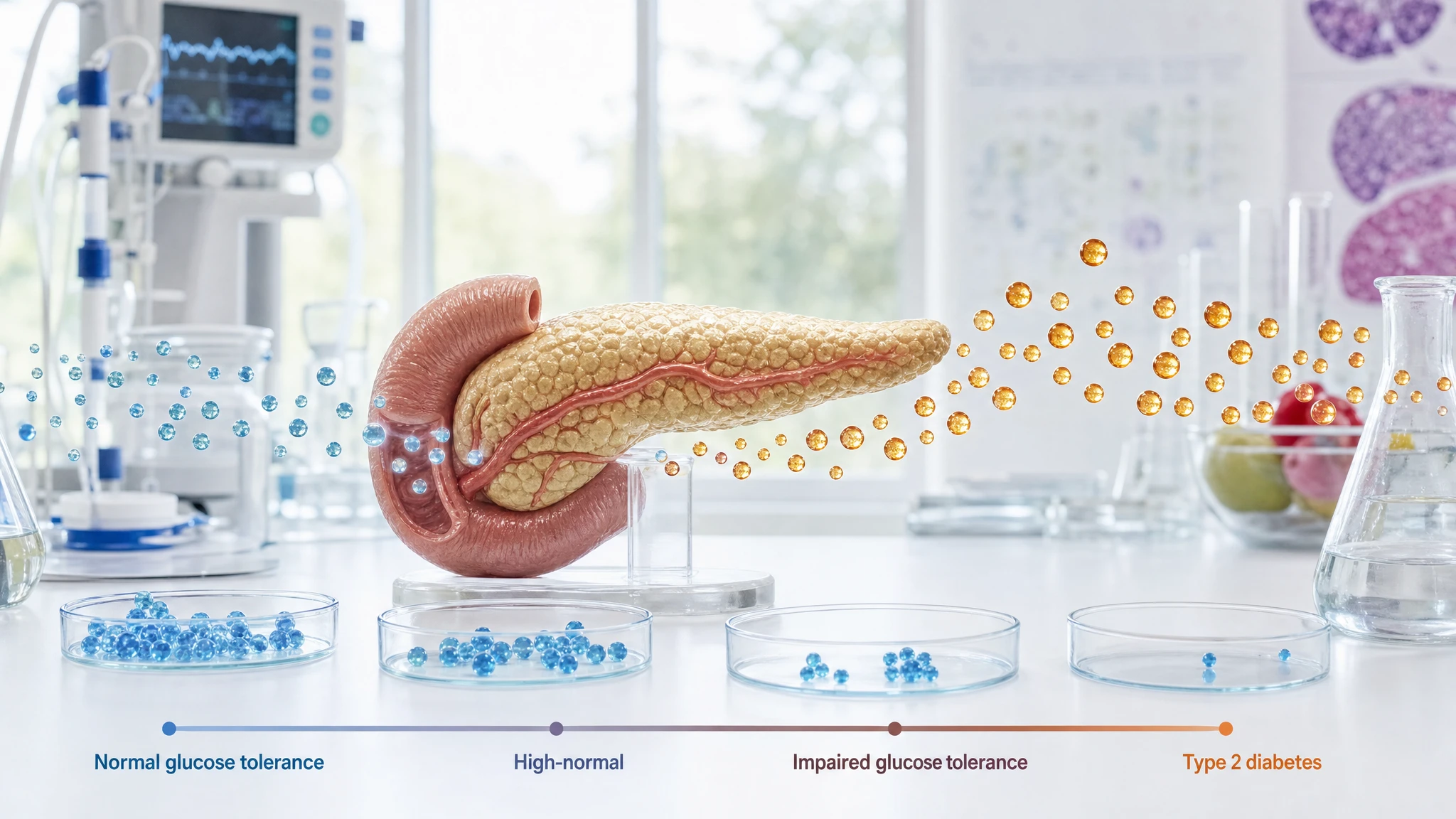
The SAM study observes that as glycemia increases after an oral glucose load, the insulin response adequate to overcome resistance progressively decreases, even within values classified as normal. Independent evidence confirms this phenomenon in various populations, but the data remain primarily observational and do not establish that every slight increase in glycemia directly causes future diabetes.
- Published 13/11/2026
- Updated 17/11/2026
- Article history
ABSTRACT
The analyzed study evaluated whether the function of pancreatic beta cells, the cells that produce insulin, changes during the transition from normal glucose tolerance to glucose intolerance and type 2 diabetes. In 388 adults, researchers compared the insulin response after an oral glucose load with insulin sensitivity measured by euglycemic clamp, a gold-standard procedure for estimating how effectively the body responds to insulin.
Beta-cell function, adjusted for insulin resistance, decreased progressively as two-hour glycemia increased, including within ranges formally compatible with normal glucose tolerance. This finding contributes to the perspective from "The Choice to Live in Health or Illness" by Dr. A. Colonnese and R. Panzironi, which suggests that pancreatic impairment may be recognizable before reaching the diagnostic thresholds for prediabetes and diabetes. Independent studies in obese youth, adults without diabetes, and women followed longitudinally show a consistent picture: higher blood glucose levels, even in non-diabetic ranges, are associated with a lower compensatory capacity of beta cells. However, there are differences between populations and measurement methods; insulin resistance may play a predominant role in some contexts. Overall, the narrative is moderately confirmed, but it does not prove that a single slightly elevated blood glucose level inevitably leads to diabetes.
Analyzed study
Beta-cell dysfunction and glucose intolerance: results from the San Antonio metabolism (SAM) study
DOI: 10.1007/s00125-003-1263-9
PMID: 14666364
The research question was at what level of glycemia a reduction in pancreatic beta-cell function becomes detectable, while simultaneously considering insulin resistance. This clarification is important: a high amount of insulin in the blood does not guarantee that the pancreas is responding adequately, because an insulin-resistant person requires more insulin to keep glycemia under control.
The study therefore evaluated whether the insulin response to glucose was proportional to both the increase in glycemia and the degree of insulin resistance. This is relevant to paragraph 3.2 because it documents the core of the narrative: along the spectrum ranging from normal glucose tolerance to type 2 diabetes, the adaptation of beta cells decreases progressively; this reduction is already observable in some people who are formally glucose-tolerant.
The research is cross-sectional: it compares groups evaluated at a specific moment in time, without following them over time. It can therefore describe an association between higher glycemia and lower beta-cell function corrected for insulin resistance, but it cannot prove that the glycemic increase is the cause of the dysfunction, nor can it estimate an individual's future risk of diabetes.
Materials and methods of the original study
The available material is only the abstract. The study included 388 participants from the San Antonio Metabolism study: 138 with normal glucose tolerance, 49 with impaired glucose tolerance, and 201 with type 2 diabetes. Glucose tolerance was assessed using an OGTT (oral glucose tolerance test), which measures how glycemia and insulin change after the intake of glucose.
Insulin sensitivity was estimated using a hyperinsulinemic-euglycemic clamp, a technique in which insulin is administered in a controlled manner and glucose is adjusted to keep glycemia stable. In simple terms, it allows for the quantification of how much glucose the body can utilize in response to insulin.
The authors calculated the ΔI/ΔG/IR index: the increase in insulin relative to the increase in glucose during the OGTT, divided by the insulin resistance measured via clamp. This index expresses a pancreatic response adapted to both the glycemic stimulus and the insulin requirement. The abstract reports comparisons between lean and obese subjects and between two-hour glycemia categories. Inclusion and exclusion criteria, recruitment period, distribution by sex and age, detailed statistical analyses, and numerical values of the index are not reported in the available material.
Results
The main result was a progressive decline in the insulin secretion index adjusted for insulin resistance as glycemia increased two hours after the OGTT. In simple terms, in people with higher post-load glycemia, the pancreas provided an insulin response that was less adequate for metabolic needs.
In lean participants with normal glucose tolerance, the ΔI/ΔG/IR index was progressively lower in groups with two-hour glycemia between 5.6 and 6.6 mmol/L and between 6.7 and 7.7 mmol/L, compared to those with values below 5.6 mmol/L. These ranges correspond approximately to 101-119 mg/dL and 121-139 mg/dL. A further reduction in the index was observed in impaired glucose tolerance, with values between 7.8 and 11.0 mmol/L, and in type 2 diabetes, with values above 11.1 mmol/L.
Lean and obese participants showed overlapping trends in the relationship between two-hour glycemia and the ΔI/ΔG/IR index. The data relevant to the book is therefore the continuous direction of the association: higher post-load glycemia corresponded to lower estimated beta-cell function in relation to insulin resistance. The abstract does not report absolute index values, confidence intervals, P-values, or analyses adjusted for other factors.
Interpretation
Beta cells function as a compensation system. When muscles, the liver, and adipose tissue respond less to insulin, the pancreas must appropriately increase insulin secretion to keep glycemia within non-diabetic limits. The study suggests that this compensation becomes progressively less effective as post-load glycemia increases.
The segment directly documented by the publication subject to the Evidence Review is: higher two-hour glycemia during OGTT → lower insulin response corrected for insulin resistance. It does not directly demonstrate the physical loss of beta cells, nor does it establish the chronological sequence in which insulin resistance and pancreatic dysfunction appear in an individual.
This distinction helps in understanding the book's paragraph. Elevated insulinemia may represent a compensatory attempt rather than proof of preserved pancreatic function. However, since the research is cross-sectional and the available information is limited to the abstract, the result should be interpreted as a robust pathophysiological association within the studied sample, not as a diagnostic threshold valid for everyone, nor as a demonstration of causality.
Independent confirming evidence
Confirmation particularly relevant to the early part of the narrative comes from a study of 407 obese children and adolescents with normal glucose tolerance. As the two-hour glycemia increased from less than 100 mg/dL to 100-119 mg/dL and then to 120-139 mg/dL, glycemia in the first 30 minutes of the OGTT increased progressively, while the increase in insulin did not grow proportionally. Consequently, the insulinogenic index, a measure of the pancreas's early response, decreased. The result remained observable at different levels of insulin sensitivity, supporting the idea that beta-cell response may be less effective even within the range of normal glucose tolerance [1]. The study is cross-sectional, concerns obese youth, and cannot be automatically extended to adults or people with different adiposity levels.
A second study examined 531 adults without diabetes, including 293 with normal tolerance and 238 with impaired glucose tolerance, belonging to Japanese and Mexican-American populations. As fasting glycemia increased from 70 to 125 mg/dL, the insulin secretion index adjusted for insulin resistance decreased exponentially; every 28 mg/dL increase was associated with a 63% reduction in the index. The association primarily concerned early secretion, within the first 30 minutes. This confirms, on a different glycemic axis, the concept that even non-diabetic increases in glycemia can be accompanied by a lower pancreatic compensatory capacity [2]. The analysis remains observational and does not allow for the complete separation of cause, consequence, and possible shared factors.
The most relevant longitudinal evidence comes from 302 women with normal glucose tolerance three months postpartum, re-evaluated at one, three, and five years. Eighty-nine developed prediabetes or diabetes. From the beginning, the future participants who progressed had higher fasting and two-hour glycemia, greater insulin resistance, and lower beta-cell function. During follow-up, the worsening of the ISSI-2, an index that integrates insulin secretion and sensitivity, proved to be the most important determinant of progression; its contribution to predictive capacity was greater than that of insulin resistance indices [3]. The sample is specific to women in the postpartum period, and the result does not prove that beta-cell dysfunction alone explains all cases of dysglycemia.
Conflicting evidence
A more cautious interpretation comes from the multicenter RODAM study, conducted on 4,079 Ghanaian adults without diabetes living in Ghana or Europe. To explain the geographical differences in impaired fasting glycemia, the authors estimated insulin resistance and beta-cell function using HOMA-IR and HOMA-B, indices derived from fasting glycemia and insulin. A one-standard-deviation increase in HOMA-IR explained an attributable fraction of 69.3% of the condition, compared to 11.1% attributed to beta-cell dysfunction estimated via HOMA-B [4].
This evidence does not negate the result of the original study, but it shows that the relative weight of the two processes may depend on the population, the glycemic parameter considered, and the method used to measure pancreatic function. The RODAM study is cross-sectional, focuses on fasting glycemia, and uses surrogate measures rather than the clamp technique or dynamic response after glucose intake. Therefore, it limits the generalizability of the idea that beta-cell reduction is always the predominant factor, without undermining the consistency of the relationship observed after an oral glucose load.
Summary table of evidence
The table distinguishes the study that is the subject of the Evidence Review from independent publications that confirm or define the scope of the narrative in the book's paragraph.
| Reference | Study type | Population or model | Main result | Direction of evidence | Strength of evidence |
|---|---|---|---|---|---|
| Original study | Cross-sectional study with OGTT and euglycemic clamp | 388 adults: normal tolerance, impaired tolerance, and type 2 diabetes | As two-hour glycemia increased, the insulin secretion index adjusted for insulin resistance decreased, even in those with normal tolerance | direct confirmation | moderate |
| [1] | Cross-sectional observational study | 407 obese children and adolescents with normal glucose tolerance | Higher two-hour glycemia within the normal range was associated with a reduction in the insulinogenic index, regardless of insulin sensitivity levels | direct confirmation | moderate |
| [2] | Cross-sectional observational study | 531 Japanese and Mexican-American adults without diabetes | Higher fasting glycemia was associated with a reduction in the insulin secretion index adjusted for insulin resistance, especially in the early phase | indirect confirmation | moderate |
| [3] | Longitudinal observational study | 302 normoglycemic women three months postpartum, followed for five years | Deterioration of beta-cell function indices was the main determinant of progression toward prediabetes or diabetes | indirect confirmation | moderate |
| [4] | Multicenter cross-sectional observational study | 4,079 adults from Ghana without diabetes living in Ghana or Europe | In the geographic differences of impaired fasting glycemia, estimated insulin resistance explained a greater share of the estimated beta-cell dysfunction | conflicting evidence | moderate |
Confirmation of the evidence
Claim in the book
In section 3.2 of “The Choice to Live in Health or Illness” by Dr. A. Colonnese and R. Panzironi, the central assertion is that beta-cell function deteriorates across the entire spectrum of glucose tolerance and that impairment can be visible even when glycemia is still within the thresholds considered normal. The text also emphasizes that insulin secretion must be interpreted in relation to the glycemic stimulus and insulin sensitivity.
Gradual increase in post-load glycemia → insulin response disproportionate to insulin resistance → reduction in the compensatory capacity of beta cells → glucose intolerance and type 2 diabetes
The publication subject to the Evidence Review was used in the book to support the following passage: the inverse relationship between two-hour glycemia and beta-cell function, adjusted for insulin resistance, continues from normal glucose tolerance to impaired tolerance and reaches its greatest severity in overt diabetes.
The connection to “The Choice to Live in Health or Illness” by Dr. A. Colonnese and R. Panzironi is scientifically specific. The original study was not cited to demonstrate every determinant of diabetes, but to document that the insulin response must be judged in relation to the glycemia that stimulates it and to insulin resistance. In their analysis, a higher two-hour glycemia corresponded to a lower compensatory capacity of beta cells across all tolerance categories.
Independent confirmations reconstruct a convergent chain. In obese young people, higher but still normal two-hour glycemia values were associated with a relatively insufficient early insulin response, even after stratification for insulin sensitivity [1]. In adults without diabetes, the increase in fasting glycemia was associated with a reduction in the insulin secretion index corrected for insulin resistance, especially in the early phase of the response [2]. In women followed for five years postpartum, the deterioration of integrated indices of insulin secretion and sensitivity preceded and explained the progression toward prediabetes or diabetes more than the variation in insulin resistance indices alone [3].
However, the literature does not authorize considering beta-cell dysfunction as the sole explanation for dysglycemia. In a population of Ghanaian origin, differences in impaired fasting glycemia were more attributable to estimated peripheral insulin resistance than to estimated beta-cell dysfunction [4]. This result highlights that the relative weight of the mechanisms changes according to population, phenotype, and the measure used.
Overall level of confirmation
MODERATE CONFIRMATION
The claim supported by the original study is confirmed by multiple independent human studies, including longitudinal data. The overall strength remains moderate because much of the evidence is observational, the populations are specific, and the various studies use non-identical measures of beta-cell function and insulin sensitivity.
Conclusions
Overall assessment
The relationship between progressively higher glycemia and reduced beta-cell compensation is well-supported in humans. The mechanism is consistent with insulin physiology and the book's section, but its relative importance varies between populations and measurement methods. The narrative receives moderate confirmation, not universal causal proof.
References
[1] The Normal Glucose Tolerance Continuum in Obese Youth: Evidence for Impairment in b-Cell Function Independent of Insulin Resistance
[2] The relationship between fasting hyperglycemia and insulin secretion in subjects with normal or impaired glucose tolerance
[3] Deteriorating beta cell function is the dominant determinant of progression from normal glucose tolerance to prediabetes/diabetes in young women following pregnancy
[4] Peripheral insulin resistance rather than beta cell dysfunction accounts for geographical differences in impaired fasting blood glucose among sub-Saharan African individuals: findings from the RODAM study
Editorial note
Artificial Intelligence was used solely as a tool to support editorial and documentary work. All content, interpretations, bibliographic citations and conclusions have been verified, reviewed and approved by the author, who assumes full scientific responsibility for them.
The manuscript was also subject to independent peer review prior to publication.
To ensure maximum transparency, the article's complete history — including the dates of submission, review, acceptance and publication, as well as information on the peer review process — is available on the dedicated Article History page.