


Bifurcation of the insulin signaling pathway in rat liver: mTORC1 is required to stimulate lipogenesis, but not to inhibit gluconeogenesis - Review of the evidence
The study analyzed shows that, in rat hepatocytes and rodent liver, insulin increases SREBP-1c through mTORC1, while keeping the inhibition of gluconeogenesis separate. Independent research confirms the mechanistic role of mTORC1 in lipogenesis, but points to parallel circuits and does not demonstrate clinical effects in humans or causality in metabolic diseases.
- Published 21/11/2026
- Updated 21/11/2026
- Article history
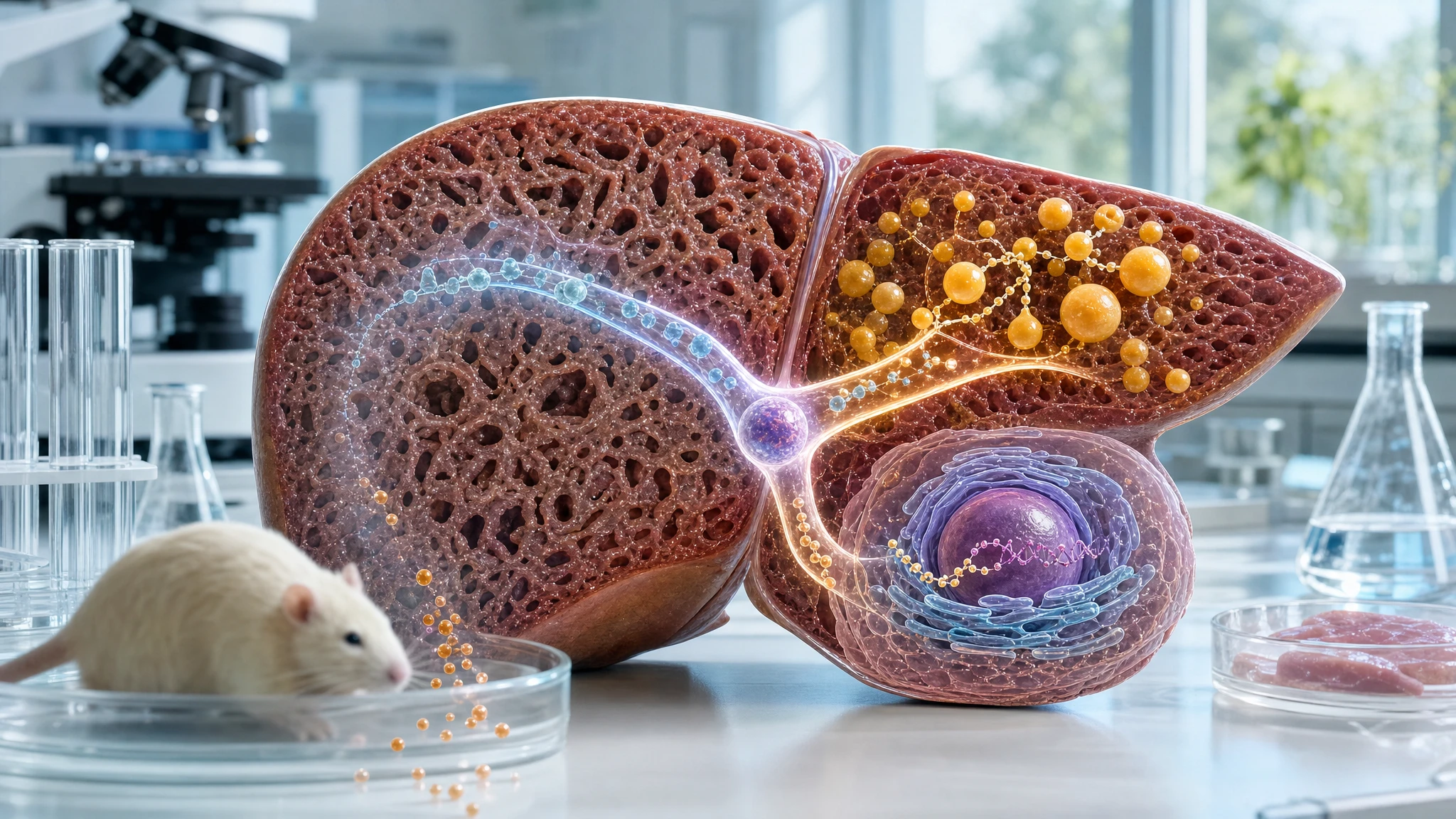
ABSTRACT
The analyzed study examined how insulin separates two important functions in the liver: the reduction of glucose production and the activation of fat synthesis. In rat hepatocytes, insulin markedly increased the messenger RNA of SREBP-1c, a transcription factor that activates genes involved in fatty acid production, and reduced that of PEPCK, a gluconeogenesis gene. Inhibition of mTORC1 blocked the increase in SREBP-1c without preventing the reduction of PEPCK.
This result contributes to the section of "The Choice to Live Healthy or in Disease" by Dr. A. Colonnese and R. Panzironi dedicated to the insulin activation of SREBP-1c and the selective role of mTORC1 in lipogenesis. Independent studies in hepatocytes, mice, and other cellular models confirm that mTORC1 is necessary for a significant part of SREBP-1c activation and lipogenesis. However, genetic evidence indicates that persistent activation of mTORC1, on its own, is not sufficient to reproduce the lipogenic program. The confirmation therefore concerns primarily the mechanistic and preclinical level, not clinical outcomes in humans.
Analyzed study
Bifurcation of insulin signaling pathway in rat liver: mTORC1 required for stimulation of lipogenesis, but not inhibition of gluconeogenesis
PMID: 20133650
PMCID: PMC2840492
The research question was whether insulin uses the same molecular pathway to control both glucose production and fat production in the liver. The authors evaluated the hypothesis of a bifurcation in insulin signaling: a common initial segment, followed by different branches for gluconeogenesis and lipogenesis.
The central point for paragraph 5.3 is as follows: insulin activates SREBP-1c, a protein that enters the nucleus and increases the activity of genes necessary for the synthesis of fatty acids and triglycerides. The study verified whether this response depended on PI3K and AKT, two proteins that transmit the insulin signal, and on mTORC1, a protein complex that coordinates growth and nutrient availability.
The publication is relevant to "The Choice to Live in Health or Illness" by Dr. A. Colonnese and R. Panzironi because it directly documents the insulin → PI3K/AKT → mTORC1 → increased SREBP-1c segment. However, it cannot demonstrate on its own that chronic hyperinsulinemia in humans causes inflammation, hepatic steatosis, or other metabolic diseases: the study uses cells and rodents and primarily evaluates short-term molecular signals.
Materials and methods of the original study
The available material is only the abstract. The authors exposed rat hepatocytes, i.e., liver cells cultured in the laboratory, to insulin and measured the messenger RNA of SREBP-1c and PEPCK. Messenger RNA is the molecule that carries the instructions for producing a protein: a variation in it therefore signals a change in gene activation.
To separate the different signaling steps, pharmacological inhibitors of PI3K, AKT, and mTORC1 were used. Rapamycin, used at concentrations lower than one nanomolar, was employed as an inhibitor of mTORC1. An inhibitor of S6 kinase, a protein located downstream of mTORC1, was also used.
The authors then verified the phenomenon in the livers of rats and mice subjected to a fasting protocol followed by refeeding, a condition that causes an increase in insulin. The number of animals, detailed characteristics of the cell cultures, precise exposure times, inclusion and exclusion criteria, secondary endpoints, and statistical analyses are not reported in the available material.
Results
In rat hepatocytes, insulin increased SREBP-1c messenger RNA by 25-fold. In practical terms, the insulin signal strongly activated the genetic program that promotes lipid synthesis. In the same cells, insulin reduced the messenger RNA of PEPCK by 95%, an enzyme important for gluconeogenesis, i.e., hepatic glucose production.
PI3K and AKT inhibitors blocked both the increase in SREBP-1c and the reduction of PEPCK. This indicates that PI3K and AKT are necessary for both responses studied. Rapamycin, on the other hand, selectively blocked the induction of SREBP-1c by insulin but did not alter the reduction of PEPCK. The result therefore suggests that, after AKT, the signal splits: mTORC1 is required for the lipogenic branch, but not for the branch that suppresses PEPCK.
A similar selective effect of rapamycin was observed in the liver of rats and mice after fasting and refeeding. The S6 kinase inhibitor did not block the insulin-induced increase in SREBP-1c. This suggests that the pathway from mTORC1 to SREBP-1c does not necessarily depend on S6 kinase in this specific transcriptional control. The available material does not report P values, confidence intervals, or complete numerical data from the experiments.
Interpretation
The biological significance is that insulin does not act as a single metabolic switch. In liver cells, it can keep the program that promotes fat synthesis active even when another of its effects, the control of glucose production, follows a different regulation. This helps to understand the concept of selective insulin resistance observed in animal models: some insulin signals may be attenuated, while lipogenic ones may be preserved.
The pathway documented by the publication is insulin → PI3K/AKT → mTORC1 → transcriptional induction of SREBP-1c. The experimental demonstration is strong within the models used because rapamycin reduced the induction of SREBP-1c without eliminating the repression of PEPCK. However, a pharmacological inhibitor alone does not identify all the molecular targets involved and does not prove that mTORC1 is the sole regulator of SREBP-1c.
Regarding the narrative of “The Choice to Live in Health or Illness” by Dr. A. Colonnese and R. Panzironi, the study precisely supports the idea that lipogenesis represents a functionally distinguishable branch of insulin signaling and that mTORC1 is indispensable for the insulin-induced expression of SREBP-1c in the rodent liver. It does not directly demonstrate the subsequent step toward inflammatory lipid mediators nor the effects of chronic insulin stimulation in humans.
Independent confirming evidence
Particularly relevant independent verification was obtained in primary murine hepatocytes and mice. Yecies and colleagues observed that rapamycin reduced the insulin-induced increase of Srebp1c and Fasn, a gene essential for fatty acid synthesis, while increasing certain upstream AKT signals. After fasting and refeeding, rapamycin also reduced SREBP-1 activation in the liver. These data directly confirm that mTORC1 is necessary for the normal insulin-induced expression of SREBP-1c and hepatic lipogenesis in rodents [1].
The same study also clarified an important limitation of the linear chain. In mice with hepatic deletion of Tsc1, a genetic modification that keeps mTORC1 constitutively active, SREBP-1c and lipogenesis were not adequately activated. The authors proposed that AKT also contributes through the reduction of Insig2a, a regulator that hinders SREBP-1c activation. mTORC1 therefore appears necessary, but not sufficient on its own [1].
Owen and colleagues investigated a second level of regulation, namely the proteolytic maturation of SREBP-1c. This maturation allows the active form of the protein to reach the nucleus. In transgenic rat hepatocytes, insulin required mTORC1 and S6 kinase to increase SREBP-1c processing. This confirms that mTORC1 can control not only the amount of SREBP-1c messenger RNA, but also the availability of the active protein; the mechanism, however, concerns a different level than the transcriptional one examined in the original study [2].
In a non-hepatic cell model and in the fruit fly, Porstmann and colleagues showed that AKT activation requires mTORC1 to support SREBP-dependent lipogenesis. Silencing SREBP reduced AKT-induced lipogenesis and attenuated the increase in cell size. This result does not demonstrate an effect in the human liver, but it reinforces the biological coherence of the AKT → mTORC1 → SREBP → lipid synthesis sequence [3].
Conflicting evidence
The evidence does not contradict the fact that mTORC1 is required for the acute induction of SREBP-1c by insulin in the models studied. However, it shows that the relationship is not linear and depends on the context. Kenerson and colleagues deleted Tsc1 specifically in mouse hepatocytes, producing persistent activation of mTORC1. Contrary to the hypothesis that more mTORC1 automatically leads to more fat in the liver, these animals showed a lower tendency for diet-induced lipid accumulation and a slight reduction in hepatic SREBP-1c expression during fasting [4].
This result is biologically consistent with the existence of feedback loops: an artificially maintained mTORC1 signal can reduce AKT and alter other factors essential for SREBP-1c. The conflicting evidence therefore limits the interpretation that mTORC1 activation is, by itself, sufficient to produce lipogenesis or steatosis. It does not eliminate the scientific correspondence between the original study and the book's paragraph, which instead concerns the necessity of mTORC1 in the acute response to insulin.
Summary table of evidence
The table distinguishes the study subject to the Evidence Review from independent publications that confirm or define the scope of the narrative passage.
| Reference | Study type | Population or model | Main result | Direction of evidence | Strength of evidence |
|---|---|---|---|---|---|
| Original study | Cellular and animal | Rat hepatocytes; rat and mouse liver | Rapamycin blocks insulin-induced SREBP-1c, but not PEPCK repression. | direct confirmation | moderate |
| [1] | Animal and cellular | Primary murine hepatocytes and mice with hepatic Tsc1 alterations | mTORC1 is required for insulin-induced SREBP-1c, but its isolated activation is not sufficient. | direct confirmation | moderate |
| [2] | Cellular and animal | Transgenic rat hepatocytes | mTORC1 and S6 kinase are required for insulin-mediated SREBP-1c processing. | indirect confirmation | moderate |
| [3] | Cellular and animal | Cultured cells and Drosophila | mTORC1 and SREBP support AKT-dependent lipogenesis and growth. | biologically consistent evidence | low |
| [4] | Animal | Mice with hepatic Tsc1 deletion and high-fat diet | Persistent mTORC1 activation does not automatically increase SREBP-1c or hepatic lipid accumulation. | discordant evidence | moderate |
Confirmation of the evidence
Claim in the book
In section 5.3, “The Choice to Live in Health or Illness” by Dr. A. Colonnese and R. Panzironi, it is stated that insulin increases SREBP-1c in the liver and that pharmacological inhibition of mTORC1 selectively blocks this induction, distinguishing the lipogenic branch from other metabolic effects of the hormone.
Insulin → PI3K/AKT → mTORC1 → increase in SREBP-1c → activation of lipogenesis
The publication subject to the Evidence Review was used in the book to support the following passage: insulin activation of SREBP-1c requires PI3K/AKT and, selectively, mTORC1; blocking mTORC1 reduces SREBP-1c induction without preventing the repression of PEPCK, indicating a functional bifurcation of insulin signaling in the liver.
The correspondence between the paragraph and the original study is direct: the publication precisely measures the insulin-induced increase of SREBP-1c and shows that this increase is blocked by rapamycin, while the repression of PEPCK remains preserved. Independent literature reinforces the same segment of the chain. In hepatocytes and mouse liver, mTORC1 was found to be necessary for the insulin-driven increase of SREBP-1c and lipogenic genes [1]. A second study in rats confirms that mTORC1 also controls the maturation of the SREBP-1c protein, extending the mechanism beyond the mere control of messenger RNA [2]. Cellular and fruit fly data further show that the AKT-mTORC1-SREBP link contributes to lipid synthesis and cell growth [3].
However, the picture requires an essential clarification to correctly interpret the narrative of “The Choice to Live in Health or Illness” by Dr. A. Colonnese and R. Panzironi: mTORC1 is necessary for part of the lipogenic insulin response, but it is not sufficient on its own. Chronic activation of mTORC1 in mice with hepatic Tsc1 deletion did not automatically increase SREBP-1c or steatosis, likely due to feedback loops that reduce other essential signals, including AKT [1,4]. The chain is therefore well-supported as an acute experimental mechanism in rodents, but it does not equate to proof that every condition of hyperinsulinemia produces the same outcomes in humans.
Overall level of confirmation
MECHANISTIC CONFIRMATION
The original publication and several independent studies converge in showing that mTORC1 is necessary for the insulin-induced expression of SREBP-1c and for components of lipogenesis in cells and rodents. Direct evidence in humans remains limited, and persistent activation of mTORC1 is not sufficient, on its own, to reproduce the lipogenic program.
Conclusions
The study analyzed clearly supports that, in the rodent liver, insulin signaling diverges after PI3K and AKT: mTORC1 is necessary for the increase of SREBP-1c and for the lipogenic program, but not for the repression of PEPCK. This conclusion is confirmed by independent experiments in cells and animals.
The evidence is solid at a mechanistic level, but must be interpreted within its context. SREBP-1c also depends on parallel pathways and feedback circuits; therefore, mTORC1 activation alone is not sufficient to explain fat accumulation in the liver. The link with chronic hyperinsulinemia and human clinical outcomes requires further validation.
Overall assessment
The narrative is confirmed at a mechanistic level: cellular and animal studies show quite consistently that mTORC1 is necessary for part of the insulin-mediated activation of SREBP-1c and lipogenesis. However, the mechanism is context-dependent, as persistently active mTORC1 is not sufficient on its own.
References
[1] Akt Stimulates Hepatic SREBP1c and Lipogenesis through Parallel mTORC1-Dependent and Independent Pathways
[2] Insulin stimulation of SREBP-1c processing in transgenic rat hepatocytes requires p70 S6-kinase
[3] SREBP Activity Is Regulated by mTORC1 and Contributes to Akt-Dependent Cell Growth
[4] Tuberous Sclerosis Complex-1 Deficiency Attenuates Diet-Induced Hepatic Lipid Accumulation
Editorial note
Artificial Intelligence was used solely as a tool to support editorial and documentary work. All content, interpretations, bibliographic citations and conclusions have been verified, reviewed and approved by the author, who assumes full scientific responsibility for them.
The manuscript was also subject to independent peer review prior to publication.
To ensure maximum transparency, the article's complete history — including the dates of submission, review, acceptance and publication, as well as information on the peer review process — is available on the dedicated Article History page.