


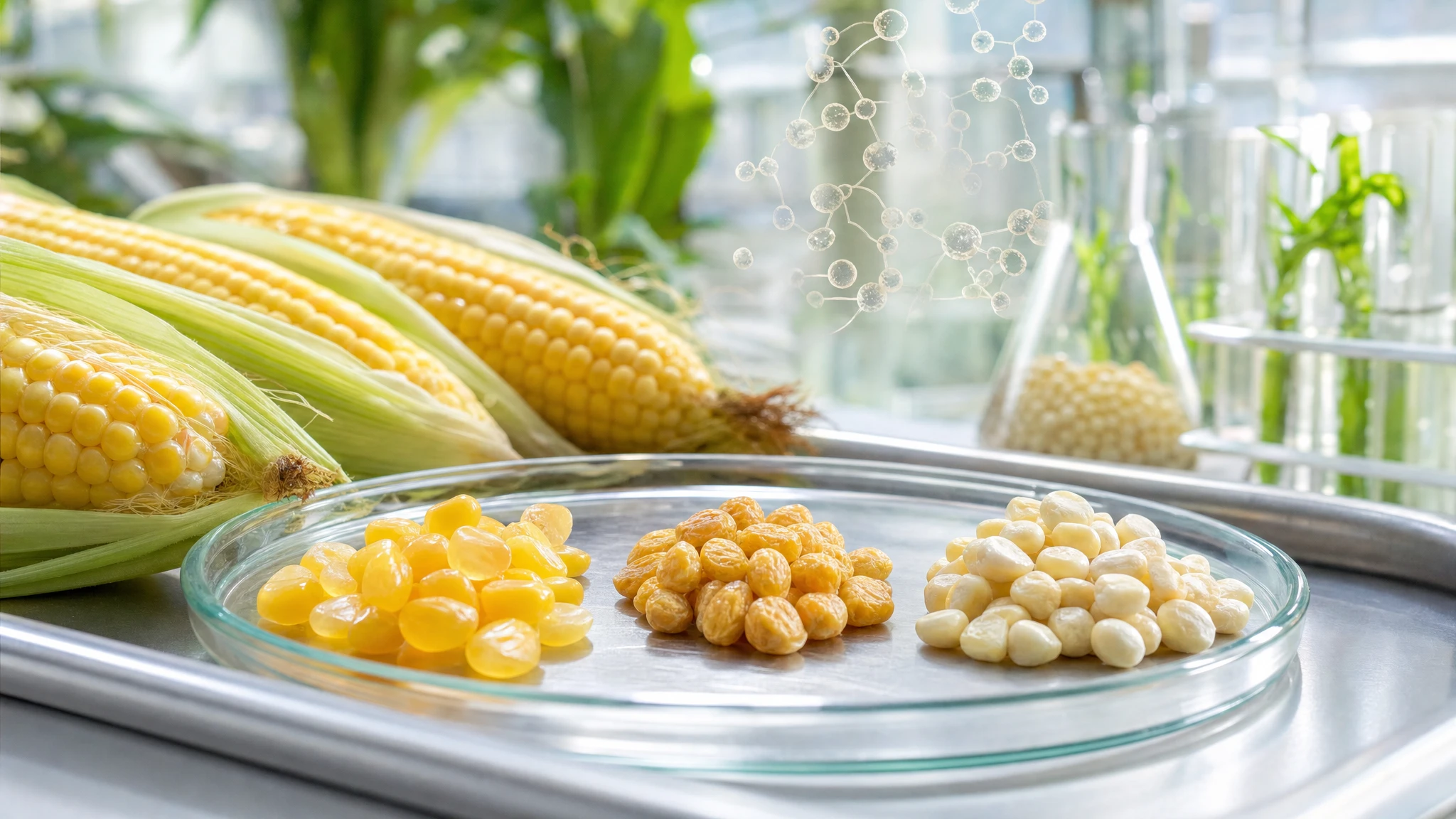
Carbohydrate concentration in sugary-1, sugar-enhanced, and shrunken sweet corn kernels - Review of the evidence
The analyzed study compares carbohydrates in three types of sweet corn, but the full text or abstract is not available in the provided material. Therefore, based on the title, it only asserts an interest in differences between genotypes. Independent studies confirm genetic mechanisms that can increase sugars, not the direct quantitative comparison with teosinte.
- Published 09/11/2026
- Updated 11/11/2026
- Article history
ABSTRACT
The analyzed study concerns the carbohydrate concentration in the kernels of three types of sweet corn. Since neither the full text nor the abstract of the publication is available in the provided material, it is not possible to precisely describe the sample, methods, numerical results, or statistical comparison. However, the title indicates an interest in the differences in sugars and starch between sweet corn genotypes.
In the section "The Choice to Live in Health or Illness" by Dr. A. Colonnese and R. Panzironi, the study is cited to support the idea that agricultural selection can favor corn with a higher sugar content compared to teosinte. Independent evidence confirms that mutations and sweet corn breeding programs alter the distribution of sugars and starch in the kernels. However, they do not confirm the specific claim of a sugar content up to four times higher than that of teosinte. The most prudent conclusion is therefore that the correspondence exists on a mechanistic and agronomic level, but that the quantitative comparison reported in the book requires a direct source.
Analyzed study
Kernel Carbohydrates Concentration in Sugary-1, Sugary Enhanced and Shrunken Sweet Corn Kernels
The research question derived from the title is whether the carbohydrate concentration in the caryopses—that is, the botanically mature kernels of corn—differs between sugary-1 sweet corn, sugar-enhanced corn, and shrunken corn. This question is relevant to the section "The Choice to Live in Health or Illness" by Dr. A. Colonnese and R. Panzironi, as it concerns how specific cultivated varieties can have a different composition of sugars and starch.
However, the title does not allow us to determine whether samples of teosinte, the wild ancestor of corn, were included, nor does it allow us to verify the quantitative data reported in the book. The study can be linked to the part of the narrative concerning the variability of carbohydrates in selected sweet corn; based on the available material, it cannot, on its own, prove that sweet corn contains up to four times the sugar of teosinte.
Materials and methods of the original study
The source of the text is indicated as unavailable, and the field containing the publication text is empty. Consequently, the experimental design, number of varieties or replicates, location and period of cultivation, harvest stage, analytical techniques, units of measurement, comparison group, statistical analyses, and inclusion criteria are not reported in the available material.
From the title alone, it can be inferred that the publication examines three categories of sweet corn: sugary-1, sugar-enhanced, and shrunken. It is not possible to verify whether these categories corresponded to individual lines, commercial hybrids, or groups of varieties, nor whether teosinte was present as a control.
Results
The available material does not report numerical results from the original publication. Therefore, absolute or percentage values of sugars, starch, or other carbohydrates, differences between groups, confidence intervals, statistical probability values, or measures of variability are not available.
The only verifiable element from the title is that the study focused on carbohydrate concentration in different sweet corn genotypes. This is compatible with a possible interest in the different distribution between soluble sugars and starch, but it does not allow for a precise quantitative result to be attributed to the research. In particular, it does not allow us to confirm that one of the examined genotypes had a sugar content four times higher than that of teosinte.
Interpretation
In simple terms, the sweeter taste of some corn cobs is due to the fact that a larger portion of carbohydrates in the kernel remains as sugars, rather than being converted into starch. Starch is the primary form in which many plants store energy; soluble sugars contribute more to the perception of sweetness when corn is harvested young.
The publication subject to the Evidence Review therefore appears consistent with the part of the narrative regarding the compositional differences of sweet corn. However, the specific passage that the book attributes to it also includes an evolutionary and quantitative comparison with teosinte. This comparison cannot be verified because neither the text nor the abstract of the study are available, and the title does not mention teosinte. Independent evidence supports the genetic mechanism that modifies sugars and starch, but it does not authorize the automatic transfer of a numerical value from one type of corn to all cultivated varieties or to the comparison with its wild ancestor.
Independent supporting evidence
Initial confirmation of the mechanism comes from a molecular study on the sugary1 gene. In corn kernels, mutations of this gene have been associated with an increase in sucrose, a reduction in amylopectin—a branched component of starch—and the accumulation of phytoglycogen, a soluble polysaccharide. The work therefore clarifies why a genetic modification can shift the kernel's composition toward a higher sugar content. This is a mechanistic confirmation, not a comparison between sweet corn and teosinte [1].
A genomic and population analysis of modern sweet corn has further shown that its recent evolution includes genetic regions subject to selection and candidates associated with the composition of the endosperm, the nutrient-rich part of the kernel, and a higher sugar content. The study analyzed genetic relationships between teosinte, traditional varieties, modern sweet corn, and grain corn. It therefore argues that selection and varietal improvement have contributed to distinguishing modern sweet corn, but it does not measure a four-to-one ratio between the sugars in sweet corn and those in teosinte [2].
An agronomic study on 60 hybrids derived from near-isogenic lines—that is, lines very similar to each other except for specific genetic variants—found differences in total sugars, sucrose, glucose, fructose, polysaccharides, and starch between endosperm types and harvest dates. The result reinforces the idea that genotype and maturation influence the kernel's composition. It also shows an important limitation: there is no single sugar quantity representative of all sweet corn, because the value changes with the genetic background and the time of harvest [3].
Conflicting evidence
No directly conflicting evidence of sufficient relevance has been identified; this does not prove the absence of contrary results. The main point of attention is that the available research documents differences between maize genotypes and their genetic mechanisms, rather than a direct and replicated measurement of the specific comparison between sweet corn and teosinte indicated in the book's paragraph.
Furthermore, data on near-isogenic hybrids show that the content of sugars, starch, and other carbohydrates varies with the genetic type and the harvest date [3]. This heterogeneity does not contradict the fact that some selections may produce sweeter kernels, but it makes a single quantitative generalization for all sweet corn varieties overly simplistic.
Summary table of evidence
The table distinguishes the publication under review from the independent research used to evaluate the book's passage.
| Reference | Study type | Population or model | Main result | Direction of evidence | Strength of evidence |
|---|---|---|---|---|---|
| Original study | Agronomic study; text not available | Three categories of sweet corn derivable from the title | The title indicates a comparison of carbohydrate concentration; results and methods not reported in the available material | biologically consistent evidence | preliminary |
| [1] | Molecular and genetic | Corn kernels with sugary1 gene mutations | sugary1 mutations increase sucrose and reduce amylopectin | direct confirmation | moderate |
| [2] | Population genomic | 5,381 teosinte and corn genotypes | Modern sweet corn shows signs of selection in regions associated with endosperm composition and higher sugar content | indirect confirmation | moderate |
| [3] | Experimental agronomic | 60 corn hybrids with different endosperm types | Sugars and carbohydrates vary between genotypes and harvest dates | biologically consistent evidence | moderate |
Confirmation of the evidence
Claim in the book
In the section of "The Choice to Live in Health or Illness" by Dr. A. Colonnese and R. Panzironi, it is stated that agricultural selection has favored plants with higher starch accumulation and that sweet corn can contain up to four times the sugar of teosinte. The statement links crop selection to a change in the carbohydrate composition of the kernel.
Genetic and varietal selection → alteration of starch synthesis in the endosperm → higher proportion of sugars in the kernel of some sweet corn varieties → differences compared to non-sweet or ancestral genotypes
The publication subject to the Evidence Review was used in the book to support the following passage: selected sweet corn may have a different carbohydrate composition than other types of corn, with variations in the proportion of sugars and starch in the kernels.
The correspondence with the paragraph from “The Choice to Live in Health or Illness” by Dr. A. Colonnese and R. Panzironi therefore concerns the principle according to which the genetic selection of corn can modify the fate of carbohydrates in the kernel. This mechanism is directly supported by experiments on the sugary1 gene: when this gene is mutated, sucrose increases and a component of starch decreases [1]. Genomic analyses place these characteristics in the context of the evolution and improvement of modern sweet corn, identifying selection signals linked to endosperm composition and a higher sugar content [2]. Finally, experiments on hybrids confirm that the direction and magnitude of the differences depend on the genotype and the harvesting stage [3].
However, the original publication cannot be considered verifiable proof of the “up to four times” quantitative comparison with teosinte, because the material provided does not contain the text or the abstract, and the title does not indicate an analysis of teosinte. Independent literature therefore confirms the chain of genetic selection → modification of starch and sugars, but leaves the specific numerical value cited in the book unproven in this Review of evidence.
Overall level of confirmation
INDIRECT CONFIRMATION
The biological link between the selection of sweet corn and the higher presence of sugars in specific genotypes is well supported by molecular, genomic, and agronomic evidence. The confirmation remains indirect due to the comparison with teosinte and the quantitative value reported in the book, which cannot be verified in the original study available.
Conclusions
Available evidence supports that the genetic improvement of sweet corn can modify the ratio between sugars and starch in the kernels. The mechanism is well-supported for mutations that reduce or alter starch synthesis, while actual differences depend on the variety and maturity. A precise comparison with teosinte and the claim of a content up to four times higher require direct validation with verifiable comparative data.
Overall assessment
The narrative regarding the possibility that the selection of sweet corn increases sugar content is fairly well supported at a mechanistic and agronomic level. The connection with the book's paragraph is consistent, but the quantitative data regarding teosinte remains unverified in the original study material and requires direct confirmation.
References
[1] Characterization of the maize gene sugary1, a determinant of starch composition in kernels.
[2] Genome assembly and population genomic analysis provide insights into the evolution of modern sweet corn
[3] Genetic variation for endosperm carbohydrates and total soluble solids in shrunken2 , sugary1 , waxy1 , and wild‐type near‐isogenic corn lines across three harvest dates
Editorial note
Artificial Intelligence was used solely as a tool to support editorial and documentary work. All content, interpretations, bibliographic citations and conclusions have been verified, reviewed and approved by the author, who assumes full scientific responsibility for them.
The manuscript was also subject to independent peer review prior to publication.
To ensure maximum transparency, the article's complete history — including the dates of submission, review, acceptance and publication, as well as information on the peer review process — is available on the dedicated Article History page.