


Chronic increase in physical activity inhibits mTOR/S6K1 signaling in the fed state and reduces IRS-1 serine phosphorylation in rat skeletal muscle - Evidence review
In rats, nine weeks of spontaneous activity reduced the activation of mTOR, S6K1, and IRS-1 in muscle, while increasing an indicator of oxidative capacity. The result supports a possible rebalancing of insulin feedback, but does not demonstrate causality or clinical benefits in humans. Independent studies show contextual confirmation, but also model dependency.
- Published 18/11/2026
- Updated 18/11/2026
- Article history
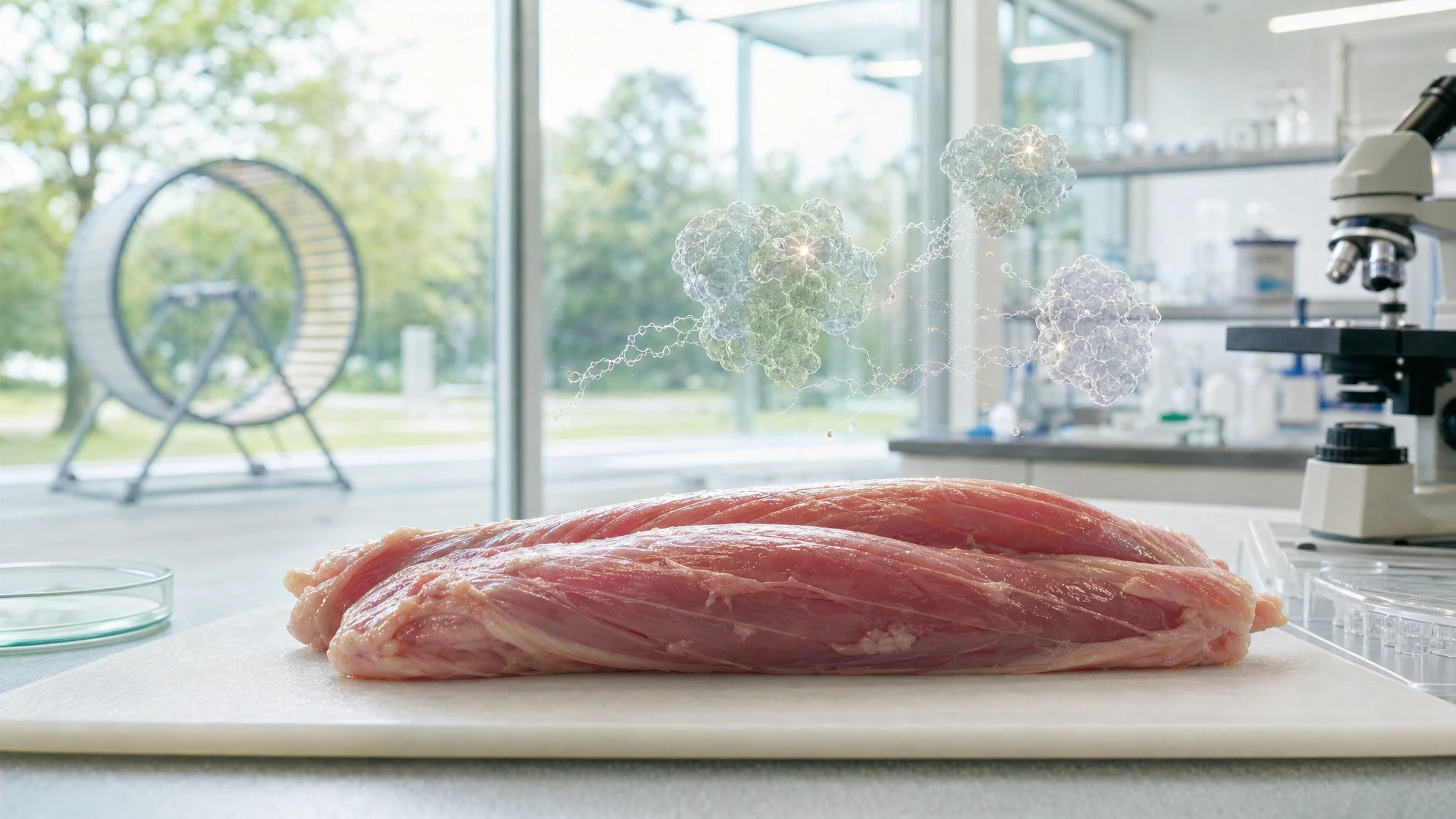
ABSTRACT
The analyzed study evaluated whether a chronic increase in spontaneous physical activity modifies a molecular chain in rat skeletal muscle that can reduce the response to insulin: mTOR, S6K1, and IRS-1. After nine weeks with free access to a running wheel, active rats showed lower phosphorylation—that is, lower regulatory activation—of mTOR, S6K1, and IRS-1 compared to sedentary rats. Citrate synthase activity, an indicator of the muscle's capacity to produce energy through mitochondria, also increased.
In section 4.8 of "The Choice to Live in Health or Illness" by Dr. A. Colonnese and R. Panzironi, the study contributes to the narrative that exercise can attenuate the negative mTOR-S6K1 feedback on IRS-1. Independent studies in rats fed a high-fat diet confirm a concomitant reduction of mTORC1, S6K1, and inhibitory IRS-1 phosphorylation following training. However, other experiments show that improvements in insulin sensitivity can occur even without a basal reduction in mTOR/S6K1. The conclusion is therefore mechanistically plausible and moderately supported in animal models, but not proven as a universal explanation in humans.
Analyzed study
A chronic increase in physical activity inhibits fed-state mTOR/S6K1 signaling and reduces IRS-1 serine phosphorylation in rat skeletal muscle
DOI: 10.1139/h07-149
PMID: 18347658
PMCID: PMC2706125
The research question was whether prolonged increased physical activity could reduce the activity of the mTOR/S6K1 pathway in skeletal muscle and, consequently, the phosphorylation of serine residues on IRS-1. IRS-1 (insulin receptor substrate 1) is a protein that helps transmit the insulin signal inside the cell. When some of its serine sites are persistently phosphorylated, signal transmission can become less efficient.
The relevance to paragraph 4.8 of "The Choice to Live in Health or Illness" by Dr. A. Colonnese and R. Panzironi is specific: the study examines the segment physical activity → reduced mTOR/S6K1 signaling → reduced serine phosphorylation of IRS-1. It does not directly evaluate insulin sensitivity with a functional test, nor does it demonstrate that the reduction in IRS-1 phosphorylation is the cause of the observed metabolic benefits. Instead, it documents a molecular change consistent with the attenuation of a negative feedback loop on the insulin pathway.
Materials and methods of the original study
The study compared sedentary male Sprague-Dawley rats with rats that had free access to a running wheel for nine weeks. The animals were studied in the fed state, meaning without a prior fast as reported in the available material. The soleus muscle, a leg muscle rich in oxidative fibers suitable for using oxygen to produce energy, was harvested.
Using immunoblotting (a technique that measures the presence and modification state of specific proteins), mTOR, S6K1, IRS-1, and AKT, also known as protein kinase B, were evaluated. Citrate synthase activity in the muscle and plasma concentrations of insulin and glucose were also measured. The total sample size, inclusion and exclusion criteria, randomization procedures, distances covered, predefined endpoints, and full details of the statistical analyses are not reported in the available material, which consists only of the abstract.
Results
Compared to sedentary rats, physically active ones showed a significant reduction in the phosphorylation of mTOR at the Ser2448 site, S6K1 at the Thr389 site, and IRS-1 at the Ser636-639 sites. Simply put, in the muscle of active rats, some signals that may contribute to the inhibition of IRS-1 were less active. The abstract indicates statistical significance but does not report fully readable P-values, percentage magnitudes of the reductions, or confidence intervals.
The total amount of the main proteins in the mTOR pathway did not change. This suggests that the observed difference primarily concerned their activation state rather than their abundance. Citrate synthase activity and the total amount of SKAR, a protein linked to S6K1 signaling, were instead higher in active rats. No differences were reported for the phosphorylation or total amount of AKT.
The result most relevant to the book's narrative is therefore the parallel reduction in phosphorylated mTOR, S6K1, and IRS-1. However, since no selective experimental blockade of mTOR or S6K1 was performed, the study does not prove that the lower phosphorylation of IRS-1 was caused exclusively by the reduction in mTOR/S6K1.
Interpretation
The most immediate biological significance is that prolonged physical activity can alter how muscle manages signals related to energy and nutrient availability. mTORC1 (mammalian target of rapamycin complex 1) and S6K1 are normally involved in regulating growth and protein synthesis. If their activation is persistent, they can increase certain IRS-1 phosphorylations that reduce the efficiency of insulin signaling.
The analyzed study is consistent with the hypothesis that increased physical activity attenuates this molecular brake: less mTOR and S6K1 phosphorylation was accompanied by less IRS-1 phosphorylation at the Ser636-639 sites. The increase in citrate synthase is compatible with an oxidative adaptation of the muscle. However, the relationship remains associative within the experimental model: active rats also differed from sedentary ones in terms of overall activity and body mass, and the design does not separate these factors.
For the book section, the segment that is effectively supported is therefore the attenuation, in rat muscle, of the mTOR/S6K1/IRS-1 sequence following chronic physical activity. Subsequent greater activation of PI3K or AKT, or a clinical improvement in insulin resistance in humans, is not directly demonstrated.
Independent supporting evidence
Confirmation particularly close to the book's narrative comes from an independent experiment in rats fed a high-fat diet. After eight weeks on the diet, skeletal muscle showed increased mTORC1 formation, S6K1 phosphorylation at Thr389, and inhibitory IRS-1 phosphorylation at Ser636/639, along with a reduced muscle glucose transport response to insulin. Four weeks of training normalized insulin-stimulated glucose transport and brought phosphorylated mTORC1, S6K1, and IRS-1 levels back toward control levels [1]. This study therefore confirms, in the context of diet-induced insulin resistance, the direction of the chain: physical activity → reduced mTORC1/S6K1 signaling → reduced IRS-1 phosphorylation. It remains a study on rats and does not definitively isolate which step is essential for the recovery of glucose transport.
A second experimental study evaluated the functional link between mTORC1, IRS-1, and insulin response in rats subjected to a single session of electrically induced muscle contractions, used as a model of resistance exercise. Six hours after stimulation, mTORC1 activation and IRS-1 phosphorylation at sites Ser612 and Ser632/635 increased; at the same time, reduced AKT activation by insulin was observed. Treatment with rapamycin, a pharmacological inhibitor of mTORC1, attenuated these phosphorylations and further increased insulin-stimulated glucose uptake in the muscle [2]. This result reinforces the pathway: mTORC1 → serine phosphorylation of IRS-1 → attenuation of insulin signaling. The limitation is significant: it concerns acute exercise, male rats, and a drug that is not equivalent to the normal physiology of prolonged training.
Taken together, the two independent studies do not prove that every benefit of exercise depends on mTOR/S6K1. However, they show that, in different rat models, the reduction of this signaling and of IRS-1 phosphorylation is biologically consistent with improved muscle glucose utilization in response to insulin [1,2].
Conflicting evidence
An independent experiment in rats fed a high-fat diet and subjected to six weeks of exercise found an improvement in glucose tolerance and insulin-stimulated 2-deoxyglucose uptake in the soleus and extensor digitorum longus muscles. However, exercise did not directly reduce basal phosphorylation of mTOR at Ser2448, S6K1 at Thr389, or AKT at Ser473 in the soleus; in the extensor digitorum longus, it even prevented the diet-induced reduction of S6K1 phosphorylation [3].
This evidence does not deny that exercise can reduce mTOR/S6K1 and IRS-1 phosphorylation in other contexts. However, it shows that the improvement in muscle insulin resistance can be dissociated from a uniform basal reduction of this pathway and may depend on the muscle type, training regimen, diet, and timing of the sampling. Consequently, the mechanism described in the original study is plausible but cannot be considered the sole explanation for the benefits of exercise.
Summary table of evidence
The table distinguishes the publication under review from independent evidence that confirms or defines the scope of the same biological narrative.
| Reference | Study type | Population or model | Main result | Direction of evidence | Strength of evidence |
|---|---|---|---|---|---|
| Original study | Experimental animal | Male Sprague-Dawley rats, spontaneous wheel running for nine weeks | Reduction in mTOR, S6K1, and IRS-1 phosphorylation; increased citrate synthase activity | direct confirmation | preliminary |
| [1] | Animal and cellular | Rats on a high-fat diet and L6 myotubes | Training: normalization of glucose transport, mTORC1, S6K1 Thr389, and IRS-1 Ser636/639 | direct confirmation | moderate |
| [2] | Experimental animal | Gastrocnemius muscle of male rats with electrically induced contractions | Inhibition of mTORC1 reduced IRS-1 phosphorylation and increased insulin-stimulated glucose uptake | indirect confirmation | moderate |
| [3] | Experimental animal | Sprague-Dawley rats on a high-fat diet with six weeks of exercise | Improved muscle insulin response without uniform basal reduction of mTOR/S6K1 | conflicting evidence | moderate |
Confirmation of the evidence
Claim in the book
In paragraph 4.8 of "The Choice to Live in Health or Illness" by Dr. A. Colonnese and R. Panzironi, the relevant statement is that physical activity can help rebalance the mTOR-S6K1 pathway and reduce the inhibitory phosphorylation of IRS-1, in addition to the increased glucose consumption due to muscle contraction.
Chronic physical activity → reduced mTOR/S6K1 activation → reduced serine phosphorylation of IRS-1 → reduced negative feedback on insulin signaling
The publication subject to the Evidence Review was used in the book to support the following passage: after nine weeks of spontaneous physical activity, rat skeletal muscle shows a reduction in the phosphorylation of mTOR, S6K1, and IRS-1, consistent with the attenuation of negative feedback on insulin signaling.
The correspondence between the study and the paragraph is direct at the molecular level: the research discussed in the article measures exactly the three nodes of the indicated chain—mTOR, S6K1, and IRS-1—and observes a coordinated reduction in their phosphorylation in the muscle of physically active rats. However, the study does not demonstrate the entire sequence described in the chapter, as it does not directly measure PI3K, GLUT4 transport, or insulin sensitivity via a clamp.
Independent evidence strengthens the narrative. In rats with insulin resistance induced by a high-fat diet, training reduced the activation of mTORC1 and S6K1, decreased the phosphorylation of IRS-1, and normalized insulin-induced glucose transport [1]. A second model showed that pharmacological inhibition of mTORC1 reduces IRS-1 phosphorylation and further improves insulin-stimulated glucose uptake following muscle contractions [2]. These data support a convergent chain, but another study documented an improvement in insulin sensitivity without a uniform basal reduction of mTOR/S6K1 [3].
Overall level of confirmation
MECHANISTIC CONFIRMATION
The passage is well-supported in rat models and by experimental interventions linking mTORC1, IRS-1, and the insulin response. The demonstration remains primarily molecular and animal-based; furthermore, the effect varies depending on the muscle and the metabolic context. It is therefore not possible to extend the mechanism as a single or directly proven explanation in humans.
Conclusions
The analyzed study documents that increased spontaneous physical activity, maintained for nine weeks, is associated with a reduction in the phosphorylation of mTOR, S6K1, and IRS-1 in rat skeletal muscle. This result specifically supports the passage in the book regarding the possible rebalancing of the mTOR-S6K1 feedback on IRS-1.
Independent evidence confirms that, in some models of insulin resistance, training or inhibition of mTORC1 can reduce IRS-1 phosphorylations associated with less efficient insulin signaling. The confirmation is primarily mechanistic and animal-based. Discordant results indicate that exercise can also improve the insulin response through different pathways or without uniformly reducing basal mTOR/S6K1 activity. The mechanism is therefore well-founded as a possible component of the muscle response to exercise, but it requires further validation in humans.
Overall assessment
The narrative is confirmed at a mechanistic level: physical activity, mTOR/S6K1, and IRS-1 phosphorylation show a consistent direction across multiple animal models. The connection to the book's section is precise, but the robustness remains moderate because the mechanism is not uniform across different muscles and has not been proven as a sole cause in humans.
References
[1] Lipid-induced mTOR activation in rat skeletal muscle reversed by exercise and 5′-aminoimidazole-4-carboxamide-1-b-d-ribofuranoside
[2] Enhanced skeletal muscle insulin sensitivity after acute resistance-type exercise is upregulated by rapamycin-sensitive mTOR complex 1 inhibition
Editorial note
Artificial Intelligence was used solely as a tool to support editorial and documentary work. All content, interpretations, bibliographic citations and conclusions have been verified, reviewed and approved by the author, who assumes full scientific responsibility for them.
The manuscript was also subject to independent peer review prior to publication.
To ensure maximum transparency, the article's complete history — including the dates of submission, review, acceptance and publication, as well as information on the peer review process — is available on the dedicated Article History page.