


Climate change and overfishing increase a neurotoxic substance in marine predators - Evidence review
The study modeled increases in methylmercury in marine predators: up to 23% in Atlantic cod following dietary changes linked to overfishing and 56% in bluefin tuna associated with warming. Independent confirmations support bioaccumulation and the role of temperature, but the estimates remain dependent on models and the ecological context.
- Published 09/11/2026
- Updated 11/11/2026
- Article history
ABSTRACT
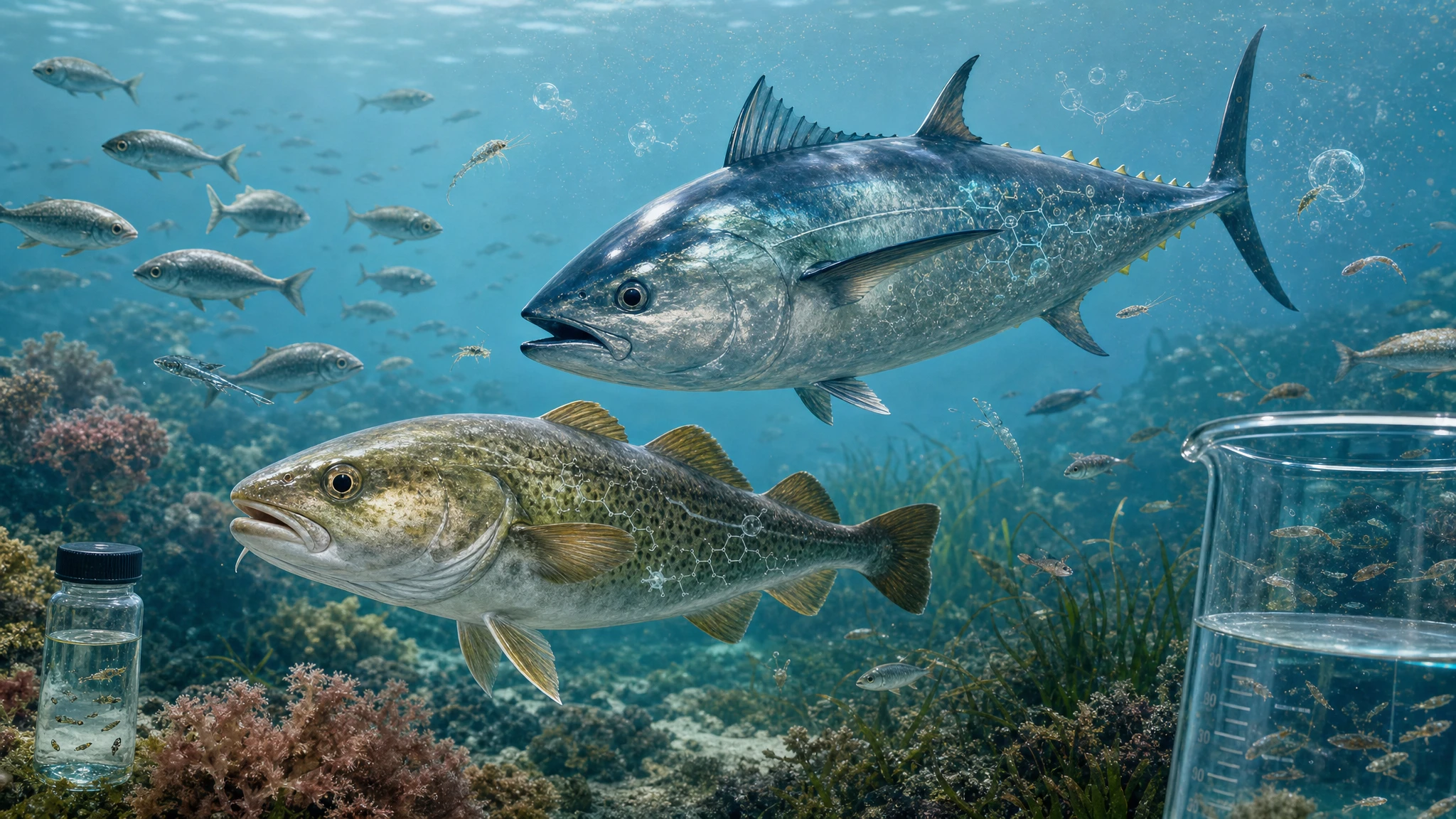
The analyzed study examined how changes in marine ecosystems can affect methylmercury (MeHg, a form of mercury that can damage the nervous system) in predatory fish consumed by humans. Using over thirty years of data and ecosystem models, the authors estimated an increase of up to 23% in Atlantic cod between the 1970s and the 2000s, associated with dietary changes resulting from overfishing. They also estimated a 56% increase in Atlantic bluefin tuna in relation to warming seawater.
In the section "The Choice to Live in Health or Illness" by Dr. A. Colonnese and R. Panzironi, the publication contributes primarily to the narrative that methylmercury concentrates in fish along the food chain and can be influenced by fishing and climate change. However, the claim regarding the 66 countries is not reported in the available abstract of the analyzed study. Independent evidence confirms the bioaccumulation of mercury in aquatic food webs, the significance of exposure from seafood in certain populations, and the possibility that higher temperatures increase MeHg in specific experimental models. Important limitations remain: effects vary between species, ecosystems, diet, and environmental conditions, and ecological estimates do not directly measure individual clinical risk.
Analyzed study
Climate change and overfishing increase neurotoxicant in marine predators
DOI: 10.1038/s41586-019-1468-9
PMID: 31391584
The research question was whether changes in marine ecosystems, particularly overfishing and warming waters, could alter the concentration of methylmercury in marine predators intended for human consumption. The hypothesis was that these changes could counteract, or even outweigh, the reduction in mercury pollution achieved by decreasing environmental emissions.
The work is relevant to the section "The Choice to Live in Health or Illness" by Dr. A. Colonnese and R. Panzironi because it documents the ecological segment of the narrative: methylmercury does not depend solely on the amount present in the water, but also on the fish's diet and temperature, factors that can change when marine food webs are altered.
The study can therefore support the idea that fishing and climate can influence MeHg in predatory fish. However, it cannot prove that every fish consumer exceeds a safety threshold, nor can it quantify the risk to fetal development in every country. In particular, the data reported in the book regarding 66 countries does not appear in the available abstract of the analyzed publication.
Materials and methods of the original study
Only the abstract is available. The authors state that they used over thirty years of data and ecosystem modeling, which are mathematical tools that reconstruct the relationships between the environment, prey, predators, and contaminants. The model considered Atlantic cod and Atlantic bluefin tuna, two marine predators of dietary interest.
For cod, the analysis attributed part of the increase in MeHg to dietary changes triggered by overfishing. For bluefin tuna, the model estimated the effect of changes in seawater temperature. The abstract states that the estimate regarding tuna is consistent with observations from 2017.
The number of biological samples, the exact locations and years of collection, the data selection criteria, the model formulas, the detailed statistical analyses, the uncertainty intervals, and the validation procedures are not reported in the available material. Furthermore, no clinical follow-up in humans or direct measurements of individual dietary exposure are provided.
Results
The result most directly linked to the book's section concerns Atlantic cod. The model estimated that MeHg concentrations increased by up to 23% between the 1970s and the 2000s. According to the authors, this increase was associated with changes in the cod's diet that began following overfishing. In simple terms, if a predator changes the prey it consumes, the amount of contaminant it accumulates can also change.
For Atlantic bluefin tuna, the model estimated a 56% increase in MeHg in tissues between the lowest sea temperature point, recorded in 1969, and more recent peak levels. This estimated growth was greater than the 22% reduction attributed to lower MeHg concentrations in seawater in the late 1990s and 2000s. The significance of this comparison is that warming and fish physiology could increase accumulation even when the environmental availability of mercury decreases.
The abstract also notes that in the United States, 82% of the population's overall exposure to MeHg comes from the consumption of marine seafood, and about 40% comes from fresh and canned tuna. These data describe the dietary relevance of the exposure but do not constitute an individual measure of neurological damage.
Interpretation
The biological message is that methylmercury does not behave like a static contaminant. It can increase along the food web, and its concentration in fish depends both on what they eat and how much they consume to support their metabolism. Warmer water can increase the energy requirements of some fish and, consequently, their consumption of prey; if this prey contains MeHg, accumulation in tissues can increase.
The segment specifically documented by the analyzed study is therefore: alteration of the trophic web or temperature increase → change in the predator's food intake and metabolism → estimated increase of MeHg in tissues. This is an ecotoxicological chain, not a clinical demonstration in humans.
The data on cod is derived from a reconstruction based on historical data and a model; the data on tuna is a model-based prediction compared with 2017 observations. The results are consistent with a possible causal role of fishing and warming in modifying MeHg in marine predators, but they do not allow for the automatic extension of these percentages to all species, all oceans, or every future scenario.
Independent confirming evidence
A global systematic review collected 164 studies conducted in 43 countries on biomarkers of MeHg exposure in women and children who consumed seafood. Biomarkers are biological measures, such as mercury in blood or hair, used to estimate exposure. The authors found that, in various contexts of fish or marine mammal consumption, average or high values could reach or exceed the FAO/WHO reference. This confirms the part of the narrative stating that aquatic food is an important route of exposure and that some populations may be in conditions of greater vulnerability. However, it does not confirm the specific number of 66 countries and does not demonstrate that all fish consumption leads to fetal harm [1].
A meta-analysis of 69 studies, covering 205 aquatic food webs worldwide, showed that mercury tends to increase as it moves toward higher trophic levels. The trophic level indicates the position in the food chain: a predator that consumes other animals generally occupies a higher level. For MeHg, the average trophic magnification slope was positive, equal to 0.24, although it was highly variable across ecosystems. This independent evidence confirms the upstream part of the book's narrative: predatory fish can accumulate greater amounts of mercury compared to organisms located lower in the food web [2].
An experimental and field study on estuarine killifish, small coastal fish, provided mechanistic confirmation of the possible effect of temperature. In the two 30-day laboratory experiments, conducted at 15, 21, and 27 °C with a controlled diet containing MeHg, fish exposed to the highest temperature showed higher MeHg concentrations; the main effect of temperature was statistically significant, with a P-value of less than 0.001. In the field data, temperature explained a significant portion of the MeHg variability in the fish. This does not prove the same increase in bluefin tuna, but it makes the hypothesis that warming could increase MeHg in certain fish and environments biologically consistent [3].
Conflicting evidence
A review of the epidemiological literature on low-dose MeHg exposure in humans found that the observed neurological outcomes can differ based on age, sex, timing of exposure, and the characteristics of the populations studied. The authors did not identify a uniform pattern for all health effects of low-level exposures. This does not contradict bioaccumulation in fish or the neurotoxic potential of MeHg, but it limits the inference that a higher environmental or dietary concentration automatically corresponds to predictable clinical harm in every individual [4].
There is also an important ecological limitation. Rising temperatures may promote the intake of the contaminant, but they can also accelerate the growth of certain organisms and dilute the contaminant within a larger body mass. Consequently, the direction and magnitude of the warming effect can change depending on the species, food availability, food web, and environment. No directly conflicting evidence sufficiently relevant to the specific historical outcome of Atlantic cod has been identified; this does not prove the absence of contrary results.
Summary table of evidence
The table distinguishes the study that is the subject of the review from the independent publications used to verify the steps of the narrative.
| Reference | Study type | Population or model | Main result | Direction of evidence | Strength of evidence |
|---|---|---|---|---|---|
| Original study | Time series and ecosystem modeling | Atlantic cod and Atlantic bluefin tuna | Estimated increase of up to 23% of MeHg in cod following trophic changes; estimated 56% increase in tuna associated with warming | direct confirmation | moderate |
| [1] | Systematic review | 164 studies in 43 countries on women and children exposed through seafood | In various contexts, average or elevated biomarkers reached or exceeded the FAO/WHO reference | indirect confirmation | moderate |
| [2] | Meta-analysis | 205 aquatic food webs from 69 studies | Mercury, including MeHg, increases on average toward higher trophic levels | biologically consistent evidence | high |
| [3] | Experimental and field study | Estuarine killifish in temperature-controlled experiments and coastal sites | Higher temperatures were associated with increased MeHg concentrations in fish | indirect confirmation | moderate |
| [4] | Epidemiological literature review | Human studies with low-dose MeHg exposure | Neurological effects at low exposure levels do not show a uniform pattern across populations and life stages | conflicting evidence | moderate |
Confirmation of the evidence
Claim in the book
In section 1.2.2 of “The Choice to Live in Health or Illness” by Dr. A. Colonnese and R. Panzironi, methylmercury is described as a neurotoxic substance that bioaccumulates along the food chain. The text further states that overfishing, by altering trophic chains, and ocean warming can increase its accumulation in predatory fish. The reference to 66 countries concerns exposure beyond thresholds considered safe for fetal development.
Mercury in the environment → transformation into methylmercury → bioaccumulation in the food web → predatory fish → changes in diet and temperature → variation of MeHg in tissues
The publication subject to the Evidence Review was used in the book to support the following passage: overfishing can alter the diet of marine predators and increase methylmercury in their tissues; water warming can, in turn, promote greater accumulation of methylmercury in some predatory fish.
The correspondence between the analyzed study and the section of “The Choice to Live in Health or Illness” by Dr. A. Colonnese and R. Panzironi is precise regarding the ecological segment of the food chain. The publication subject to the Evidence Review estimates an increase in MeHg in Atlantic cod following dietary changes associated with overfishing, and an increase in bluefin tuna associated with warming. The meta-analysis on aquatic food webs confirms the essential biological premise, namely the higher concentration of mercury at high trophic levels [2]. Furthermore, the study on killifish shows that an experimental increase in temperature can increase MeHg in fish tissues [3]. The global review on exposure confirms that seafood products are a relevant route of exposure in specific population groups [1].
However, the sentence regarding the 66 countries requires clarification. This data is not reported in the available abstract of the analyzed study, which does not present an estimate for 66 countries. The available independent review instead collects studies from 43 countries and indicates that exposure may exceed reference values in certain consumption contexts, without reproducing that specific number [1]. Furthermore, MeHg exposure alone does not allow for the prediction of an individual neurological effect, as outcomes at low doses are heterogeneous and depend on the context [4].
Overall level of confirmation
MODERATE CONFIRMATION
The transition regarding fishing, warming, and the variation of MeHg in predatory fish is supported by the original study and by independent evidence converging on trophic bioaccumulation and the potential effect of temperature. The confirmation remains moderate because many estimates are ecosystem-based or experimental and do not directly demonstrate individual clinical risk in humans.
Conclusions
The analyzed study pertinently supports the idea that methylmercury concentrations in predatory fish can be altered by ecological changes, including overfishing and water warming. This narrative is moderately supported by independent research on bioaccumulation in the food web and by experiments showing an increase in MeHg in fish exposed to higher temperatures. The data regarding the 66 countries is not documented in the available material of the original study and requires a specific source. The evidence does not authorize transforming environmental estimates into an automatic prediction of individual neurological damage, but it does justify attention to the variability of species, ecosystems, and consumption patterns.
Overall assessment
The ecological narrative is fairly well supported: methylmercury increases in food webs, and temperature or trophic changes can modify its accumulation in fish. The confirmation is moderate because the effects are context-dependent and the link to clinical outcomes in humans remains less direct.
References
[1] Global methylmercury exposure from seafood consumption and risk of developmental neurotoxicity: a systematic review
[3] Experimental and Natural Warming Elevates Mercury Concentrations in Estuarine Fish
[4] Evidence on the Human Health Effects of Low-Level Methylmercury Exposure
Editorial note
Artificial Intelligence was used solely as a tool to support editorial and documentary work. All content, interpretations, bibliographic citations and conclusions have been verified, reviewed and approved by the author, who assumes full scientific responsibility for them.
The manuscript was also subject to independent peer review prior to publication.
To ensure maximum transparency, the article's complete history — including the dates of submission, review, acceptance and publication, as well as information on the peer review process — is available on the dedicated Article History page.