


cPLA2 is phosphorylated and activated by MAP kinase - Evidence review
The original study shows that the phosphorylation of cPLA2a by MAP kinase increases enzymatic activity and that the Ser505Ala mutation reduces arachidonic acid release. Independent studies confirm this cellular step in experimental models, but indicate multifactorial regulation. It does not demonstrate the effects of chronic insulin in humans nor clinical inflammation.
- Published 23/11/2026
- Updated 23/11/2026
- Article history
ABSTRACT
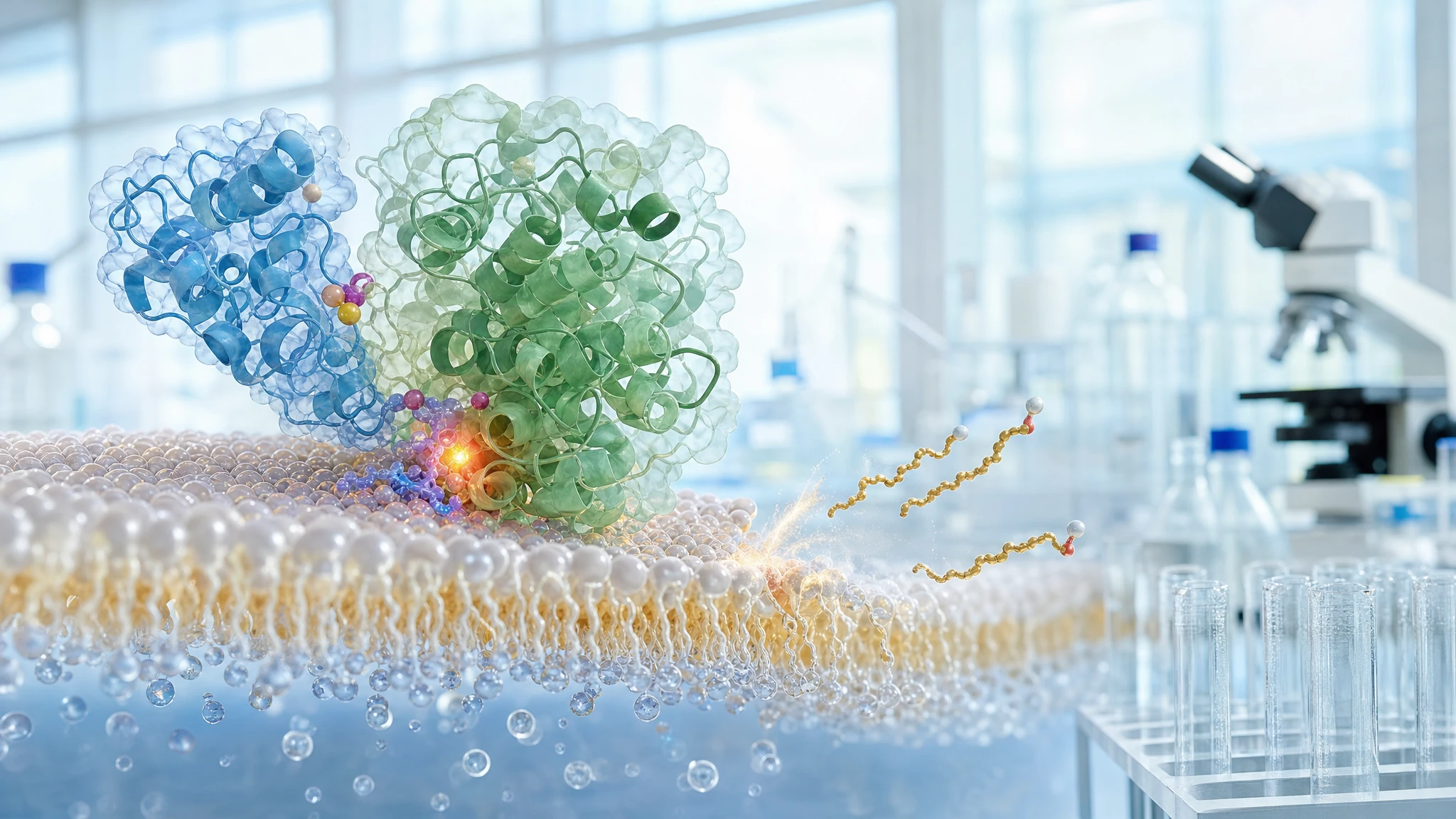
The analyzed study examined whether MAP kinase, a family of proteins that transmits signals from the outside to the inside of the cell, can activate cytosolic phospholipase A2 (cPLA2), an enzyme that releases arachidonic acid from membrane phospholipids. The authors observed that phosphorylation of the enzyme at serine 505 increases its activity and that a mutation preventing this modification almost completely reduces the release of arachidonic acid following cellular stimulation.
In "The Choice to Live in Health or Illness" by Dr. A. Colonnese and R. Panzironi, the publication contributes to the passage stating that the activation of the MAPK/ERK pathway can promote the activation of cPLA2a and the mobilization of arachidonic acid. Independent studies support the functional role of serine 505, the membrane, and intracellular calcium, but also show that the control of the enzyme depends on the stimulus and the cell type. The most prudent conclusion is therefore mechanistic: the MAP kinase–cPLA2–arachidonic acid link is well-documented in experimental models, while it does not, on its own, demonstrate an effect of chronic insulin or an inflammatory outcome in humans.
Analyzed study
The research question was whether MAP kinase could directly modify cPLA2 and whether this modification was important for the release of arachidonic acid. The hypothesis was biologically relevant because cPLA2 acts as an enzyme that makes arachidonic acid contained in cell membranes available; this lipid can then be used to produce various biologically active mediators, including some mediators of inflammation.
The relevance to the book's paragraph concerns a specific segment of the proposed chain: activation of a MAP kinase → phosphorylation of cPLA2 → increased enzyme activity → increased release of arachidonic acid. The publication did not directly evaluate insulin, chronic insulin exposure, systemic inflammation, or clinical outcomes in humans. It can therefore document a cellular mechanism, not the entire pathophysiological chain described in the paragraph.
Materials and methods of the original study
Only the abstract is available. The study combined biochemical and cellular experiments. The authors evaluated whether cPLA2 was a substrate for MAP kinase, meaning a protein that can be modified by this enzyme through phosphorylation—the addition of a phosphate group capable of altering its behavior. They then measured the enzymatic activity following phosphorylation and identified the main site of the modification: serine 505.
A mutated form of cPLA2 was also produced in which serine 505 was replaced with alanine, denoted as Ser-505→Ala. This substitution prevented phosphorylation of the site by MAP kinase. The authors then compared the release of arachidonate—the ionized form of arachidonic acid—in intact cells after stimulation with extracellular agonists. The number of experiments, the exact cell type, selection criteria, concentrations used, duration of incubations, specific statistical tests, and significance values are not reported in the available material.
Results
The key finding is that cPLA2 was identified as a substrate for MAP kinase. In simple terms, MAP kinase could add a phosphate group to cPLA2, and this modification increased the enzyme's catalytic activity—that is, its ability to facilitate the release of arachidonic acid from membrane phospholipids.
The identified site was serine 505. The authors noted that this site coincided with the main phosphorylation point observed in cells treated with phorbol ester, an experimental stimulant of cell signaling. When serine 505 was replaced with alanine, the mutated protein was no longer a substrate for MAP kinase. In intact cells, this mutation resulted in an absent or minimal increase in arachidonate release in response to agonists, compared to the enhancement observed with the non-mutated enzyme.
The abstract does not report absolute values, percentage reductions, sample sizes, confidence intervals, or P-values. It is therefore not possible to precisely quantify the magnitude of the effect. The data directly supporting the book's paragraph is directional and clear: preventing the phosphorylation of serine 505 strongly reduced the release of arachidonic acid induced by extracellular stimuli.
Interpretation
The biological significance of the result is that cPLA2 does not act simply because it is present in the cell: it can be made more efficient by intracellular signals. Phosphorylation of serine 505 represents one such regulation. Simply put, the MAP kinase signal can make cPLA2 better suited to reach or act on the membrane, where phospholipids containing arachidonic acid are present.
The pathway documented by the publication is therefore MAP kinase → phosphorylation of cPLA2 at serine 505 → increased enzyme activity and release of arachidonic acid. This is a causal demonstration in experimental models, because the mutation of the site altered the biological outcome. However, it does not prove that ERK is the only MAP kinase involved, that cPLA2 is regulated solely by phosphorylation, nor that chronic insulin signaling is the primary activator of the enzyme in all tissues.
The narrative of the paragraph indeed requires other steps: intracellular calcium promotes the transfer of cPLA2 to suitable membranes, and the overall response varies depending on the stimulus. For this reason, the original work precisely supports the link between phosphorylation and the mobilization of arachidonic acid, but it does not exhaust the regulation of cPLA2 nor its clinical consequences.
Independent supporting evidence
Independent confirmation particularly close to the original result came from experiments with human cPLA2 modified in HEK293 cells. The Ser505Ala substitution reduced the enzyme's affinity for membranes containing phosphatidylcholine, especially at low calcium concentrations. After stimulation with ionomycin, cells expressing normal cPLA2 or a variant mimicking phosphorylation released arachidonic acid, whereas the Ser505Ala variant showed little release and did not adequately reach the perinuclear region. This study confirms that serine 505 phosphorylation promotes stable interaction with the membrane and supports the pathway: phosphorylation → access to phospholipids → arachidonic acid release. It is solid mechanistic evidence, but it was obtained in transfected cells and not in humans [1].
A second study examined rabbit vascular smooth muscle cells stimulated with noradrenaline. Stimulation first increased cPLA2 phosphorylation at serine 515 and subsequently ERK1/2 activation and phosphorylation at serine 505. The ERK1/2 inhibitor reduced phosphorylation at serine 505; furthermore, the combined Ser515Ala/Ser505Ala mutation blocked both cPLA2 phosphorylation and arachidonic acid release. The work confirms that the ERK component can contribute to serine 505 phosphorylation, but it also shows that an upstream signal linked to calcium and CaMKII kinase participates in the sequence. The confirmation is direct for the vascular model studied, but not automatically transferable to other tissues [2].
A third study, conducted in human HEK cells, showed that the Ser505Ala variant reached internal membranes more slowly after an increase in intracellular calcium or levels of phosphatidylinositol 4,5-bisphosphate, a regulatory membrane lipid. In four experiments, arachidonic acid release by the Ser505Ala variant was lower than that of the normal protein under various stimulation conditions, with differences reported as statistically significant. This confirms the paragraph's premise that calcium, membrane, and phosphorylation work together: calcium does not necessarily replace serine 505 phosphorylation, but acts in concert with it to allow for effective mobilization of arachidonic acid [3].
Conflicting evidence
A study on murine peritoneal macrophages confirmed that cPLA2 is necessary for the release of arachidonic acid and the production of eicosanoids, which are lipid mediators derived from arachidonic acid. However, it also showed that the relationship between ERK, serine 505 phosphorylation, and arachidonic acid release is not linear under all conditions. ERK and p38 contributed to serine 505 phosphorylation, but ERK inhibition reduced the release induced by certain stimuli even when serine 505 phosphorylation remained unchanged. Conversely, ERK inhibition did not reduce the release caused by the calcium ionophore alone [4].
This evidence does not negate the results of the original study. Rather, it indicates that, in macrophages and for specific agonists, ERK can influence the release of arachidonic acid through additional mechanisms as well, likely including transcriptional regulation and new protein synthesis. The limitation of the chain proposed in the book is therefore the presentation of MAPK/ERK as the sole or universally primary activator: the regulation of cPLA2 depends on the cell type, the stimulus, calcium, and additional signaling pathways.
Summary table of evidence
The table summarizes the contribution of the original study and independent publications to the specific MAP kinase–cPLA2–arachidonic acid release chain.
| Reference | Study type | Population or model | Main result | Direction of evidence | Strength of evidence |
|---|---|---|---|---|---|
| Original study | Cellular and biochemical | cPLA2 protein, Ser-505 site mutagenesis, and intact cells; full details not available in the abstract | Phosphorylation by MAP kinase increases cPLA2 activity; the Ser-505→Ala mutation drastically reduces induced arachidonate release. | direct confirmation | moderate |
| [1] | Cellular, biochemical, and mutagenesis | Human cPLA2 and transfected HEK293 cells | Ser505Ala reduces interaction with the membrane, cellular translocation, and arachidonic acid release; Ser505Glu preserves function. | direct confirmation | moderate |
| [2] | Cellular and mutagenesis | Rabbit vascular smooth muscle cells | ERK1/2 phosphorylation at serine 505 contributes to arachidonic acid release; the double mutation Ser515Ala/Ser505Ala blocks it. | direct confirmation | moderate |
| [3] | Cellular and imaging | Stably transfected human HEK cells | Ser505Ala delays translocation to internal membranes and reduces arachidonic acid release following stimuli involving calcium or membrane lipids. | indirect confirmation | moderate |
| [4] | Cellular and genetic | Murine peritoneal macrophages, including cPLA2-deficient macrophages | ERK contributes to arachidonic acid release, but some effects persist without changes in Ser505 phosphorylation and are stimulus-dependent. | discordant evidence | moderate |
Confirmation of the evidence
Claim in the book
In section 5.4.1 of “The Choice to Live in Health or Illness” by Dr. A. Colonnese and R. Panzironi, the relevant statement is that the phosphorylation of cPLA2a by MAPKs increases the enzyme's activity and that a mutation capable of preventing this modification results in a drastic reduction in the release of arachidonic acid following extracellular stimulation. The section adds that intracellular calcium and phosphorylation cooperate in the transfer of the enzyme toward phospholipid-rich membranes containing arachidonic acid.
MAPK/ERK signaling → phosphorylation of cPLA2a at serine 505 → increased membrane interaction and enzymatic activity → release of arachidonic acid → availability for lipid mediators
The publication subject to the Evidence Review was used in the book to support the following passage: MAP kinase phosphorylates cPLA2 at serine 505, increasing the enzyme's activity; if serine 505 is replaced with alanine and cannot be phosphorylated, the release of arachidonic acid in response to agonists is almost absent or strongly reduced.
The correspondence between the original study and the paragraph is direct for the serine 505 phosphorylation → arachidonic acid release segment. Independent literature reinforces this segment: the Ser505Ala mutation reduces the stability of the interaction with the membrane, translocation, and the release of arachidonic acid, while a variant that mimics phosphorylation retains these functions more effectively [1]. In vascular smooth muscle cells, ERK1/2 contributes to the phosphorylation of serine 505, and the joint perturbation of the Ser515 and Ser505 sites blocks the release of arachidonic acid [2]. In human cells, serine 505 is also necessary for efficient translocation to internal membranes in response to calcium and regulatory lipids [3].
However, the chain should not be interpreted as exclusive or universal. In macrophages, ERK can influence the release of arachidonic acid through mechanisms other than just serine 505 phosphorylation, and the effect of ERK inhibition varies according to the stimulus used [4]. The original publication does not demonstrate that chronic insulin is the main activator of cPLA2a, nor does it directly document the production of inflammatory mediators or clinical consequences in humans. Instead, it demonstrates an essential molecular step that is biologically consistent with the mobilization of arachidonic acid.
Overall level of confirmation
MECHANISTIC CONFIRMATION
The link between serine 505 phosphorylation of cPLA2 and increased arachidonic acid mobilization is supported by multiple independent studies involving mutagenesis, translocation measurements, and lipid release analysis. The evidence remains predominantly cellular or animal-based and dependent on the experimental context; therefore, a direct demonstration of the entire insulin and inflammation chain in humans is still lacking.
Conclusions
Overall assessment
The mechanism linking serine 505 phosphorylation of cPLA2 to arachidonic acid mobilization is fairly well supported by independent experiments. The consistency with the specific passage in the book is high, but the confirmation remains primarily mechanistic: calcium, membrane, stimulus, and cell type all modify the response.
References
[2] cPLA2 phosphorylation at serine-515 and serine-505 is required for arachidonic acid release in vascular smooth muscle cells
[3] Phosphorylation of cPLA2a at Ser505 Is Necessary for Its Translocation to PtdInsP2-Enriched Membranes
Editorial note
Artificial Intelligence was used solely as a tool to support editorial and documentary work. All content, interpretations, bibliographic citations and conclusions have been verified, reviewed and approved by the author, who assumes full scientific responsibility for them.
The manuscript was also subject to independent peer review prior to publication.
To ensure maximum transparency, the article's complete history — including the dates of submission, review, acceptance and publication, as well as information on the peer review process — is available on the dedicated Article History page.