


Effect of chicken, fat, and vegetables on glycemia and insulinemia of a white rice-based meal in healthy adults - Review of the evidence
In the twelve healthy adults studied, adding chicken, peanut oil, and vegetables to white rice significantly reduced the glycemic response without a proportional increase in insulin. Independent studies on mixed meals confirm the principle, but small sample sizes, different foods, and variable results require further caution in broadly extending clinical conclusions.
- Published 11/11/2026
- Updated 11/11/2026
- Article history
ABSTRACT
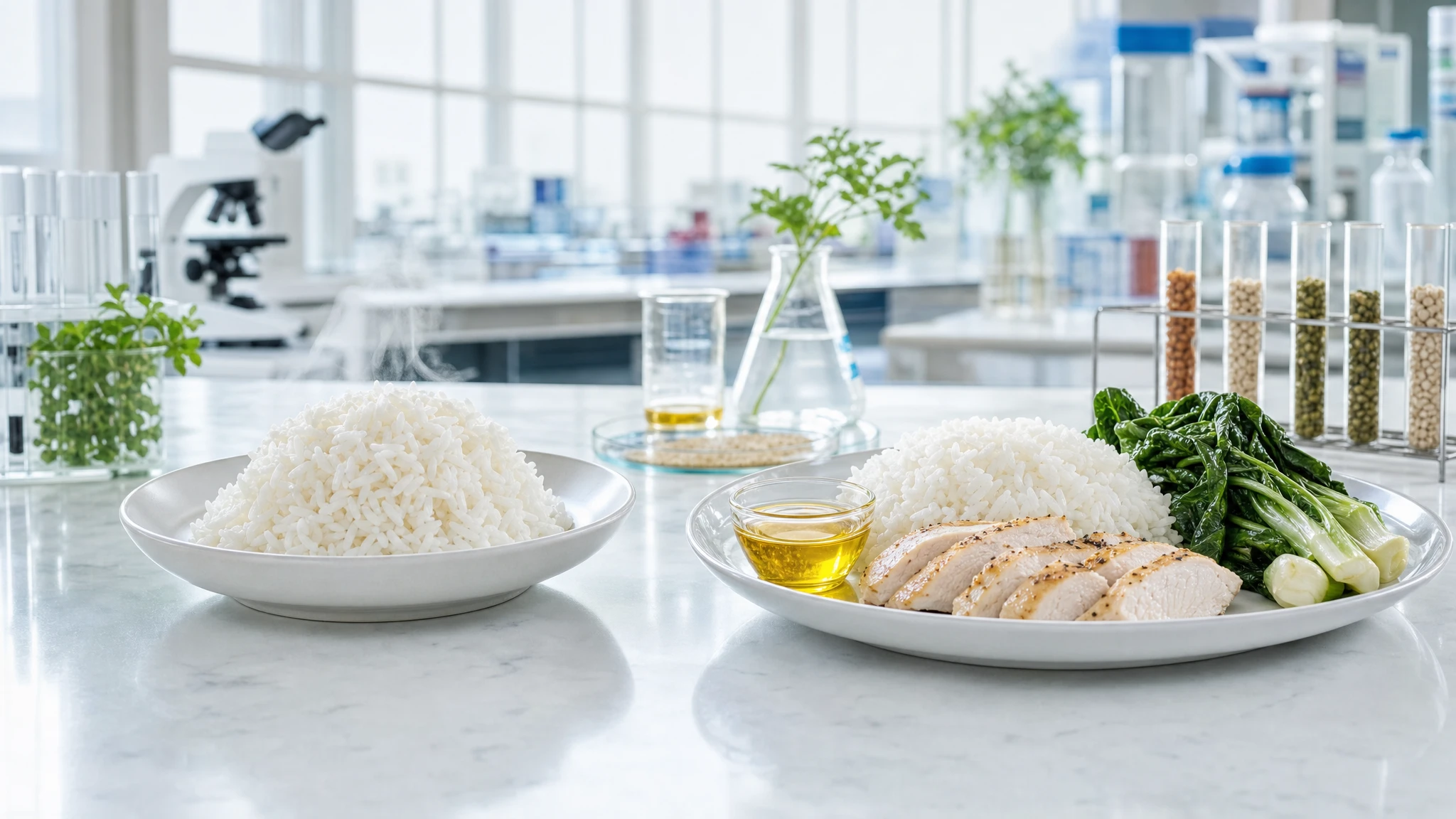
The analyzed study evaluated whether the addition of chicken breast, peanut oil, leafy vegetables, or a combination thereof modifies glycemia and insulinemia after a white rice meal in twelve healthy adults. In this randomized crossover study, each participant consumed different food combinations. Rice alone showed a high glycemic index, while the meal with chicken, oil, and vegetables produced a glycemic response that was approximately halved, without a proportional increase in the insulin response.
The research contributes to the narrative of "The Choice to Live in Health or Illness" by Dr. A. Colonnese and R. Panzironi, according to which the same carbohydrate-rich food can determine different metabolic effects when consumed as part of a mixed meal. Independent studies on potatoes, broccoli, and mixed meals confirm that proteins, fats, and food structure can attenuate or delay the glycemic spike. However, the available evidence is primarily acute, conducted on small samples, and does not allow for the deduction of long-term clinical benefits.
Analyzed study
Effect of chicken, fat and vegetable on glycaemia and insulinaemia to a white rice-based meal in healthy adults
DOI: 10.1007/s00394-014-0678-z
PMID: 24817596
The research question was simple yet relevant: does white rice produce the same glycemia and insulin response when consumed alone or together with proteins, fats, and vegetables? The hypothesis was that these meal components could modify the speed and intensity with which glucose enters the bloodstream.
The relevance to the book's section is specific. In “The Choice to Live in Health or Illness” by Dr. A. Colonnese and R. Panzironi, the publication is cited to argue that a high-glycemic index food, such as white rice, can behave in a metabolically different way if included in a meal with chicken, oil, and vegetables. The study directly measures the acute post-meal response; it does not evaluate diabetes, weight loss, cardiovascular complications, long-term pancreatic health, or the therapeutic efficacy of a particular diet.
Materials and methods of the original study
A randomized crossover study was conducted at the Clinical Nutrition Research Centre in Singapore. In a crossover design, each volunteer tests multiple dietary conditions on different days: this allows for the comparison of responses within the same person and limits individual differences.
The participants were twelve healthy volunteers. Each consumed, in random order and at one-week intervals, five test meals: white rice alone; rice with chicken breast; rice with peanut oil; rice with a leafy vegetable; and rice with chicken, oil, and vegetables. A glucose solution, used as a reference food, was consumed three times. After each meal, capillary blood samples were collected in series over three hours to measure glycemia and insulin.
The authors calculated the glycemic index, which is a measure of the blood glucose response compared to a standard reference, and the insulin index, which is the insulin response compared to the same reference. The exact quantities of rice, chicken, oil, and vegetables, the inclusion and exclusion criteria, the demographic characteristics of the participants, and the details of the statistical analyses are not reported in the available material, which consists only of the abstract.
Results
The main finding is that the combination of the three components reduced the glycemic response compared to white rice consumed in isolation. The glycemic index of white rice was 96, a high value, while that of the meal with chicken breast, peanut oil, and vegetables was 50. In practical terms, the glycemic response measured after the mixed meal was about half of that observed with rice alone.
Each component showed an effect in the same direction, but more modest compared to the combination. The addition of oil delayed the time of the glucose peak and reduced the incremental area under the curve, i.e., the overall glucose exposure above the baseline value over time; the corresponding glycemic index was 67. The addition of chicken produced a glycemic index of 73, while the addition of vegetables alone produced a glycemic index of 82.
The insulin response did not move identically to glycemia. The insulin indices of the meals with rice ranged from 54 to 89. Chicken increased the insulin response while simultaneously reducing the glycemic response: this is consistent with a greater stimulus for insulin secretion, but it does not prove that such an effect is favorable in every person or in every context. The meal with vegetables had the lowest insulin index. According to the authors, the combination of chicken, oil, and vegetables attenuated glycemia the most without requiring a proportional increase in insulin demand. P-values, confidence intervals, and individual results are not reported in the available material.
Interpretation
For the reader, the biological message is that rice does not act as an isolated food when eaten together with other foods. Proteins, fats, and vegetables can change how quickly the glucose derived from starch reaches the blood and how intensely the pancreas is stimulated to release insulin.
The segment documented directly by the study is: white rice combined with chicken, oil, and vegetables → lower postprandial glycemic response compared to rice alone. Chicken is plausibly linked to increased insulin secretion; oil can delay the appearance of the glycemic peak; vegetables can contribute through the food matrix, that is, the structure formed by water, fiber, and cell walls. However, these mechanistic explanations were not measured directly in the analyzed study.
The result does not authorize the conclusion that adding fats to any meal is always useful, nor that lower acute glycemia automatically equates to lower insulinemia, a lower risk of diabetes, or a lasting clinical benefit. The small sample size, the short observation period, and the population consisting of healthy adults limit generalizability.
Independent supporting evidence
A confirmation particularly close to the book's narrative comes from a randomized crossover study on eleven healthy adults that compared mashed potatoes alone with meals containing chicken, rapeseed oil, and salad. The mashed potatoes alone had a glycemic index of 108; with chicken, oil, and salad, the glycemic index dropped to 54. In this case as well, the composition of the entire meal, not just the starchy food, significantly modified the glycemic response. Chicken increased the insulin index, while oil reduced it; the result directly confirms that proteins, fats, and plant components can produce different responses compared to isolated carbohydrates [1].
A second crossover study examined eighteen healthy people and eighteen people with type 2 diabetes not treated with medication. Compared to glucose alone, a mixed meal containing glucose, protein, and fat reduced glycemic excursion in both groups. The research also observed greater beta-cell function, lower insulin clearance—that is, less removal of insulin from the blood—a slower appearance of paracetamol used as an indirect indicator of gastric emptying, and greater GIP secretion. These data support the narrative's point that lower glycemia after a mixed meal may depend on multiple coordinated adaptations, not just a single mechanism [2].
The specific contribution of vegetables was explored in a further randomized crossover study in thirteen healthy adults. Mashed potatoes with cooked broccoli significantly reduced the glycemic peak, insulin peak, and initial responses compared to potatoes alone. However, adding fiber extracted from broccoli or cellulose did not produce significant differences. This finding is biologically consistent with the idea that whole vegetables may have an effect not only due to the amount of fiber, but also due to their overall food structure [3].
Taken together, these studies do not exactly replicate the rice-based recipe, but they converge on the essential point of the paragraph: a starchy food can generate a different glycemic response if consumed as part of a mixed meal. However, these remain acute studies with small samples and different foods; therefore, the confirmation primarily concerns immediate postprandial physiology.
Conflicting evidence
A crossover study conducted on breakfast meals provided an important note of caution. In sixteen participants evaluated in Sydney and ten in Toronto, the amount of carbohydrates and the glycemic index of the foods together explained about 88% of the variability in the mean glycemic response; within the range of composition examined, proteins and fats did not show a relevant independent relationship with the glycemic response. The authors therefore concluded that, for those meals, the quality and quantity of carbohydrates were stronger determinants than fats and proteins [4].
This result does not invalidate studies on rice or potatoes, but it indicates that the effect of meal composition depends on the recipe, the quantities, the base starchy food, the preparation, and the individuals studied. The book's narrative is therefore more robust if interpreted as a principle of glycemic response modulation, rather than a rule according to which proteins and fats would always and predictably reduce glycemia after any carbohydrate-rich meal.
Summary table of evidence
The table distinguishes the study under review from independent publications that confirm or limit the narrative of the paragraph.
| Reference | Study type | Population or model | Main result | Direction of evidence | Strength of evidence |
|---|---|---|---|---|---|
| Original study | Randomized crossover | 12 healthy adults | Rice with chicken, peanut oil, and vegetables: glycemic index 50 versus 96 for rice alone. | direct confirmation | moderate |
| [1] | Crossover RCT | 11 healthy adults | Mashed potatoes with chicken, oil, and salad: glycemic index 54 versus 108 for mashed potatoes alone. | direct confirmation | moderate |
| [2] | Crossover RCT | 18 healthy individuals and 18 with type 2 diabetes | The mixed meal reduced glycemic excursion compared to glucose alone, with more endocrine and gastrointestinal adaptations. | indirect confirmation | moderate |
| [3] | Crossover RCT | 13 healthy adults | Whole broccoli with potatoes reduced the initial glycemic and insulin response; extracted fibers and cellulose did not. | biologically consistent evidence | moderate |
| [4] | Crossover study | 16 participants in Sydney and 10 in Toronto | Carbohydrates and glycemic index explained approximately 88% of the variability in glycemic response; independent effects of protein and fat were negligible. | discordant evidence | moderate |
Confirmation of the evidence
Claim in the book
In section 2.3 of “The Choice to Live in Health or Illness” by Dr. A. Colonnese and R. Panzironi, the central claim is that white rice consumed with chicken breast, peanut oil, and vegetables results in a much lower glycemic response compared to rice eaten in isolation, without requiring a proportional increase in insulin. From this, the text concludes that the metabolic quality of a meal depends on the interaction between its components and not solely on the presence of a carbohydrate-rich food.
Starchy food consumed alone → rapid increase in postprandial glucose → addition of protein, fats, and vegetables → modification of digestion, absorption, and insulin response → lower glycemic response
The publication subject to the Evidence Review was used in the book to support the following point: white rice, a high-glycemic index food when consumed in isolation, can produce a substantially lower glycemic response when combined in the same meal with chicken, oil, and vegetables; the observed effect stems from the combination of foods rather than the simple classification of rice as a carbohydrate.
The correspondence between the publication and the paragraph is direct: the study analyzed compares rice alone with rice combined with chicken, peanut oil, and vegetables, and observes a reduction in the glycemic index from 96 to 50. Independent literature reinforces the same narrative across different starchy foods. In a meal based on mashed potatoes, chicken, oil, and salad significantly reduced the glycemic index compared to potatoes consumed alone [1]. In healthy individuals and those with type 2 diabetes, the mixed meal reduced glycemic excursion compared to isolated glucose and was associated with changes in beta-cell function, insulin clearance, gut hormones, and gastric emptying [2]. Results with broccoli and potatoes also suggest that whole vegetables may contribute through their food matrix, not just through isolated fiber [3].
The confirmation is not absolute. Another study found that, in specific breakfast meals, carbohydrates and glycemic index explained most of the glycemic response, while proteins and fats had limited independent effects [4]. Therefore, the narrative in “The Choice to Live in Health or Illness” by Dr. A. Colonnese and R. Panzironi is supported as a physiological principle dependent on the context of the meal, but not as an identical prediction for every food, portion, or person.
Overall level of confirmation
MODERATE CONFIRMATION
The transition is documented directly in the study on rice and supported by independent crossover trials in humans showing a lower glycemic response with mixed meals. The strength remains moderate because the samples are small, the studies are acute, the meals are not identical, and some research indicates that carbohydrates and the glycemic index may remain the primary determinants in certain contexts.
Conclusions
The study analyzed directly supports the finding that, in the healthy adults examined, consuming white rice together with chicken, peanut oil, and vegetables reduces the glycemic response compared to rice consumed alone. Independent evidence makes the general principle that meal composition and structure modulate postprandial glycemia quite well-supported. However, it remains to be validated how much this effect varies between individuals, recipes, quantities, and metabolic conditions, and whether these acute differences translate into lasting clinical benefits.
Overall assessment
The narrative is moderately supported: the original study and independent evidence in humans show that mixed meals can reduce the glycemic response compared to isolated starchy sources. The mechanism is biologically plausible, but it depends on the composition of the meal and the context; it does not demonstrate long-term clinical benefits.
References
[1] Protein and fat modify the glycaemic and insulinaemic responses to a mashed potato-based meal
[2] Mixed meal ingestion diminishes glucose excursion in comparison with glucose ingestion via several adaptive mechanisms in people with and without type 2 diabetes
[3] Glyceamic and insulinaemic response to mashed potato alone, or with broccoli, broccoli fibre or cellulose in healthy adults
Editorial note
Artificial Intelligence was used solely as a tool to support editorial and documentary work. All content, interpretations, bibliographic citations and conclusions have been verified, reviewed and approved by the author, who assumes full scientific responsibility for them.
The manuscript was also subject to independent peer review prior to publication.
To ensure maximum transparency, the article's complete history — including the dates of submission, review, acceptance and publication, as well as information on the peer review process — is available on the dedicated Article History page.