


Effect of the lysosomotropic agent chloroquine on mTORC1 activation and protein synthesis in human skeletal muscle - Evidence review
The study shows that, after essential amino acids, chloroquine did not reduce either S6K1 phosphorylation or muscle protein synthesis in humans. In cells, however, the effect was inhibitory. This supports S6K1 as a component of the anabolic response, but not as a unique quantitative gauge; contextual confirmation in humans via independent experimental studies is required.
- Published 18/11/2026
- Updated 18/11/2026
- Article history
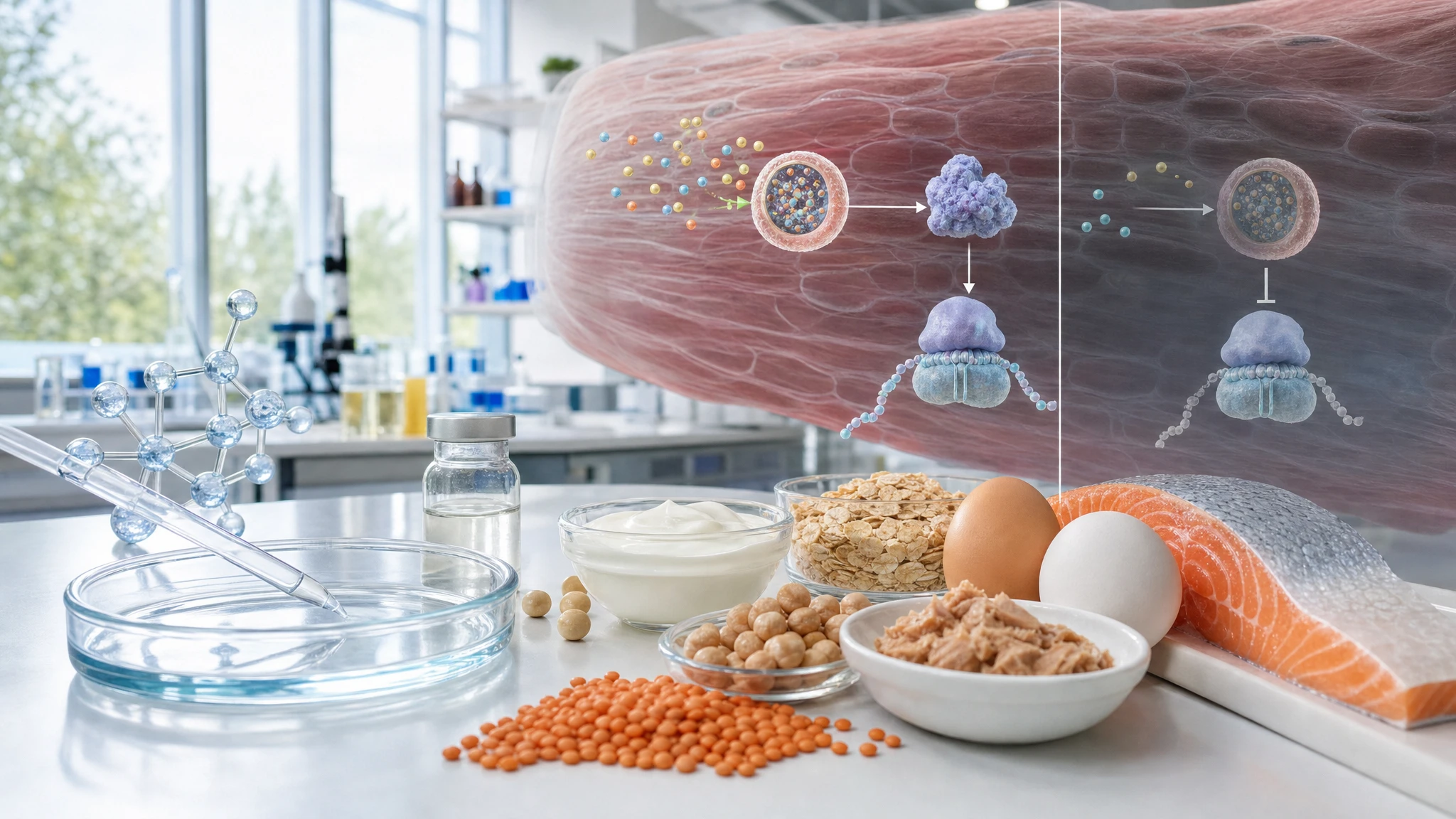
ABSTRACT
The original study investigated whether chloroquine, a drug capable of altering lysosomal function, modified mTORC1 activation and muscle protein synthesis following the intake of essential amino acids. Fourteen healthy young adults were assigned to either chloroquine or a control group; the authors also conducted experiments on murine muscle cells. In humans, amino acids increased the phosphorylation of S6K1 and other mTORC1 pathway signals with no differences detected between groups, while muscle protein synthesis did not differ between chloroquine and control. In cells, however, chloroquine reduced the response to leucine and protein synthesis.
In section 4.7 of “The Choice to Live in Health or Illness” by Dr. A. Colonnese and R. Panzironi, the study contributes to the clarification that S6K1 phosphorylation is a useful indicator of anabolic activation, but not a direct and sufficient quantitative measure of final protein synthesis. Independent studies in humans confirm both the necessary role of mTORC1 in the response to amino acids and the fact that variations in S6K1 may not translate proportionally into variations in protein synthesis. The evidence is therefore moderately supported and dependent on the experimental context.
Analyzed study
Effect of the lysosomotropic agent chloroquine on mTORC1 activation and protein synthesis in human skeletal muscle
DOI: 10.1186/s12986-021-00585-w
PMID: 34118944
PMCID: PMC8199655
The research question was whether the lysosome, a cellular structure that recycles components and helps sense nutrients, was essential for amino acids to activate mTORC1 in human muscle. mTORC1 is a protein complex that promotes the initiation of new protein production. S6K1 is one of the proteins located downstream of mTORC1: its phosphorylation, which is the addition of a phosphate group that signals its activation, is often used as an index of the anabolic response.
The relevance to paragraph 4.7 is specific. The publication measured both S6K1 phosphorylation and muscle protein synthesis in the same experiment. This allows for an assessment of whether the molecular signal and the final biological outcome necessarily proceed in an overlapping manner. However, the study was not designed to calculate an individual quantitative relationship between S6K1 phosphorylation and protein synthesis; it can therefore document the coexistence or lack of separation of the two responses under the tested conditions, but it cannot define an S6K1 value that predicts protein synthesis in every person or situation.
Materials and methods of the original study
The authors conducted a randomized clinical trial in 14 healthy, recreationally active, non-smoking adults aged between 18 and 40 years. Ten participants were men and four were women. Seven individuals were assigned to the control group and seven to the chloroquine group. The treated group received 250 mg of chloroquine the evening before and 500 mg on the morning of the study, for a total of 750 mg; the control group did not receive a placebo. Participants consumed 10 g of essential amino acids after two vastus lateralis muscle biopsies. In the text, the authors report that one participant per group was excluded due to the inability to obtain the third biopsy, while the figure captions report seven participants per group: this discrepancy is not clarified in the available material.
Muscle protein synthesis was measured using phenylalanine isotopic tracers and reported as the fractional synthesis rate or FSR, which is the percentage of muscle protein renewed in one hour. Muscle protein degradation and whole-body proteolysis were also analyzed. Using western blot, a technique that measures specific proteins or their phosphorylated forms, mTORC1, S6K1, 4E-BP1, and rpS6 were evaluated. Muscle samples were collected before the amino acid Intake and at 60 and 120 minutes afterward.
In a second set of experiments, the authors used C2C12 myotubes, which are differentiated murine muscle cells in culture. They compared untreated cells, cells exposed to 1 mmol/L of leucine for 10 minutes, and cells pretreated with 2 mg/mL of chloroquine for one hour before leucine. Signaling was evaluated in eight replicates per condition. Cellular protein synthesis was assessed using the SUnSET method, based on the incorporation of puromycin into newly produced proteins, in six replicates per condition.
Results
In human muscle, the availability of leucine and phenylalanine in the blood and muscle increased after the essential amino acid drink in both groups. No differences emerged between chloroquine and control for these concentrations. This indicates that any potential effect of the drug did not depend on a reduced appearance of the measured amino acids in the blood or muscle tissue.
One hour after the amino acids, the phosphorylation of mTORC1, S6K1, 4E-BP1, and rpS6 increased compared to baseline in both the control group and the chloroquine group. After two hours, some signals remained statistically elevated compared to baseline only in the control group; in the chloroquine group, the increase for S6K1 showed a trend but did not reach the significance threshold declared by the authors, with P=0.07. However, no significant differences were reported between the groups for the total abundance of the analyzed proteins.
Muscle protein synthesis did not differ between the groups at any time point, with P>0.05. After the amino acids, the FSR increased compared to rest in the chloroquine group, while in the control group there was a trend toward an increase with P=0.06. The study does not report the full numerical values of the FSR shown in the figure in the available text. Muscle protein degradation at rest also did not differ between the groups. Whole-body proteolysis decreased after the amino acids in the control group, but not in the chloroquine group; however, no significant difference was detected between the groups.
In C2C12 cells, leucine increased the phosphorylation of mTORC1 and S6K1 compared to the control. Pretreatment with chloroquine abolished this increase under the experimental conditions used. Chloroquine also reduced cellular protein synthesis both in a nutrient-rich environment and after nutrient deprivation. These results therefore show cellular inhibition, but do not demonstrate that the same intensity of lysosomal alteration was reached in human muscle with the administered dose.
Interpretation
In simple terms, the study shows that a molecular signal and the final result of protein production are not the same thing. S6K1 participates in transmitting the mTORC1 signal to the cellular machinery that builds proteins, but the amount of phosphorylated S6K1 in a single sample does not automatically equate to the amount of protein built by the muscle over the entire observed period.
The segment of the chain documented by the publication is: essential amino acids → activation of mTORC1 and S6K1 → muscle protein synthesis response. In humans, chloroquine did not statistically separate these steps: it did not significantly reduce either the S6K1 response at one hour or protein synthesis compared to the control. In murine cells, however, chloroquine reduced both the mTORC1-S6K1 response to leucine and protein synthesis. The contrast between the two models suggests that dose, drug distribution, cell type, and nutritional conditions can alter the interpretation of the mechanism.
The result most relevant to the book's narrative is not that S6K1 is irrelevant. On the contrary, S6K1 was activated along with other anabolic signals after amino acids. The limitation is interpretive: this study does not prove that S6K1 phosphorylation constitutes a direct quantitative indicator of protein synthesis, because the pharmacological intervention in humans did not produce a significant dissociation between the two measures, and no individual correlation analysis was performed. The research therefore reinforces the need to consider S6K1 within a network of signals, rather than as the sole gauge of biological outcome.
Independent confirmatory evidence
Initial confirmation of the pathway's role, distinct from the use of S6K1 as a simple quantitative indicator, comes from a randomized crossover study in eight young adults. After 10 g of essential amino acids, muscle protein synthesis increased by approximately 60% in the control group; the administration of rapamycin, an mTORC1 inhibitor, blocked the increase in protein synthesis and attenuated or blocked mTORC1 signaling. This result directly supports the fact that mTORC1 is necessary for the response to amino acids in human muscle. However, it does not establish that the intensity of S6K1 phosphorylation alone linearly measures the magnitude of protein synthesis [1].
A metabolic experiment in humans tested amino acids and four levels of insulin while maintaining high amino acid availability. Tripling the amino acids with low insulin doubled muscle protein synthesis, with P<0.01. With the same amount of amino acids, increasing insulin instead increased p70S6K (i.e., S6K1) phosphorylation, but did not further increase muscle protein synthesis. This dissociation is particularly relevant to the book: S6K1 activation may accompany an anabolic environment without, by itself, providing a quantitative reading of final protein synthesis [2].
Another randomized study in 21 young men and women compared 10 g of essential amino acids alone or combined with 30 g of sucrose or alanine. All groups showed an increase in S6K1 at 60 minutes. Some mTORC1 signals were more prolonged with carbohydrates or alanine, but the areas under the curve for protein synthesis, protein degradation, and net protein balance did not differ between the three groups. The longer duration of some signals did not, therefore, translate into a greater overall anabolic effect over the course of three hours [3].
Overall, this research confirms a more precise chain than the popular science formulation: mTORC1 and S6K1 are a relevant part of the response to amino acids, but protein synthesis also depends on substrate availability, the duration of the stimulus, other protein translation factors, and the metabolic context. The studies are conducted primarily in healthy young adults and observe acute responses; they do not allow for direct inferences regarding long-term effects on muscle mass, strength, or health.
Conflicting evidence
The evidence does not suggest that S6K1 is a valueless marker. In a study of 16 healthy young people and 16 healthy older adults, strength training increased the phosphorylation of mTOR, S6K1, and other translation proteins in the young group, along with muscle protein synthesis. In the young participants, at 24 hours, the phosphorylation of mTOR and S6K1 was positively correlated with protein synthesis. This shows that, under certain conditions, S6K1 can be associated with the synthetic response [4].
In the same study, however, the older adults showed neither a significant increase in mTORC1-S6K1 signaling nor an increase in protein synthesis after exercise; furthermore, in the older adults, the authors did not observe a correlation between phosphorylation and protein synthesis. The evidence is therefore contextual, not truly contradictory to the statement in the book: it confirms that the relationship can exist, but it is not automatically constant across ages, stimuli, and physiological conditions. No directly conflicting evidence sufficiently relevant to the topic was identified; this does not prove the absence of contrary results.
Summary table of evidence
The table distinguishes the study under review from the independent publications used to evaluate the passage in the book.
| Reference | Study type | Population or model | Main result | Direction of evidence | Strength of evidence |
|---|---|---|---|---|---|
| Original study | Randomized human study and cellular study | 14 healthy young adults; C2C12 murine myotubes | Amino acids increased S6K1 in both human groups with no difference in protein synthesis between chloroquine and control; in cells, chloroquine reduced signaling and synthesis. | biologically consistent evidence | moderate |
| [1] | Crossover RCT | 8 healthy young adults | Rapamycin blocked the approximately 60% increase in protein synthesis induced by 10 g of essential amino acids. | direct confirmation | moderate |
| [2] | Experimental metabolic study | Healthy young men | With constant amino acids, the increase in S6K1 phosphorylation induced by insulin did not further increase muscle protein synthesis. | direct confirmation | moderate |
| [3] | Parallel-group RCT | 21 young men and women | More prolonged mTORC1 signals in some groups did not increase the overall anabolic effect compared to essential amino acids alone. | direct confirmation | moderate |
| [4] | Comparative experimental study | 16 healthy young and 16 healthy older adults after resistance exercise | In young adults, S6K1 and protein synthesis increased and were correlated; in older adults, both responses were attenuated and the correlation did not emerge. | discordant evidence | moderate |
Confirmation of the evidence
Claim in the book
In paragraph 4.7 of “The Choice to Live in Health or Illness” by Dr. A. Colonnese and R. Panzironi, the relevant statement is that S6K1 phosphorylation is often used as an indicator of mTORC1 anabolic activation, but it does not necessarily represent a direct quantitative index of protein synthesis. The final outcome depends on the integration of nutritional, metabolic, and mechanical signals.
Amino acids and other stimuli → mTORC1 → S6K1 and other translation effectors → muscle protein synthesis
The publication subject to the Evidence Review was used in the book to support the following passage: S6K1 phosphorylation is an element of the anabolic response activated by amino acids, but its isolated measurement is not equivalent to a direct quantification of final muscle protein synthesis.
The original study is relevant because it simultaneously evaluated S6K1 and protein synthesis in human muscle following essential amino acids. It observed an increase in S6K1 phosphorylation in both groups at one hour, with no differences between chloroquine and the control group regarding muscle protein synthesis. This does not prove a statistical dissociation between S6K1 and protein synthesis, but it shows that interpreting the signal requires comparison with a directly measured functional outcome.
Independent evidence better defines the significance of this relationship. Pharmacological inhibition of mTORC1 blocks the synthetic response to amino acids, supporting the necessity of this pathway in human muscle [1]. However, with amino acids kept constant, an increase in S6K1 phosphorylation induced by insulin did not result in a further increase in protein synthesis [2]. Similarly, more prolonged mTORC1 signaling after the addition of carbohydrates or alanine did not increase the overall anabolic balance compared to essential amino acids alone [3]. The relationship can, however, be positive in specific contexts, such as after exercise in young adults, while it appears less clear in the elderly [4].
The narrative in “The Choice to Live in Health or Illness” by Dr. A. Colonnese and R. Panzironi is therefore confirmed in its precise meaning: S6K1 is a relevant effector of mTORC1 and a biologically informative indicator, but it is not sufficient, on its own, to quantitatively measure total protein synthesis or muscle adaptation.
Overall level of confirmation
MODERATE CONFIRMATION
The connection is supported by independent experimental studies in humans, which demonstrate both the necessity of mTORC1 and the possible dissociation between increased S6K1 phosphorylation and increased protein synthesis. The confirmation remains moderate because the studies are acute, involve small sample sizes, and focus primarily on healthy young adults.
Conclusions
The analyzed study appropriately supports the idea that S6K1 is part of the anabolic response regulated by mTORC1, but it does not allow for the use of its phosphorylation as an independent quantitative measure of muscle protein synthesis. Chloroquine inhibited signaling and synthesis in cells, but did not produce the same detectable effect in human muscle at the dose used. Independent evidence shows that mTORC1 is necessary for the response to amino acids and, at the same time, that the magnitude of molecular signals does not always proportionally determine the magnitude of the functional outcome. The book passage is therefore moderately supported and always requires an interpretation dependent on the biological context.
Overall assessment
The narrative is moderately supported. mTORC1-S6K1 is well-supported as the biological axis of the muscle anabolic response, but S6K1 phosphorylation is not a universal quantitative measure of protein synthesis. The human evidence is consistent, though limited by small sample sizes, acute observations, and dependence on age and stimulus.
References
[1] Mammalian Target of Rapamycin Complex 1 Activation Is Required for the Stimulation of Human Skeletal Muscle Protein Synthesis by Essential Amino Acids1–3
[2] Disassociation between the effects of amino acids and insulin on signaling, ubiquitin ligases, and protein turnover in human muscle
[3] Aging impairs contraction-induced human skeletal muscle mTORC1 signaling and protein synthesis
[4] Addition of Carbohydrate or Alanine to an Essential Amino Acid Mixture Does Not Enhance Human Skeletal Muscle Protein Anabolism
Editorial note
Artificial Intelligence was used solely as a tool to support editorial and documentary work. All content, interpretations, bibliographic citations and conclusions have been verified, reviewed and approved by the author, who assumes full scientific responsibility for them.
The manuscript was also subject to independent peer review prior to publication.
To ensure maximum transparency, the article's complete history — including the dates of submission, review, acceptance and publication, as well as information on the peer review process — is available on the dedicated Article History page.