


Evolution of human eating behavior - Evidence review
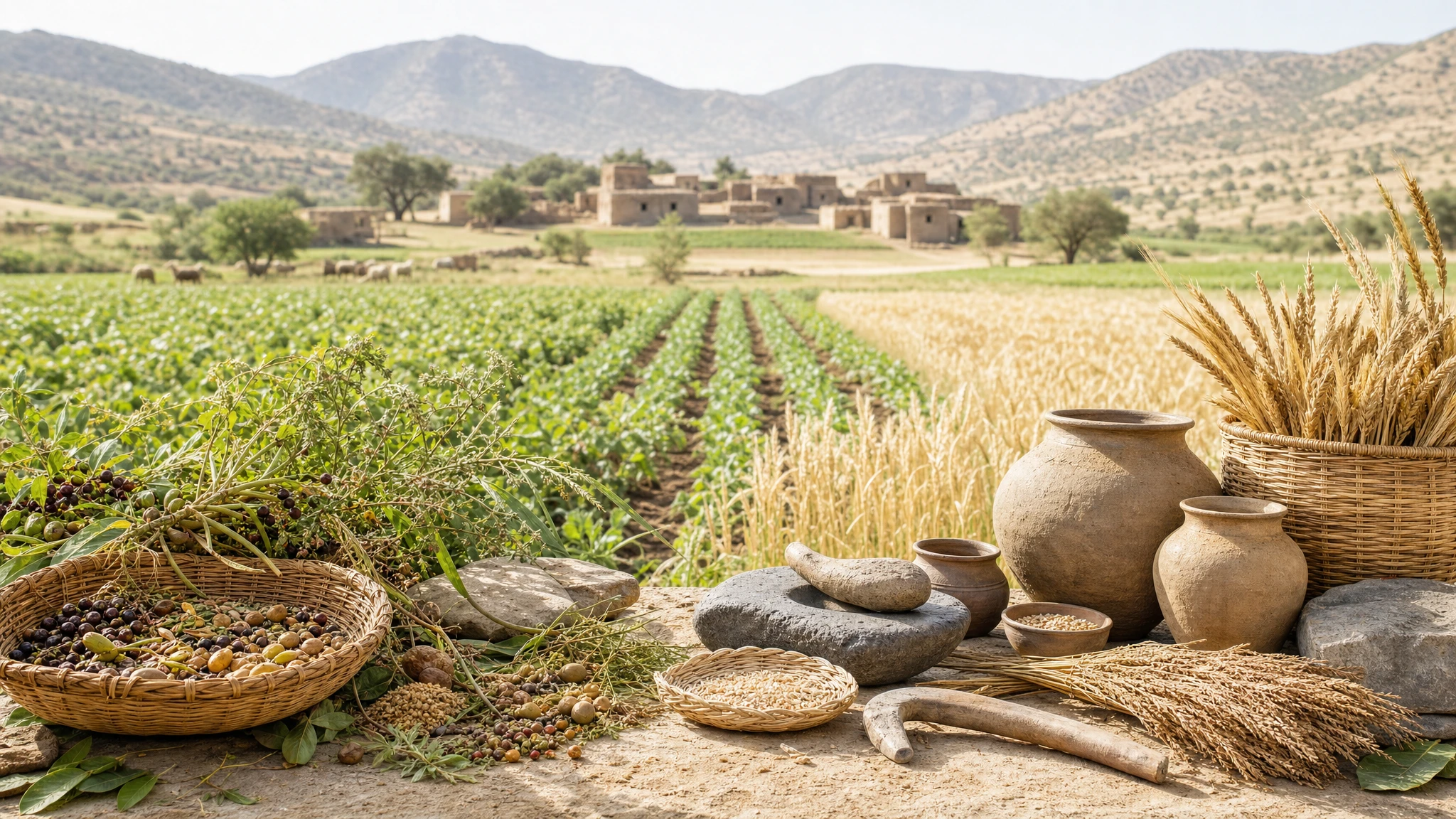
The study discusses how food production favored more stable settlements compared to the mobility required by foraging for wild resources. This is an evolutionary synthesis, not experimental evidence. Archaeology and demography support the general association but show different and not always linear regional paths, which should be interpreted with caution.
- Published 09/11/2026
- Updated 11/11/2026
- Article history
ABSTRACT
The publication subject to this Evidence review is an evolutionary-based contribution on human eating behavior. Neither the full text nor the abstract is available in the provided material; therefore, it is not possible to directly verify the study design, analyzed sources, selection criteria, or specific results. Its use in the section "The Choice to Live in Health or Illness" by Dr. A. Colonnese and R. Panzironi concerns the transition from the mobile search for natural resources to food production through cultivation and animal husbandry, associated with greater settlement stability.
Independent evidence shows that mobility was a frequent characteristic of terrestrial hunter-gatherer societies because available resources varied in space and time. Archaeological and paleodemographic studies also indicate that the shift to agricultural economies was often accompanied by demographic transformations compatible with a more stable life. However, the transition was not uniform: in some regions, mixed economies and non-linear sequences existed for millennia. The book's narrative is therefore consistent at a historical-anthropological level, but it should be understood as a general trend, not as a universal rule.
Analyzed study
Evolution of the human feeding behavior
The research question that can be reconstructed from the title is how human dietary behavior has changed over the course of evolution in relation to shifts in how food is obtained. In the section "The Choice to Live in Health or Illness" by Dr. A. Colonnese and R. Panzironi, the publication is cited to contextualize a specific historical shift: cultivation and animal husbandry made it possible to live more stably in one place, reducing the need to move constantly in search of food.
The publication may be relevant to this evolutionary reconstruction because the transition from hunting and gathering to food production alters both the availability of resources and the daily organization of communities. However, the provided material does not contain the full text or the abstract of the study. Therefore, it is not possible to attribute specific results, archaeological data, quantitative analyses, or detailed conclusions to it that are not reported in the available material.
Materials and methods of the original study
This information is not provided in the available material. Since neither the full text nor an abstract is available, it is not possible to verify whether the publication used a narrative review, archaeological data, anthropological comparisons, historical sources, biological data, or other methodologies.
The source inclusion criteria, the specific historical period examined, the number of populations or sites considered, the variables analyzed, and any statistical methods or quality control procedures for the evidence are not reported in the available material. Consequently, the publication cannot be evaluated here as if it were an experimental study or a meta-analysis with verifiable quantitative results.
Results
The passage for which the study was cited in the book concerns a general historical relationship: food production through cultivation and animal husbandry can reduce the dependence on the constant movement required to exploit dispersed wild resources. This relationship is plausible and is supported by independent literature, but the extent to which it was demonstrated in the original study cannot be verified with the material provided.
Interpretation
In simple terms, those who live primarily by hunting, fishing, and gathering must often adapt their movements to the seasonal location of resources. Cultivation and animal husbandry, on the other hand, make it possible to organize part of food production around fields, animals, storage facilities, and more permanent dwellings. This does not mean that every farmer was completely sedentary or that every hunter-gatherer was nomadic.
The segment of the narrative chain that the publication subject to the Evidence Review was likely used to support is: food production through cultivation and animal husbandry → less need to follow dispersed wild resources → greater possibility of stable settlements. Since the content of the publication is not accessible in the provided material, this attribution derives from the specific context of the citation in the book and not from a direct verification of its data. Independent sources allow for an assessment of the narrative's consistency, but they do not replace a full reading of the original study.
Independent supporting evidence
The first step in the narrative concerns the mobility of populations that depend on the search for wild resources. Hamilton and colleagues examined ethnographic data and an ecological model regarding the residential mobility of hunter-gatherers. The authors report that most groups dependent on terrestrial plants and animals move their camp several times a year, as food and material resources are unevenly distributed across the territory and change over time. This evidence directly confirms the idea that, in many hunting and gathering economies, obtaining food required repeated relocation. However, the same authors point out important exceptions: in particularly rich and predictable environments, especially coastal ones, some hunter-gatherers could be almost sedentary [1].
The second step concerns the relationship between the shift to a food-producing economy and the transformation of population organization. Bocquet-Appel analyzed paleodemographic indicators derived from approximately 200 archaeological cemeteries and ethnographic data, describing a demographic transition associated with the shift from mobile foraging economies to agricultural economies. The increase in fertility observed in various series is also interpreted in light of lower energy expenditure related to mobility and child-rearing. The study does not directly measure harvest predictability nor does it prove that every single agricultural community was sedentary, but it reinforces the coherence between agriculture, reduced mobility, and demographic changes in multiple historical contexts [2].
Overall, these independent studies support a historically plausible chain: the variable distribution of wild resources favored frequent movement; food production in specific locations, on the other hand, could make a settled life more feasible. The level of confirmation remains primarily anthropological and archaeological: this is not a controlled experiment, but rather the convergence of ethnographic, archaeological, and demographic data.
Conflicting evidence
An important clarification comes from the archaeobotanical analysis by Fuller and Lucas, which compared data regarding cultivation, domestication, and the composition of economies in the Near East. The authors noted the persistence of mixed economies, in which gathering, hunting, cultivation, and the use of species in the process of domestication coexisted for approximately 4,000 years. Their results do not support a consistently rapid and linear succession from mobile hunter-gatherers to sedentary farmers [3].
This evidence does not directly contradict the general idea that agriculture and animal husbandry can foster more stable settlements. However, it limits its generalizability: plant domestication, cultivation, animal husbandry, mobility, and sedentarism did not proceed everywhere in the same order nor at the same speed. No directly conflicting evidence sufficiently relevant to the general trend has been identified; this does not prove the absence of contrary results.
Summary table of evidence
The table distinguishes the publication subject to the Evidence Review from the independent research used to evaluate the specific narrative of the book's paragraph.
| Reference | Study type | Population or model | Main result | Direction of evidence | Strength of evidence |
|---|---|---|---|---|---|
| Original study | Evolutionary contribution; method not verifiable in the available material | Not reported in the available material | The bibliographic context in the book links food production to greater settlement stability; specific results are not verifiable. | neutral evidence | preliminary |
| [1] | Comparative ethnographic study with ecological model | Hunter-gatherer societies | Most terrestrial groups change settlements several times a year to follow variably distributed resources. | direct confirmation | moderate |
| [2] | Archaeological and paleodemographic study | Approximately 200 archaeological cemeteries and ethnographic data | The transition from mobile foraging economies to agricultural economies is associated with marked changes in fertility and population growth. | indirect confirmation | moderate |
| [3] | Comparative archaeobotanical study | Southwestern Near East sites | Mixed economies based on gathering and cultivation persisted for millennia, without a single trajectory toward agriculture. | discordant evidence | moderate |
Confirmation of the evidence
Claim in the book
In section 1.1.3, “The Choice to Live in Health or Illness” by Dr. A. Colonnese and R. Panzironi, it is stated that cultivation and animal husbandry allowed humans to settle in fixed locations, thanks to a more predictable food production that was less dependent on the uncertainties of hunting and gathering.
Scattered and variable wild resources → repeated movements of hunter-gatherers → localized cultivation and animal husbandry → greater possibility of stable settlements
The publication subject to the Evidence Review was used in the book to support the following passage: the transition from foraging through hunting and gathering to cultivation and animal husbandry made living in stable settlements more feasible, reducing the need to move continuously to find food resources.
The scientific correspondence between the paragraph and the publication subject to the Evidence Review concerns the transition from an economy based on foraging for resources to one based, at least in part, on their production. In “The Choice to Live in Health or Illness” by Dr. A. Colonnese and R. Panzironi, this change is presented as a condition that favored living in fixed locations. Since the text of the original publication is not available in the provided material, it is not possible to establish how directly it documents every element of the chain.
Independent literature convergently confirms the core of the narrative. Terrestrial hunter-gatherer societies often tended to move to exploit resources that were locally depleted or available in different places and seasons [1]. The shift to agricultural economies has been associated in numerous contexts with significant demographic transformations and a reduction in the energy costs of mobility, elements compatible with greater residential stability [2]. However, archaeobotanical data show that the change was neither universal nor immediate: cultivation, domestication, and sedentarism could combine in different ways and for long periods [3].
Overall level of confirmation
INDIRECT CONFIRMATION
The narrative is supported by consistent independent evidence regarding the mobility of hunter-gatherers and the transformations associated with the adoption of agriculture. The confirmation is indirect because the available material does not allow for the verification of the original study's data and because the relationship between agriculture and sedentarism varies according to region, environment, and historical phase.
Conclusions
The passage in the book linking cultivation and animal husbandry to the increased possibility of living in stable settlements is quite well-supported as a historical-anthropological trend. Independent evidence indicates that mobility was often necessary for economies based on foraging for wild resources and that the adoption of agriculture was associated with significant demographic and social transformations.
However, the conclusion requires precision. Not all hunter-gatherer populations were mobile, not all agricultural communities were fully sedentary, and the transition occurred at different times in various regions. The original publication can only be evaluated to a limited extent, as the text and abstract are not available in the provided material.
Overall assessment
The narrative is quite well-supported from an anthropological and archaeological perspective: mobility often characterized the search for wild resources, and agriculture favored more stable settlements in many contexts. Confirmation remains indirect, as the text of the original study is not available and historical trajectories were very different by region.
References
[1] The ecological and evolutionary energetics of hunter‐gatherer residential mobility
[2] The Agricultural Demographic Transition During and After the Agriculture Inventions
[3] Contrasting pathways to domestication and agriculture around Southwest Asia
Editorial note
Artificial Intelligence was used solely as a tool to support editorial and documentary work. All content, interpretations, bibliographic citations and conclusions have been verified, reviewed and approved by the author, who assumes full scientific responsibility for them.
The manuscript was also subject to independent peer review prior to publication.
To ensure maximum transparency, the article's complete history — including the dates of submission, review, acceptance and publication, as well as information on the peer review process — is available on the dedicated Article History page.