


Glycemic and insulinemic response to mashed potatoes alone or with broccoli, broccoli fiber, or cellulose in healthy adults - A review of the evidence
In the thirteen healthy adults, cooked broccoli consumed with mashed potatoes reduced the glycemic peak and the initial insulin response; isolated fibers and cellulose did not. The data supports the importance of the vegetable matrix, but it stems from a small, acute, non-blinded study that needs to be confirmed in larger and more diverse populations.
- Published 11/11/2026
- Updated 11/11/2026
- Article history
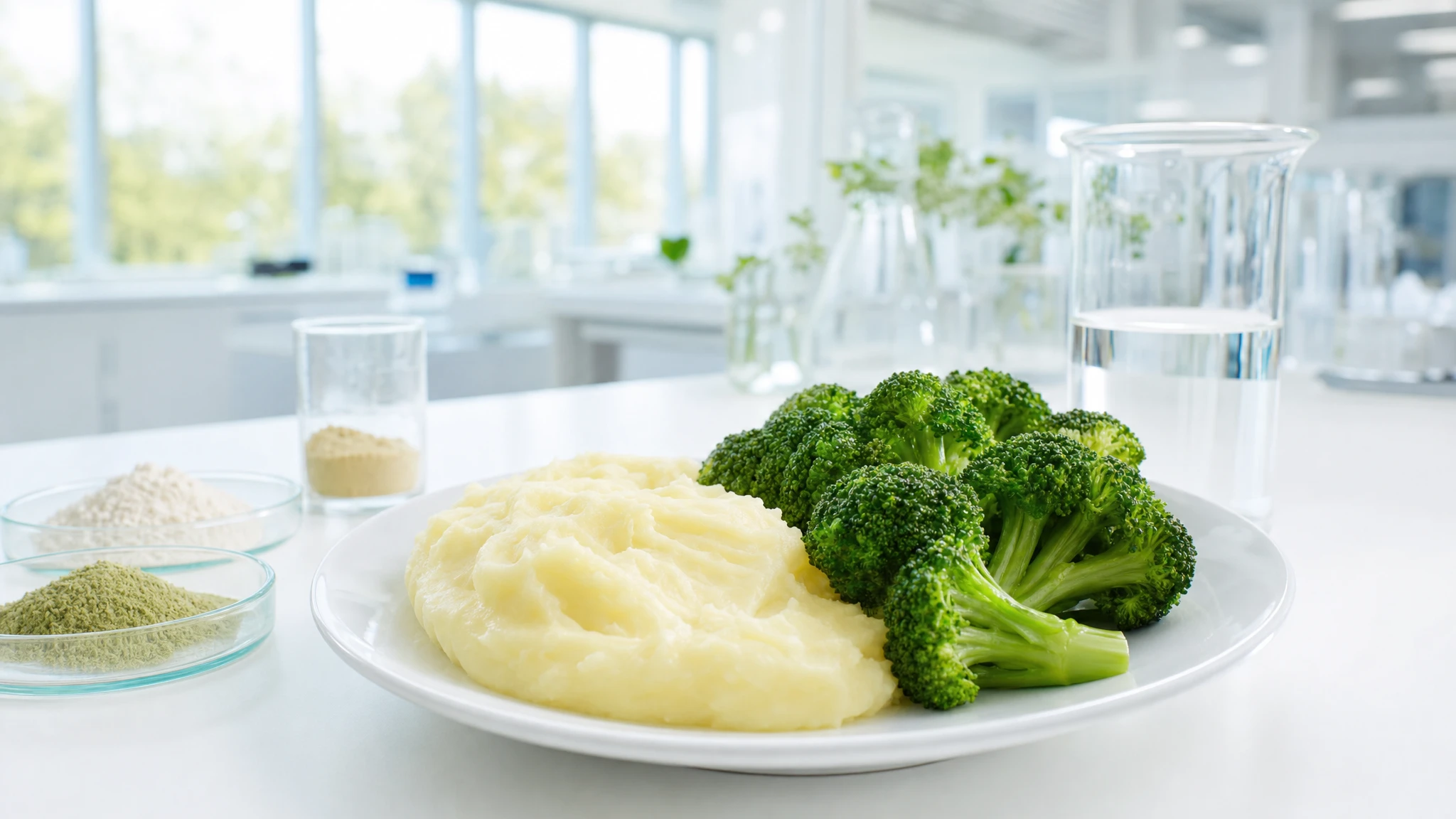
ABSTRACT
The original study evaluated whether consuming cooked broccoli together with mashed potatoes modified the glucose and insulin response after the meal, compared to potatoes consumed alone or with fiber extracted from broccoli or cellulose. In thirteen healthy adults, whole broccoli reduced the glycemic peak and early insulin response, while isolated fibers and cellulose did not produce significant differences.
The publication contributes to the narrative of "The Choice to Live in Health or Illness" by Dr. A. Colonnese and R. Panzironi, according to which the metabolic effect of a vegetable does not depend solely on isolated fiber, but also on its food matrix, i.e., the physical structure in which nutrients and plant components are embedded. Independent studies confirm that non-homogenized vegetables and more intact food structures can reduce the glycemic response after starch-rich meals. However, the evidence is acute, conducted primarily in healthy subjects, and does not allow for attributing the effect to a single component of broccoli nor for demonstrating long-term clinical benefits.
Analyzed study
Glyceamic and insulinaemic response to mashed potato alone, or with broccoli, broccoli fibre or cellulose in healthy adults
DOI: 10.1007/s00394-016-1309-7
PMID: 27655525
The research question was whether a realistic portion of cooked broccoli, consumed alongside mashed potatoes, would modify the post-meal increase in glycemia and insulin compared to mashed potatoes alone. The authors also compared whole broccoli with fiber extracted from broccoli and with cellulose, a structural plant fiber.
The hypothesis relevant to the book's section is that the effect of a vegetable on post-meal metabolism is not explained solely by the amount of added fiber. The research can show immediate differences in glucose and insulin curves after four experimental meals. However, it cannot identify with certainty the mechanism responsible, establish long-term effects, nor directly extend the results to people with diabetes, obesity, or other metabolic conditions.
Materials and methods of the original study
A randomized, non-blinded crossover study was conducted. In a crossover design, each participant tests multiple dietary conditions and therefore serves as their own control; non-blinded means that both participants and researchers were aware of the meal consumed. Thirteen healthy subjects participated, each exposed to four meals: mashed potatoes alone; mashed potatoes with cooked broccoli; mashed potatoes with broccoli fiber; and mashed potatoes with cellulose.
Capillary blood samples were collected between 0 and 180 minutes after the meal, and glycemia and insulinemia were measured. The authors calculated the incremental area under the curve, or iAUC, a measure of the overall increase relative to the baseline value over a period of time. Differences between meals were evaluated using analysis of variance for repeated measures. Inclusion and exclusion criteria, detailed participant characteristics, exact food quantities, nutritional composition of the meals, duration of the washout periods between tests, and complete numerical values are not reported in the available material, which consists only of the abstract.
Results
The main result was a reduction in the early response when cooked broccoli was consumed with mashed potatoes. Compared to potatoes alone, the broccoli-potato meal produced a lower glycemic peak, a lower maximum increase in glycemia, and a lower glycemic iAUC in the first 30 minutes. The insulin iAUC in the first 30 minutes was also lower. Simply put, at the beginning of the post-meal period, glucose and insulin response increased less rapidly.
However, the curve for the meal with broccoli returned to baseline later. Between 60 and 120 minutes, the insulin iAUC was significantly higher compared to the other meals. No significant differences emerged between the meal with broccoli and the other meals regarding the insulin peak, the maximum increase in insulin, or the other glucose and insulin iAUCs. This indicates a temporal redistribution of the response, not a proven reduction of insulin over the entire three-hour period.
When only fibers extracted from broccoli or cellulose were added to the mashed potatoes, no significant differences in the glycemic or insulin response were observed compared to mashed potatoes alone. The abstract does not report absolute values, percentage reductions, P-values, or confidence intervals; such data are therefore not available in the examined material.
Interpretation
For a non-technical reader, the data suggests that eating the vegetable in its whole food form can modify the speed at which glucose derived from potato starch appears in the blood. The comparison with isolated fibers and cellulose makes it unlikely that the observed effect depends solely on the addition of fiber as a separate substance.
The segment actually documented is: whole cooked broccoli paired with mashed potatoes → lower initial increase in glycemia and insulin compared to mashed potatoes alone; extracted fibers or cellulose → no significant difference. The publication did not directly measure gastric emptying, starch digestion in the intestine, cell walls, water retained by the vegetable, or bioactive compounds. Therefore, the idea that these elements cooperate in slowing down digestion is biologically plausible, but in the study, it remains an interpretation and not a direct demonstration.
This level of evidence corresponds precisely to the passage in “The Choice to Live in Health or Illness” by Dr. A. Colonnese and R. Panzironi, which distinguishes the whole vegetable from isolated fiber. It does not, however, prove that every high-glycemic index food is compensated in the same way by any vegetable, nor that the acute effect prevents metabolic diseases.
Independent confirming evidence
Direct confirmation of the structural aspect of this narrative comes from a randomized crossover study involving sixteen healthy volunteers. Non-homogenized cooked vegetables—that is, kept in a recognizable physical form—were added to rice. Eggplant, cauliflower, and bok choy reduced the glycemic index compared to rice alone, with values of 67, 73, and 71, respectively; their homogenized counterparts, however, showed no significant difference from rice. In vitro experiments, conducted outside the body, also showed lower starch hydrolysis in meals containing non-homogenized vegetables. This study supports the pathway of structured plant matter → slower carbohydrate digestion → lower early glycemic response, although it concerns rice and vegetables other than broccoli [1].
A systematic review with meta-analysis examined 25 randomized crossover studies, totaling 369 healthy participants, on the relationship between the structure of starchy foods and the post-meal response. Intact and larger particles were associated with a reduction in postprandial glycemic exposure, with a standardized mean difference of −0.43 (95% confidence interval from −0.58 to −0.28), and a reduction in insulin response of −0.63 (interval from −0.86 to −0.40). The synthesis does not specifically concern broccoli, but it independently confirms that the physical structure of food can modulate the availability of starch for digestion [2].
These findings converge on the fact that the shape and integrity of a meal can matter just as much as its chemical composition. Important limitations remain: the studies are primarily acute, the sample sizes are small, and the relative contribution of chewing, texture, volume, water, fiber, and other matrix components cannot be precisely separated. Furthermore, the meta-analysis included different starchy foods and different structural manipulations, so it does not quantify the specific effect of broccoli when paired with potatoes.
Conflicting evidence
A 2024 randomized crossover trial shows that the effects of the plant-based form are not uniform in every context. Nineteen healthy young men consumed chopped and chewed cabbage or the same cabbage in purée form, followed by a carbohydrate-rich energy jelly. Postprandial glycemia did not differ between the two conditions. In the group that chewed the cabbage, however, exposure to insulin and GIP, an intestinal hormone that promotes insulin secretion, increased; GLP-1 also increased at certain early time points [3].
This result does not directly contradict the study on broccoli, because the vegetable, the accompanying carbohydrate, the texture of the meal, and the role of chewing are different. However, it shows that keeping a vegetable in solid form does not automatically guarantee lower glycemia. The benefit depends on the dietary context and the experimental model; no directly conflicting evidence sufficiently relevant to the specific comparison between whole broccoli, isolated broccoli fiber, and cellulose associated with mashed potatoes has been identified.
Summary table of evidence
The table distinguishes the publication that is the subject of the review from the independent evidence used to verify the narrative passage of the book.
| Reference | Study type | Population or model | Main result | Direction of evidence | Strength of evidence |
|---|---|---|---|---|---|
| Original study | Non-blinded randomized crossover trial | 13 healthy adults; four experimental meals | Cooked broccoli with mashed potatoes: lower glycemic peak and initial insulin response; isolated fiber and cellulose: no significant difference | biologically consistent evidence | preliminary |
| [1] | Randomized crossover trial with in vitro testing | 16 healthy volunteers; rice and vegetable-based meals | Non-homogenized cooked vegetables reduced the glycemic index; homogenized versions showed no significant difference from rice | direct confirmation | moderate |
| [2] | Systematic review with meta-analysis of crossover trials | 25 randomized trials; 369 healthy participants | Intact and larger particles associated with lower postprandial glycemic and insulin response | indirect confirmation | moderate |
| [3] | Randomized crossover trial | 19 healthy young men; solid or pureed cabbage followed by energy jelly | No difference in glycemia; higher insulin and incretin response with chewed cabbage | discordant evidence | preliminary |
Confirmation of the evidence
Claim in the book
In section 2.3 of “The Choice to Live in Health or Illness” by Dr. A. Colonnese and R. Panzironi, the central claim is that whole broccoli combined with mashed potatoes reduces the glycemic peak and the initial insulin response, whereas isolated broccoli fiber and cellulose do not produce the same effect. The text interprets this difference as an indication of the role of the plant food matrix, rather than fiber alone.
Plant in its intact matrix → lower accessibility of starch to digestive enzymes → more gradual glucose absorption → lower glycemic peak and lower initial insulin response
The publication subject to the Evidence Review was used in the book to support the following passage: when mashed potatoes are consumed with whole cooked broccoli, the initial glycemic and insulin response is reduced compared to mashed potatoes alone; the same does not occur when adding fiber extracted from broccoli or cellulose. The data therefore supports the potential role of the plant food matrix beyond its isolated fiber content.
The correspondence between the paragraph and the original study is based directly on the comparison between whole broccoli versus isolated fibers or cellulose. The experiment does not identify which component of the matrix is responsible, but it documents that the preparations are not metabolically equivalent. In independent research, non-homogenized vegetables associated with rice reduced the glycemic index, while the same vegetables when homogenized did not significantly reduce the response compared to rice; in vitro tests also indicated slower starch digestion [1]. A meta-analysis of crossover trials confirms that more intact starch structures and larger particles are associated with reductions in postprandial glucose and insulin responses [2].
The picture, however, requires caution. A further study on solid cabbage compared to puree did not observe a reduction in glycemia, although it did detect changes in the insulin response and gut hormones [3]. Therefore, in “The Choice to Live in Health or Illness” by Dr. A. Colonnese and R. Panzironi, the narrative is supported by the general principle that the structure of the vegetable and the meal can modulate the early response to carbohydrates, but it does not allow for the claim that the effect is constant for every vegetable, every preparation, or every population.
Overall level of confirmation
MODERATE CONFIRMATION
The original publication directly documents the relevant comparison, and independent studies converge on the role of food structure in reducing the postprandial glycemic response. The confirmation remains moderate because the studies are acute, small, primarily conducted on healthy adults, and do not fully separate the effects of structure, mastication, fiber, water, and the overall composition of the meal.
Conclusions
Overall assessment
The narrative is moderately supported. The original comparison shows an early effect of whole broccoli that is not replicated by isolated fibers, and independent studies confirm that the integrity of food structure can reduce the glycemic response. However, sample sizes remain small, results are context-dependent, and long-term clinical evidence is insufficient.
References
[1] Acute effects of non-homogenised and homogenised vegetables added to rice-based meals on postprandial glycaemic responses and in vitro carbohydrate digestion
[2] The impact of starchy food structure on postprandial glycemic response and appetite: a systematic review with meta-analysis of randomized crossover trials
[3] Effect of vegetable consumption with chewing on postprandial glucose metabolism in healthy young men: a randomised controlled study
Editorial note
Artificial Intelligence was used solely as a tool to support editorial and documentary work. All content, interpretations, bibliographic citations and conclusions have been verified, reviewed and approved by the author, who assumes full scientific responsibility for them.
The manuscript was also subject to independent peer review prior to publication.
To ensure maximum transparency, the article's complete history — including the dates of submission, review, acceptance and publication, as well as information on the peer review process — is available on the dedicated Article History page.