


Hepatic insulin clearance is the main determinant of insulin sensitivity in healthy dogs - A review of the evidence
In healthy dogs, greater insulin elimination was associated with higher insulin sensitivity, more closely than adiposity or pancreatic secretion. The result is consistent with human studies and mouse models, but the study was observational and animal-based: it does not prove that reducing clearance directly causes insulin resistance in humans.
- Published 11/11/2026
- Updated 11/11/2026
- Article history
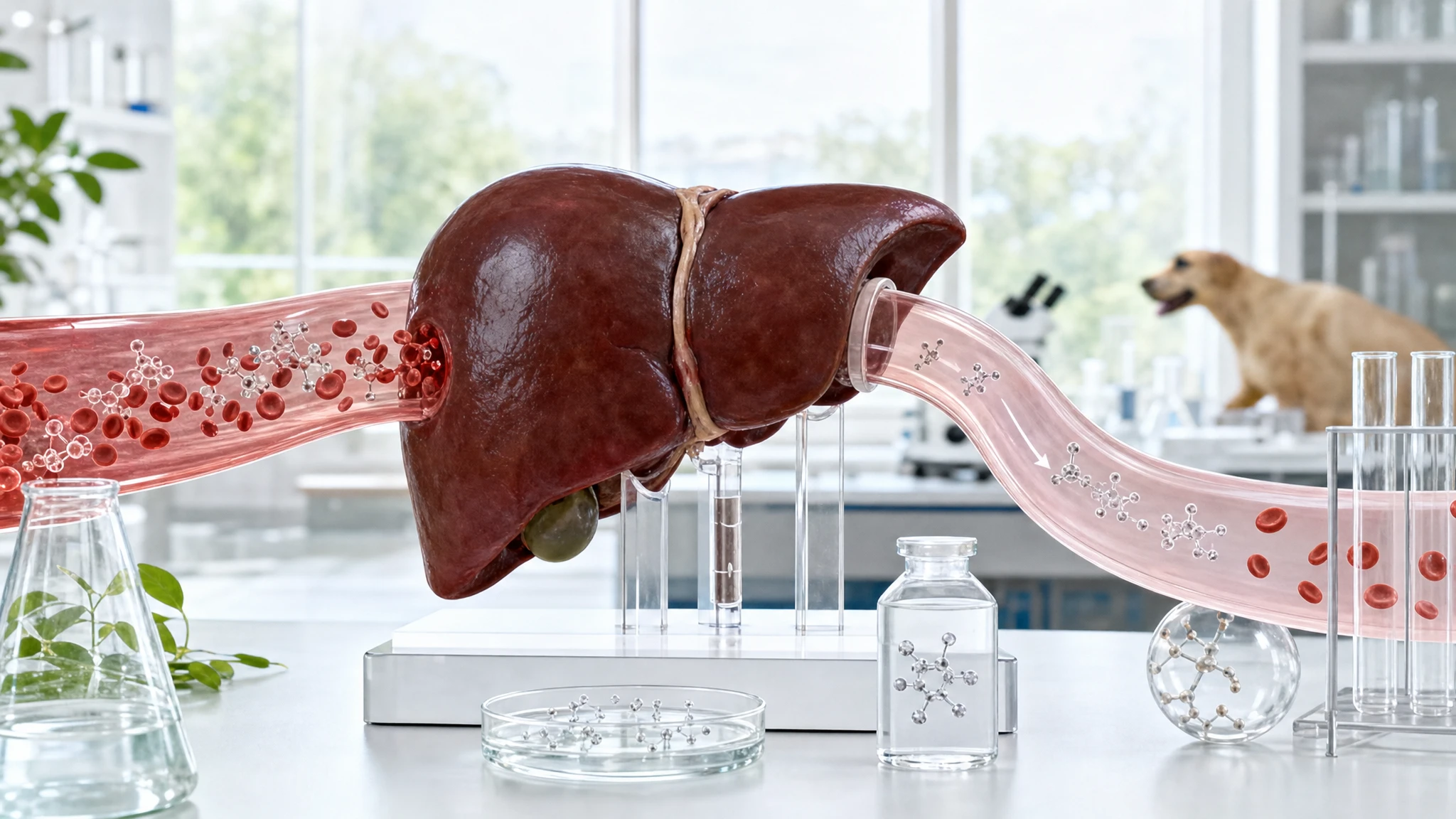
ABSTRACT
The original study examined whether, in 90 healthy dogs, insulin sensitivity depended primarily on adiposity, pancreatic secretion, or insulin clearance—that is, the body's ability to remove the hormone from the blood. Metabolic insulin clearance was found to be the factor most strongly associated with higher insulin sensitivity; conversely, lower clearance was accompanied by higher basal insulinemia and lower sensitivity.
The research contributes to the narrative of "The Choice to Live in Health or Illness" by Dr. A. Colonnese and R. Panzironi, which suggests that reduced insulin elimination can promote hyperinsulinemia and be associated with insulin resistance. Independent studies in humans confirm the association between lower clearance, lower sensitivity, and higher metabolic risk; mouse models also support a possible causal sequence. However, some human data indicate that, when evaluating insulin secretion and sensitivity simultaneously, clearance might not be an independent determinant of dysglycemia. The most prudent conclusion is that clearance is a relevant component of metabolic regulation, but its causal role in humans requires further confirmation.
Analyzed study
Hepatic insulin clearance is the primary determinant of insulin sensitivity in the normal dog
DOI: 10.1002/oby.20625
PMID: 24123967
PMCID: PMC3969862
The research question was which factor best explains the differences in insulin sensitivity under basal conditions, i.e., after an overnight Fasting and before any dietary or pharmacological interventions. The authors compared three potential determinants: the amount and distribution of adipose tissue, the secretory response of pancreatic beta cells, and insulin clearance, which is the rate at which the hormone is removed from circulation.
The hypothesis was that a reduction in clearance, especially hepatic, could increase circulating insulin and be associated with a progressive reduction in the hormone's effectiveness in tissues. This is the segment relevant to sections 2.2 and 3.3 of “The Choice to Live in Health or Illness” by Dr. A. Colonnese and R. Panzironi: clearance is not just an elimination process, but a regulator of tissue exposure to insulin.
The study documents a strong association between higher clearance and greater insulin sensitivity in healthy dogs. However, since the data are primarily collected at a single point in time and in an animal model, it cannot establish on its own whether reduced clearance precedes insulin resistance, is a consequence of it, or contributes to both directions of the relationship.
Materials and methods of the original study
The authors analyzed baseline data from 90 male mixed-breed dogs, approximately one year old with an average weight of 28.7 ± 0.3 kg. The animals were metabolically healthy, with normal glucose tolerance, and the data were derived from several previous studies. All measurements were taken after overnight fasting, prior to the initiation of any pharmacological or dietary treatments. No formal inclusion or exclusion criteria are reported beyond the description of their health status and normal glucose tolerance.
Whole-body insulin sensitivity was measured primarily using the hyperinsulinemic-euglycemic clamp, a technique in which insulin is infused while maintaining stable glycemia: a greater amount of glucose required to maintain this balance generally indicates a greater response to insulin. In 36 dogs, sensitivity was also assessed using an intravenous glucose tolerance test and a minimal model. Total, visceral, and subcutaneous adipose mass were measured in all animals using magnetic resonance imaging.
Insulin clearance was calculated primarily during the clamp by dividing the amount of infused insulin by its stable plasma concentration. In a subgroup, it was also estimated following an intravenous insulin injection. Glucose-stimulated secretion was assessed in 86 dogs using a graded hyperglycemic clamp and in 36 using an intravenous test. Associations were examined using correlation and multiple regression analysis, accounting for procedural differences between the aggregated studies.
Results
The dogs had relatively uniform fasting glycemia, averaging 93.5 ± 0.7 mg/dl, but showed very wide differences in both fat quantity and insulin response. Trunk adipose mass varied nearly eightfold, from 172 to 1,363 cm³. Insulin sensitivity measured by clamp varied nearly thirteenfold, from 5.9 to 75.9 dl/min/kg per μU/ml. This data indicates that animals with normal glycemia can have very different capacities to respond to insulin.
A greater amount of total, visceral, and subcutaneous fat was associated with lower insulin sensitivity; the adjusted associations were statistically significant, with p<0.012, p<0.017, and p<0.025, respectively. Fasting insulin was also inversely associated with sensitivity: higher insulin concentrations were accompanied by a lower tissue response to the hormone.
The central finding, however, was the positive relationship between insulin clearance and insulin sensitivity. Higher clearance was associated with greater sensitivity, while lower clearance predicted greater insulin resistance. The correlation between clearance and sensitivity derived from the clamp was r=0.53, with p<0.00001; in simple terms, in the sample, the capacity to clear insulin was more closely linked to sensitivity than indices of pancreatic secretion. The relationship was confirmed in the subgroup evaluated with an intravenous test.
Indices of glucose-stimulated insulin secretion were not significantly associated with sensitivity in the main analysis. The authors report p=0.36 for the acute insulin response to glucose and p=0.07 for the slope of the glucose-insulin relationship obtained from the hyperglycemic clamp. These results do not demonstrate that secretion is irrelevant in metabolic physiology; they only indicate that, in this cohort of healthy, fasting dogs, it was not the dominant predictor of insulin sensitivity.
Interpretation
The biological significance is that the amount of insulin in the blood depends on two processes: how much insulin the pancreas releases and how much insulin the body, especially the liver, removes. If insulin clearance decreases, the same secreted amount can remain in the blood for longer and produce hyperinsulinemia, i.e., persistently high concentrations of the hormone.
The analyzed study directly supports the part of the narrative stating that lower clearance is associated with lower insulin sensitivity and higher insulinemia. This association was found to be stronger than that observed for adiposity and insulin secretion in this experimental model. The authors therefore proposed a possible chain: lower hepatic clearance → higher circulating insulin → prolonged tissue exposure to insulin → reduced insulin sensitivity.
However, this causal sequence remains a hypothesis in the context of the study. Clearance and sensitivity were measured using rigorous and independent techniques, but clearance was not selectively manipulated in the dogs to demonstrate that its reduction produced insulin resistance. Furthermore, results in animals cannot be automatically transferred to human physiology and the natural history of diabetes.
Independent supporting evidence
Confirmation in humans of the relationship described in the book comes from a study of 91 adults with obesity but without diabetes. Participants were divided into three groups based on insulin resistance. In the least marked resistance, reduced insulin clearance represented the first detectable adaptation; in more resistant forms, an increase in insulin secretion was also observed. The cross-sectional design does not define the cause, but it confirms the sequence in which lower clearance can appear before a greater compensatory secretory response [1].
A second study evaluated 110 lean or obese adolescents using a clamp and oral glucose tolerance test, with a re-evaluation after two years. Insulin sensitivity was directly correlated with whole-body clearance: when sensitivity decreased, hepatic clearance decreased. Furthermore, lower initial hepatic insulin extraction was an independent determinant of worse beta-cell function at follow-up. This is longitudinally informative human evidence, but not proof that clearance is the primary cause of reduced sensitivity [2].
Consistency with a possible clinical impact is reinforced by a prospective cohort of 570 Native American adults without diabetes. Of the 448 participants followed for a median of 7.9 years, 146 developed type 2 diabetes. Lower metabolic clearance was associated with greater adiposity, higher fasting insulin, lower insulin sensitivity, and a higher risk of incident diabetes after adjustment for major metabolic factors. The hazard ratio for a one-standard-deviation difference in clearance was 0.77, with a 95% confidence interval of 0.61-0.98 and p=0.03: since the value is less than one, higher clearance was associated with lower risk, and therefore lower clearance with higher risk. The study is observational and concerns a specific population, so it does not prove the causal mechanism on its own [3].
A mouse model, on the other hand, offers an experimental verification of the proposed sequence. In mice with inactivation of CEACAM1, a protein that promotes the uptake and degradation of insulin in the liver, clearance was reduced and hyperinsulinemia increased without a documented increase in glucose-induced insulin secretion. Subsequently, insulin resistance appeared, especially hepatic. Genetic manipulation makes this evidence closer to a causal test, but it concerns mice and a specific molecular alteration, not the set of causes of human insulin resistance [4].
Conflicting evidence
An analysis of 353 non-Hispanic white and African American adults who underwent an oral glucose tolerance test found that reduced clearance, lower sensitivity, and lower beta-cell function were each associated with early dysglycemia when considered separately. However, in the model that simultaneously included clearance, sensitivity, and secretion, only insulin resistance and reduced secretion remained independently associated with prediabetes or newly diagnosed type 2 diabetes [5].
This result does not deny that lower clearance accompanies hyperinsulinemia or reduced sensitivity. It does, however, indicate that in that sample, and with estimates derived from the oral test, clearance may primarily act as an adaptation or a biomarker related to other metabolic defects, rather than as a dominant independent factor. The difference compared to the original study may depend on the animal model versus humans, the cross-sectional design, the measurement methods, and the stage of the disease analyzed.
Summary table of evidence
The table distinguishes the associative result observed in the original study from independent confirmations in humans and experimental models.
| Reference | Study type | Population or model | Main result | Direction of evidence | Strength of evidence |
|---|---|---|---|---|---|
| Original study | Animal, observational with direct physiological measurements | 90 healthy male mixed-breed dogs | Higher clearance associated with higher insulin sensitivity; secretion not a dominant predictor | biologically consistent evidence | moderate |
| [1] | Cross-sectional observational | 91 adults with obesity without diabetes | Reduced clearance emerged as the primary adaptation to lower sensitivity; secretion increased in the most resistant groups | direct confirmation | moderate |
| [2] | Observational with follow-up | 110 lean and obese adolescents | Lower sensitivity correlated with lower clearance; initial hepatic extraction associated with subsequent beta-cell function | direct confirmation | moderate |
| [3] | Prospective cohort | 570 Native American adults without diabetes | Lower clearance associated with higher subsequent risk of type 2 diabetes | direct confirmation | moderate |
| [4] | Genetic animal model | Mice with CEACAM1 inactivation and controls | Reduced clearance and hyperinsulinemia preceded insulin resistance, without increased glucose-stimulated secretion | direct confirmation | moderate |
| [5] | Cross-sectional observational | 353 non-Hispanic white and African American adults | Reduced clearance did not remain independently associated with dysglycemia after joint consideration of sensitivity and secretion | discordant evidence | moderate |
Confirmation of the evidence
Claim in the book
In the analyzed paragraphs of “The Choice to Live in Health or Illness” by Dr. A. Colonnese and R. Panzironi, insulin clearance is described as a regulator of the amount of hormone that reaches the tissues. The central claim is that a reduction in clearance can increase circulating insulin, promote persistent tissue exposure to the hormone, and contribute to the development of insulin resistance, rather than being merely a consequence of it.
Reduced hepatic clearance → longer insulin persistence in the blood → persistent hyperinsulinemia → lower insulin sensitivity → higher metabolic risk
The publication subject to the Evidence Review was used in the book to support the following passage: in metabolically healthy animals, a lower capacity to clear insulin is associated with higher basal insulinemia and lower insulin sensitivity, with a stronger association than that observed for adiposity and pancreatic secretion.
The publication subject to the Evidence Review documents the link between clearance and sensitivity in dogs, but proposes the causal direction from reduced clearance to insulin resistance as a hypothesis. Independent literature expands on this observation. In adults with obesity without diabetes, lower clearance may appear as an early adaptation when sensitivity decreases, prior to a more evident increase in insulin secretion [1]. In adolescents, lower sensitivity and lower clearance are correlated, while initial hepatic insulin extraction is associated with subsequent β-cell function [2].
In a prospective cohort of Native American adults, lower clearance was associated with a higher future risk of diabetes even after adjustment for sensitivity, secretion, and adiposity [3]. In mice, genetically induced reduction of clearance via CEACAM1 produced hyperinsulinemia and subsequent insulin resistance, offering mechanistic causal support for the proposed chain [4]. However, in the MILES study, reduced clearance did not maintain an independent association with dysglycemia when sensitivity and secretion were considered together [5]. For "The Choice to Live in Health or Illness" by Dr. A. Colonnese and R. Panzironi, the evidence therefore supports the relevant role of clearance in the regulation of hyperinsulinemia and sensitivity, but requires caution in attributing a universal causal role to it in humans.
Overall level of confirmation
MODERATE CONFIRMATION
The relationship between reduced clearance, hyperinsulinemia, and lower sensitivity is replicated in human and animal studies, with a prospective cohort linking reduced clearance to a higher incidence of type 2 diabetes. Causality is primarily supported by murine models, while human data remain largely observational and not entirely consistent.
Conclusions
The original study convincingly shows that, in the healthy dogs examined, insulin clearance is closely associated with insulin sensitivity and basal hormone concentrations. This supports the physiological relevance of the liver as a regulator of systemic insulin exposure. Independent evidence in humans is consistent with lower clearance being associated with lower sensitivity and higher metabolic risk, while experiments in mice make a causal relationship plausible. However, the demonstration that reduced clearance is an early and causal event in human type 2 diabetes remains incomplete and requires validation in larger longitudinal and interventional studies.
Overall assessment
The narrative is moderately supported. The link between reduced clearance, hyperinsulinemia, and lower sensitivity is fairly well documented in animals and observed in humans. The causal mechanism is confirmed primarily at the murine level; in clinical data, differences remain between populations, measurement methods, and statistical models.
References
[1] Adapting to insulin resistance in obesity: role of insulin secretion and clearance
[2] Lower Insulin Clearance Parallels a Reduced Insulin Sensitivity in Obese Youths and Is Associated With a Decline in b-Cell Function Over Time
[3] Lower insulin clearance is associated with increased risk of type 2 diabetes in Native Americans
[4] Carcinoembryonic Antigen-Related Cell Adhesion Molecule 1
[5] Defining the Relative Role of Insulin Clearance in Early Dysglycemia in Relation to Insulin Sensitivity and Insulin Secretion: The Microbiome and Insulin Longitudinal Evaluation Study (MILES)
Editorial note
Artificial Intelligence was used solely as a tool to support editorial and documentary work. All content, interpretations, bibliographic citations and conclusions have been verified, reviewed and approved by the author, who assumes full scientific responsibility for them.
The manuscript was also subject to independent peer review prior to publication.
To ensure maximum transparency, the article's complete history — including the dates of submission, review, acceptance and publication, as well as information on the peer review process — is available on the dedicated Article History page.