


Hyperinsulinemia causes glomerular podocyte damage and albuminuria through a self-amplifying GSK3b-IRS1 insulin desensitization circuit - A review of the evidence
The study shows that, in mice and podocytes, prolonged excess insulin reduces insulin signaling, activates GSK-3b, and damages the intestinal barrier, increasing urinary albumin. Independent evidence confirms the inhibitory role of GSK-3b on IRS-1 and the human association, but specific, replicated, and long-term renal clinical trials are lacking.
- Published 19/11/2026
- Updated 19/11/2026
- Article history
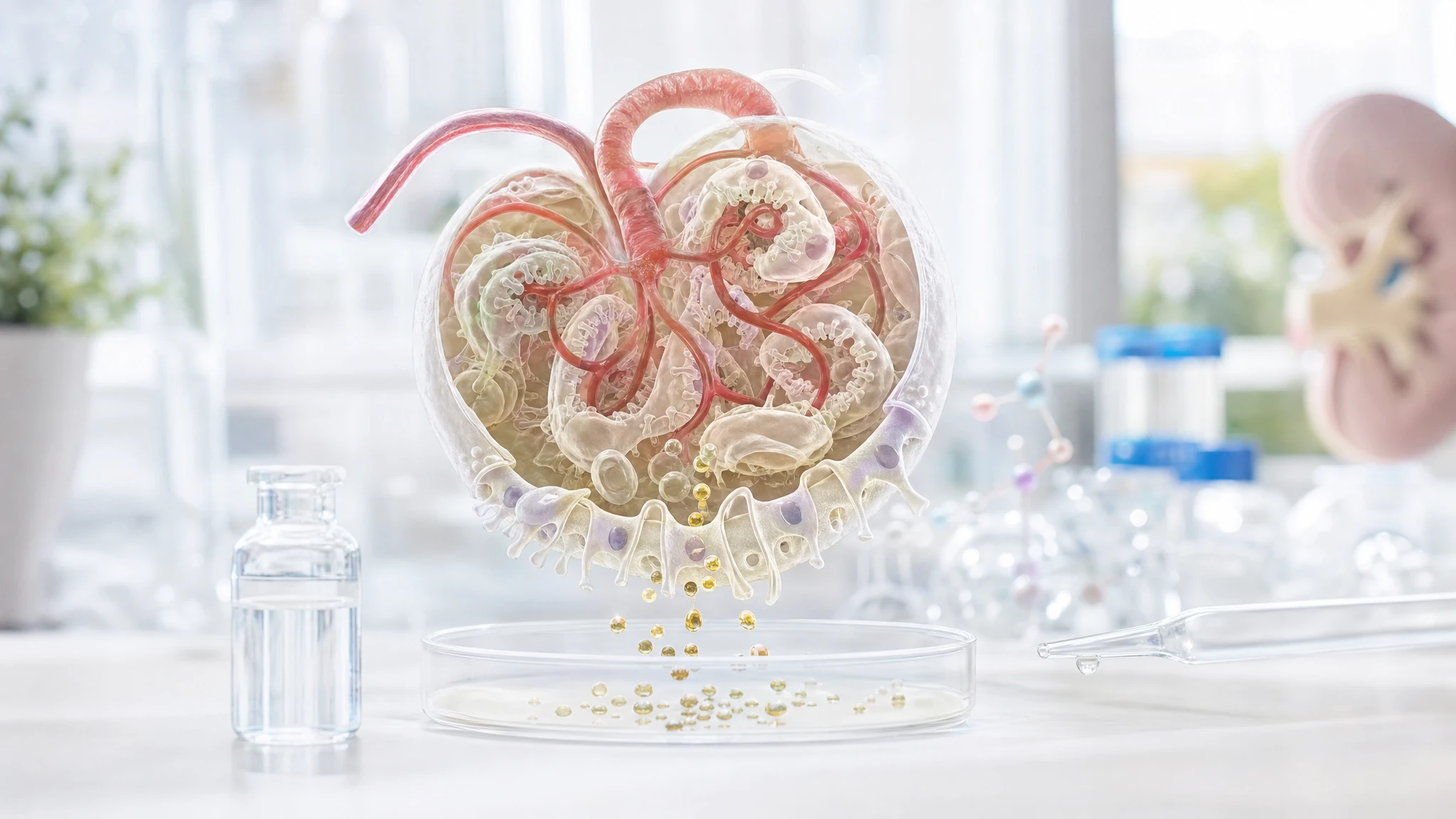
ABSTRACT
The analyzed study evaluated whether hyperinsulinemia, i.e., a persistent excess of insulin in the blood, can directly damage glomerular podocytes, which are essential cells of the barrier that prevents proteins from passing into the urine. The authors combined experiments in pre-diabetic db/db mice, genetically modified mice, laboratory-cultured murine podocytes, and treatment with tideglusib, a GSK-3b inhibitor.
In the experimental models, the increase in insulin preceded hyperglycemia and was accompanied by albuminuria, loss of podocyte integrity signals, and reduced insulin response. The central finding is the proposal of a circuit in which reduced AKT activity leaves GSK-3b more active; this modifies IRS-1 in an inhibitory manner and further renders the insulin pathway less efficient. In "The Choice to Live in Health or Illness" by Dr. A. Colonnese and R. Panzironi, the study thus contributes to the narrative that chronic hyperinsulinemia can promote insulin resistance and organ damage before overt hyperglycemia. Independent research confirms the GSK-3b→IRS-1 molecular pathway, and prospective studies in humans associate elevated insulin with a higher incidence of microalbuminuria. However, the complete circuit is demonstrated primarily in cellular and animal models; it does not prove that tideglusib prevents or cures kidney damage in humans.
Analyzed study
Hyperinsulinemia drives glomerular podocyte injury and albuminuria via a self-perpetuating GSK3b-IRS1 insulin desensitization circuit
DOI: 10.1016/j.metabol.2026.156571
PMID: 41747805
PMCID: PMC13715427
The research question was whether hyperinsulinemia can directly cause damage to the kidney filtration barrier, even before the onset of hyperglycemia, and which cellular mechanism might explain this relationship. The authors' hypothesis is that in podocytes, prolonged exposure to high insulin concentrations progressively depletes the insulin receptor and reduces the cell's response to the hormonal signal.
The central segment concerns the IRS1–PI3K–AKT pathway. IRS-1 (insulin receptor substrate 1, an adapter protein that transmits the signal from the insulin receptor) helps activate PI3K and AKT, two components that promote glucose utilization and, among other things, limit GSK-3b. When AKT is less active, GSK-3b can remain more active. The study proposes that active GSK-3b phosphorylates IRS-1 on serine 332, further reducing its function: a circuit of mutual worsening of insulin sensitivity.
This is why the publication is relevant to both paragraph 4.13 and paragraph 14.9 of “The Choice to Live in Health or Illness” by Dr. A. Colonnese and R. Panzironi. It does not prove that every human case of albuminuria depends on this circuit, nor does it prove that hyperinsulinemia is the only cause of kidney disease. Instead, it documents, in preclinical models, a plausible causal pathway between attenuated insulin signaling, GSK-3b hyperactivity, IRS-1 inhibition, podocyte damage, and albuminuria.
Materials and methods of the original study
The authors primarily used male db/db mice, a model with a leptin receptor mutation that develops obesity, hyperinsulinemia, and subsequently type 2 diabetes. They were compared with control db/m mice at 4, 6, and 10 weeks of age. The number of animals per group is not reported in the available material. In a separate experiment, 4-week-old db/db mice were randomized to receive tideglusib 5 mg/kg intraperitoneally every other day for two weeks or the vehicle.
A genetic model in which GSK-3b is constitutively active was also studied: heterozygous GSK3bS9A mice, compared with wild-type littermates and evaluated at 8 weeks. Immortalized and differentiated murine podocytes were used in culture, exposed to 100 nM insulin for periods ranging from 30 minutes to 10 days; some were treated with 5 μM tideglusib. The authors also artificially increased GSK-3b activity or reduced it through genetic mutants and insulin receptor silencing.
The main measurements included the urinary albumin/creatinine ratio, known as uACR (an index of the amount of albumin excreted in the urine), the expression of podocin and synaptopodin as indicators of podocyte integrity, EGR1 as an indicator of cellular stress, glucose uptake, immunoblotting, immunofluorescence, co-immunoprecipitation, and protein phosphorylation analysis. For statistical analysis, t-tests, analysis of variance, and linear regressions were used; the authors considered a P-value of less than 0.05 to be significant. The complete numerical values for the figures, group sizes, and several details of the supplementary methods are not reported in the available material.
Results
In db/db mice, serum insulin was already elevated at 4 weeks, when glycemia was comparable to that of the controls. At 6 weeks, albuminuria was present, preceding the marked hyperglycemia observed at 10 weeks, when mean glycemia exceeded 300 mg/dL. In the glomeruli of prediabetic mice, podocin decreased and EGR1 increased, while the podocyte number marker WT1 changed little. In other words, the filtering cells appeared to be suffering before any evident numerical loss.
Glomerular insulin signaling was attenuated: the amount of the insulin receptor β subunit was reduced, and insulin induced less AKT phosphorylation. Phosphorylation is a chemical modification that can turn a protein on or off; in this case, lower AKT phosphorylation indicates a reduced intracellular response to insulin. In parallel, glucose uptake in isolated glomeruli decreased following insulin stimulation.
The finding most relevant to the book's narrative is that GSK-3β was more highly expressed and less phosphorylated at the Ser9 position. Since phosphorylation at Ser9 normally inhibits GSK-3β, the reduction in the p-GSK3βSer9/GSK3β ratio was interpreted as increased kinase activity. In podocytes, GSK-3β and IRS-1 co-localized, and co-immunoprecipitation supported their physical interaction; exposure to high insulin increased this. As exposure was prolonged, the insulin receptor decreased, inhibitory phosphorylation of IRS-1 at Ser332 increased, and the AKT signal decreased.
Manipulation experiments reinforced the causal relationship in the model. Making GSK-3β constitutively active increased the inhibitory phosphorylation of IRS-1, reduced AKT phosphorylation, and worsened indicators of podocyte damage. Conversely, an inactive form of the kinase or tideglusib reduced IRS-1 phosphorylation at Ser332, increased the AKT response, and preserved podocyte markers. In GSK3βS9A mice, albuminuria increased with no reported differences in glycemia, insulin, or blood pressure compared to controls. In db/db mice, two weeks of tideglusib reduced albuminuria and indicators of podocyte damage. The available text does not report the absolute values, confidence intervals, or P-values of the individual figures.
Interpretation
The proposed biological significance is that high chronic insulin exposure may make the podocyte less capable of responding to further insulin signals. A podocyte functions as part of a highly selective filter; if it is altered, a greater amount of albumin can reach the urine. In the study, this damage is not attributed solely to hyperglycemia, because in db/db mice, some changes were already detectable in the prediabetic phase.
The mechanistic detail is the sequence: reduction of the insulin receptor and the IRS-1–PI3K–AKT pathway → less inhibition of GSK-3b → greater inhibitory phosphorylation of IRS-1 → further attenuation of the insulin signal. This is precisely the link in the chain that connects this work to the chapters of the book: GSK-3b is not described only as an enzyme downstream of insulin, but also as a negative regulator capable of compromising IRS-1 when it remains active.
The data support causality within the experimental models, because the authors modified GSK-3b both genetically and pharmacologically. However, important limitations remain. The db/db model presents many metabolic alterations beyond hyperinsulinemia; the cellular model uses 100 nM of insulin, a concentration that does not automatically equate to the exposure of human podocytes; and tideglusib may have biological effects beyond the specific target studied. The renal protection observed in animals does not constitute a demonstration of clinical efficacy in humans.
Independent supporting evidence
The most direct part of the narrative, namely that GSK-3 can modify IRS-1 and reduce insulin signaling, had already been demonstrated in an independent model by Eldar-Finkelman and Krebs. The authors studied purified IRS-1 and CHO cells engineered to express the insulin receptor and IRS-1. GSK-3 phosphorylated IRS-1, and this modification reduced the insulin-induced tyrosine phosphorylation of IRS-1. In cells expressing normal GSK-3 or the active S9A variant, tyrosine phosphorylation of IRS-1 dropped to 62% and 55% of the control, respectively; that of the insulin receptor also decreased to 78.3% and 58.3%. This directly confirms the GSK-3b→IRS-1→signal attenuation principle, although it is not a study on the kidney or albuminuria [1].
A second level of the narrative concerns the link between reduced insulin sensitivity and the subsequent onset of albuminuria in humans. In a prospective cohort of 1,192 non-diabetic Korean men initially without microalbuminuria, followed from 2005 to 2010, the incidence of microalbuminuria increased from 1.8% in the lowest tertile of fasting insulin to 6.5% in the highest tertile. Compared to the lowest tertile, the relative risk estimated as a hazard ratio was higher both in the intermediate tertile (95% confidence interval 1.01–5.89) and in the highest tertile (95% confidence interval 1.40–7.78). A hazard ratio compares the rate at which an event occurs in the groups studied. This data does not identify GSK-3b or IRS-1 in the kidneys of the participants and does not prove causality, but it confirms in humans the direction of the prospective association between higher fasting insulin and increased onset of albuminuria [2].
The two pieces of evidence are complementary: the first documents the molecular mechanism in cells, the second documents a prognostic association in the population. Together, they do not prove that the same circuit is responsible for all human cases of albuminuria, but they make the experimental model proposed by the analyzed study biologically coherent.
Conflicting evidence
A small experimental study in humans indicates that the effect of insulin on the kidney depends on the clinical context and the duration of exposure. Twelve healthy volunteers and twelve people with type 2 diabetes without albuminuria underwent, on separate days, four hours of high or low insulin infusion while maintaining stable glycemia. In healthy volunteers, high insulin did not significantly increase urinary albumin excretion. In people with type 2 diabetes, however, albumin excretion increased from 3.6 ± 0.8 to 5.4 ± 1.1 μg/min, with P less than 0.01 [3].
This result does not directly contradict the GSK-3b–IRS-1 cellular circuit, which was not measured in the human study. However, it scales back an overly broad interpretation: an acute increase in insulin does not necessarily produce albuminuria in all individuals. The difference between four-hour exposure and chronic hyperinsulinemia, the presence of diabetes, and the different renal sites involved can modify the effect. No directly conflicting evidence sufficiently relevant to the phosphorylation of IRS-1 by GSK-3b in podocytes has been identified; this does not prove the absence of contrary results.
Summary table of evidence
The table distinguishes the publication subject to the review from independent research that confirms or defines specific steps of the narrative.
| Reference | Study type | Population or model | Main result | Direction of evidence | Strength of evidence |
|---|---|---|---|---|---|
| Original study | Animal, cellular, and genetic | db/db mice, GSK3bS9A mice, and murine podocytes | Prolonged hyperinsulinemia associated with reduced IRS1–PI3K–AKT signaling, increased GSK-3b activity, podocyte damage, and albuminuria; GSK-3b inhibition attenuated these outcomes. | direct confirmation | moderate |
| [1] | Cellular and biochemical | Purified IRS-1 and CHO cells with insulin receptor and IRS-1 | GSK-3 phosphorylated IRS-1, and increased GSK-3 reduced insulin-stimulated phosphorylation of IRS-1 and the receptor. | direct confirmation | moderate |
| [2] | Prospective observational | 1,192 non-diabetic Korean men without baseline microalbuminuria | Higher fasting insulin associated with increased future incidence of microalbuminuria. | indirect confirmation | moderate |
| [3] | Acute human experimental | 12 healthy volunteers and 12 people with type 2 diabetes | Acute insulin infusion did not significantly increase albuminuria in healthy individuals, but it did increase it in people with type 2 diabetes. | discordant evidence | low |
Confirmation of the evidence
Claim in the book
In sections 4.13 and 14.9, “The Choice to Live in Health or Illness” by Dr. A. Colonnese and R. Panzironi describes GSK-3b as a negative regulator of IRS-1 when it remains active. The book links this mechanism to a reduction in insulin transduction and, in the kidney, to the possibility that chronic hyperinsulinemia may promote early podocyte damage and albuminuria even before overt hyperglycemia.
Persistent hyperinsulinemia → reduction of the insulin receptor and the IRS1–PI3K–AKT pathway → reduced inhibition of GSK-3b → inhibitory phosphorylation of IRS-1 → further insulin desensitization → podocyte damage and albuminuria
The publication subject to the Evidence Review was used in the book to support the following passage: in podocytes, a persistent reduction in insulin signaling can leave GSK-3b more active; GSK-3b can then inhibit IRS-1, creating a circuit that amplifies insulin desensitization and is associated with damage to the renal filtration barrier.
The correspondence with the book is specific rather than generic. The analyzed study documents, in podocytes and murine models, the segment GSK-3b activates → greater inhibitory phosphorylation of IRS-1 → lower AKT activity, with functional consequences on the filtering cell and on albuminuria. The biochemical basis of the GSK-3→IRS-1 pathway is confirmed by an independent experiment in which GSK-3 phosphorylated IRS-1 and reduced the response of IRS-1 and the insulin receptor [1].
The part of the narrative regarding the possible early onset of a renal complication receives observational support in humans: higher fasting insulin levels have been associated with a greater future incidence of microalbuminuria in non-diabetic individuals [2]. This association does not prove that the molecular mechanism identified in podocytes occurred in the participants. Furthermore, an acute experiment indicates that insulin does not necessarily increase albuminuria in healthy subjects, while it does increase it in people with type 2 diabetes, highlighting a dependence on the metabolic condition and the duration of exposure [3].
For “The Choice to Live in Health or Illness” by Dr. A. Colonnese and R. Panzironi, the most rigorous formulation is therefore that the GSK-3b/IRS-1 circuit is well-supported as a mechanism for attenuating insulin signaling, while its role as a driving force for renal complications in humans requires direct validation in clinical and translational studies.
Overall level of confirmation
MECHANISTIC CONFIRMATION
The GSK-3b→IRS-1 molecular pathway is confirmed by independent cellular data, and the analyzed study causally links it to podocyte damage in animal and cellular models. Human evidence supports the association between insulin alterations and albuminuria, but does not directly demonstrate the entire GSK-3b–IRS-1 circuit in human kidneys.
Conclusions
The analyzed study provides consistent preclinical evidence that prolonged hyperinsulinemia can impair the insulin response of podocytes and be associated with albuminuria through a circuit involving GSK-3b and IRS-1. The molecular core of the narrative is well-supported by independent cellular evidence, while prospective data in humans make the link between elevated insulin and the onset of albuminuria plausible. Clinical translation remains preliminary: it has not yet been proven that blocking GSK-3b prevents kidney damage in people with hyperinsulinemia.
Overall assessment
The narrative is confirmed at a mechanistic level: GSK-3b can reduce IRS-1 function, and the analyzed study links this circuit to podocyte damage in preclinical models. The human association between high insulin and albuminuria is fairly well supported, but the complete renal circuit and therapeutic efficacy remain to be clinically demonstrated.
References
[1] Phosphorylation of insulin receptor substrate 1 by glycogen synthase kinase 3 impairs insulin action
Editorial note
Artificial Intelligence was used solely as a tool to support editorial and documentary work. All content, interpretations, bibliographic citations and conclusions have been verified, reviewed and approved by the author, who assumes full scientific responsibility for them.
The manuscript was also subject to independent peer review prior to publication.
To ensure maximum transparency, the article's complete history — including the dates of submission, review, acceptance and publication, as well as information on the peer review process — is available on the dedicated Article History page.