


Hyperinsulinism and Polycystic Ovary Syndrome (PCOS): The role of insulin clearance - Evidence review
In women with polycystic ovary syndrome, the study observed higher insulin levels and lower metabolic clearance compared to women with prediabetes matched for age and weight. This indicates that reduced elimination contributes to hyperinsulinemia, but does not clarify its causes. Independent studies confirm the phenomenon, with significant individual differences.
- Published 14/11/2026
- Updated 17/11/2026
- Article history
ABSTRACT
The analyzed study compared 22 women with polycystic ovary syndrome (PCOS) and normal glucose tolerance with 21 women with prediabetes, matched for age and body mass index. Using a hyperinsulinemic-euglycemic clamp and an oral glucose tolerance test, the authors observed similar peripheral insulin sensitivity in both groups, but lower metabolic insulin clearance in women with PCOS and an inverse relationship between clearance and insulin levels after glucose intake.
The publication contributes to the passage from “The Choice to Live in Health or Illness” by Dr. A. Colonnese and R. Panzironi, which states that excess circulating insulin in PCOS does not depend exclusively on increased pancreatic secretion, but also on reduced elimination of the hormone. Independent studies confirm that reduced clearance is frequent in PCOS, although it shows heterogeneity linked to obesity, androgens, and clinical phenotype. The most prudent conclusion is that reduced clearance contributes to hyperinsulinemia in many, but not necessarily all, women with PCOS.
Analyzed study
Hyperinsulinism and polycystic ovary syndrome (PCOS): role of insulin clearance
DOI: 10.1007/s40618-015-0372-x
PMID: 26294351
The research question was whether hyperinsulinemia—that is, the presence of high concentrations of insulin in the blood—in women with PCOS depends solely on a reduced tissue response to the hormone or also on its decreased elimination. The hypothesis was that women with PCOS and normal glycemia might have an insulin action profile similar to that of women with prediabetes who are comparable in age and body mass index, but differ in the way insulin is cleared from circulation.
The connection to section 3.3 of “The Choice to Live in Health or Illness” by Dr. A. Colonnese and R. Panzironi is precise: the study examines whether elevated insulin in PCOS may reflect reduced metabolic clearance, in addition to pancreatic secretion. Clearance is the rate at which the body removes insulin from the blood; the liver plays a central role in this process, but the measurement taken during the clamp also includes the peripheral removal of the hormone.
The study can therefore document a difference between groups and an inverse association between clearance and circulating insulin. However, it cannot establish the cause of the reduced clearance, nor can it demonstrate that it is the sole origin of hyperinsulinemia or that it necessarily precedes insulin resistance in PCOS.
Materials and methods of the original study
The available material is only the abstract. The study included 22 women with PCOS and normal glucose tolerance and 21 women with prediabetes without hyperandrogenism or ovulatory disorders, matched for age and body mass index. Hyperandrogenism indicates increased levels or effects of androgens, sex hormones also present in women.
All participants underwent a hyperinsulinemic-euglycemic clamp, an experimental procedure in which insulin is infused and glucose is kept stable to estimate how much glucose the body uses in response to the hormone. Insulin sensitivity was assessed using the M-value, which is the amount of glucose required to maintain stable glycemia during the clamp. An oral glucose tolerance test (OGTT) was also performed, with measurements taken after glucose intake.
Insulin secretion was estimated using the insulinogenic index, the oral disposition index, and the area under the curve for insulin over two hours. Clearance was estimated as the metabolic insulin clearance rate during the clamp. Complete inclusion and exclusion criteria, recruitment period, detailed clinical characteristics, infusion dosages, complete statistical methods, and study location are not reported in the available material.
Results
In simple terms, women with PCOS had a higher insulin response after a glucose load, but did not show peripheral insulin sensitivity different from that of women with prediabetes of the same weight and age. The two-hour insulin area under the curve, which summarizes insulin exposure after the test, was greater in PCOS (p<0.011). The insulinogenic index and the oral disposition index were also higher, with p<0.001 respectively.
Overall two-hour glycemia was lower in the PCOS group, with a statistically significant difference. The M-value did not differ between the groups; therefore, no measurable difference in peripheral insulin sensitivity between PCOS and prediabetes emerged in this sample.
The most relevant result for the book concerns clearance. The metabolic insulin clearance rate was lower in women with PCOS: median 420 ml/m²/min, interquartile range 227-588, compared to 743 ml/m²/min, interquartile range 597-888, in women with prediabetes (p<0.001). This means that, during the clamp, insulin was removed from the blood more slowly in the PCOS group.
In the PCOS group, lower clearance was independently associated with a greater area under the insulin curve after glucose: coefficient b=-0.878, p<0.001. The association was also inverse in the prediabetes group, b=-0.501. A negative coefficient here indicates that as clearance decreased, insulin exposure increased. This data shows a strong relationship, but does not by itself prove a causal link.
Interpretation
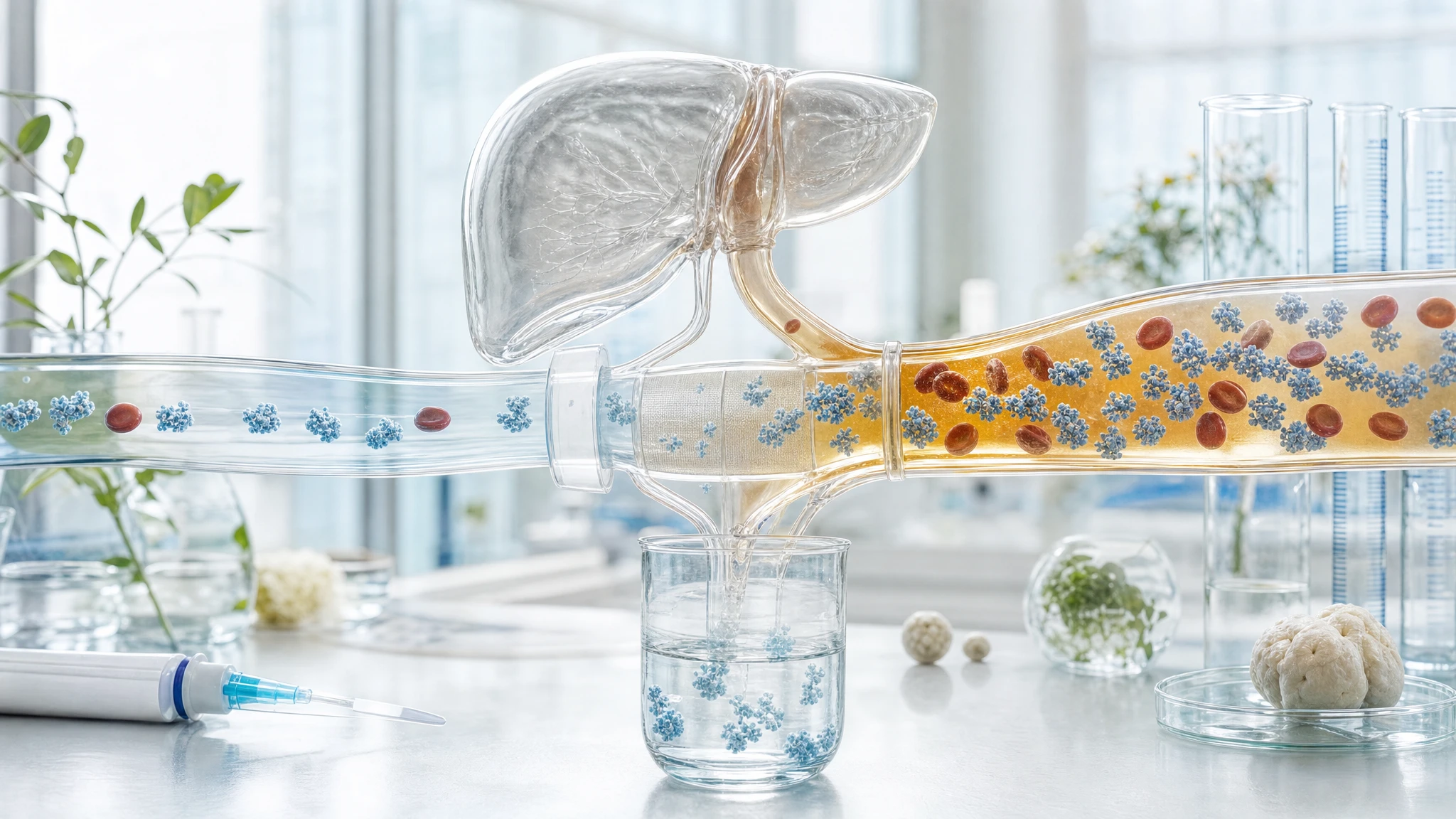
The primary biological significance is that the concentration of insulin in the blood does not depend solely on how much insulin is produced by the pancreas. It also depends on how quickly the body eliminates it. If removal slows down, the same secreted amount can remain in circulation longer and produce higher blood levels.
In the comparison performed, PCOS was distinguished from prediabetes primarily by lower clearance and greater insulin exposure, rather than a difference in the M-value. The segment of the chain documented by the publication subject to the Evidence Review is therefore: PCOS with normal glucose tolerance → reduced metabolic insulin clearance → higher hyperinsulinemia during the OGTT.
The authors interpret the reduced clearance as a major contributor to hyperinsulinemia in PCOS. This is an interpretation consistent with the observed correlation, but the cross-sectional design does not allow for the complete separation of the roles of clearance, secretion, adiposity, androgens, and other metabolic factors. Furthermore, the clearance measured during the clamp is not equivalent to a direct measurement of hepatic insulin extraction alone.
Independent supporting evidence
Independent confirmation comes from a study of 35 women with PCOS and 10 normo-ovulatory controls. The participants underwent an OGTT and a hyperinsulinemic-euglycemic clamp. Hyperinsulinemic women with PCOS showed lower hepatic insulin clearance values compared to both the controls and the normoinsulinemic women with PCOS, regardless of body mass index. The study directly supports the premise that reduced insulin clearance may contribute to hyperinsulinemia in PCOS; however, the sample size was small, and the subgroups were further divided by weight and insulin level [1].
A second, larger study evaluated 190 women with PCOS and normal glucose tolerance using a hyperinsulinemic-euglycemic clamp. Metabolic insulin clearance was reduced in approximately two-thirds of the participants. In multivariate analysis, adiposity, estimates of insulin secretion, and androgen concentrations were independent predictors of clearance. This evidence confirms the direction of the association observed in the analyzed study and adds that the phenomenon is not uniform: reduced clearance is also linked to the individual woman's body composition and hormonal characteristics [2].
Taken together, these studies do not show that pancreatic secretion is irrelevant. Instead, they show that hyperinsulinemia can arise from a combination of two components: increased secretion and decreased removal. This is precisely the specific point in the book's narrative to which the original publication contributes.
Conflicting evidence
A result useful for defining the limits of generalization comes from a study that compared 15 lean women with PCOS and 28 obese women with PCOS with their respective control groups. In lean women with PCOS, no significant differences emerged compared to lean controls regarding early insulin secretion, C-peptide, or hepatic insulin extraction. In obese women with PCOS, however, post-glucose insulin was higher, and early C-peptide secretion did not increase in parallel; hepatic extraction was only slightly and not significantly reduced compared to obese controls [3].
These data do not directly refute the analyzed study, but they indicate that reduced clearance cannot be demonstrated with the same evidence in every PCOS phenotype. Abdominal obesity, fat distribution, diagnostic criteria, method of clearance estimation, and subgroup size can alter the results. No directly conflicting evidence sufficiently relevant to demonstrate an increase in clearance in PCOS has been identified; this does not prove the absence of contrary results.
Summary table of evidence
The table distinguishes the study covered in the review from independent publications and summarizes the level at which each piece of evidence contributes to the narrative.
| Reference | Study type | Population or model | Main result | Direction of evidence | Strength of evidence |
|---|---|---|---|---|---|
| Original study | Comparative observational with clamp and OGTT | 22 normoglycemic women with PCOS and 21 women with prediabetes, matched for age and body mass index | In PCOS, lower metabolic insulin clearance and greater insulin exposure; peripheral sensitivity similar to the prediabetes group | direct confirmation | moderate |
| [1] | Experimental observational with OGTT and clamp | 35 women with PCOS and 10 normo-ovulatory controls | Hyperinsulinemic women with PCOS had lower hepatic clearance compared to controls and normoinsulinemic PCOS | direct confirmation | moderate |
| [2] | Observational with clamp | 190 women with PCOS and normal glucose tolerance | Reduced metabolic clearance in approximately two-thirds of participants; adiposity, secretion, and androgens were independent predictors | direct confirmation | moderate |
| [3] | Comparative observational with OGTT and clamp | 15 lean and 28 obese women with PCOS, with 34 controls stratified by weight | In lean women, no significant differences in hepatic extraction emerged; results varied with obesity | discordant evidence | low |
Confirmation of the evidence
Claim in the book
In section 3.3, “The Choice to Live in Health or Illness” by Dr. A. Colonnese and R. Panzironi, it is stated that in women with PCOS, the excess of circulating insulin depends largely on an impaired elimination of the hormone and not exclusively on increased pancreatic secretion.
PCOS → reduced metabolic insulin clearance → longer insulin persistence in the blood → hyperinsulinemia
The publication subject to the Evidence Review was used in the book to support the following passage: in women with PCOS, when matched for age and body mass index with women with prediabetes, lower metabolic insulin clearance is closely associated with higher insulin concentrations following an oral glucose tolerance test.
The correspondence between the study and the narrative in “The Choice to Live in Health or Illness” by Dr. A. Colonnese and R. Panzironi is direct. The original research does not attempt to demonstrate the entire pathophysiology of PCOS nor to exclude increased pancreatic secretion. Instead, it documents the specific segment according to which lower metabolic clearance accompanies hyperinsulinemia, in a comparison with women with prediabetes similar in age and weight.
Independent literature reinforces this segment. Ciampelli and colleagues found lower hepatic clearance in women with hyperinsulinemic PCOS, even independently of body mass index [1]. Tosi and colleagues later observed reduced metabolic clearance in about two-thirds of 190 women with PCOS and showed that adiposity, insulin secretion, and androgens contribute independently to its variability [2]. However, the overall interpretation must remain cautious: in another study, lean women with PCOS did not show significant differences in hepatic extraction compared to lean controls [3].
The chain is therefore supported in humans at an observational and physiological level: slower clearance can increase exposure to insulin. It remains to be defined, across the different PCOS phenotypes, how much pancreatic secretion, hepatic extraction, peripheral elimination, adiposity, and androgens weigh respectively.
Overall level of confirmation
MODERATE CONFIRMATION
The transition is supported by multiple human studies that employ advanced metabolic tests and show a consistent direction of association. The confirmation is moderate, not strong, because the samples are relatively small or selected, the estimation methods for clearance differ, and the results vary between lean and obese PCOS phenotypes.
Conclusions
The analyzed study appropriately supports the idea that hyperinsulinemia in PCOS should not be interpreted solely as the result of increased pancreatic secretion. In participants with PCOS, metabolic insulin clearance was lower compared to the prediabetes group matched for age and weight, and was associated with a greater insulin response following glucose intake.
Independent evidence confirms that reduced clearance frequently contributes to hyperinsulinemia in PCOS. However, the phenomenon appears heterogeneous and dependent on the clinical context, particularly on adiposity, androgen profile, and individual metabolic characteristics. The book's narrative is therefore moderately supported regarding the specific passage on the contribution of reduced insulin elimination, while the causes and temporal sequence of the phenomenon require further validation.
Overall assessment
The narrative is moderately supported: physiological studies in humans indicate that reduced insulin clearance may contribute to hyperinsulinemia in PCOS, in addition to pancreatic secretion. The mechanism is fairly well supported, but its intensity varies between clinical phenotypes and does not allow for attributing every case of hyperinsulinemia to a single cause.
References
[1] Heterogeneity in beta cell activity, hepatic insulin clearance and peripheral insulin sensitivity in women with polycystic ovary syndrome
[2] Serum Androgens Are Independent Predictors of Insulin Clearance but Not of Insulin Secretion in Women With PCOS
Editorial note
Artificial Intelligence was used solely as a tool to support editorial and documentary work. All content, interpretations, bibliographic citations and conclusions have been verified, reviewed and approved by the author, who assumes full scientific responsibility for them.
The manuscript was also subject to independent peer review prior to publication.
To ensure maximum transparency, the article's complete history — including the dates of submission, review, acceptance and publication, as well as information on the peer review process — is available on the dedicated Article History page.