


Hypothesis: The role of reduced hepatic insulin clearance in the pathogenesis of type 2 diabetes - A review of the evidence
The study proposes that reduced hepatic insulin clearance increases circulating insulin and may promote insulin resistance, beta-cell stress, and type 2 diabetes. Independent studies confirm the link with hyperinsulinemia and future diabetes risk, but do not yet definitively demonstrate that reduced clearance is the initial cause in humans.
- Published 14/11/2026
- Updated 17/11/2026
- Article history
ABSTRACT
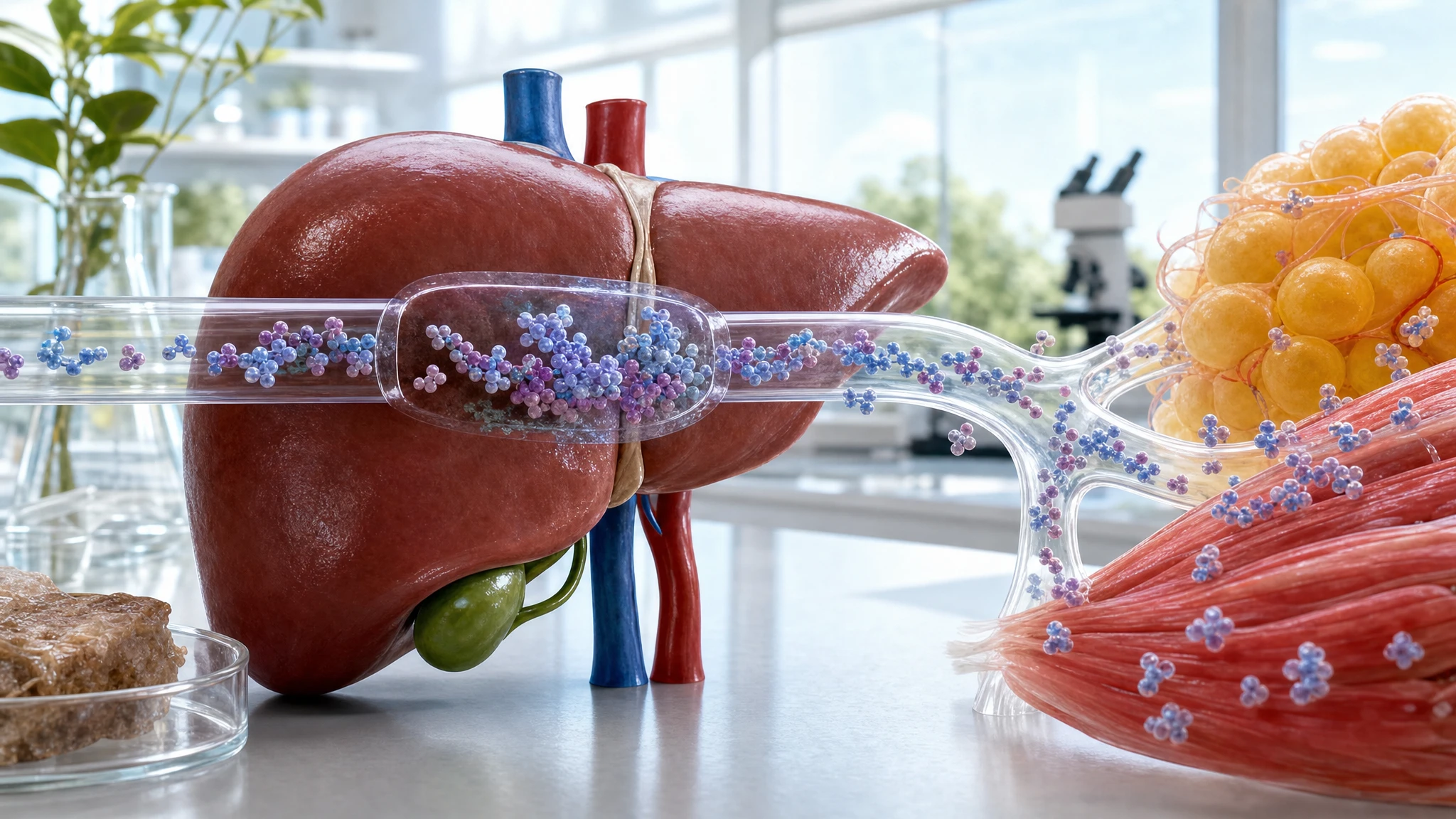
The publication analyzed is a hypothesis paper proposing a possible shift in the sequence of events leading to the development of type 2 diabetes. The authors suggest that, in certain predisposed individuals, the liver may clear less insulin than normal; consequently, a greater amount of the hormone reaches the muscles and adipose tissue. Persistent hyperinsulinemia could then worsen insulin resistance and increase the functional load on pancreatic beta cells.
This proposal contributes to the sections on insulin clearance, hyperinsulinemia, and insulin resistance in "The Choice to Live in Health or Illness" by Dr. A. Colonnese and R. Panzironi. Independent evidence confirms that clearance significantly influences circulating insulin and that lower clearance can precede an increased risk of diabetes. However, the question of causality remains open: other studies interpret the reduction in clearance primarily as a compensatory adaptation to pre-existing insulin resistance.
Analyzed study
Hypothesis: Role of Reduced Hepatic Insulin Clearance in the Pathogenesis of Type 2 Diabetes
DOI: 10.2337/db19-0098
PMID: 31431441
PMCID: PMC6702636
The research question was whether reduced hepatic insulin clearance—that is, a lower capacity of the liver to remove the hormone during its first pass from the pancreas to the general circulation—could be an initial event in the pathogenesis of type 2 diabetes. The hypothesis evaluated is therefore different from the more traditional model, in which insulin resistance comes first and the reduction in clearance represents primarily a compensatory response.
The reason for its relevance to the book's sections is precise: the publication supports the segment of the chain suggesting that lower hepatic insulin elimination can increase the insulin present in the blood without requiring a proportional increase in pancreatic secretion. In simple terms, the insulin level depends both on how much hormone is released by the pancreas and on how quickly it is removed.
The study analyzed is neither a clinical trial nor a prospective cohort. It is a hypothesis paper based on already available data, including the wide individual variability in the amount of insulin removed by the liver and observations that clearance is lower in some populations. It can therefore formulate a coherent pathophysiological explanation, but it cannot prove on its own that reduced clearance causes diabetes in humans.
Materials and methods of the original study
The available material contains only the abstract of the publication. It indicates that this is a hypothesis article, not a new experimental study with participants recruited by the authors.
The available material does not report an overall sample size, inclusion or exclusion criteria, data collection period, control group, interventions, follow-up, laboratory techniques, predefined endpoints, or original statistical analyses. Therefore, there is no information available to assess the risk of selection bias or the precision of any estimates produced by the authors.
However, the abstract does report some contextual data used to construct the hypothesis: the fraction of insulin cleared by the liver can vary from approximately 20% to 80% among individuals; furthermore, it reports a 67% lower hepatic clearance in African Americans compared to European Americans, as well as lower clearance in African American children between 7 and 13 years of age. The detailed characteristics of the studies from which these data are derived are not reported in the available material.
Results
The main finding of the article is conceptual. The authors propose that reduced insulin clearance by the liver increases the amount of insulin reaching the systemic circulation. This condition is defined as peripheral hyperinsulinemia: it means that muscles, adipose tissue, and other organs remain exposed to higher concentrations of insulin.
According to the hypothesis, chronic exposure to elevated concentrations of the hormone may worsen insulin resistance, that is, progressively reduce the tissues' response to insulin. To maintain control of glycemia, pancreatic beta cells would then have to work harder; over time, this overload could contribute to their functional loss and the onset of type 2 diabetes.
The abstract indicates that the fraction of insulin removed by the liver varies from 20% to 80% and that hepatic clearance is reportedly 67% lower in African Americans compared to European Americans. These data show that insulin clearance is not a fixed parameter and can contribute significantly to circulating levels of the hormone. However, the available article does not report the samples, confidence intervals, P-values, or the methods by which these comparisons were obtained.
The result directly relevant to the book is therefore as follows: lower clearance can increase circulating insulin even without demonstrating a proportional increase in pancreatic secretion. The further step, from increased insulin exposure to the development of insulin resistance and diabetes, is presented as a plausible pathophysiological hypothesis and not as direct causal proof provided by this publication.
Interpretation
For the reader, the essential point is that a high blood insulin level does not automatically mean the pancreas is producing too much of the hormone. It may also mean that the liver, and to some extent other organs, are clearing it more slowly. Insulin clearance is therefore a regulator of the amount of insulin that reaches the tissues.
The proposed chain is biologically consistent: reduced hepatic insulin extraction → higher peripheral insulin → possible reduction in tissue response to the hormone → increased functional demand on beta cells. The segment directly documented by the publication subject to the Evidence Review is primarily the initial one, from reduced clearance to greater systemic insulin availability.
The strength of the interpretation is limited by the study design. A hypothesis can integrate experimental, clinical, and physiological observations, but it does not establish the temporal order of events in individual people and does not exclude alternative explanations. For example, visceral obesity, fat accumulation in the liver, increased free fatty acids, and pre-existing insulin resistance can simultaneously reduce clearance and increase circulating insulin.
Consequently, the publication does not prove that every case of type 2 diabetes begins with reduced hepatic clearance. Instead, it plausibly argues that this process may be one of the determinants of hyperinsulinemia and, in some contexts, a possible early factor in metabolic progression.
Independent supporting evidence
Initial confirmation concerns the significance of fasting insulin levels. In an observational study of 470 Mexican-American adults, metabolic insulin clearance was found to be the strongest independent factor associated with fasting insulin concentrations. An increase in clearance was associated with a reduction in fasting insulin, while lower clearance was associated with higher levels. The standardized coefficient for clearance was −0.35, with P <0.0001, which is higher in absolute value than that of insulin sensitivity. This result directly confirms the passage in the book stating that insulinemia depends not only on pancreatic secretion but also on the rate of hormone elimination. As this is a cross-sectional study, it does not establish which phenomenon comes first. [1]
Evidence closer to the proposed temporal sequence comes from a cohort of 570 Native American adults without diabetes at baseline. Among the 448 participants observed for a median of 7.9 years, 146 new cases of diabetes occurred, equal to 32%. Higher metabolic insulin clearance was associated with a lower risk of developing diabetes: for every one-standard-deviation increase in clearance, the hazard ratio, or HR, was 0.77; this corresponds to a 23% relative reduction in the rate of event occurrence. The 95% confidence interval was 0.61-0.98 and the P-value was 0.03, after adjustment for adiposity, insulin secretion, insulin sensitivity, and other factors. The data supports the idea that lower clearance may precede a higher risk of diabetes, but it remains an observational association and not proof of causality. [2]
Overall, these two independent studies build a convergent chain: clearance contributes to circulating insulin levels, and lower clearance, at least in a specific cohort, is associated with a higher probability of future diabetes. They therefore confirm the main points of the book's narrative, even without proving that the reduction in clearance is the initial event in all populations.
Conflicting evidence
An important alternative interpretation emerges from a physiological study conducted on 368 adults with normal glucose tolerance, impaired glucose tolerance, or type 2 diabetes. Metabolic insulin clearance during a euglycemic-hyperinsulinemic clamp—a test that measures the body's response to controlled amounts of insulin—was lower in obese subjects and was inversely associated with insulin resistance, with r = −0.52 and P <0.0001. The authors interpreted this reduction primarily as an adaptation that helps temporarily maintain a sufficient amount of insulin when tissues respond less effectively to the hormone. [3]
In the same study, following an oral glucose load, clearance decreased rapidly in participants without diabetes or with impaired glucose tolerance, whereas this response was reduced in people with type 2 diabetes. This observation indicates that the decrease in clearance may also have a compensatory physiological function and does not necessarily represent an initial defect.
The conflicting evidence does not deny that low clearance may contribute to hyperinsulinemia. However, it reduces certainty regarding the universal causal direction proposed by the hypothesis: in some contexts, reduced clearance may precede or promote insulin resistance, while in others, it may primarily be an adaptive response to insulin resistance, obesity, or changes in insulin secretion.
Summary table of evidence
The table distinguishes the publication subject to the Evidence Review from the independent research used to confirm or define the narrative.
| Reference | Study type | Population or model | Main result | Direction of evidence | Strength of evidence |
|---|---|---|---|---|---|
| Original study | Hypothesis paper | Synthesis of previous data; no new samples reported in the available material | Proposes that reduced hepatic clearance increases peripheral insulin and may contribute to insulin resistance and type 2 diabetes | biologically consistent evidence | preliminary |
| [1] | Cross-sectional observational | 470 Mexican-American adults | Lower metabolic clearance was associated with higher fasting insulin; clearance was the strongest independent determinant | direct confirmation | moderate |
| [2] | Prospective observational | 570 Native American adults without diabetes; 448 followed for a median of 7.9 years | Higher clearance was associated with a lower risk of incident diabetes, HR 0.77 per standard deviation | indirect confirmation | moderate |
| [3] | Cross-sectional physiological observational | 368 adults with normal glucose tolerance, impaired tolerance, or type 2 diabetes | Clearance was reduced in states of insulin resistance, and the authors interpreted it primarily as a metabolic compensation | discordant evidence | moderate |
Confirmation of the evidence
Claim in the book
In the analyzed paragraphs of “The Choice to Live in Health or Illness” by Dr. A. Colonnese and R. Panzironi, the central claim is that blood insulin concentrations result from the balance between pancreatic secretion and clearance, especially hepatic. A reduction in clearance can increase systemic insulin without a proportional increase in secretion and may contribute, over time, to insulin resistance, beta-cell stress, and type 2 diabetes.
Reduced hepatic insulin clearance → higher insulin in systemic circulation → possible chronic hyperinsulinemia → possible insulin resistance and beta-cell stress → increased risk of type 2 diabetes
The publication subject to the Evidence Review was used in the book to support the following passage: reduced hepatic elimination of insulin increases the amount of the hormone that reaches peripheral tissues and can therefore contribute to the development of chronic hyperinsulinemia, which cannot be attributed solely to pancreatic hypersecretion.
The correspondence between the publication and the chapters of “The Choice to Live in Health or Illness” by Dr. A. Colonnese and R. Panzironi is direct on a physiological level: insulin clearance is a necessary component for interpreting insulin levels measured in the blood. A study of 470 Mexican-American adults specifically confirms that lower clearance is associated with higher fasting insulin levels, regardless of insulin sensitivity, body mass index, waist circumference, and glycemia. [1]
The next step, from clearance to future diabetes risk, is supported by prospective data: in a cohort of Native American adults, higher clearance was associated with a lower risk of incident diabetes, even after adjusting for relevant metabolic factors. [2] This reinforces the hypothesis that clearance is not merely a passive indicator of metabolic status.
However, this narrative cannot be considered a causal sequence already proven in humans. A large physiological study observed that reduced clearance accompanies states of insulin resistance and may represent a compensatory adaptation useful for maintaining glycemia in the short term. [3] Independent literature therefore confirms with good consistency the role of clearance in determining hyperinsulinemia and in signaling higher metabolic risk, but the causal direction between clearance and insulin resistance remains an open question.
Overall level of confirmation
MODERATE CONFIRMATION
The original publication is relevant to the passage cited in the book, and independent human data confirm both the association between lower clearance and higher insulinemia, as well as the prospective link to diabetes. The initial causality of reduced clearance, however, remains uncertain because alternative interpretations exist that also consider it a compensatory response to insulin resistance.
Conclusions
Overall assessment
The role of insulin clearance in determining insulinemia is fairly well supported. The association between reduced clearance and diabetes risk is confirmed by prospective data, but the complete causal sequence remains moderately supported. The book's narrative is consistent with the evidence, provided it is presented as a non-definitive pathophysiological hypothesis.
References
[1] Fasting insulin reflects heterogeneous physiological processes: role of insulin clearance
[2] Lower insulin clearance is associated with increased risk of type 2 diabetes in Native Americans
[3] Adaptation of Insulin Clearance to Metabolic Demand Is a Key Determinant of Glucose Tolerance
Editorial note
Artificial Intelligence was used solely as a tool to support editorial and documentary work. All content, interpretations, bibliographic citations and conclusions have been verified, reviewed and approved by the author, who assumes full scientific responsibility for them.
The manuscript was also subject to independent peer review prior to publication.
To ensure maximum transparency, the article's complete history — including the dates of submission, review, acceptance and publication, as well as information on the peer review process — is available on the dedicated Article History page.