


Inhibitory mechanism of caffeine on insulin-stimulated glucose uptake in adipose cells - Evidence review
The study shows that caffeine reduces, in murine adipose cells, the activation of AKT and the movement of GLUT4 necessary for glucose uptake. Independent studies confirm an acute worsening of insulin sensitivity, but do not demonstrate that cortisol, IRS-1/2, and chronic coffee consumption follow the same mechanism in humans under habitual conditions.
- Published 20/11/2026
- Updated 20/11/2026
- Article history
ABSTRACT
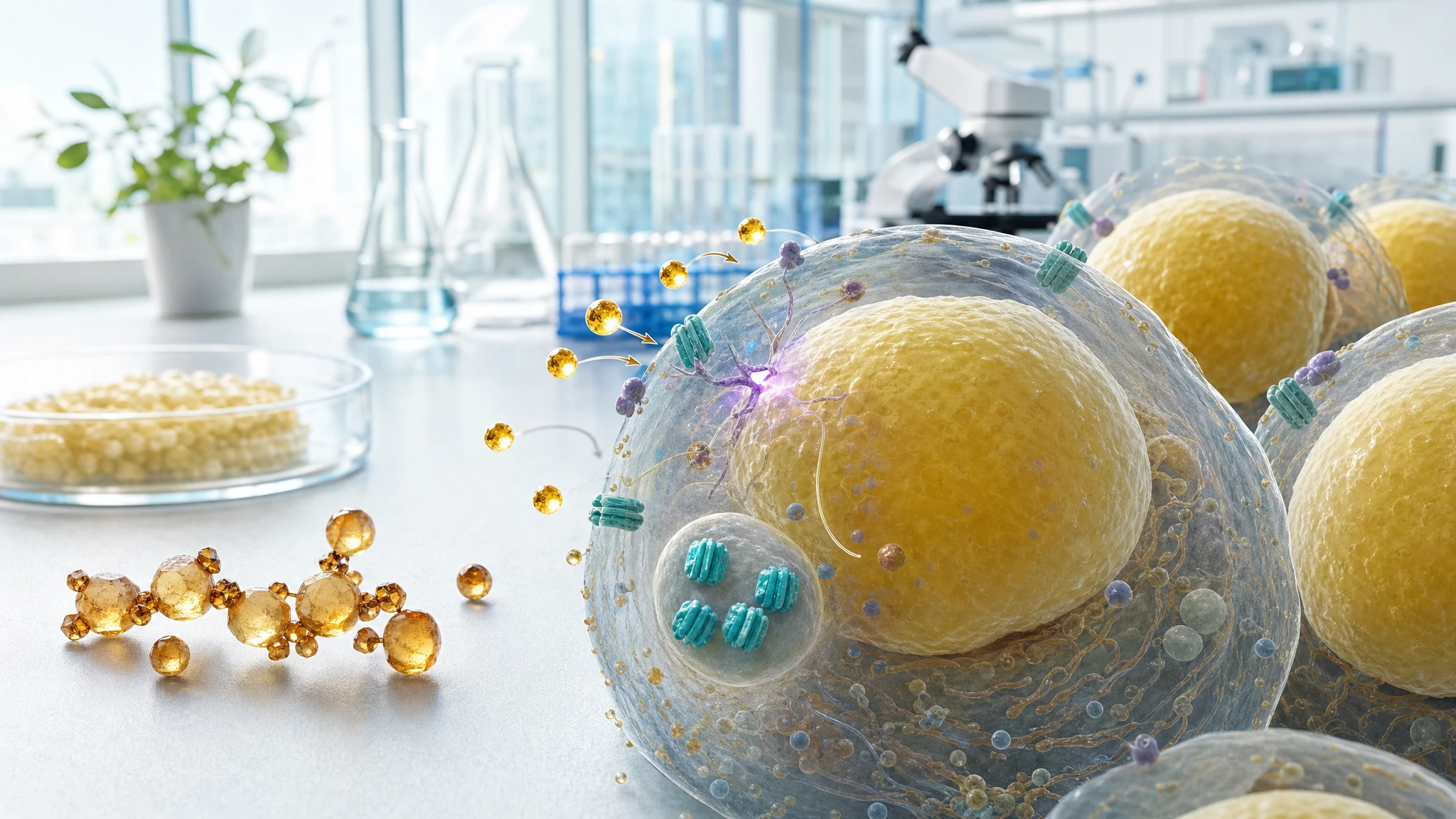
The analyzed study examined whether caffeine can hinder the action of insulin in adipose cells. In adipose cells derived from a murine cell line and in primary brown adipocytes, caffeine reduced the entry of a glucose analog in a concentration-dependent manner. It also reduced AKT activation and GLUT4 translocation, i.e., the movement toward the cell membrane of the protein that allows glucose to enter the cell.
In the narrative of "The Choice to Live in Health or Illness" by Dr. A. Colonnese and R. Panzironi, the publication therefore contributes primarily to the cellular pathway of caffeine → lower AKT signal → lower GLUT4 availability → lower glucose entry. Independent clinical studies and a meta-analysis suggest that acute caffeine intake may reduce insulin sensitivity; however, a 24-week trial on caffeinated coffee did not detect a worsening of insulin sensitivity. The original study did not measure cortisol, the insulin receptor, or IRS-1/2, therefore it does not directly demonstrate that part of the chain described in the book.
Analyzed study
Inhibitory mechanism of caffeine on insulin-stimulated glucose uptake in adipose cells
DOI: 10.1016/j.bcp.2004.07.036
PMID: 15476664
The research question was whether caffeine could reduce insulin-induced glucose uptake in adipose cells and, crucially, through which step of the insulin signaling pathway. The hypothesis was that caffeine interferes with the mechanism that moves GLUT4, a glucose transporter, from the inside of the cell to its surface. When GLUT4 reaches the cell membrane, glucose can enter the cell more easily; if this movement decreases, glucose entry decreases.
The study is relevant to section 4.16 because it documents a precise segment of the proposed chain: caffeine can hinder the phosphorylation—that is, the functional activation—of AKT and reduce the translocation of GLUT4 in adipose cells. However, it cannot demonstrate that this phenomenon occurs with the same intensity in the human body following habitual coffee consumption. Furthermore, the available material is only the abstract: information not reported in the abstract must be considered not reported in the available material.
Materials and methods of the original study
The publication used murine preadipocyte cells MC-3T3-G2/PA6 differentiated into mature fat cells. It also employed cultured primary brown adipocytes. The cells were pretreated with caffeine and then stimulated with insulin; the comparison was therefore between cells exposed to insulin with or without caffeine.
Glucose uptake was evaluated using radiolabeled 2-deoxy-D-glucose, a molecule used as an experimental indicator of glucose transport. The localization of GLUT4 was analyzed to verify whether insulin promoted its translocation to the membrane. The authors also examined the activation of PI3K, PKC-zeta, and AKT, proteins involved in the transmission of the insulin signal within the cell.
The number of experiments, the specific concentrations of caffeine and insulin, the animal selection criteria, the randomization procedures, the complete statistical analyses, and the numerical values are not reported in the available material. No follow-up is reported, consistent with an experiment conducted on cultured cells.
Results
The main finding is that pretreatment with caffeine reduced insulin-induced glucose uptake in murine fat cells in a concentration-dependent manner: as the caffeine concentration increased, the inhibition of glucose uptake increased. The same trend was observed in primary brown adipocytes.
In simple terms, insulin normally sends a signal to the cell to take in glucose. Caffeine weakened a part of this signal. Specifically, it reduced the translocation of GLUT4 to the cell membrane. It also blocked the phosphorylation and activation of AKT, a protein that helps transmit the insulin signal to glucose transport systems.
Caffeine did not alter the activation of PI3K or PKC-zeta under the experimental conditions described in the abstract. This suggests that, in the model studied, the interference did not indiscriminately affect all insulin signals, but was detectable primarily at the level of AKT and the subsequent movement of GLUT4. Absolute values, percentage reductions, P-values, and confidence intervals are not reported in the available material.
Interpretation
The biological significance of the result is limited but clear: in these adipose cells, caffeine made the response to insulin, which facilitates glucose uptake, less efficient. The documented sequence is caffeine → reduced AKT activation → reduced GLUT4 translocation → reduced glucose uptake. AKT is a signaling protein that helps the cell respond to insulin; GLUT4 is the transporter that allows glucose to cross the membrane in tissues such as muscle and adipose tissue.
This step is consistent with the statement in paragraph 4.16, which attributes to caffeine an inhibitory effect on the PI3K/AKT pathway and GLUT4 translocation. However, the study did not measure cortisol, the insulin receptor, or IRS-1/2 substrates. Therefore, it does not demonstrate that the observed effect is amplified by cortisol or that it depends on a dysfunction of the insulin receptor and IRS-1/2. These are additional components of the narrative that require specific evidence.
Since these are cellular experiments and the full text was not accessible, the work provides mechanistic evidence, not a measure of the clinical effect of caffeine or coffee in the general population. Its strength lies in identifying a possible link in the cellular chain; its limitation is that it does not, on its own, establish realistic doses, duration of effect, or metabolic consequences in humans.
Independent confirmatory evidence
The most extensive confirmation of the acute effect on the body comes from a meta-analysis of seven randomized crossover studies conducted on healthy subjects. Compared to the placebo, caffeine reduced the insulin sensitivity index with a standardized mean difference of −2.06, with a 95% confidence interval from −2.67 to −1.44. The result indicates a reduction in the insulin response in the short term, albeit with moderate heterogeneity between studies, equal to 49% [1]. This evidence confirms the overall direction of the book's narrative, but does not directly identify AKT, GLUT4, IRS-1/2, or cortisol.
A randomized, double-blind, crossover trial evaluated 12 healthy volunteers using the euglycemic-hyperinsulinemic clamp, the experimental method that keeps glycemia constant while measuring how much glucose the body uses in response to insulin. Intravenously administered caffeine reduced insulin sensitivity by 15% compared to the placebo. In the same study, adrenaline concentrations increased approximately fivefold; the authors therefore proposed a possible contribution from catecholamines. No increase in cortisol was detected in the work, and the mechanism cannot be reduced to a single pathway [2].
Subsequent experimental research directly examined adipocytes isolated from rodents and human adipose tissue. Caffeine reduced basal and insulin-stimulated transport in rodent adipocytes; in human adipocytes from six donors, 0.1 mM of caffeine showed a trend toward reduced glucose uptake and numerically attenuated the response to insulin. This study is independent and biologically consistent with the original observation, but the concentrations used and the small number of human cells limit direct application to the normal consumption of caffeinated beverages [3].
Taken together, this evidence supports the idea that caffeine may acutely reduce the efficiency with which insulin promotes glucose utilization. Clinical evidence primarily concerns global insulin sensitivity; evidence for the AKT-GLUT4 pathway is derived mainly from isolated cells and tissues. None of the independent studies selected here directly confirm the part of the book's sentence relating to cortisol, the insulin receptor, and IRS-1/2.
Conflicting evidence
A 24-week randomized controlled trial compared four daily cups of instant caffeinated coffee with a placebo beverage in 126 overweight adults with reduced insulin sensitivity. Insulin sensitivity measured by clamp did not change significantly compared to the placebo: mean percentage difference of 4.0%, 95% confidence interval from −8.3% to 18.0%, P=0.53. Fasting glycemia and adiponectin, a biomarker linked to insulin sensitivity, also showed no significant differences [4].
This result does not refute the acute effect of pure caffeine observed in crossover studies, but it shows that it is incorrect to automatically transfer such an effect to chronic coffee consumption. Coffee contains many substances besides caffeine, the body can develop adaptations over time, and the studied population was specific. No directly conflicting evidence sufficiently relevant to the blocking of AKT and the translocation of GLUT4 was identified; this does not prove the absence of contrary results.
Summary table of evidence
The table distinguishes the cellular evidence from the publication under review from independent research that confirms or defines the scope of the same narrative.
| Reference | Study type | Population or model | Main result | Direction of evidence | Strength of evidence |
|---|---|---|---|---|---|
| Original study | Cellular | Differentiated murine adipose cells and primary brown adipocytes | Caffeine reduced AKT activation, GLUT4 translocation, and insulin-stimulated glucose uptake. | direct confirmation | moderate |
| [1] | Meta-analysis of crossover RCTs | Seven studies in healthy subjects | Acute caffeine reduced the insulin sensitivity index compared to placebo. | direct confirmation | moderate |
| [2] | Double-blind crossover RCT | 12 healthy volunteers | Intravenous caffeine reduced insulin sensitivity by 15% and increased adrenaline. | direct confirmation | moderate |
| [3] | Ex vivo cellular | Rodent adipocytes and human adipocytes from six donors | Caffeine reduced glucose transport in rodent adipocytes and numerically attenuated the insulin response in human cells. | biologically consistent evidence | preliminary |
| [4] | Controlled RCT | 126 overweight adults with reduced insulin sensitivity | Four daily cups of caffeinated coffee for 24 weeks did not significantly change insulin sensitivity. | discordant evidence | moderate |
Confirmation of the evidence
Claim in the book
In section 4.16 of “The Choice to Live in Health or Illness” by Dr. A. Colonnese and R. Panzironi, the relevant statement is that caffeine hinders the PI3K/AKT pathway, reduces GLUT4 translocation, and therefore limits glucose entry into cells; the text adds that cortisol activation would amplify this effect through the insulin receptor, IRS-1/2, and GLUT4.
Caffeine → reduced AKT activation → reduced GLUT4 translocation → reduced cellular glucose uptake → reduced insulin sensitivity
The publication subject to the Evidence Review was used in the book to support the following passage: caffeine can hinder insulin signaling in adipose cells by reducing AKT activation and GLUT4 translocation, resulting in a decrease in glucose uptake.
The correspondence between the analyzed study and the paragraph is precise for the AKT-GLUT4 segment. The publication shows in adipose cells that caffeine reduces AKT phosphorylation, limits the translocation of GLUT4 to the membrane, and decreases glucose uptake. Independent evidence reinforces the direction of the effect: a meta-analysis of seven crossover trials reports an acute reduction in insulin sensitivity with caffeine [1], while a clamp trial found a 15% reduction and an increase in adrenaline [2]. An independent experiment on rodent and human adipocytes is consistent with a reduction in glucose transport, but remains preliminary for human cells [3].
In “The Choice to Live in Health or Illness” by Dr. A. Colonnese and R. Panzironi, the section attributing the phenomenon to cortisol and insulin receptor and IRS-1/2 dysfunction requires a distinction, however. The original study did not measure these elements. Furthermore, the trial on caffeinated coffee consumed daily for 24 weeks did not find a significant reduction in insulin sensitivity [4]. The literature therefore convergently confirms an acute effect of caffeine on insulin action, but does not demonstrate that the entire proposed chain, including cortisol and IRS-1/2, operates in the same way during habitual coffee consumption.
Overall level of confirmation
MECHANISTIC CONFIRMATION
The caffeine → AKT/GLUT4 → reduced glucose uptake pathway is directly supported in adipose cells and is consistent with clinical studies on the acute effect of caffeine on insulin sensitivity. However, evidence in humans regarding the precise molecular mechanism and the role of cortisol, the insulin receptor, and IRS-1/2 remains limited.
Conclusions
The study analyzed supports at a cellular level that caffeine can reduce glucose uptake in adipose cells by hindering AKT activation and GLUT4 translocation. This finding is consistent with independent studies showing an acute reduction in insulin sensitivity in humans. The confirmation is primarily mechanistic: it does not allow us to conclude that habitual coffee consumption produces the same effect, nor that cortisol and IRS-1/2 substrates are the mechanism demonstrated by this publication. The context, duration of exposure, and the difference between pure caffeine and coffee remain determining factors.
Overall assessment
The narrative is confirmed at a mechanistic level regarding the reduction of AKT activation, GLUT4 translocation, and glucose uptake in adipose cells. The acute effect on insulin sensitivity in humans is fairly well supported, while the extension to cortisol, IRS-1/2, and chronic coffee consumption remains moderately supported.
References
[1] Acute caffeine ingestion reduces insulin sensitivity in healthy subjects: a systematic review and meta-analysis
[3] Novel Facet of an Old Dietary Molecule? Direct Influence of Caffeine on Glucose and Biogenic Amine Handling by Human Adipocytes
Editorial note
Artificial Intelligence was used solely as a tool to support editorial and documentary work. All content, interpretations, bibliographic citations and conclusions have been verified, reviewed and approved by the author, who assumes full scientific responsibility for them.
The manuscript was also subject to independent peer review prior to publication.
To ensure maximum transparency, the article's complete history — including the dates of submission, review, acceptance and publication, as well as information on the peer review process — is available on the dedicated Article History page.