


Properties and regulation of cytosolic phospholipase A2 - Review of the evidence
The study analyzed describes cPLA2a as an enzyme capable of releasing arachidonic acid from membrane phospholipids, making it available for eicosanoids. Independent studies in human and murine macrophages confirm this biological node. However, the relative importance of the enzyme varies depending on the cells, stimuli, and mediators considered, requiring clinical caution and further experimental confirmation.
- Published 23/11/2026
- Updated 23/11/2026
- Article history
ABSTRACT
The publication analyzed addresses the properties and regulation of cytosolic phospholipase A2, now commonly referred to as cPLA2a: an enzyme that can release arachidonic acid from cell membrane phospholipids. In section 5.4.3 of “The Choice to Live in Health or Illness” by Dr. A. Colonnese and R. Panzironi, the study is cited to support the claim that cPLA2a represents a central regulator of arachidonic acid availability and, therefore, of eicosanoid production.
Since the full text and abstract of the original study are not available in the provided material, it is not possible to analytically reconstruct its methods, sample, and quantitative results. However, independent evidence shows that the genetic absence or inhibition of cPLA2a significantly reduces the release of arachidonic acid and various lipid mediators in murine and human macrophages. A murine model of sepsis indicates, however, that some eicosanoids can also be produced through pathways independent of cPLA2a. The book's narrative is therefore well-supported on a mechanistic level, but it should not be extended indiscriminately to every cell, mediator, or clinical condition.
Analyzed study
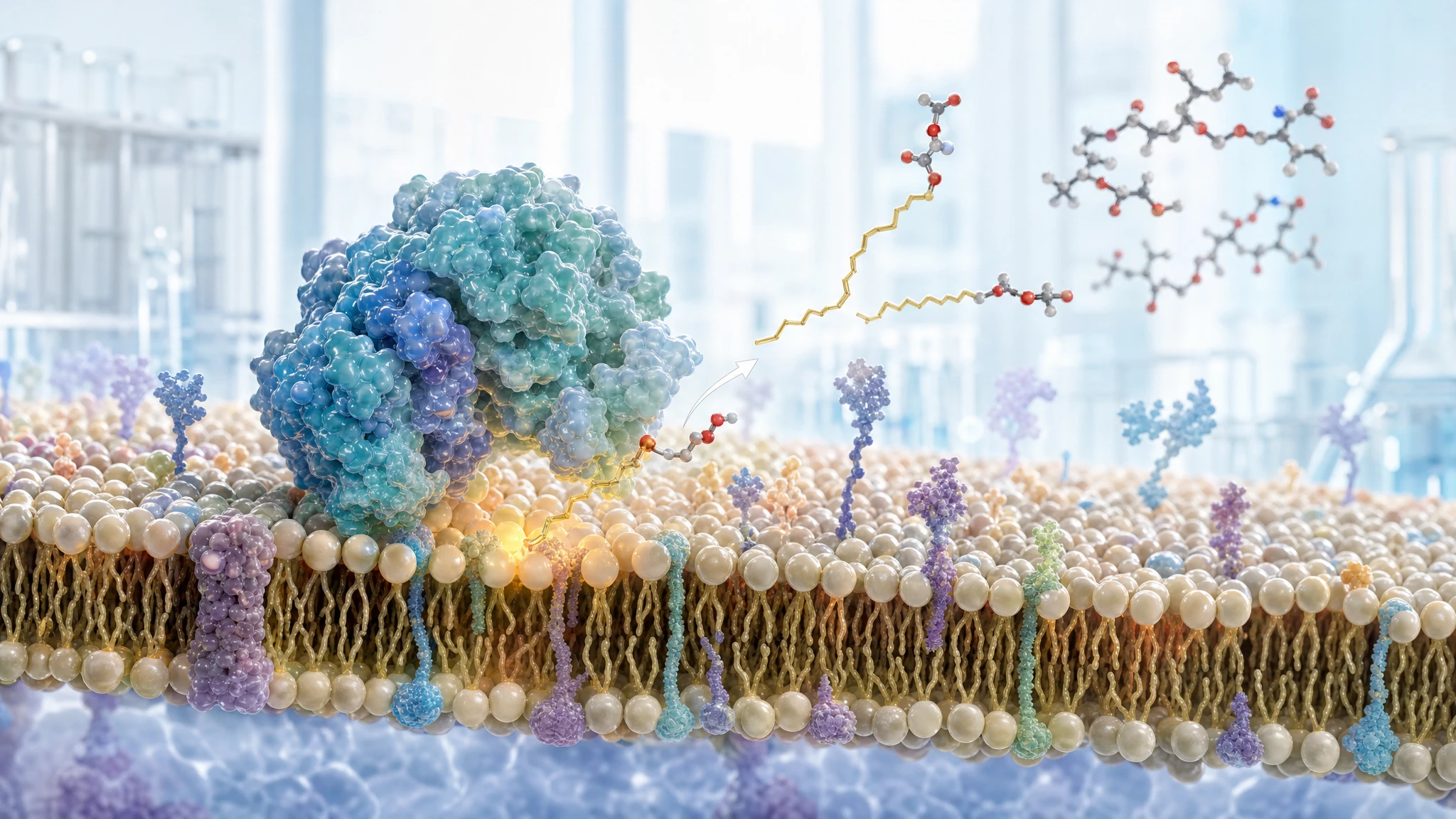
The scientific question relevant to the book's paragraph is whether cytosolic phospholipase A2 alpha, or cPLA2a, represents a decisive step in making free arachidonic acid available. In simple terms, arachidonic acid is normally incorporated into cell membranes; to be transformed into many lipid signals, it must first be detached from those phospholipids. cPLA2a is a phospholipase, meaning it is an enzyme that cleaves specific membrane phospholipids.
The publication is relevant to paragraph 5.4.3 of “The Choice to Live in Health or Illness” by Dr. A. Colonnese and R. Panzironi because the cited passage concerns precisely the selectivity of cPLA2a toward phospholipids containing arachidonic acid and its role in the availability of the substrate necessary for the synthesis of eicosanoids. Eicosanoids are lipid molecules that include prostaglandins, thromboxanes, and leukotrienes, and they participate in many local responses, including inflammation.
The title of the publication indicates a work dedicated to the properties and regulation of the enzyme. However, the full text and the abstract are not available in the provided material. It is therefore not possible to attribute specific experiments, quantitative values, or further conclusions to the analyzed study beyond the scientific correspondence explicitly stated in the book's paragraph. The publication contributes to the segment of the chain that goes from cPLA2a to the release of arachidonic acid; it does not, by itself, demonstrate the entire relationship between metabolism, insulin, inflammation, and disease.
Materials and methods of the original study
This information is not provided in the available material. The field relating to the study text is empty, and the source of the text is indicated as unavailable. Consequently, the study design, any number of experiments or samples, the cell or animal models used, selection criteria, laboratory techniques, endpoints, statistical analyses, and numerical results are not reported in the available material.
Based on the title and the brevity of the bibliographic citation, it is not correct to infer that the publication was a clinical trial, an animal study, or a cellular experiment. For the purposes of this Evidence Review, the original study is therefore considered as the source cited in the book for the biological concept related to cPLA2a, while the experimental verification of the passage is entrusted to the available independent publications.
Results
The available material does not contain experimental results, quantitative data, statistical significance values, percentages, concentrations, or comparisons between groups directly attributable to the analyzed study. Therefore, it is not possible to faithfully report specific results without risking the attribution of unverified information to the publication.
The passage for which the study is used in the book is, however, clearly identifiable: cPLA2a acts on membrane phospholipids containing arachidonic acid and can release this fatty acid in a form usable by enzymes that produce eicosanoids. The biological significance is that the cell does not automatically have access to all the arachidonic acid incorporated into its membranes; it must first mobilize a free portion of it. This release is a necessary step for many, but not all, of the pathways that generate lipid mediators derived from arachidonic acid.
Interpretation
The correspondence between the analyzed publication and the book chapter concerns a precise cellular mechanism. First, cPLA2a is activated; then, the enzyme cleaves membrane phospholipids containing arachidonic acid; finally, the amount of free arachidonic acid available for the synthesis of eicosanoids increases. In summary: activation of cPLA2a → release of arachidonic acid → availability of the substrate for prostaglandins, thromboxanes, and leukotrienes.
This interpretation does not imply that cPLA2a is the only enzyme involved in every tissue or at every stage of the inflammation response. The phospholipase A2 family actually includes different enzymes with partially different localizations, substrates, and functions. The sustainable message is more limited: in cells and conditions where cPLA2a is the primary enzyme that releases arachidonic acid from phospholipids, its activity can control the immediate availability of the precursor for numerous eicosanoids.
Independent evidence allows this interpretation to be verified using complementary approaches: genetic deletion of the enzyme in murine macrophages, pharmacological inhibition in human macrophages, and in vivo evaluation of lipid mediators in mice lacking cPLA2a. These studies support the central molecular pathway, but they do not prove that the same chain necessarily produces identical clinical effects in humans.
Independent confirming evidence
Direct confirmation of the central segment of the narrative comes from mouse peritoneal macrophages genetically lacking cPLA2. In macrophages deficient in this enzyme, the release of arachidonic acid and the production of eicosanoids induced by stimuli that increased intracellular calcium, as well as those that did not, were quantitatively suppressed. The study also showed that MAPK pathways—intracellular signaling pathways that regulate many cellular responses—contribute to the mobilization of arachidonic acid through mechanisms that are not limited to the phosphorylation of cPLA2 alone [1]. The model is murine and cellular, and therefore documents a causal relationship in the macrophage but does not quantify the effect in the human organism.
A second study extended this finding to a human model using primary pulmonary macrophages, which are immune cells obtained directly from donors. Two structurally different cPLA2a inhibitors completely blocked the release of arachidonic acid triggered by both experimental stimuli and stimuli relevant to the immune response, such as lipopolysaccharide and Mycobacterium protein derivative. The same inhibitors reduced the synthesis of platelet-activating factor, a lipid mediator, by 70%. Conversely, the inhibitor of secretory phospholipases A2 did not reduce the release of arachidonic acid or the production of platelet-activating factor [2]. This result confirms, in a human cellular model, that cPLA2a may be the primary immediate regulator of arachidonic acid availability.
Overall, the two independent publications converge on the same direction of effect: reducing or abolishing cPLA2a activity reduces the release of arachidonic acid and limits the formation of various lipid mediators. The confirmation is particularly strong for the cellular link cPLA2a → free arachidonic acid → eicosanoids. However, the broader part of the book's narrative connecting this system to chronic insulin stimulation remains indirect, because the publications considered here did not directly study hyperinsulinemia in humans.
Conflicting evidence
The available evidence does not contradict the important role of cPLA2a, but it shows that this role is not absolute in every biological context. In a mouse model of sepsis induced by cecal ligation and puncture, mice lacking cPLA2a produced fewer prostaglandins and less leukotriene B4, as well as lower concentrations of interleukin-6 and CCL2. However, the production of 12-hydroxyeicosatetraenoic acid, another mediator derived from arachidonic acid, was not reduced by the loss of the enzyme [3].
This finding indicates that in systemic inflammation, there may be robust pathways independent of cPLA2a that generate at least some lipid derivatives of arachidonic acid. Furthermore, despite the reduction of various mediators and less weight loss, the genetic absence of cPLA2a did not result in a survival advantage in the sepsis model [3]. The limitation is that this is an animal model of acute disease, not a human trial.
The most balanced interpretation is therefore that cPLA2a often represents a primary regulator of the release of arachidonic acid and many eicosanoids, but it is not necessarily the only source of free arachidonic acid nor the sole determinant of the inflammatory outcome. The relevance of the enzyme depends on the cell type, the stimulus, the duration of activation, and the lipid mediator being considered.
Summary table of evidence
The table distinguishes the publication under review from independent evidence that confirms or defines the biological pathway discussed.
| Reference | Study type | Population or model | Main result | Direction of evidence | Strength of evidence |
|---|---|---|---|---|---|
| Original study | Publication on the properties and regulation of cPLA2 | Not reported in the available material | Cited in the book for the role of cPLA2a in mobilizing arachidonic acid from membrane phospholipids. | biologically consistent evidence | preliminary |
| [1] | Cellular with genetic deletion | cPLA2-deficient mouse peritoneal macrophages | The absence of cPLA2 quantitatively suppressed the release of arachidonic acid and the production of eicosanoids induced by various stimuli. | direct confirmation | moderate |
| [2] | Cellular pharmacological | Primary human pulmonary macrophages | Two cPLA2a inhibitors blocked the release of arachidonic acid and reduced platelet-activating factor by 70%. | direct confirmation | moderate |
| [3] | Animal with genetic deletion | cPLA2a-deficient mice in the cecal ligation and puncture sepsis model | The loss of cPLA2a reduced prostaglandins and leukotriene B4, but did not reduce 12-hydroxyeicosatetraenoic acid. | discordant evidence | moderate |
Confirmation of the evidence
Claim in the book
In section 5.4.3 of “The Choice to Live in Health or Illness” by Dr. A. Colonnese and R. Panzironi, cPLA2a is described as the well-characterized isoform capable of selectively mobilizing arachidonic acid from membrane phospholipids, thus becoming a primary regulator of the availability of this substrate and the production of pro-inflammatory eicosanoids.
activated cPLA2a → hydrolysis of phospholipids containing arachidonic acid → increase in free arachidonic acid → synthesis of eicosanoids
The publication subject to the Evidence Review was used in the book to support the following passage: cPLA2a possesses a distinctive function in releasing arachidonic acid from membrane phospholipids, regulating the availability of the precursor necessary for the production of numerous eicosanoids.
The analyzed publication is consistently placed within the section "The Choice to Live in Health or Illness" by Dr. A. Colonnese and R. Panzironi, as it concerns the biochemical bridge between membrane lipids and eicosanoids: the mobilization of arachidonic acid. Independent confirmations document that, in murine macrophages, the absence of cPLA2 significantly reduces both the release of arachidonic acid and the production of eicosanoids following various stimuli [1]. In human pulmonary macrophages, the inhibition of cPLA2a blocks the release of arachidonic acid and reduces the production of a lipid mediator, providing confirmation in primary human material [2].
The chain is therefore directly supported up to the availability of arachidonic acid and the synthesis of various lipid mediators. However, the sepsis model in mice specifies the limitation of this generalization: the loss of cPLA2a reduces prostaglandins and leukotriene B4, while it does not reduce another derivative of arachidonic acid, 12-hydroxyeicosatetraenoic acid [3]. This suggests that the enzyme is a major, though not necessarily exclusive, node in the eicosanoid cascade.
Overall level of confirmation
MECHANISTIC CONFIRMATION
The pathway of cPLA2a → arachidonic acid release → production of many eicosanoids is confirmed by causal experiments in murine macrophages and by pharmacological inhibition in human macrophages. The evidence remains primarily cellular and animal-based; furthermore, some lipid mediators can derive from pathways independent of cPLA2a.
Conclusions
The narrative that cPLA2a mobilizes arachidonic acid from membrane phospholipids and enables its use for the synthesis of many eicosanoids is well-supported at a mechanistic level. Experimental confirmation includes murine macrophages with genetic deletion of the enzyme and human macrophages treated with cPLA2a inhibitors.
However, the evidence does not justify the idea that cPLA2a exclusively controls every mediator derived from arachidonic acid or every consequence of inflammation. Some alternative pathways can maintain the production of specific eicosanoids. The link with hyperinsulinemia and clinical outcomes therefore requires direct validation in appropriate human studies.
Overall assessment
The mechanism by which cPLA2a releases arachidonic acid and promotes the production of numerous eicosanoids is confirmed at a mechanistic level by murine studies and primary human cells. The consistency with the book's section is high, but the exclusivity of the enzyme and the clinical consequences remain moderately supported.
References
[1] Cytosolic Phospholipase A2 Is Required for Macrophage Arachidonic Acid Release by Agonists That Do and Do Not Mobilize Calcium
[2] Expression of phospholipases A2 in primary human lung macrophages
Editorial note
Artificial Intelligence was used solely as a tool to support editorial and documentary work. All content, interpretations, bibliographic citations and conclusions have been verified, reviewed and approved by the author, who assumes full scientific responsibility for them.
The manuscript was also subject to independent peer review prior to publication.
To ensure maximum transparency, the article's complete history — including the dates of submission, review, acceptance and publication, as well as information on the peer review process — is available on the dedicated Article History page.