


Role of beta-arrestin 1 in the metastatic progression of colorectal cancer - Evidence review
The study shows that in colorectal carcinoma cells, PGE2 can assemble an EP4-beta-arrestin1-Src complex that activates EGFR and promotes migration and liver metastasis in experimental models. Independent studies confirm EP4-EGFR transactivation but reveal cell-line-dependent mechanisms. Evidence in humans remains indirect and requires further clinical validation.
- Published 24/11/2026
- Updated 24/11/2026
- Article history
ABSTRACT
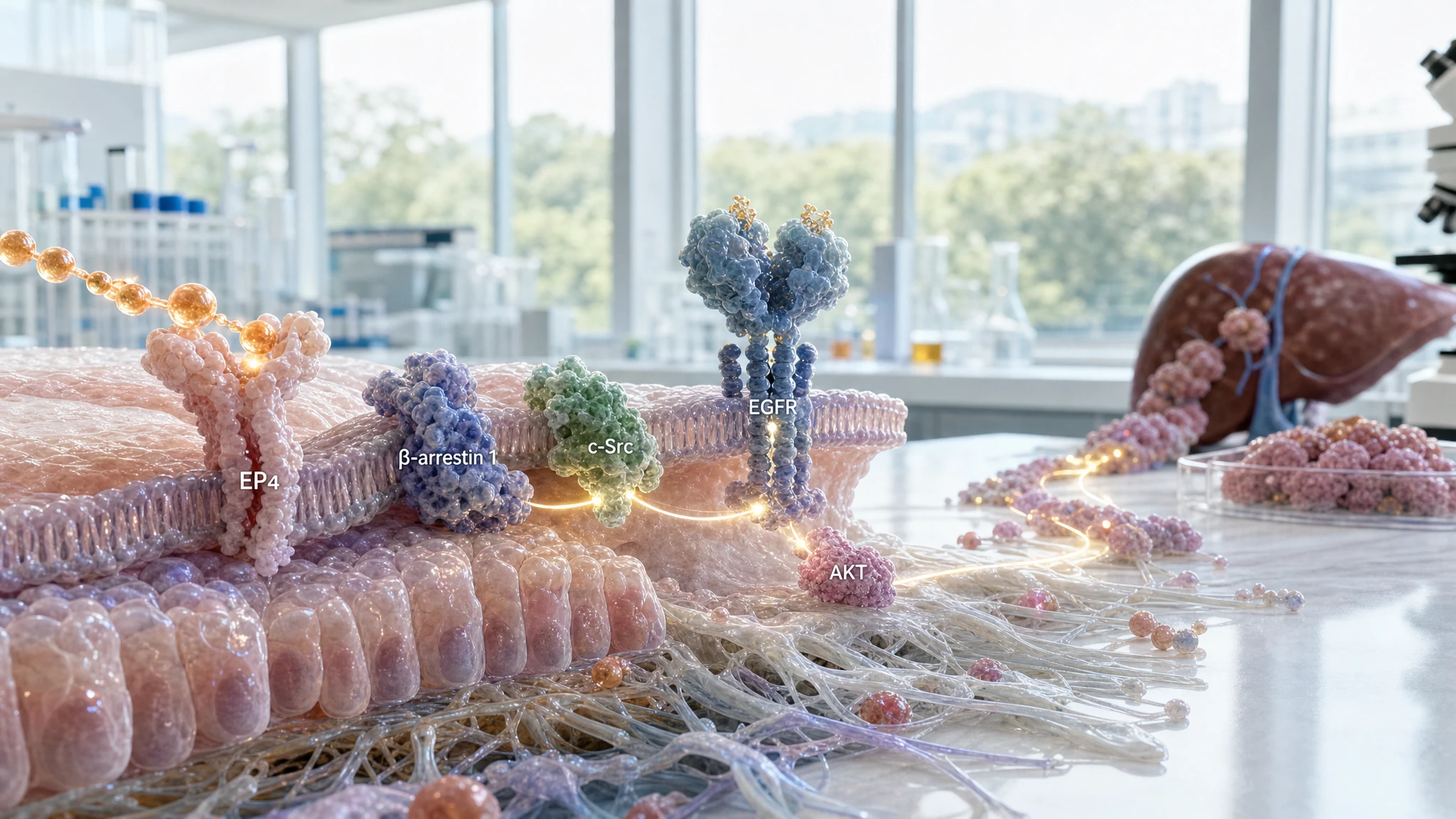
The analyzed study examined how prostaglandin E2 (PGE2, a lipid mediator produced during inflammation) can promote the spread of colorectal carcinoma. In tumor cells, the authors observed the formation of a complex between the EP4 receptor, beta-arrestin 1, and c-Src, a protein that transmits intracellular signals. This complex was associated with the indirect activation of EGFR and the AKT protein, with effects on cell migration in vitro and spread to the liver in an in vivo model.
In paragraph 5.6 of “The Choice to Live in Health or Illness” by Dr. A. Colonnese and R. Panzironi, the publication contributes specifically to the narrative that the PGE2-EP4 signal can activate EGFR and support cellular programs linked to migration and metastatic capacity. Independent studies confirm the PGE2-induced transactivation of EGFR and, in colorectal cells, an EP4-dependent pathway. However, the molecular pathway is not identical in all models: in some colorectal cells, EP4 promotes pro-tumorigenic characteristics without transactivating EGFR. The confirmation is therefore primarily mechanistic and experimental.
Analyzed study
Role of beta-arrestin 1 in the metastatic progression of colorectal cancer
PMID: 16432186
PMCID: PMC1360588
The research question was whether beta-arrestin 1, a protein that can organize signals from membrane receptors, was necessary to link PGE2 to the epidermal growth factor receptor, EGFR. The authors evaluated the hypothesis that the binding of PGE2 to the EP4 receptor formed a complex with beta-arrestin 1 and c-Src, capable of activating EGFR and subsequent cellular signals.
The relevance to the book's section is precise. The publication does not demonstrate the entire sequence described in the chapter, from the initial metabolic condition to tumor growth in humans. Instead, it documents the experimental segment PGE2 → EP4/beta-arrestin 1/c-Src → EGFR transactivation → AKT → cell migration and metastatic spread in the model used.
The study can therefore demonstrate that, under the experimental conditions examined, disrupting the interaction between beta-arrestin 1 and c-Src reduces the migration of colorectal carcinoma cells and spread to the liver in the in vivo model. It cannot demonstrate that the same mechanism is present in all human colorectal tumors, nor that the PGE2 produced in every inflammatory context causes metastasis in humans.
Materials and methods of the original study
Only the abstract of the publication is available. The authors studied colorectal carcinoma cells expressing either normal beta-arrestin 1 or mutated forms of the same protein. They evaluated the effects of PGE2 on the physical association between EP4, beta-arrestin 1, and c-Src, on the indirect activation of EGFR, and on the downstream signaling of AKT, a protein involved in cell survival and motility.
The abstract also reports on in vitro cell migration experiments and in vivo liver metastatic spread. The sample size, the precise type of animal model, PGE2 concentrations, treatment duration, metastasis evaluation criteria, detailed laboratory techniques, statistical analyses, and numerical values are not reported in the available material.
Results
The key finding is that PGE2 induced the association between EP4, beta-arrestin 1, and c-Src. In simple terms, the inflammatory signal brought together three cellular components into a complex capable of transmitting the message to other growth and movement pathways. This complex was associated with the transactivation of EGFR, meaning its indirect activation without necessarily requiring its usual ligand to initiate the signal.
Downstream of EGFR, the authors detected the activation of AKT. The proposed biological significance is that PGE2 does not act solely as an inflammatory signal, but may also enhance programs that help tumor cells move. The interaction between beta-arrestin 1 and c-Src was described as critical both for the migration of cells in culture and for the spread of the disease to the liver in the in vivo model.
The abstract does not report absolute values, percentages of reduction in migration or metastatic burden, P-values, confidence intervals, number of replicates, or animal group sizes. Therefore, it is not possible to quantify the magnitude of the effect or assess its statistical precision from the available material.
Interpretation
For the reader, the main takeaway is that a molecule linked to inflammation can activate, through its receptor, a signaling network that facilitates the movement of tumor cells. In the model studied, EP4 does not appear to be a simple signal reception point: it participates in the formation of a complex with beta-arrestin 1 and c-Src, which is necessary to activate EGFR and AKT.
The most directly documented segment is PGE2 → EP4/beta-arrestin 1/c-Src → EGFR/AKT → experimental migration and metastatic spread. This is the scientific correspondence to the book's statement regarding the disruption of the complex and the reduction of migration and metastatic capacity.
However, this interpretation must remain limited. The study uses cellular models and an in vivo model not detailed in the available abstract. It does not establish that EP4 activates EGFR via the same mechanism in every tissue or tumor cell line. Furthermore, it does not demonstrate that hyperinsulinemia is the cause of PGE2 production in the context studied.
Independent supporting evidence
Initial confirmation of the link between PGE2 and EGFR comes from independent experiments conducted in Caco-2, LoVo, and HT-29 colon cancer cell lines, as well as in non-tumorigenic gastric cells. PGE2 rapidly increased EGFR phosphorylation—that is, its activation—and activated ERK2, a signal linked to proliferation. Blocking EGFR reduced the activation of ERK2, the expression of c-fos, and the proliferation induced by PGE2. Blocking c-Src, metalloproteinases, or the TGF-alpha ligand prevented this transactivation. This work confirms the PGE2 → c-Src → EGFR pathway but proposes a mechanism involving the release of an EGFR ligand and does not specifically evaluate the EP4/beta-arrestin 1 complex [1].
In HCA-7 colon carcinoma cells, a second study identified EP4 as a necessary receptor for an amplification circuit: stimulation with PGE2 activated EP4, the Gai protein, and PI3K, a pathway that regulates various growth signals. Metalloproteinases then released a membrane-bound ligand capable of transactivating EGFR, activating ERK, and increasing COX-2 expression. Since COX-2 contributes to the production of PGE2, the result is consistent with a PGE2 → EP4 → EGFR → COX-2 → further PGE2 circuit. This is a direct confirmation of the EP4-EGFR connection in a colorectal carcinoma cell line, but it remains an experiment in only one cell line [2].
A third study verified the EP4-EGFR relationship in mouse models of gastric tumorigenesis. In the gastric tumors of mice, PGE2 signaling through EP4 increased EGFR activation by inducing EGFR ligands and ADAM proteases, which are enzymes that release growth signals from the membrane. The authors also observed that EGFR inhibition reduced tumor development in the model. This evidence does not concern the colon and does not verify beta-arrestin 1, but it strengthens the biological plausibility of EP4-EGFR transactivation in vivo [3].
Conflicting evidence
Directly relevant evidence shows that the pathway is not invariable. In HT-29 colorectal carcinoma cells engineered to highly express EP4, activation of EP4 by PGE2 increased resistance to apoptosis—that is, programmed cell death—and anchorage-independent growth. However, it did not increase proliferation and did not cause EGFR transactivation. In this model, the anti-apoptotic effect was primarily associated with an increase in cyclic AMP, an intracellular messenger, and the phosphorylation of CREB [4].
This result does not negate the mechanism observed in the analyzed study, but it indicates that EP4 can utilize different pathways depending on the cell line, the level of receptor expression, and the molecular context. The statement in the book should therefore be read as a description of an experimentally documented pathway, not as a universal rule for all tumor cells or for all effects of PGE2.
Summary table of evidence
The table distinguishes the study that is the subject of the Evidence Review from the independent publications used to confirm or define the scope of the book's narrative passage.
| Reference | Study type | Population or model | Main result | Direction of evidence | Strength of evidence |
|---|---|---|---|---|---|
| Original study | Cellular and in vivo model | Colorectal carcinoma cells with normal or mutated beta-arrestin 1; in vivo model not specified in the abstract | PGE2 formed an EP4/beta-arrestin 1/c-Src complex, activated EGFR and AKT; disrupting the interaction reduced migration and experimental hepatic spread | direct confirmation | moderate |
| [1] | Cellular | Caco-2, LoVo, and HT-29 colon tumor lines; RGM1 gastric cells | PGE2 rapidly increased EGFR and ERK2 activation; inhibitors of EGFR, c-Src, metalloproteinases, or TGF-alpha reduced the signal | indirect confirmation | moderate |
| [2] | Cellular | HCA-7 human colon carcinoma cells | PGE2 via EP4 activated Gai, PI3K, metalloproteinases, EGFR, and ERK, increasing COX-2 | direct confirmation | moderate |
| [3] | Animal and cellular | Murine models of gastric tumorigenesis | PGE2-EP4 signaling increased EGFR ligands and ADAM proteases, with EGFR activation in gastric tumors | biologically consistent evidence | moderate |
| [4] | Cellular | HT-29 colorectal carcinoma cells with EP4 overexpression | EP4 increased resistance to apoptosis and anchorage-independent growth, but did not transactivate EGFR | discordant evidence | moderate |
Confirmation of the evidence
Claim in the book
In section 5.6 of “The Choice to Live in Health or Illness” by Dr. A. Colonnese and R. Panzironi, the relevant statement is that the stimulation of EP4 by PGE2 can transactivate EGFR and that the disruption of the molecular complex involved drastically reduces cell migration and metastatic capacity.
PGE2 → EP4/beta-arrestin 1/c-Src → EGFR transactivation → AKT and motility signals → experimental migration and metastatic spread
The publication subject to the Evidence Review was used in the book to support the following passage: PGE2 can activate EP4 and organize a complex with beta-arrestin 1 and c-Src; this complex transactivates EGFR, and its disruption reduces the migration of colorectal carcinoma cells and metastatic capacity in the experimental model.
The link between PGE2 and EGFR is confirmed by independent studies in colon cancer cells, in which PGE2 increased EGFR activation and downstream signaling; blocking c-Src or EGFR reduced these responses [1]. The connection most relevant to the narrative of the paragraph was verified in HCA-7 colon carcinoma cells: PGE2 activated EP4 and, through Gai, PI3K, metalloproteinases, and an EGFR ligand, transactivated EGFR [2]. In murine models of gastric cancer, the EP4-EGFR pathway was also observed in vivo, albeit through a mechanism based on the induction of EGFR ligands and ADAM proteases [3].
This evidence supports the narrative of "The Choice to Live in Health or Illness" by Dr. A. Colonnese and R. Panzironi at the level of cell signaling: PGE2 can amplify growth and motility signals via EP4 and EGFR. This confirmation is not universal, as in HT-29 cells, EP4 promoted survival and anchorage-independent growth without activating EGFR [4]. The literature therefore indicates a biologically consistent chain that is nonetheless dependent on the experimental context.
Overall level of confirmation
MECHANISTIC CONFIRMATION
The original publication directly documents the EP4/beta-arrestin 1/c-Src complex and its experimental effects on migration and metastasis. Independent studies confirm PGE2-EP4-EGFR transactivation in cellular and animal models, but direct clinical demonstrations in humans are lacking, and the mechanism varies between cell lines.
Conclusions
The study analyzed directly supports a specific part of the narrative: under the experimental conditions examined, PGE2 can use EP4, beta-arrestin 1, and c-Src to activate EGFR and promote the migration of colorectal carcinoma cells. Independent evidence confirms the PGE2-EP4-EGFR link and its biological relevance quite well.
However, the complete chain leading to human metastasis has not been proven. The available evidence is derived primarily from cultured cells and animal models, while an independent colorectal model shows that EP4 can produce pro-tumor effects without transactivating EGFR. The narrative is therefore well-supported at a mechanistic level, but requires clinical validation and a better definition of the contexts in which each signaling pathway prevails.
Overall assessment
The correspondence between the study and the book section is well-defined: the work documents the EP4-beta-arrestin 1-c-Src complex and the link to EGFR. The narrative is confirmed at a mechanistic level by independent studies, but it appears to be dependent on the cell model and has not yet been proven as a complete causal chain in humans.
References
[1] Prostaglandin E2 transactivates EGF receptor: A novel mechanism for promoting colon cancer growth and gastrointestinal hypertrophy
[2] Induction of cyclooxygenase-2 expression by prostaglandin E2 stimulation of the prostanoid EP4 receptor via coupling to Gai and transactivation of the epidermal growth factor receptor in HCA-7 human colon cancer cells
[3] Activation of epidermal growth factor receptor signaling by the prostaglandin E2 receptor EP4 pathway during gastric tumorigenesis
Editorial note
Artificial Intelligence was used solely as a tool to support editorial and documentary work. All content, interpretations, bibliographic citations and conclusions have been verified, reviewed and approved by the author, who assumes full scientific responsibility for them.
The manuscript was also subject to independent peer review prior to publication.
To ensure maximum transparency, the article's complete history — including the dates of submission, review, acceptance and publication, as well as information on the peer review process — is available on the dedicated Article History page.