


Black pepper piperine: preparation, pungent taste, and biological activities in the 2024 review
In 2024, Chinese researcher Zou and colleagues published a comprehensive review in the journal Food Chemistry dedicated to the preparation of piperine from black pepper, the transmission of the pungent sensation, and the biological activities reported in experimental literature. The work integrates data on extraction methods, synthesis, sensory receptors, and potential applications in food science.
- Published 13/10/2026
- Updated 22/10/2026
- Reviewed 22/10/2026
- Article history
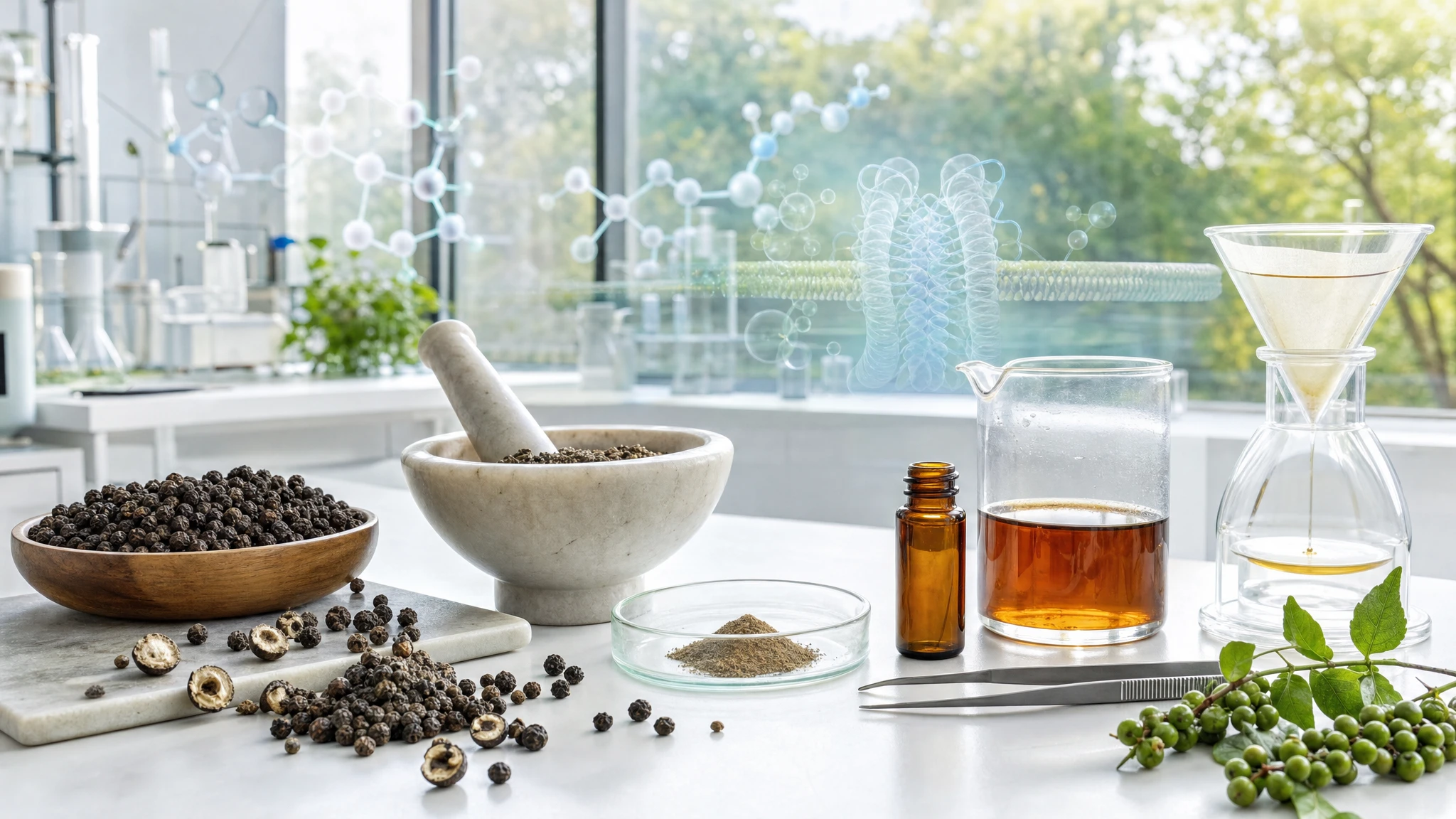
ABSTRACT : WHAT THE SCIENCE SAYS
The review by Zou and colleagues examines how piperine can be obtained from black pepper, why it causes a pungent sensation, and which biological activities have been described in the literature. The central message is that while the molecule is significant, it is not synonymous with the entire spice nor with its effects in daily nutrition.
The authors' synthesis collects studies on extraction, chemical and biological synthesis, perception of the pungent taste, bioavailability, and experimental activities of piperine, a natural alkaloid present in Piper nigrum. In simple terms, the work connects three different questions: how to isolate this molecule, how it interacts with sensory systems, and what has been observed in biological models. Regarding the pungent sensation, the authors point to TRPV1, an ion channel present in nerve endings that can transform a chemical stimulus into a signal perceived as heat or irritation. The review also reports preclinical results on inflammatory, metabolic, nervous, and cellular processes. However, these results come from heterogeneous sources, including cells and animals, and do not automatically demonstrate a clinical benefit of black pepper or piperine in humans. The work does not present a new experiment, does not enroll participants, and does not establish an effective dietary dose. It therefore serves primarily to distinguish the composition of the spice from the available evidence on concentrated preparations and the isolated molecule.
What this research analyzed
For those who use black pepper, the practical point to understand is that its pungent taste and chemical composition depend on both the plant and its processing. In 2024, Zou and colleagues examined piperine as a molecule that can be isolated from the fruit of Piper nigrum, describing its extraction, purification, synthesis, and food-related applications. They also compiled studies on how piperine is perceived by the body.
The sensory process involves TRPV1 (an ion channel that, in nerve cells, responds to chemical and thermal stimuli). When this channel opens, it allows the movement of ions and contributes to generating the nerve signal associated with pungency. The review also considers antioxidant, anti-inflammatory, metabolic, and neurobiological activities reported primarily in experimental systems. However, it does not indicate a systematic procedure for study selection nor a unified quantitative assessment of their quality; therefore, the breadth of the topics does not equate to uniform clinical evidence.
Research data
Preparation, pungency and bioactivity transduction of piperine from black pepper (Piper nigrum L.): A comprehensive review
- It is a literature review: it does not present a new experiment on humans, animals, or pepper samples.
- It examines traditional, modern, and innovative methods for extracting piperine, as well as chemical and biosynthetic synthesis strategies.
- It identifies the activation of TRPV1 as a relevant step for pungency, but gathers biological evidence of widely varying levels.
What results emerge from the study
The most robust descriptive finding is that piperine makes a significant contribution to the pungent sensation of black pepper. The authors report that it can interact with TRPV1: in simple terms, the molecule can stimulate a sensory structure involved in the perception of heat and irritation. This clarifies why pepper has a characteristic taste, without implying that piperine is the only compound responsible for the sensory experience.
The review also distinguishes between methods for obtaining piperine from plant matrices and pathways for producing it through synthesis. The practical implication is that a spice, an extract, and a purified substance are not interchangeable products: their concentration, the other molecules present, and their methods of use differ. The authors list numerous biological activities observed in the literature, but the publication does not provide a single clinical effect, a therapeutic dose, or an estimate of the benefit in humans. The results should therefore be read as a map of available research, not as an indication for medical use.
Why this study is relevant
This work is relevant because it separates three levels that are often confused: black pepper as a food, piperine as a component, and extracts as concentrated preparations. For the reader, this distinction prevents the direct application of data obtained with purified piperine or experimental concentrations to the spice used in cooking. This is an essential step for interpreting product labels with caution.
The review is also useful because it places pungency within a verifiable biological mechanism. Independent studies on cells expressing the human receptor confirm that piperine can activate TRPV1 [1]. Subsequent analyses have identified specific points of the protein involved in this activation [2]. These findings reinforce the molecular explanation for the pungent sensation, but they remain experiments on cells and proteins: they do not, on their own, measure taste intensity, habitual intake, or health consequences.
Study limitations and what it does NOT demonstrate
The 2024 publication by Zou and colleagues is a broad review, not a clinical trial. Consequently, it does not prove that eating black pepper prevents or treats diseases, nor does it establish how much pepper or piperine should be consumed. It also does not allow for the effects described for standardized extracts or isolated piperine to be attributed to the whole spice.
A second limitation concerns the variability of the raw material. Harvesting, season, drying, and analytical technique can alter the measured composition of pepper. In an analysis of commercial samples and different drying processes, high-temperature mechanical treatment primarily modified the essential oil profile, while the season contributed to compositional differences [3]. This data suggests that there is no universal profile for black pepper, but it does not allow for the prediction of the piperine content of any given product or its effect on the body.
Independent confirming evidence
The most compelling chain of evidence begins with sensory perception. McNamara and colleagues studied HEK293 cells (human embryonic kidney cells used as a laboratory model) modified to express human TRPV1. Piperine activated electrical currents consistent with the opening of the channel; the half-maximal effective concentration, EC50, was 37.9 ± 1.9 micromolar. This value indicates potency in the cellular system, not a dietary dose. Blocking by TRPV1 antagonists supports the link between piperine and the sensory channel [1]. The confirmation is direct for the cellular mechanism, but not for perception in the whole organism.
Dong and colleagues strengthened the next step with structural modeling, mutagenesis, and functional measurements in cells. In simple terms, they verified whether modifying certain points of the protein would change the response to piperine. Mutation of the T671 residue reduced or abolished activation, supporting an interaction in the TRPV1 binding pocket [2]. This is direct mechanistic confirmation, but it remains confined to an experimental model. Regarding processing, Vieira and colleagues analyzed piperine, essential oils, and minerals in relation to season and drying [3]. The relationship with the review is convergent: preparation can change the product profile; however, it does not prove that every chemical variation predictably modifies the perceived pungency.
Conflicting evidence
Available evidence suggests that the amount of piperine should not be equated with perceived pungency. In a study on green pepper subjected to five drying processes, freeze-dried samples showed more measurable piperine than those air-dried with hot air, yet the latter received the highest pungency score in a sensory evaluation conducted by ten assessors [4]. This result is relevant because it suggests that oral release, sample structure, and other compounds may influence perception. However, this is a study on green pepper and a small sensory group, so it does not automatically describe commercial black pepper.
Another alternative interpretation concerns the composition of the spice. Okumura and colleagues tested 19 pepper compounds in HEK cells expressing TRPV1 or TRPA1, a second sensory channel. Several molecules, in addition to piperine, activated one or both channels; six compounds activated both [5]. This does not refute the role of piperine, but it diminishes the idea that the pungent taste of pepper is explained by a single substance. No directly conflicting evidence of sufficient relevance has been identified; this does not prove the absence of contrary results.
Comparative overview
Independent publications clarify which parts of the narrative are supported and where their application remains limited.
| Publication | Model and main result | Relationship with the 2024 review | Interpretative caution |
|---|---|---|---|
| McNamara et al., 2005 [1] | HEK293 cells with human TRPV1; piperine activates the channel, EC50 37.9 ± 1.9 micromolar. | Direct confirmation of the link between piperine and pungency signaling. | Cellular model; does not measure dietary intake or clinical benefit. |
| Dong et al., 2019 [2] | Cells and TRPV1 mutagenesis; T671 is relevant for piperine-induced activation. | Direct confirmation of the proposed molecular mechanism. | Mechanistic result, not sensory or clinical evidence. |
| Vieira et al., 2022 [3] | Black pepper samples; season and drying mainly modify essential oils and certain elements. | Indirect confirmation that processing influences the product profile. | Does not establish a uniform effect on piperine or pungency. |
| Wang et al., 2025 [4] | Green pepper with five drying methods; higher measured piperine did not coincide with greater sensory pungency. | Downsizes the equivalence between piperine quantity and perception. | Ten evaluators and a different matrix than commercial black pepper. |
| Okumura et al., 2010 [5] | HEK cells with TRPV1 or TRPA1; multiple pepper compounds activated sensory channels. | Shows that piperine does not exhaust the sensory complexity of the spice. | Cellular experiment with isolated compounds. |
Editorial Conclusion
The work by Zou and colleagues organizes a vast body of literature on piperine, connecting preparation techniques, pungent perception, and experimental biological results. Its main contribution is conceptual: black pepper is a food matrix, while piperine is a single molecule that can be extracted, concentrated, and studied separately. Independent evidence supports that piperine activates TRPV1, a channel involved in the sensation of heat and irritation. This clarifies an important part of pungency without reducing the flavor of pepper to a single mechanism. Processing can alter the chemical profile of the product, but it does not allow for automatic deductions regarding sensory intensity, final piperine content, or health consequences. The biological activities gathered in the review are useful as a research framework, especially in preclinical settings. They do not constitute proof that black pepper or piperine extracts offer therapeutic benefits in humans. The most accurate interpretation remains cautious, distinguished by product, dose, studied model, and the quality of available evidence.
References
[1] Effects of piperine, the pungent component of black pepper, at the human vanilloid receptor (TRPV1)
[2] A distinct structural mechanism underlies TRPV1 activation by piperine
[3] The effects of drying methods and harvest season on piperine, essential oil composition, and multi-elemental composition of black pepper
[4] A comprehensive study on the effects of drying methods on the color, structure, flavor, and nutritional properties of green peppers (Piper nigrum L.)
Editorial note
Artificial Intelligence was used solely as a tool to support editorial and documentary work. All content, interpretations, bibliographic citations and conclusions have been verified, reviewed and approved by the author, who assumes full scientific responsibility for them.
The manuscript was also subject to independent peer review prior to publication.
To ensure maximum transparency, the article's complete history — including the dates of submission, review, acceptance and publication, as well as information on the peer review process — is available on the dedicated Article History page.