


What is black pepper: definition, piperine, and biological significance for health
Research describes black pepper as a spice derived from the dried fruits of Piper nigrum. Piperine is its most studied compound and is responsible for much of its pungent taste. However, the spice is a food made up of many substances, and its composition can vary. Therefore, to understand studies and labels, it is necessary to distinguish between the food, the extract, and the isolated substance.
- Published 06/10/2026
- Updated 08/10/2026
- Reviewed 30/09/2026
- Article history
ABSTRACT : WHAT THE SCIENCE SAYS
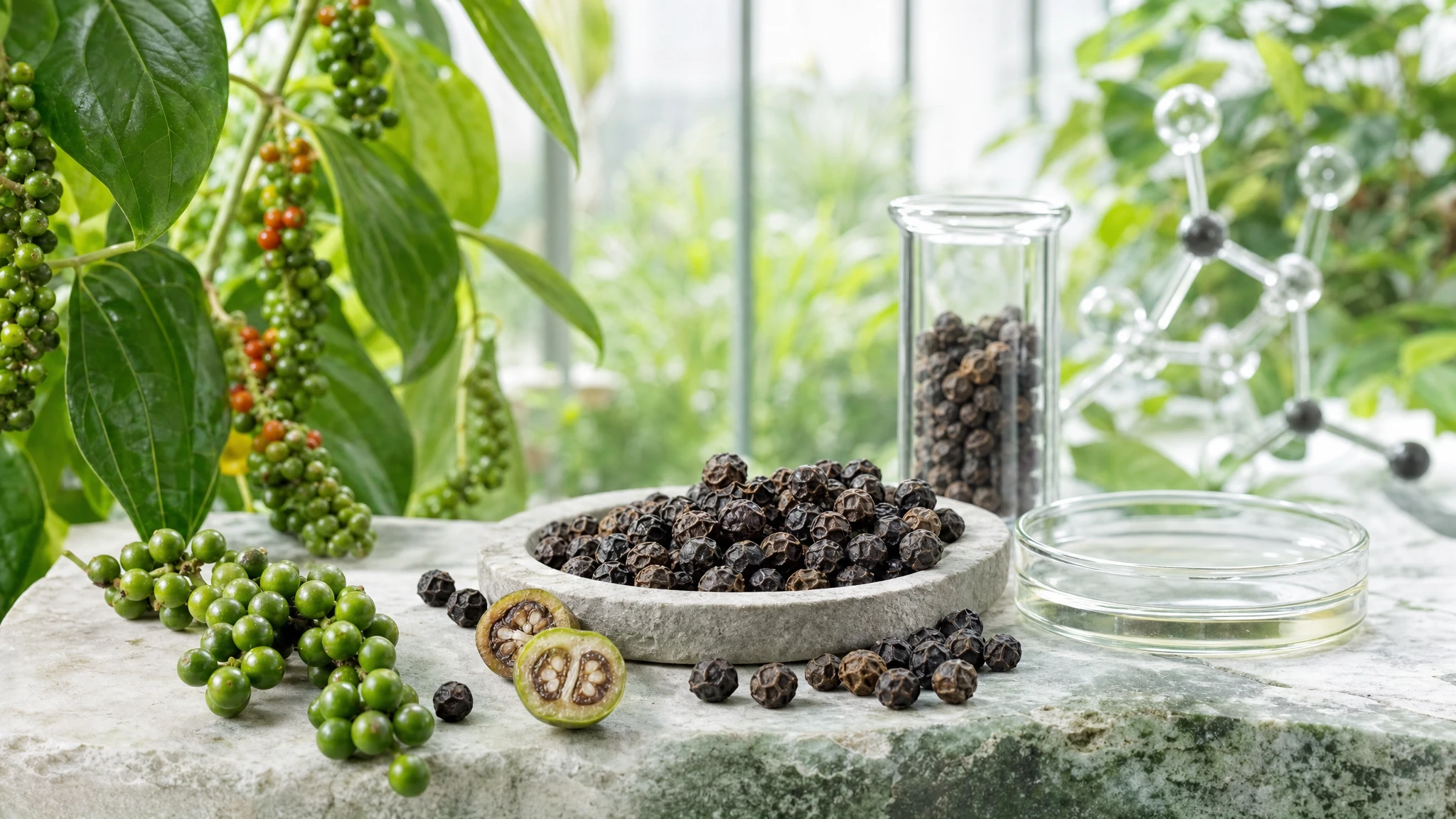
Black pepper is a common spice, but it is often described as a single substance. In reality, it is the dried fruit of Piper nigrum, a tropical plant with specific botanical, sensory, and chemical traits. Among its compounds, piperine stands out—a natural alkaloid (a nitrogen-containing compound produced by the plant). Piperine provides the pungent taste and generates significant interest among researchers. This distinction helps in reading labels and better understanding studies and products on the market.
In this article, we will look at what black pepper is, where its pungent taste comes from, and why piperine is so widely studied. Finally, we will examine how the composition of pepper changes in various preparations. We will then connect its origin and the substances present to a critical reading of products.
- Botanical origin of black pepper and characteristics of the dried fruit
- Piperine as the alkaloid responsible for the pungent taste
- Difference between the whole spice and the isolated molecule
- Differences between peppercorns, powder, and extracts
- How to correctly read labels and derived products
What black pepper really is: botanical origin and composition
To understand what black pepper is, you have to start with the plant and not just the flavor. This pungent spice comes from the fruit of Piper nigrum. It is a food matrix (a combination of substances present in the same food) that contains aromas and bioactive compounds. Piperine in black pepper plays a central role, but it is not the only element to be aware of.
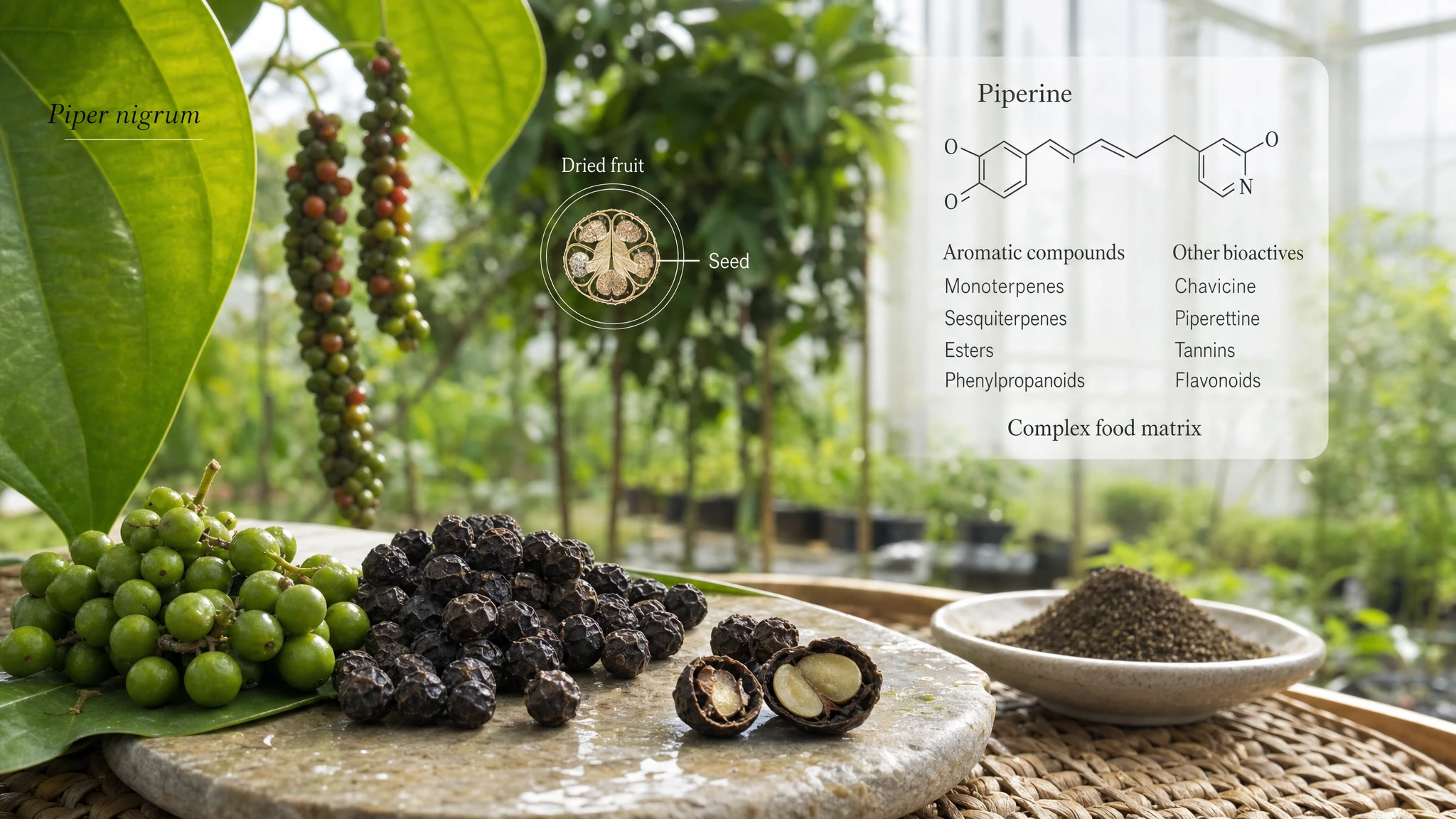
When asking what black pepper is, the answer begins with the plant. Black pepper is obtained from the fruits of Piper nigrum, which has been cultivated for centuries in tropical regions. It is therefore not just a single molecule, but a plant material containing many compounds. The amount of these substances can vary.
This reading distinguishes pepper as a food from an isolated substance. A bioactive compound is a molecule that acts on biological processes. The final product, however, remains a dried fruit with a complex chemical structure.
Research interest therefore stems from three aspects: botanical origin, processing, and active substances. Together, these elements explain the biological value of the spice. The next step concerns the most studied compound and its function in the body.
Pepper is therefore a pungent spice with a chemical profile that is richer than its taste alone suggests. Before examining the most studied substance, it is useful to establish four key points:
- The tropical plant produces fruits, which are harvested at a specific stage.
- After harvesting, the fruit is dried and becomes a spice.
- The food matrix contains various compounds.
- The pungent taste arises from the combination of the substances present.
The botanical basis of black pepper shows why this spice is not synonymous with a single substance. The following three steps explain which plant it comes from and how it becomes a spice. They also clarify why it is a complex food matrix.
Botanical origin of black pepper and the Piper nigrum plant
Black pepper comes from the fruits of Piper nigrum, a tropical plant cultivated primarily to obtain aromatic peppercorns for culinary use. This botanical origin is important because it distinguishes the plant species from the finished product: the pepper we use is not a neutral powder, but the result of the fruit's transformation. The plant belongs to the Piperaceae family and grows in hot, humid regions. Its fruits are small drupes that change color during ripening.
In scientific terms, referring to black pepper means referring to a spice with a well-defined agricultural, botanical, and chemical identity. Available reviews describe Piper nigrum as a complex spice, in which the most studied component is piperine, alongside other compounds [1] [2]. The limitation of these summaries is that while they explain the whole well, they do not replace the analysis of individual constituents: the botanical origin clarifies the source, not the function of every molecule present in the fruit.
Dried fruit and spice: how black pepper is created
Black pepper comes from a dried fruit, harvested at a specific stage of ripening. Subsequently, the fruit is processed to become the spice we know. This step changes its appearance, aroma, shelf life, and flavor intensity. Defining it as a dried fruit clarifies an important point.
It is not a pure substance, but a processed plant food without its natural compounds being separated. Processing involves the fruit as a whole and keeps the substances it contains together. Reviews describe this sequence and show that the spice retains the nature of a whole product. A summary on black pepper and piperine reports on the preparation and the pungent taste due to the processing of the fruit [3]. Drying explains how the spice is created, but it does not by itself define the biological role of its compounds. This aspect requires a more precise examination. Therefore, preparation and composition must be considered together, but they answer different scientific questions.
Black pepper food matrix: why it is not a single molecule
Black pepper should be considered a food matrix, meaning a set of components present within the same ingredient. This concept is useful because it avoids reducing the spice to a single molecule and allows for a correct understanding of its pungent taste as the combined effect of multiple substances. In addition to piperine, pepper contains essential oils, alkaloids, and other phenolic compounds. These elements interact with one another and contribute to the overall sensory profile.
In practice, black pepper does not function as an isolated active ingredient, but as a complex food in which aroma, structure, and chemical composition influence each other. Reviews agree on this point and explain that piperine is the main compound, but not the only one present [1] [4]. This interpretive limitation is important: when a study analyzes an extract, it is not always describing the effect of the whole spice. For this reason, the matrix approach helps to avoid hasty conclusions and sets the stage for understanding why piperine is so widely studied.
Recent research and updates
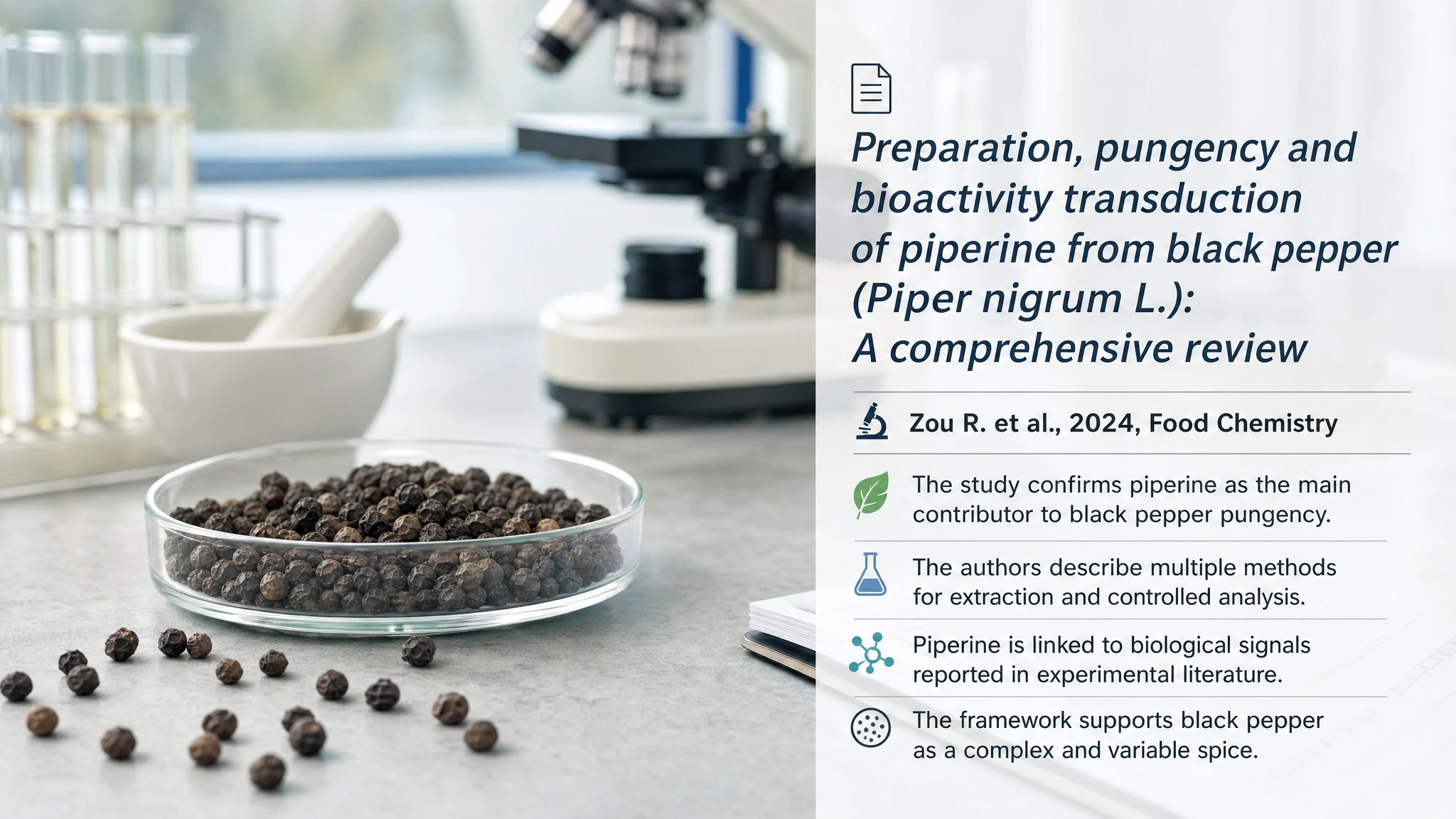
In 2024, Chinese researcher Ruixuan Zou and colleagues published a study in the journal Food Chemistry. The work updated data on the extraction, pungent taste, and biological activities of piperine, the natural alkaloid found in black pepper. The study helps to view the spice as a complex food, rather than a single substance.
Preparation, pungency and bioactivity transduction of piperine from black pepper (Piper nigrum L.): A comprehensive review
- The research confirms that piperine is responsible for much of the pungent taste of black pepper.
- The authors describe various methods for extracting and studying piperine in a controlled manner.
- The study links piperine to biological signals already observed in experimental research.
- The data remain consistent with the idea that black pepper is a complex and variable spice.
Piperine in black pepper: why it is the most studied compound
Piperine attracts significant biomedical research because it gives black pepper much of its pungent taste. It is also the substance in the spice with the highest number of experimental data. Understanding this distinction helps in reading labels and studies without confusing the pepper with a single molecule. Here, we look at its biological interest and its use as a chemical reference.
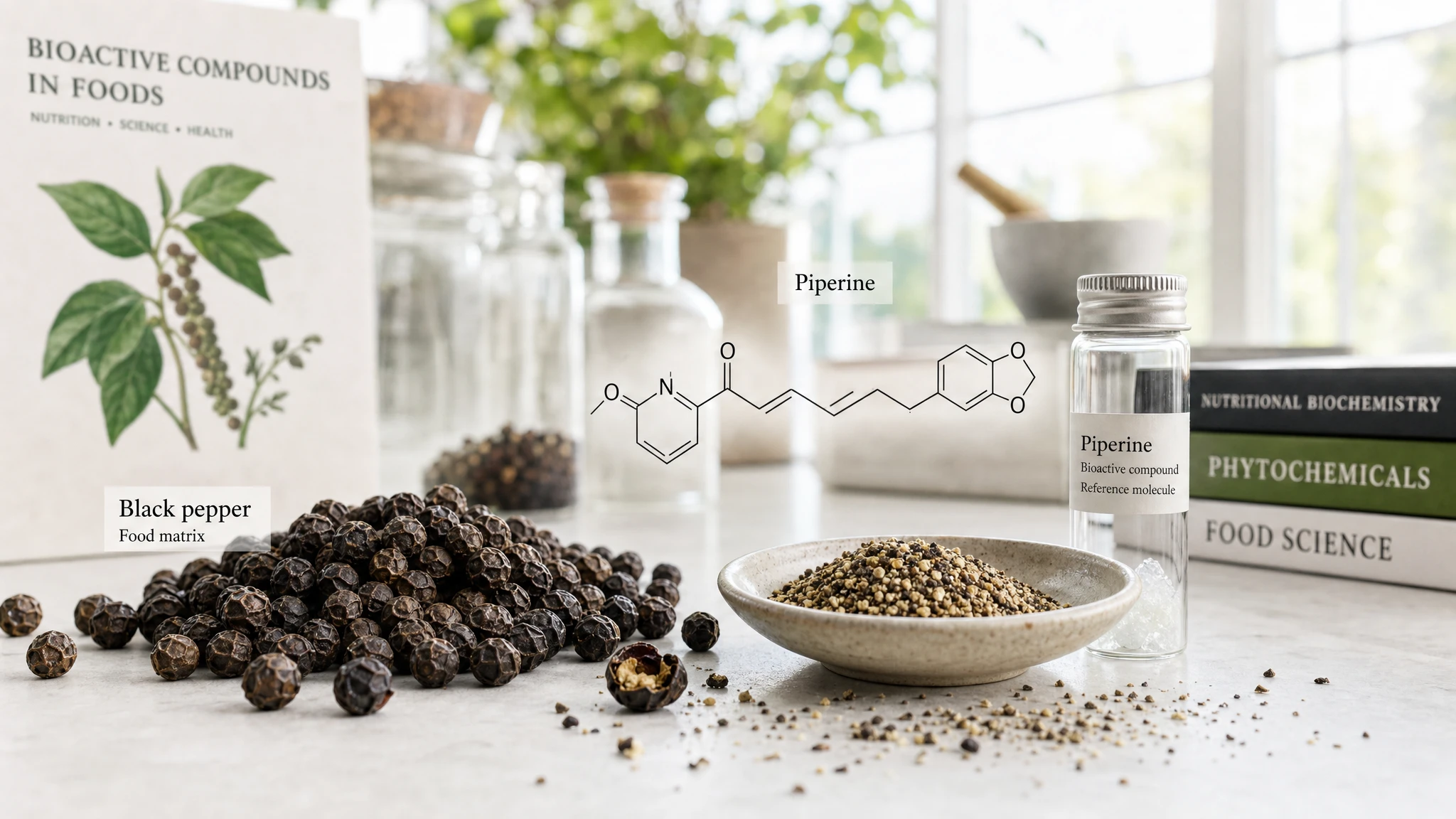
In black pepper, piperine is of interest to research for two reasons: its pungent taste and its potential biological role. This alkaloid (a natural nitrogen-containing compound) is the primary chemical reference used to study the spice. It allows for the analysis of the pungent sensation and a portion of the biological activity.
Piperine is also central because it can be isolated, measured, and compared across different products. However, on its own, it does not describe all of black pepper or its potential effects. Nevertheless, it remains a good starting point for better understanding the spice. From here, we move on to the more practical aspects of the molecule.
Studies often examine the isolated molecule, but in food, it is part of a complex matrix. To interpret research correctly, it is necessary to distinguish between several levels of analysis:
- The molecule causes much of the pungent sensation typical of the spice.
- Research often uses it as a reference bioactive compound.
- Black pepper contains many substances, not just one molecule.
- Concentrated extracts are not equivalent to the spice used in cooking.
The following paragraphs explain what piperine is and why it is not the same as whole black pepper.
What is piperine and why does it make black pepper pungent
Piperine is an alkaloid, a nitrogen-containing natural compound found in black pepper. It is the primary cause of the spicy sensation that many people associate with this spice. Simply put, it is the molecule that contributes most to its sensory profile. It therefore determines much of the pungent taste we perceive in the mouth.
For this reason, it is often described as the most characteristic bioactive compound of Piper nigrum. This holds true even when we consume the spice as a dried fruit rather than as an extract. Research studies it extensively because it can be isolated and measured with precision. This precision allows for the comparison of the same molecule when examined in different products. Furthermore, it remains linked to the food product and thus maintains practical value. These syntheses have a limitation: they are reviews and do not measure a single direct effect in everyday food. Instead, they show why piperine has become the most widely used reference in experimental studies. Whole black pepper, in fact, remains a more complex food matrix.
Black pepper and piperine: why they are not synonymous
Black pepper and piperine represent two different levels of the same story: the former is a spice obtained from the dried fruit of Piper nigrum, while the latter is a single molecule found within it. This distinction is important because a pungent spice is never the same thing as the compound that provides part of its flavor.
Black pepper contains many constituents, while piperine is just one of them, albeit the most studied. Therefore, when reading the literature, it is necessary to understand whether the data refers to the food, an extract, or the pure substance. The limitation is clear: results obtained from isolated piperine cannot be automatically transferred to black pepper in the kitchen, where actual dosage, preparation, and food matrix come into play. The distinction, therefore, is not just terminological but also methodological: it is needed to correctly interpret both studies and commercial products.
Where is piperine found in black pepper and derived products
Piperine is found in black pepper, but its quantity is not always the same. It varies between granules, powder, and extracts because the raw material, processing, and degree of concentration differ. In derivative products, the presence of the bioactive compound matters, but so does how much of it remains in the final product. The latter constitutes the food matrix, which is the set of substances present in the food. For this reason, two packages of black pepper or two supplements containing extract may act differently. Piperine is the most useful chemical reference for comparing similar products. However, it is not enough on its own to describe the entire spice.
A study on 24 healthy volunteers used Sahastara extract capsules, administered orally. The capsules contained 100 or 200 mg of extract, and the piperine was measurable in the body [5]. The data confirms that the substance can be tracked even in preparations other than peppercorns. The research, however, concerns a standardized extract and a single dose. Therefore, it does not describe how much black pepper consumed daily as food can vary. For this reason, the actual content of each product must be evaluated on a case-by-case basis.
Why the piperine content changes in products
To understand what black pepper is, one must also consider how much piperine it contains. This amount varies based on origin, ripening, drying, and the form of the product. Therefore, the same spice can have a more or less intense pungent taste. The final product must therefore be evaluated based on its origin and processing.
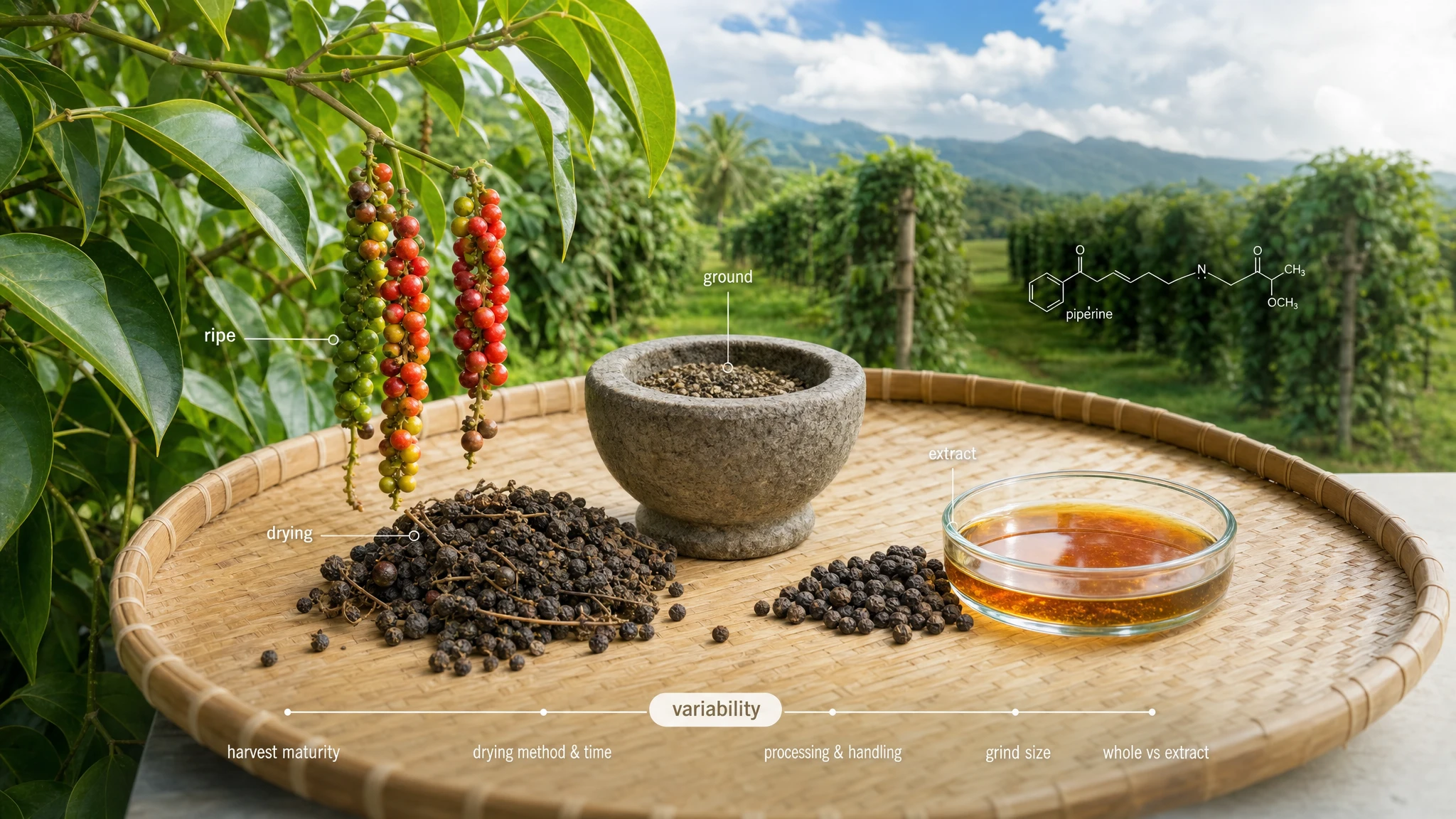
In black pepper-based products, the piperine content is not fixed. It changes based on how the fruit is harvested, dried, treated, and then processed. Even small changes in the degree of ripeness can alter the final composition of the spice.
These differences do not indicate that the product is of poor quality or unsafe. Instead, they show that the active compound varies due to natural causes and production methods, which differ in every batch. Knowing these differences helps in reading labels and distinguishing the spice from more controlled extracts.
Consequently, two similar samples may contain different amounts and have a more or less pungent taste. The indicated or perceived value therefore depends on various agricultural and technical steps. The main points are as follows:
- The degree of fruit ripeness changes the amount of piperine present.
- The type of drying can change the final chemical composition.
- Grinding and processing change how the compound is distributed.
- Extracts follow different processes than those used for the whole spice.
Differences between products arise primarily before the pepper reaches the market. Harvesting, the degree of ripeness, and post-harvest care play a central role. These steps explain why the amount of the active compound is not the same in every product.
Factors influencing the amount of piperine in black pepper
The amount of piperine can vary as early as in the field, because the fruit does not all ripen in the same way and is not always processed with the same care. Conditions such as drying, storage, and the selection of raw materials also affect the stability of the bioactive compound. For example, fruits harvested at full maturity tend to have more piperine than unripe ones. Sun-drying, if not controlled, can degrade part of the compound. The duration and temperature of storage also play a role: hot and humid environments accelerate the loss of potency. Finally, the manual selection of peppercorns discards damaged ones, which often have an altered chemical profile.
In this sense, black pepper is a plant-based food where the composition reflects both the biology of the plant and production choices. The limitation of these summaries is that they encompass many different conditions without setting a single value, but the message remains consistent: the concentration is not constant and depends on the journey from the field to the finished product.
Peppercorns, powder, and extracts: what changes in practice
Commercial forms are not equivalent: peppercorns, which are the dried fruit kept whole, preserve the product more intact; powder offers a larger surface area, and extracts concentrate a portion of the constituents. The whole peppercorn protects piperine from oxidation and maintains the aromatic profile for longer. Powder, on the other hand, exposes the compound to air and light, accelerating degradation. This is why it loses pungency faster than the whole grain. Extracts, obtained through solvents or mechanical processes, isolate piperine and bring it to standard concentrations, often exceeding 95% [4].
For this reason, both culinary use and how the presence of piperine in the product is interpreted change. Discussing the format helps distinguish a pungent spice from a more elaborate preparation. The data shows that an extract makes the measurement more traceable compared to the spice as is, but the limitation is clear: it is a specific preparation, not the pepper used in cooking, so it should not be conflated with the natural variability of the food product.
What standardization means in piperine-based products
Standardization indicates that a product has been formulated to contain a defined amount of piperine. In practice, it serves to reduce the variability that is normal in the whole spice and to make it clearer what you are purchasing. It is a useful criterion when comparing different products or when you want to know if the stated content has been verified. Reviews on piperine note that research and industry often work with extracts or formulations, rather than black pepper as is, precisely to achieve a more stable composition [4] [6]. An extract standardized to 95% piperine ensures that every batch has that concentration, which is impossible for the whole spice. This process involves repeated chemical analyses and adjustments to correct for the natural variations of the raw material.
The limitation is that standardized does not mean identical to the natural product: it only means more controlled. This distinction is important because it helps to better read labels and formulations without attributing to the spice a content that cannot be identical in every batch.
Summary of scientific evidence
This summary gathers the most useful sources from the bibliography. It shows how studies distinguish between black pepper, piperine, and extracts, without confusing the different levels of analysis.
| Publication year | Area studied | What the studies indicate |
|---|---|---|
| 2019 | Systematic review on black pepper and traditional uses | evidence indicates that black pepper is a complex spice and piperine is the most cited compound [1] |
| 2013 | Review on Piper nigrum and piperine | studies suggest that distinguishing the spice from the isolated molecule is essential for a proper understanding of the data [2] |
| 2017 | Piperine as a central bioactive compound | evidence indicates that piperine is the most used chemical reference in studies on black pepper [4] |
| 2024 | Preparation and pungency of piperine | data are consistent with a direct role of piperine in the pungent taste of the spice [3] |
| 2021 | Biological effects of piperine | results vary, but piperine remains the main alkaloid studied in black pepper [6] |
| 2020 | Pharmacokinetics of piperine in healthy volunteers | a standardized preparation provided measurable data on piperine after oral administration [5] |
Editorial reading of the evidence
Overall, the studies I have reviewed here provide a consistent message: black pepper is a food with a defined botanical origin. Piperine, on the other hand, is the most studied compound and is responsible for much of its pungent taste. In reading the reviews, I found a clear distinction between the whole spice, the isolated molecule, and standardized extracts, which have more controlled dosages. This distinction allows me to avoid attributing to the food itself effects observed primarily in laboratory tests or with concentrated products.
The main limitations I encountered stem from the extensive use of reviews and the few direct comparisons between different products on the market. Furthermore, much of the data I analyzed concerns isolated piperine or standardized preparations, not the black pepper used on a daily basis. For this reason, my conclusions must remain descriptive. The studies I have read clarify the origin, composition, and scientific interest well, but they are less clear regarding the actual differences between products and methods of use.
Conclusions and editorial summary
From this analysis, I have concluded that black pepper is first and foremost a food with a precise botanical origin, not just a commercial item. Its scientific interest, as shown by the research gathered here, depends on piperine, an alkaloid that causes much of its pungent taste. This substance has made the spice a highly studied model in research on natural compounds. However, I have seen that it is necessary to distinguish between the spice, the molecule, and the extract, because each level offers different and not always comparable data.
This difference, according to what emerges from the studies examined, also matters in daily use, where the actual dose, the food as a whole, and the type of product have an impact. Black pepper, therefore, is not a pure active ingredient, but an ingredient made up of many substances. This interpretation connects origin, chemistry, and culinary use, without overstating the significance of the data. The key point I have drawn from this is to recognize the spice as a food and to evaluate the results regarding piperine with balance.
Final critical note
The evidence I have reviewed clearly clarifies the role of piperine and the difference between the spice and the single molecule. However, it is less robust regarding commercially available products and their practical value in daily use. Many sources I consulted are reviews or studies on extracts: they explain the concepts well, but not the full complexity of the food. Indeed, a highly studied compound is not the same as the entire spice. I therefore believe caution is necessary to avoid attributing more to the data than they can actually show.
References
[1] A systematic review on black pepper (Piper nigrum L.): from folk uses to pharmacological applications
[3] Preparation, pungency and bioactivity transduction of piperine from black pepper (Piper nigrum L.): A comprehensive review
[4] Piperine—The Bioactive Compound of Black Pepper: From Isolation to Medicinal Formulations
[5] Pharmacokinetics of piperine after oral administration of Sahastara remedy capsules in healthy volunteers
[6] Piperine: A review of its biological effects
Editorial note
Artificial Intelligence was used solely as a tool to support editorial and documentary work. All content, interpretations, bibliographic citations and conclusions have been verified, reviewed and approved by the author, who assumes full scientific responsibility for them.
The manuscript was also subject to independent peer review prior to publication.
To ensure maximum transparency, the article's complete history — including the dates of submission, review, acceptance and publication, as well as information on the peer review process — is available on the dedicated Article History page.