


Carrot Rhamnogalacturonan-I: effects on gut microbiota and immunity
In 2025, researcher Kerezoudi, active in Sweden, and colleagues studied in the journal Microorganisms whether a rhamnogalacturonan-I derived from carrots could selectively influence intestinal bifidobacteria, certain indicators of the immune response, and the intestinal barrier in healthy adults exposed for four weeks to a low, defined daily dose.
- Published 22/10/2026
- Updated 22/10/2026
- Reviewed 22/10/2026
- Article history
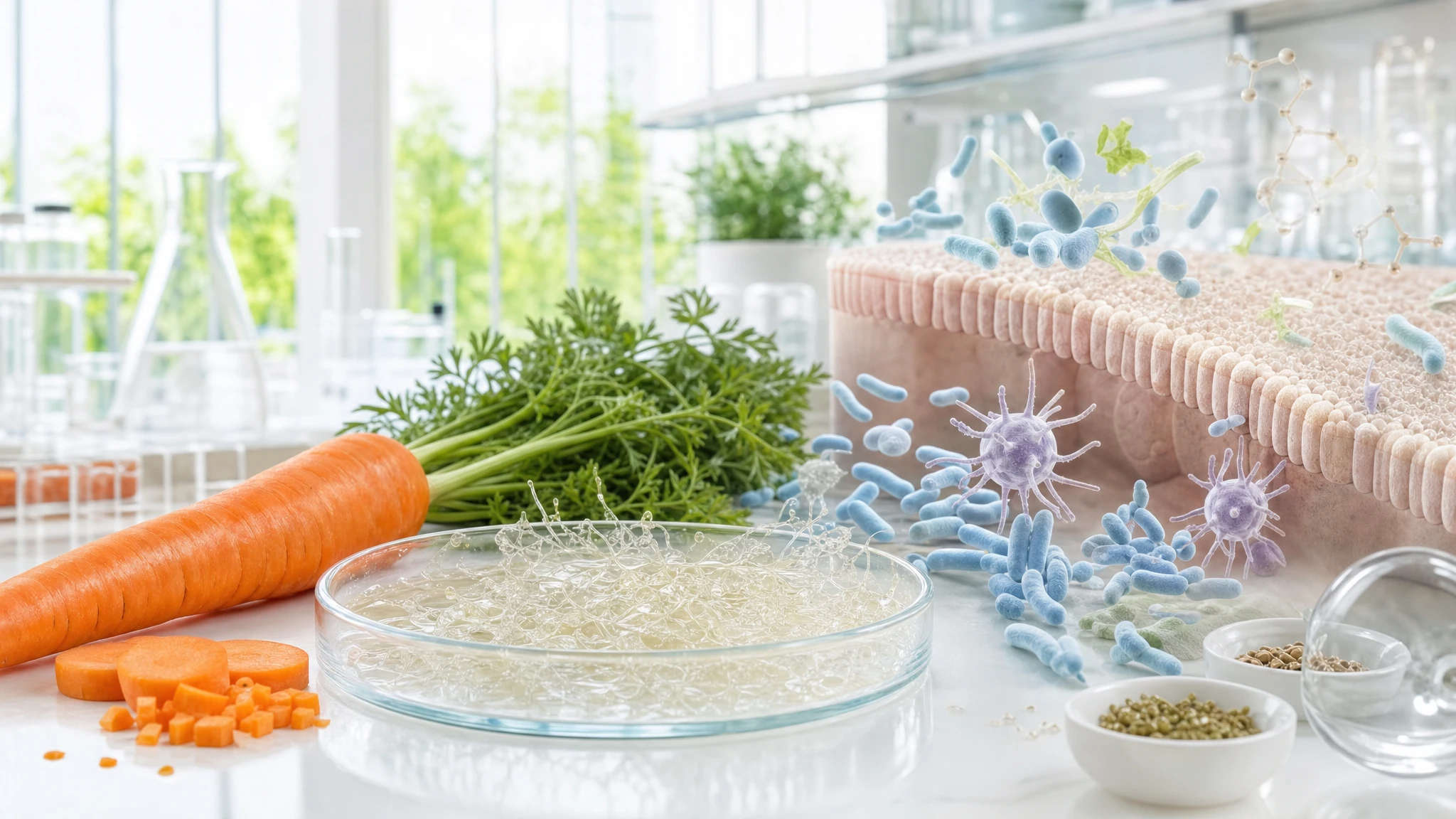
ABSTRACT : WHAT THE SCIENCE SAYS
A randomized study in healthy adults evaluated whether 500 milligrams per day of carrot rhamnogalacturonan-I, an isolated pectin fiber, modified the gut microbiota, immune signals, and barrier function. After four weeks, fecal bifidobacteria increased, without a generalized change in the measured fecal metabolites.
The authors' summary describes a randomized, double-blind, placebo-controlled study, designed to reduce the influence of participant and researcher expectations. Fifty-four healthy adults, aged 18 to 70, were assigned to either 500 milligrams per day of carrot-derived rhamnogalacturonan-I or a placebo for four weeks. The groups were also balanced for habitual dietary fiber intake and initial fecal Bifidobacterium levels. The primary outcome was to verify whether bifidobacteria increased during the intervention. In the treatment group, fecal Bifidobacterium counts increased over time, peaking at approximately 1.5 times the baseline value at the third week; the temporal comparison with the placebo was significant. After four weeks, 57% of treated participants and 43% of controls showed an individual increase. Some signs of myeloid dendritic cell activation in the blood also increased. However, most fecal short-chain fatty acids, fecal calprotectin, and quality-of-life indicators did not change. Experiments on cells and intestinal biopsies suggested barrier protection under stress, but these do not represent clinical proof in humans.
What this research analyzed
To understand the significance of the study, it is necessary to distinguish total fiber from a specific type of fiber. Carrot rhamnogalacturonan-I, abbreviated as cRG-I, is a complex part of plant pectin that is not broken down by human digestive enzymes and can therefore reach the colon. Here, it can become a substrate for certain gut microorganisms. Kerezoudi and colleagues evaluated whether this exposure primarily changed Bifidobacterium, a genus of bacteria often studied for its ability to utilize complex carbohydrates.
The human study was a randomized, double-blind, placebo-controlled, parallel-group trial. Of the 54 participants initially assigned, 28 were in the placebo group and 26 in the cRG-I group; two people in the treatment group dropped out due to antibiotic use, not because of reactions attributed to the product. The intervention involved two capsules per day, for a total of 500 mg of cRG-I. The researchers measured fecal bifidobacteria, fermentation metabolites, self-reported symptoms, and immune markers in the blood on a weekly basis. They also used preclinical models: intestinal cells and colon biopsies subjected to stress conditions. These models serve to explore possible mechanisms, not to measure clinical benefit in participants.
Research data
Carrot Rhamnogalacturonan-I Supplementation Shapes Gut Microbiota and Immune Responses: A Randomised Trial in Healthy Adults
- Randomized, double-blind, placebo-controlled trial: 54 healthy adults received 500 mg/day of cRG-I or maltodextrin for four weeks.
- Fecal Bifidobacterium counts increased in the cRG-I group over time (p = 0.017), peaking at approximately 1.5 times at week 3.
- CD86 and HLA-DR, signals of myeloid dendritic cell activation, increased compared to placebo; other fecal short-chain fatty acids did not differ.
What results emerge from the study
The main result indicates that a small amount of this pectin modified a specific microbial target, rather than the entire gut microbiota. In the cRG-I group, fecal counts of Bifidobacterium grew more over time than in the placebo group, reaching approximately 1.5 times the initial value by the third week. By the fourth week, 57% of the treated individuals and 43% of those in the placebo group showed an individual increase. This signals an average group response, but does not prove that every participant responded in the same way.
Regarding the immune system, myeloid dendritic cells—cells that help present signals to other elements of the immune response—showed a higher proportion of cells with CD86 and HLA-DR. These are markers of cell activation: they indicate that the cells were expressing more signals involved in immune communication. The comparison with the placebo was significant for the proportion of cells positive for both markers (p < 0.005); the intensity of CD86 and HLA-DR increased with p < 0.02 and p < 0.05, respectively. However, this is not equivalent to demonstrating greater protection against infections or the improvement of a disease.
Only fecal isobutyric acid was higher after four weeks, increasing from 5.96 ± 1.04 to 6.75 ± 1.91 micromoles per gram of stool. The other short-chain fatty acids, molecules produced by bacterial fermentation, did not differ. This is important because it prevents us from inferring a generalized increase in fermentation from a single metabolite. The diarrhea score decreased from 4.50 ± 1.94 to 3.67 ± 1.20; in healthy adults, this should be interpreted as slightly firmer stools, not as a treatment for diarrhea.
Why this study is relevant
The value of this research lies in demonstrating that fibers with different structures can have selective effects, even at doses much lower than those that contribute significantly to the total daily intake of dietary fiber. In this case, 500 mg per day coincided with an increase in bifidobacteria, even in individuals with an already relatively high habitual fiber intake. This finding therefore supports the idea that the composition and structure of fiber matter, in addition to the overall quantity.
Preclinical models complete the biological picture. In Caco-2 and THP-1 cells, used to simulate an intestinal epithelium exposed to inflammation, the cRG-I fermentate preserved the transepithelial electrical resistance, or TEER, an indicator of the integrity of the cell layer. In intestinal biopsies subjected to stress, cRG-I or its fermentate limited certain signals of loss of barrier function. This step suggests a plausible chain, from fiber to fermentation and the epithelial response. However, biological plausibility does not prove that the same chain produces measurable health benefits in healthy people or those with intestinal disorders.
Study limitations and what it does NOT prove
The study is brief, involved a limited number of healthy adults, and was not designed to evaluate clinical outcomes such as the prevention of diseases, infections, or chronic intestinal disorders. No hazard ratios (HR), relative risks (RR), or odds ratios (OR) are available because this was not a study on clinical events over time. The results describe variations in biomarkers and questionnaires, not a reduction in the risk of pathology.
Furthermore, the increase in Bifidobacterium does not, by itself, prove an improvement in health. The composition of the gut microbiota varies over time, and stool samples represent only a portion of the intestinal environment. The absence of differences for the majority of short-chain fatty acids, fecal calprotectin, and self-reported well-being reduces the possibility of generalizing the signal to a broad transformation of intestinal physiology. Models using cells and biopsies employ controlled concentrations and experimental conditions: they are useful for formulating hypotheses, but they do not replace a clinical trial with patient-relevant outcomes.
Independent confirmatory evidence
Confirmation in humans comes from the 2024 trial by Jian and colleagues, which analyzed intestinal samples from 146 healthy adults exposed to 0.3 or 1.5 g per day of cRG-I or a placebo for eight weeks. Here, too, the relative abundance of Bifidobacterium increased, especially B. adolescentis and B. longum. The study supports the initial step of the chain—that is, the selection of specific gut bacteria by cRG-I—but it does not demonstrate that this variation causes the respiratory outcomes analyzed in the same research program. The confirmation is direct for the bifidogenic signal, with the limitation of a healthy population and analyses based on stool samples [1].
A second trial, conducted by Kerezoudi and colleagues in 2026 on 55 healthy adults, tested a rhamnogalacturonan-I derived from chicory. The fiber was not identical to that from carrots, but at 500 mg per day for four weeks, it reproduced the increase in bifidobacteria and the increase in HLA-DR on myeloid dendritic cells. It therefore supports, with moderate strength, that some RG-I variants may link a microbial response to systemic immune signals. However, the different botanical origin prevents attributing the effect solely to the common structure [2].
The transition from fermentation to metabolites is supported by an ex vivo experiment on fecal material from 24 adults. Van den Abbeele and colleagues observed increases in acetate and propionate and growth of taxa linked to Bifidobacterium with cRG-I; compared to inulin, the gas produced was 44% lower. This is a useful mechanistic confirmation, but the model outside the organism does not include absorption, diet, intestinal motility, or a complete immune response [3].
Conflicting evidence
The available evidence suggests that one should not expect a linear dose-response. In the rhinovirus trial by Lutter and colleagues, 177 healthy adults took 0, 0.3, or 1.5 g per day of cRG-I before experimental exposure to the virus. The 0.3 g dose was associated with a 20% reduction in symptom severity and a 25% reduction in duration, while with 1.5 g, the clinical results were intermediate and more similar to the control group. The authors hypothesized an immune feedback mechanism; however, this remains an interpretation, and the respiratory context is not comparable to the intestinal research by Kerezoudi [4].
There is also a significant difference between experimental models and fecal measurements. In an in vitro system, Van den Abbeele and colleagues detected increases in acetate, propionate, lactate, and, in some phases, butyrate during the fermentation of cRG-I. In the 2025 trial, however, fecal short-chain fatty acids did not change, with the exception of isobutyrate. The two results are not necessarily incompatible, because the molecules produced in the colon can be absorbed, and feces do not measure their total production. They do show, however, that an effect observed in vitro cannot be automatically transferred to humans [5].
Comparative overview
The following publications help to assess the extent to which the results are reproducible, model-dependent, or dose-sensitive.
| Publication | Model and sample size | Main result | Relationship with the Kerezoudi study |
|---|---|---|---|
| Jian et al., 2024 [1] | RCT, 146 healthy adults exposed to cRG-I for eight weeks | Relative increase in Bifidobacterium; overall composition minimally altered | Direct confirmation of the bifidogenic signal, but not of a clinical intestinal benefit |
| Kerezoudi et al., 2026 [2] | RCT, 55 healthy adults; chicory-derived RG-I | Increase in bifidobacteria and HLA-DR on myeloid dendritic cells | Indirect confirmation for a structurally related RG-I fiber |
| Van den Abbeele et al., 2023 [3] | Ex vivo experiment with fecal microbiota from 24 adults | Increase in acetate and propionate; lower gas production compared to inulin | Supports the fermentation mechanism, without demonstrating effects in the organism |
| Lutter et al., 2021 [4] | RCT, 177 healthy adults with experimental rhinovirus exposure | Better clinical response at 0.3 g/day compared to 1.5 g/day | Shows that effects may depend on dose and biological context |
| Van den Abbeele et al., 2020 [5] | In vitro models of digestion, fermentation, and intestinal cells | Increase in certain fermentation metabolites and barrier signals | Highlights the gap between experimental results and human fecal measurements |
Editorial conclusion
The study by Kerezoudi and colleagues tested a small daily dose of carrot rhamnogalacturonan-I, an isolated pectin fiber, in healthy adults. For four weeks, 500 mg per day increased fecal bifidobacteria compared to the placebo, peaking at the third week. Signs of increased activation of myeloid dendritic cells in the blood and a slight change in stool consistency also emerged. However, most short-chain fatty acids in the stool did not change, nor did calprotectin or perceived well-being. Cellular models and biopsies suggest protection of the intestinal barrier under stress, but do not demonstrate it in participants. Subsequent and previous publications suggest that the bifidogenic effect may be reproducible, while showing that dose, botanical source, and measurement method alter the results. The most accurate interpretation is therefore limited: this short-term intervention modified some biological indicators in healthy volunteers. It does not prove specific clinical benefits.
References
[1] The impact of daily supplementation with rhamnogalacturonan-I on the gut microbiota in healthy adults: A randomized controlled trial
[2] Dietary chicory rhamnogalacturonan-I modulates gut microbiota and immune responses in healthy adults
[3] Carrot RG-I Reduces Interindividual Differences between 24 Adults through Consistent Effects on Gut Microbiota Composition and Function Ex Vivo
[4] The Dietary Intake of Carrot-Derived Rhamnogalacturonan-I Accelerates and Augments the Innate Immune and Anti-Viral Interferon Response to Rhinovirus Infection and Reduces Duration and Severity of Symptoms in Humans in a Randomized Trial
[5] A Novel Non-Digestible, Carrot-Derived Polysaccharide (cRG-I) Selectively Modulates the Human Gut Microbiota while Promoting Gut Barrier Integrity: An Integrated In Vitro Approach
Editorial note
Artificial Intelligence was used solely as a tool to support editorial and documentary work. All content, interpretations, bibliographic citations and conclusions have been verified, reviewed and approved by the author, who assumes full scientific responsibility for them.
The manuscript was also subject to independent peer review prior to publication.
To ensure maximum transparency, the article's complete history — including the dates of submission, review, acceptance and publication, as well as information on the peer review process — is available on the dedicated Article History page.