


Dietary fiber: what it really is and how it behaves in the body during digestion
Research shows that fibers are not a single block, but a family of diverse plant parts. Their structure, relationship with water, fermentability, and food matrix change their digestive journey. The definition of fiber should therefore be linked to its behavior in the body, not just its plant origin.
- Published 30/09/2026
- Updated 08/10/2026
- Reviewed 30/09/2026
- Article history

ABSTRACT : WHAT THE SCIENCE SAYS
Dietary fiber is often referred to as if it were a single ingredient, but in reality, it represents a broad family of plant components with diverse properties. It is not processed by the body in the same way as sugars or available starches, because its structure resists human digestive enzymes, at least in part.
For this reason, the term "fiber" does not only describe what is present in plants, but also how these components travel through the digestive tract, interact with water, and, in some cases, are transformed by the microbiota, which is the set of microorganisms living in the intestine. Understanding this distinction helps to better read nutritional labels, interpret food sources, and avoid misleading simplifications. Specifically, the article addresses:
- Scientific definition of fiber and its plant origin
- Differences between structure, solubility, and fermentability
- Fiber's journey between the small intestine and colon
- Role of the food matrix in fiber behavior
- Why fiber is not a single nutrient
What is dietary fiber and why is it not all the same?
Dietary fiber is not a single block, but plant parts that the body processes in different ways. Understanding their definition helps to follow the digestion of the fibrous component throughout the intestine. It also allows us to distinguish what remains intact, what changes thanks to the microbiota, and what modifies the intestinal content.

Dietary fiber are plant-derived components that the human body does not utilize in the same way it does sugars and available starch. The definition of dietary fiber therefore does not refer to a single substance, but to a broad functional category, composed of elements that share resistance to digestion in the small intestine. This very resistance explains why the term "fiber" is useful, but not enough on its own to describe their behavior in the body.
To get oriented, it's helpful to understand from the outset that fibers are not all the same in terms of structure, origin, and mode of action. Some arrive more intact in the colon, others are modified along the way, and still others primarily affect the consistency of the intestinal contents. The following sections clarify where the line is drawn between a general description and the differences that truly matter in practice.
This basic distinction is important because it avoids treating fibers as a single substance and prepares the reader to better understand the subsequent stages of fibrous material digestion.
In the following sections, we will first see how they pass through the digestive tract and then why properties such as fiber solubility, viscosity, and fermentability guide their behavior to the colon. Only then can we understand why two fiber-rich foods can have different effects, even though they belong to the same general category.
In this section, you will see some key points:
- The functional definition of fiber and its connection to plants.
- Why the same label encompasses different behaviors.
- How initial digestion affects their fate in the colon.
- In what sense the food matrix can change the final effect.
Dietary fiber forms a broad category, defined more by its effects in the body than by a single chemical formula. This definition helps explain why different types of fiber act in different ways.
What is meant by dietary fiber
Plant fibers are parts of plants that human digestive enzymes do not break down like many carbohydrates. Digestive enzymes are proteins that break food into smaller parts. The definition of dietary fiber is therefore based on its behavior in the body. It does not refer to a single molecule, but to various elements that resist at least partially digestion in the small intestine.
A 2025 review showed how important the structure of fibers is. Crystallinity, porosity, branching, and the ability of pores to absorb water regulate contact with the microbiota (the set of intestinal microorganisms) [1]. Another review indicated that dividing fibers into "soluble" and "insoluble" remains useful. However, this division does not explain all the differences in digestion [2]. Recent studies and guidelines confirm that speaking of fiber in the singular can hide important aspects [3] [4]. These works describe the category well, but do not predict a single effect valid for every type.
Why not all fibers behave the same way
The differences between fibers depend mainly on their chemical and physical structure. Some are more compact, while others are easier to access and transform. They can also bind to water and intestinal contents in different ways. Therefore, the same amount can have different effects in the body. These effects range from the small intestine to transformation in the colon. For this reason, the structure guides the fiber's digestive path.
A 2017 synthesis reiterated that the effect depends on behavior during digestion, not just presence in food [5]. A 2014 review described the complexity of these structures and their possible effect on the colon microbiota. Here, microorganisms obtain energy by breaking down complex compounds [6]. An analysis of physical properties also showed that three-dimensional shape and contact with water change the functions of fibers [7]. These sources explain the differences well, but do not prove that all types produce the same effect.
Where fibers are found in plant foods
Fibers are part of many plant foods, but they are not present everywhere in the same quantity. They are mainly found in the tissues that protect and support plants. Fruits, vegetables, legumes, whole grains, seeds, and nuts are therefore well-known sources. However, it's not just about how much fiber a food contains. The food matrix (food structure) that encloses the fiber also matters. This structure can make fiber more or less accessible during digestion.
A review of the physical processes of digestion studied plant cell walls. These walls can enclose nutrients and limit enzyme access. They can therefore change bioaccessibility (the amount available during digestion) [8]. This data helps to understand why a fiber within a plant does not act like an isolated fiber added to a food. The context therefore plays a role, but it does not alone explain all the differences. Solubility, fermentation, and viscosity must also be considered.
What experimental studies say about the differences between fibers
Human studies show that different fibers do not always produce the same biological effects. In a crossover study of 20 healthy adults, each person consumed four different fibers. In a crossover study, each participant tries all planned interventions at different times. Each type was used for 14 days, at a dose of 12 grams per day. The fibers were well tolerated and showed favorable signs for the colon due to fermentation [9].
In another crossover trial of 19 healthy adults, participants consumed 0, 5, or 10 grams of a soluble fiber with a standard meal. The trial found less hunger and more satiety hormones [10]. These results show different effects, but they do not automatically apply to the entire category. The first study is short and includes 20 people. It can therefore describe short-term tolerability, but not long-term effects. The second examines a specific fiber and not all dietary fiber. Overall, the two works indicate that the response can change based on type, dose, and meal.
Recent research and updates

In 2025, Swedish researcher Kerezoudi and colleagues published a study in Microorganisms. The group examined rhamnogalacturonan-I, a pectin (complex cell wall sugar) of plant origin. They evaluated whether a low dose could change the microbiota, immune response, and intestinal barrier. The work is recent and verified. The data confirm that not all fibers act in the same way.
Carrot Rhamnogalacturonan-I Supplementation Shapes Gut Microbiota and Immune Responses: A Randomised Trial in Healthy Adults
- The study randomly divided 54 healthy adults between 500 mg per day of cRG-I and placebo for 4 weeks. The groups were similar at baseline.
- The fiber studied was a rhamnogalacturonan-I derived from carrots, given in isolated form and at a fixed daily dose.
- Fecal levels of Bifidobacterium increased, peaking at week 3. Diarrhea assessment also improved slightly compared to placebo.
- Some markers of circulating dendritic cells (cells that guide the immune response) also increased. This data indicates a measurable effect even outside the intestine.
How they pass through digestion and reach the colon
The journey of dietary fiber is different from that of quickly absorbed nutrients. In fiber digestion, meaning the changes along the digestive tract, a portion resists digestion in the small intestine. This portion reaches the colon, where it can nourish the microbiota (the collection of intestinal microorganisms). Other fibers, however, remain almost intact throughout the entire process. Following this journey helps to better understand their effects on the body.
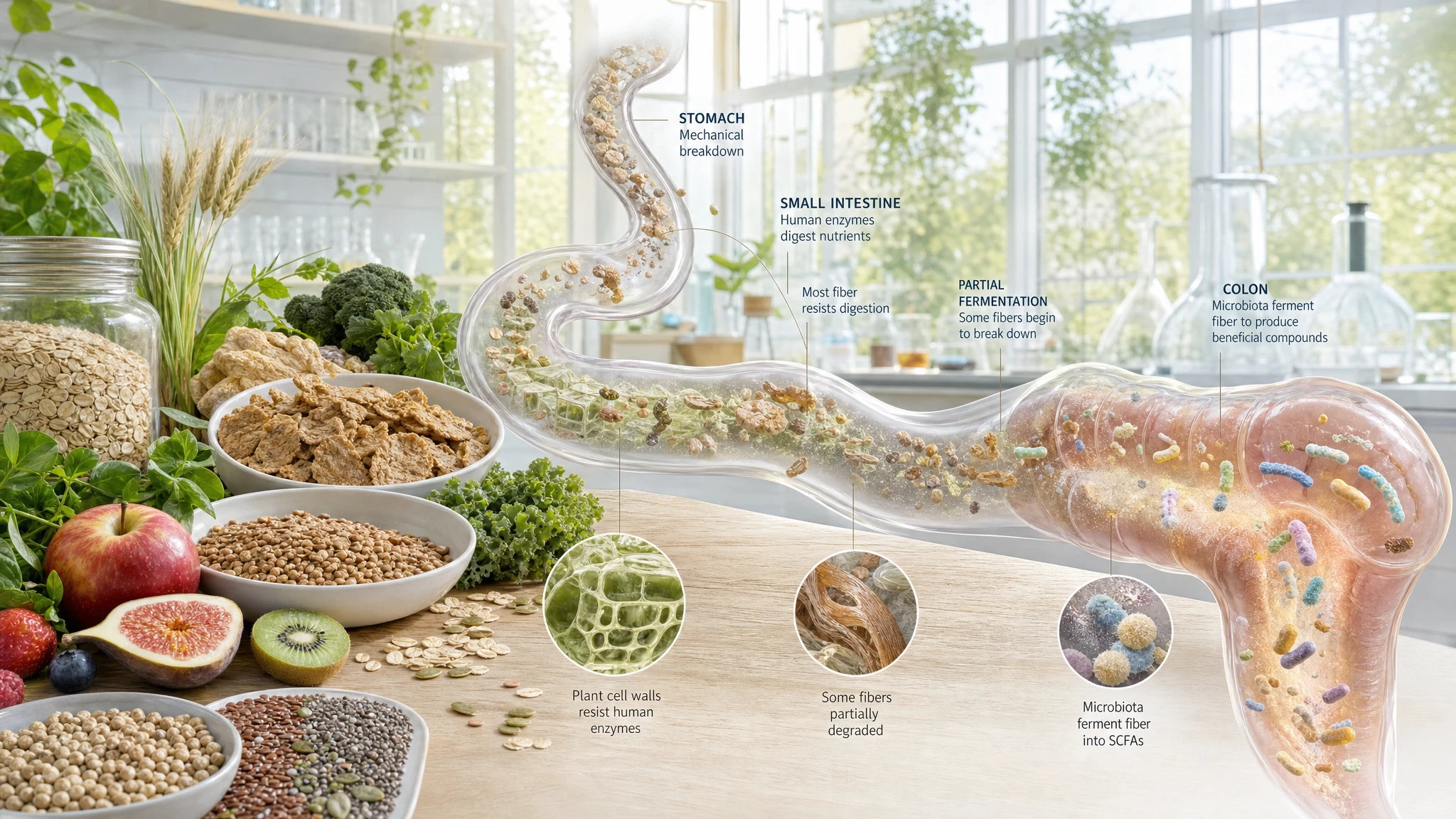
In the upper digestive tract, fibers behave differently from starches and available sugars. Human enzymes cannot completely break them down, so the body only absorbs a portion. Fiber digestion involves various steps, linked to the structure and form present in foods.
A portion then reaches the colon intact or little changed. Here, contact with microorganisms can further alter its path. To understand this step, it is useful to consider three aspects:
- some fibers resist digestion in the upper digestive tract and pass through the small intestine.
- others reach the colon, where they can nourish the microbiota.
- some change only partially during the entire digestive process.
In the colon, the fate of fibers depends on how much they have resisted and on the action of the microbiota. The following three steps explain why some remain almost intact, while others can be fermented.
Are fibers digested in the same way as other nutrients?
No: compared to available carbohydrates, fats, and proteins, fiber follows a more limited and less uniform path. The digestion of fiber in the upper tract is partial precisely because human enzymes are not designed to break down many of its structures. This means that its effect depends not only on absorption but also on transit, residence time in the lumen, and the transformations that occur before the colon. For example, a soluble fiber can form a gel that slows gastric emptying. An insoluble fiber, on the other hand, accelerates transit with almost no modification. In both cases, the path is different from that of a simple sugar, which is rapidly absorbed in the small intestine.
The limitation of this framework is that it mainly describes the general mechanism: not all fibers react in the same way, and not every plant food releases its components at the same rate. For this reason, the comparison with other nutrients should be understood as a difference in pathway, not as an absence of function.
Why many fibers reach the colon
Many fibers reach the colon because the small intestine does not have the necessary enzymes to completely break down most of their structures. As a result, a significant portion passes through the upper tract without being absorbed and reaches the final part of the intestine, where the biological context changes. Here, the presence of the microbiota becomes central, because the colon is the environment where complex compounds can be further utilized or left almost intact. A 2017 review described the colon as a place where many microorganisms obtain energy from the degradation of complex compounds, including dietary fiber [11].
The limitation is that this is a synthesis of mechanisms, not a single clinical experiment: not all fibers arrive in the same state and not all are fermented with the same intensity. However, the message is clear: passage into the colon is not a detail, but the point where their biological effect takes a different direction.
What role does the microbiota play in fiber transformation?
The microbiota does not process all fibers in the same way: its action depends on accessibility, structure, and residence time in the colon. When a fiber is more available to intestinal bacteria, it can be fermented to a greater extent; when it is more resistant, it remains longer as largely unmodified material.
In practice, the fermentation of fibrous material is the result of the interaction between the chemical composition of the fiber and the metabolic capacity of microorganisms. A 2023 in vitro study compared fibers derived from plant cell walls and observed that the composition of these walls modifies fecal fermentation profiles and microbial composition [12]. The limitation is important: the laboratory model does not reproduce everything that happens in a real person, with variable diet, motility, and microbiota. However, the data reinforces an essential point: the colon does not receive "all the same" fibers, and the microbiota responds selectively to their structure.
Solubility, viscosity, and fermentability: the properties that guide fiber behavior
The behavior of dietary fiber does not only depend on the quantity we eat. What matters most is how they interact with water, intestinal contents, and the gut microbiota (the collection of intestinal microbes). Solubility, viscosity, and fermentability help to better understand the definition of dietary fiber. They also explain why different plant fibers do not always produce the same effects. These properties are very useful for tracking the path of fiber between the small intestine and the colon.

Three properties help us understand how dietary fiber works: solubility, viscosity, and fermentability. Solubility describes how a fiber interacts with water. Viscosity indicates how much it can thicken the contents of the intestine. Fermentability shows how much the gut microbiota can use a fiber in the colon.
These differences prevent easy errors when comparing various types of fiber. Two fibers that appear similar on paper can behave differently in the intestine. Let's therefore see what the terms soluble, insoluble, fermentable, and viscous indicate. This helps to understand why viscosity and consistency are not the same thing.
These criteria do not indicate the same thing and should therefore be distinguished. The same fiber can act in different ways during its digestive journey. To navigate this, it is useful to consider these properties as interconnected criteria:
- Solubility helps understand how a fiber behaves in liquids.
- Viscosity explains how it can change the flow of intestinal contents.
- Fermentability describes how much the gut microbiota uses the fiber in the colon.
- The food matrix (food structure) can change the final effect.
The physical properties of fibers describe different aspects of their behavior in the body. It is therefore necessary to separate the three concepts before evaluating their real effects.
What soluble or insoluble fiber means
The distinction between soluble and insoluble fiber arises from how a fiber behaves in water. In practice, a more soluble fiber disperses better in liquids, while a less soluble one tends to maintain a more compact structure. This property is measured in the laboratory by agitating the fiber in an aqueous solution at a controlled temperature. After a defined time, the dissolved part is separated from the solid residue. The result is a percentage indicating how much fiber has passed into solution. This proportion allows fibers to be classified on a continuous scale, not just into two categories.
This label is useful as a first guide, but it doesn't tell the whole story: it doesn't say, for example, how much a fiber will be fermented in the colon or how much it will affect the consistency of intestinal contents. A very soluble fiber, like inulin, can ferment rapidly. Another soluble fiber, like some gums, can, however, resist bacterial attack. The limitation of the distinction is precisely this: it guides, but it doesn't alone predict behavior in the body. To understand it well, it must always be read together with other properties, especially when one wants to interpret fiber digestion without reducing it to a single label.
What does fermentable fiber mean?
A fermentable fiber is a fiber that the colon's microbiota can use, to varying degrees, as a substrate. This does not solely depend on solubility: the fiber's structure, its accessibility to microorganisms, and its transit time in the intestinal tract also matter. To measure this property, researchers use models that simulate fermentation in the colon. In these experiments, fiber is incubated with human feces in the absence of oxygen. The production of gas and short-chain fatty acids is then measured over time. Data show that soluble fibers like pectin ferment within a few hours. Other fibers, such as cellulose, remain almost intact even after long periods [3].
In other words, fermentability describes an active biological process, not just a simple chemical property of the fiber. The limitation of this data is that not all fibers behave the same way in the body, but the principle is clear: to ferment means to be available to the microbiota, not simply to dissolve. The production of short-chain fatty acids is a key outcome of this process. These molecules nourish colon cells and regulate various bodily functions.
Why viscosity and consistency are not the same thing
Viscosity indicates a fiber's ability to thicken intestinal contents when it encounters water. Consistency, on the other hand, is what is perceived or observed in the food material as a whole. To measure it objectively, instruments called rheometers or viscometers are used. These devices apply a force to the sample and record the resistance they encounter. The data is expressed in units of measurement such as millipascals per second. Fibers like glucomannan show high viscosity values even at low concentrations. Other fibers, such as inulin, increase viscosity only at very high doses.
The two can overlap, but they do not coincide: a fiber can increase viscosity under certain conditions and behave differently under others, especially depending on the food matrix in which it is incorporated. Cooking, for example, can break cell walls and change a fiber's viscosity. Chewing and stomach pH also modify these properties before the fiber reaches the colon. The limitation is that these results depend on the experimental context, but they confirm that viscosity should not be confused with a generic "density" of food.
The food matrix changes how fibers act
Dietary fiber doesn't just act based on its quantity, but also on the food's structure. The food matrix, meaning the food's architecture, can slow down or facilitate digestion. It can also change how much fiber reaches the colon and its final effect on the body.
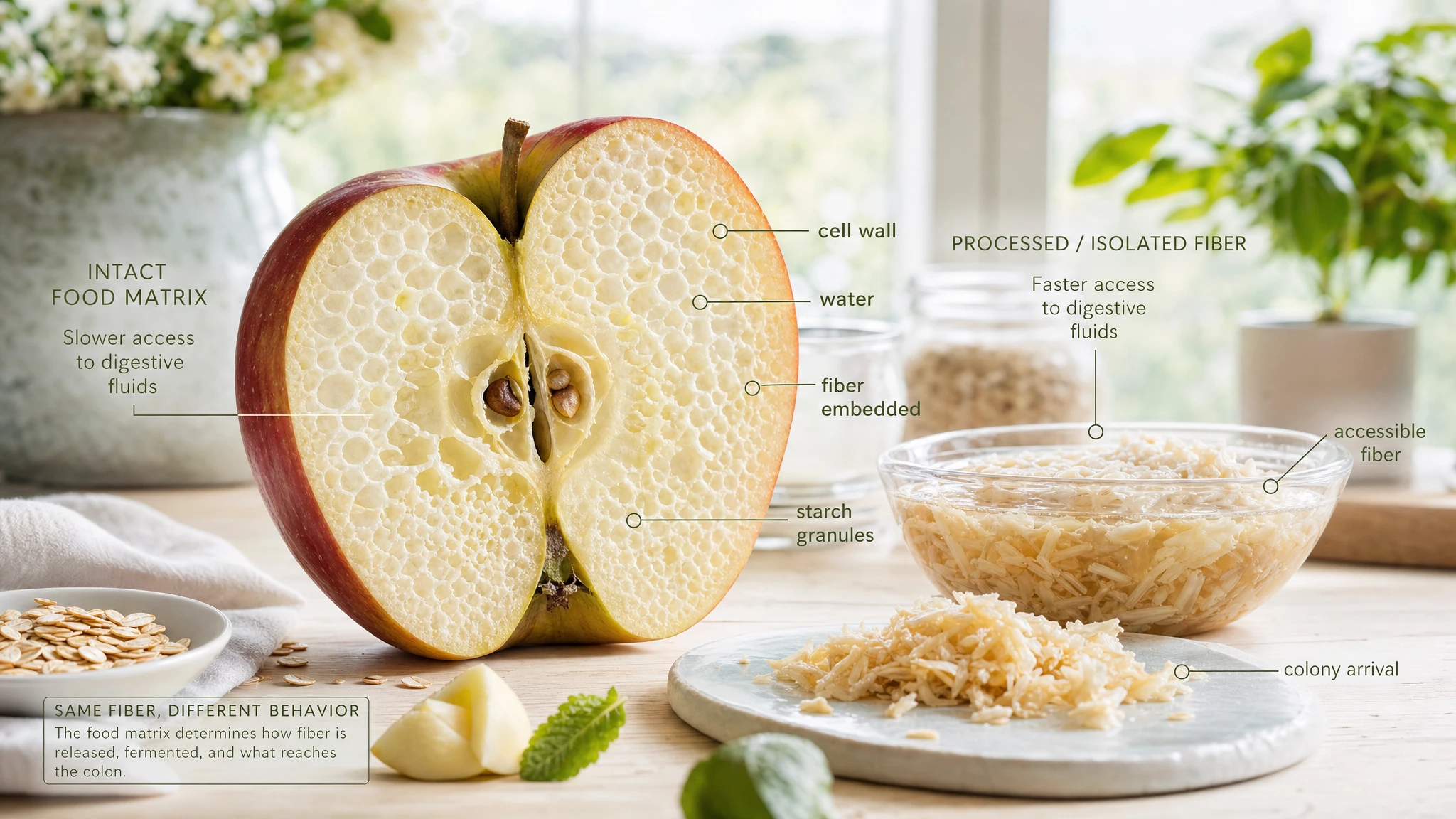
Dietary fiber are plant substances that the body does not digest and that aid intestinal transit. It's not enough to read the quantity on the label: the structure that contains them also matters. The food matrix is the architecture of food, determined by how water, cell walls, and nutrients are arranged.
This structure changes the access to fiber during digestion and what reaches the colon. For this reason, a whole plant food and an isolated fiber act differently. It can modify the release of components, contact with liquids, and access to digestive enzymes.
These aspects explain why plant fibers do not always act in the same way. Their effect also depends on the food that contains them, not just the quantity. The difference between whole food and an isolated part helps to understand the digestion of fibrous material and its effect in the colon.
To understand the effect of fiber, it is useful to distinguish three aspects:
- how the matrix retains or releases fiber;
- how much an intact food retains its original structure;
- how processing changes access to fiber and its fermentation.
The structure of food can change the path of fiber during digestion. Let's see what the food matrix indicates and why whole food is not equivalent to isolated fiber. Finally, we examine how processing can change its behavior.
What is the food matrix?
The food matrix is the three-dimensional structure of food, meaning its shape in space. It indicates not only the ingredients, but also how water, cell walls, and other parts hold them together. This network can hinder or facilitate access to fiber during digestion. This changes the speed at which they separate from food and reach the small intestine. The same fiber can therefore act differently within different structures.
A clinical study (controlled human research) examined people undergoing pelvic radiotherapy. A high fiber intake, equal to at least 18 grams of NSP per day, was associated with lower gastrointestinal toxicity compared to a lower usual intake [13]. NSP are non-starch polysaccharides (fibers other than starch). However, the research concerns a very specific context, so the data does not automatically apply to every diet. Nevertheless, it shows that the structure of food can guide the action of fiber in the body.
Why a whole food is not equivalent to isolated fiber
A whole food retains its natural structure, while an isolated fiber loses much of its initial context. This changes how the food is chewed, moistened, and broken down. It can therefore alter its passage through the small intestine and the material that reaches the colon. This difference thus concerns both the initial stages of digestion and what reaches the final part of the intestine.
It's not just about how much fiber is present. It also matters whether it remains in the plant tissue or is separated. Summaries of studies show that the same part can follow different paths depending on its form. It can remain in whole food or be extracted and added as an ingredient. However, much of the data is mechanistic (based on biological processes) or observational (derived from observing groups of people). They explain the principle well, but do not always directly measure the effect on health. In practice, it is therefore more accurate to evaluate the context of the food, not the fiber alone.
How the degree of processing modifies fiber behavior
Processing can open or break parts of the plant structure that enclose the fibers. If a food is refined, it can lose some of its initial form. Fibers thus come into different contact with digestive fluids. This can change fermentation, i.e., the use of fibers by the microbiota in the colon. The microbiota is the set of microorganisms that live in the intestine.
The various techniques do not have the same effect, but all can change access to fiber. Therefore, treatment can modify both the fiber's journey and its encounter with the microbiota. A less processed food tends to better preserve its plant casing. A more refined product, on the other hand, can more easily release available starch and change the shape of the fibers. However, these effects vary depending on the food and the treatment used. Therefore, there is no single rule valid for every product. To evaluate the result, three data must be combined: composition, structure, and processing.
Summary of scientific evidence
This summary only includes sources already cited in the article. It shows which studies support the definition, digestive journey, and functions of fibers.
| Publication Year | Area Studied | What the Studies Indicate |
|---|---|---|
| 2014 | Fiber Structure and Microbiota | links have emerged between the complex structure of fibers and the microbiota's response [6] |
| 2016 | Bioaccessibility and Food Processing | results vary, but indicate that the food matrix changes fiber access and behavior [8] |
| 2017 | Physical Behavior in the Gastrointestinal Tract | data indicate that behavior in the digestive tract helps explain the effects of fibers [7] |
| 2017 | Physiological Fate During Digestion | data consistently link digestion, intestinal transit, and effect on the body [5] |
| 2017 | Fermentation in the Colon | studies indicate that the gut microbiota uses and transforms a portion of the fibers [11] |
| 2019 | Limitations of Soluble/Insoluble Distinction | studies indicate that the soluble/insoluble division is useful, but too simplistic [2] |
| 2023 | Plant Cell Wall and Fermentation | data indicate that the cell wall can change how fermentation occurs [12] |
| 2025 | Fiber Classification and Structure | data indicate that class depends more on structure than on a single property [1] |
Editorial review of the evidence
Overall, the studies I examined for this article present a consistent picture. I observed that fibers are not all the same; rather, they comprise plant parts with different structures and functions. Their interaction with water, fermentability, and fate in the intestine also vary.
The most robust research I reviewed indicates that the effects depend on the context, cell wall, and food matrix. This led me to believe that fiber should be described by multiple properties, not as a single ingredient.
However, I must point out an important aspect: many sources I consulted are reviews or studies on biological processes, while clinical studies are often short. Therefore, the data I found do not apply with certainty to all fibers.
Furthermore, I noticed that many tests use isolated fibers or in vitro models (outside the body). The transition from tests to whole foods therefore remains partial. These limitations prevent me from deriving rules that are valid in every case.
Conclusions and editorial summary
Final critical note
The sources I examined describe the many types of fiber well, but I found a key limitation. There is no single criterion to accurately predict the effect of each fiber in every case. I observed that studies often separate structure, fermentation, and food matrix, whereas in the body these factors act together.
Furthermore, much of the data I found comes from laboratory tests or short studies. They explain some processes well, but not always the whole food. Therefore, I suggest you read the results with caution.
References
[1] Advances in understanding dietary fiber: Classification, structural characterization, modification, and gut microbiome interactions
[2] “Dietary fibre”: moving beyond the “soluble/insoluble” classification for monogastric nutrition, with an emphasis on humans and pigs
[3] Carbohydrate intake for adults and children: WHO guideline
[4] Dietary Guidelines for Americans, 2025-2030
[5] The behavior of dietary fiber in the gastrointestinal tract determines its physiological effect
[6] A Perspective on the Complexity of Dietary Fiber Structures and Their Potential Effect on the Gut Microbiota
[7] Understanding the Physics of Functional Fibers in the Gastrointestinal Tract: An Evidence-Based Approach to Resolving Enduring Misconceptions about Insoluble and Soluble Fiber
[8] Re-evaluation of the mechanisms of dietary fibre and implications for macronutrient bioaccessibility, digestion and postprandial metabolism
[9] Evaluation of the Effect of Four Fibers on Laxation, Gastrointestinal Tolerance and Serum Markers in Healthy Humans
[10] Soluble dietary fiber (Fibersol-2) decreased hunger and increased satiety hormones in humans when ingested with a meal
[12] Plant cell wall composition modulates the gut microbiota and metabolites in in-vitro fermentation
Editorial note
Artificial Intelligence was used solely as a tool to support editorial and documentary work. All content, interpretations, bibliographic citations and conclusions have been verified, reviewed and approved by the author, who assumes full scientific responsibility for them.
The manuscript was also subject to independent peer review prior to publication.
To ensure maximum transparency, the article's complete history — including the dates of submission, review, acceptance and publication, as well as information on the peer review process — is available on the dedicated Article History page.