


Ceylon or Cassia cinnamon: how to identify them and make more informed choices in the kitchen
Research shows that Ceylon and cassia are not equivalent products. They differ in botanical species, aroma, chemical compounds, and how we can identify them. The most useful studies evaluate identity, undeclared additives, and differences in taste and aroma. Powder is more difficult to distinguish. For this reason, clear information on the packaging helps in making a more informed choice.
- Published 19/10/2026
- Updated 21/10/2026
- Reviewed 21/10/2026
- Article history
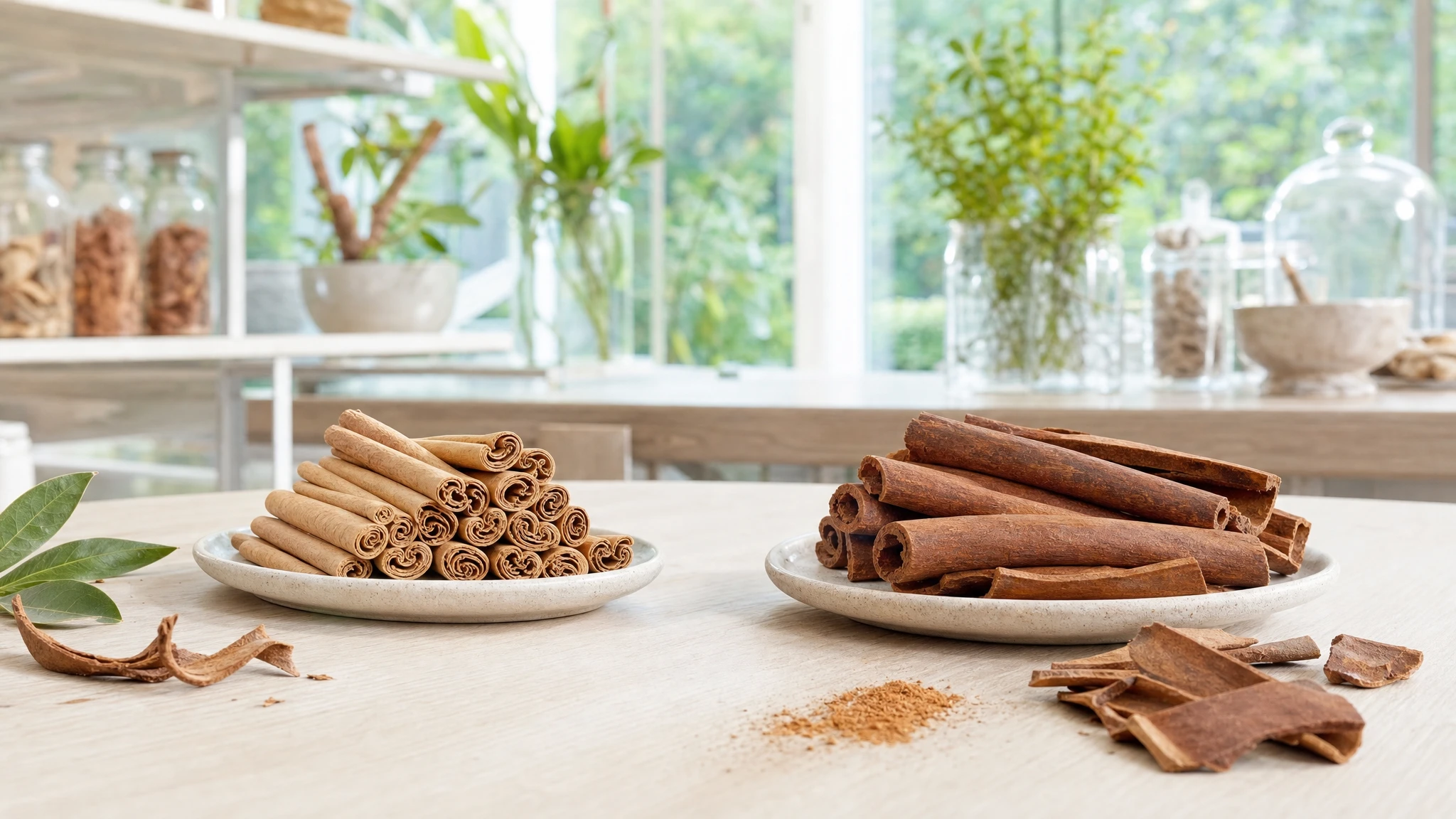
ABSTRACT : WHAT THE SCIENCE SAYS
When people talk about cinnamon, many think of a single spice, identical in every package. In reality, there are different types on the market, which vary by plant, scent, and taste. Among the most well-known are Ceylon cinnamon and Cassia, used in many foods. Both add aroma to desserts, drinks, and recipes, but they have different flavors and are identified with varying degrees of ease.
Those who know how to distinguish them can better read labels, understand the format, and choose based on their intended use. The form, whether in sticks or powder, also changes how easy it is to identify them carefully. In this article, we will look at their appearance, names, and practical use, without mistaking clues for definitive proof. In summary, these are the key points we will examine in more detail:
- Different botanical origins and names to read carefully
- Useful visual clues for sticks and other formats
- Powder requires more attention to the food label
- More delicate or more intense aroma in recipes
- More careful selection when using cinnamon frequently
Why Ceylon and Cassia are not the same cinnamon
The difference between Ceylon cinnamon and cassia is not just a commercial detail. It is the starting point for making a more informed choice. The species vary in origin, appearance, and quality of the spice. Knowing these differences helps you read labels and avoid treating all cinnamon the same way.
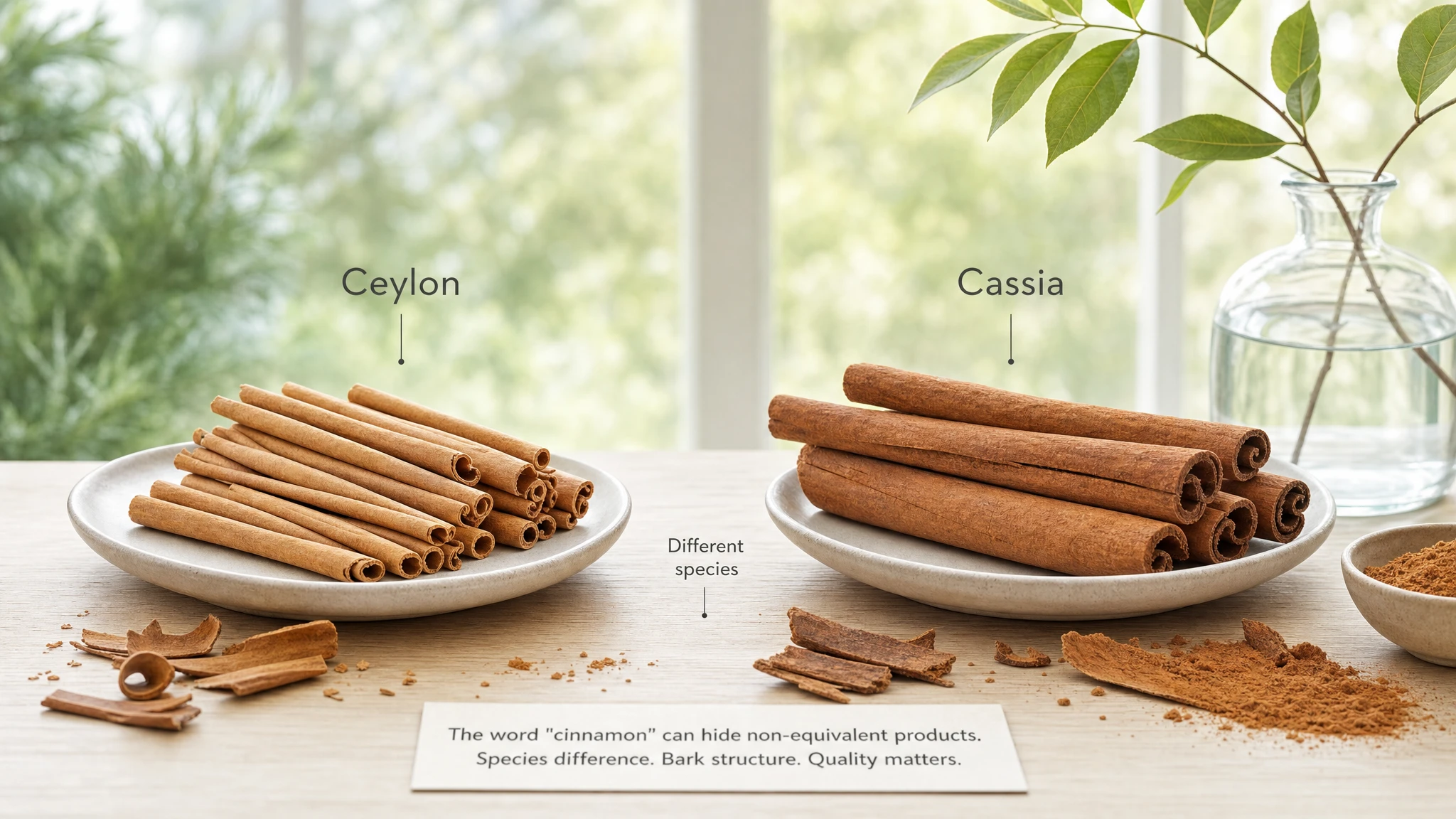
When talking about Ceylon cinnamon vs. cassia, you are not referring to just one spice. The two forms come from different Cinnamomum species. Their different origins change the quality and the bark of the product. It is important to know that "cinnamon" can refer to different spices. Using the correct name helps you understand the product and choose more carefully.
This difference matters because packaging does not always clearly indicate what it contains. The problem mainly concerns selected ground cinnamon and supermarket cinnamon. The two spices have different botanical and commercial identities. Therefore, aroma, yield, and value are not always the same.
We will first look at the visual signs of the sticks. Then we will understand why it is much more difficult to recognize the species in powder form.
To find your way, it is best to start with the full name and the easiest signs to notice:
- The botanical species are different and produce spices with their own characteristics.
- The bark changes in appearance, texture, and the way it is processed.
- The name written on the package says more than just the generic word "cinnamon."
- A careful choice begins before using the spice for cooking or seasoning.
The difference between Ceylon and cassia stems from their different botanical origins. The following paragraphs show which practical signs help to recognize them when purchasing.
Ceylon and cassia: two different botanical varieties
Ceylon and cassia are not equivalent names, but rather indicate different botanical varieties of the Cinnamomum genus. This difference explains why the word "cinnamon" describes products with very different characteristics. The bark, the texture of the stick, and the name used to sell the spice all vary. A generic label, therefore, is not enough to clearly define the product. This information matters if you are looking for a higher-quality cinnamon or want to understand what you are buying.
Sources on nomenclature and botany show that common and scientific names are often confused [1] [2] [3]. Comparing these sources clarifies which species corresponds to the different names provided. Studies indicate that distinguishing between Cinnamomum species helps in correctly reading labels and commercial data sheets. Taxonomy (the science of classifying living organisms), however, is not enough to describe the finished product. One must also evaluate the visual signs of the spice. If the whole form is missing, more precise checks are required.
Cinnamon sticks: thin layers or compact bark
When the spice is sold in sticks, its shape provides useful clues for distinguishing between types. Ceylon cinnamon tends to have many thin layers and a more fragile structure. Cassia, on the other hand, generally appears thicker, harder, and more compact. These signs are not absolute, as processing and storage can alter them. However, they remain among the easiest criteria to use when purchasing the spice. Observing the stick is helpful if the label is vague or when comparing multiple products on the shelf.
Analyses of authentic samples and spectroscopic and chromatographic tests confirm the value of these criteria [4] [5]. These tests evaluate how a substance reacts to light and separate its various compounds. The stick therefore allows for a quick visual check, but it does not offer definitive proof. Processing can change the external appearance, and the whole format is not always available. In powder form, however, the typical signs of the bark disappear almost entirely.
Cinnamon powder: why identification is more difficult
With ground cinnamon, visual inspection loses much of its utility. Grinding eliminates the structure that allows one to distinguish between different sticks. For this reason, two powders that look very similar may come from different botanical species. Color, texture, and smell provide some clues, but they do not reliably distinguish between Ceylon and cassia. The choice therefore depends on the label, the trade name, and, when present, the botanical name. This leads to a common mistake: buying generic "cinnamon" and assuming it is always the same.
Reviews of identification methods indicate that powder is the most difficult form to distinguish using the senses [6]. Laboratory analyses can identify chemical markers (substances that help recognize the species). These tests, however, are not available at the supermarket counter. The differences remain, but they become barely visible after grinding. If the spice is frequently included in your diet, reading the packaging carefully helps you understand what you are buying.
Recent research and updates
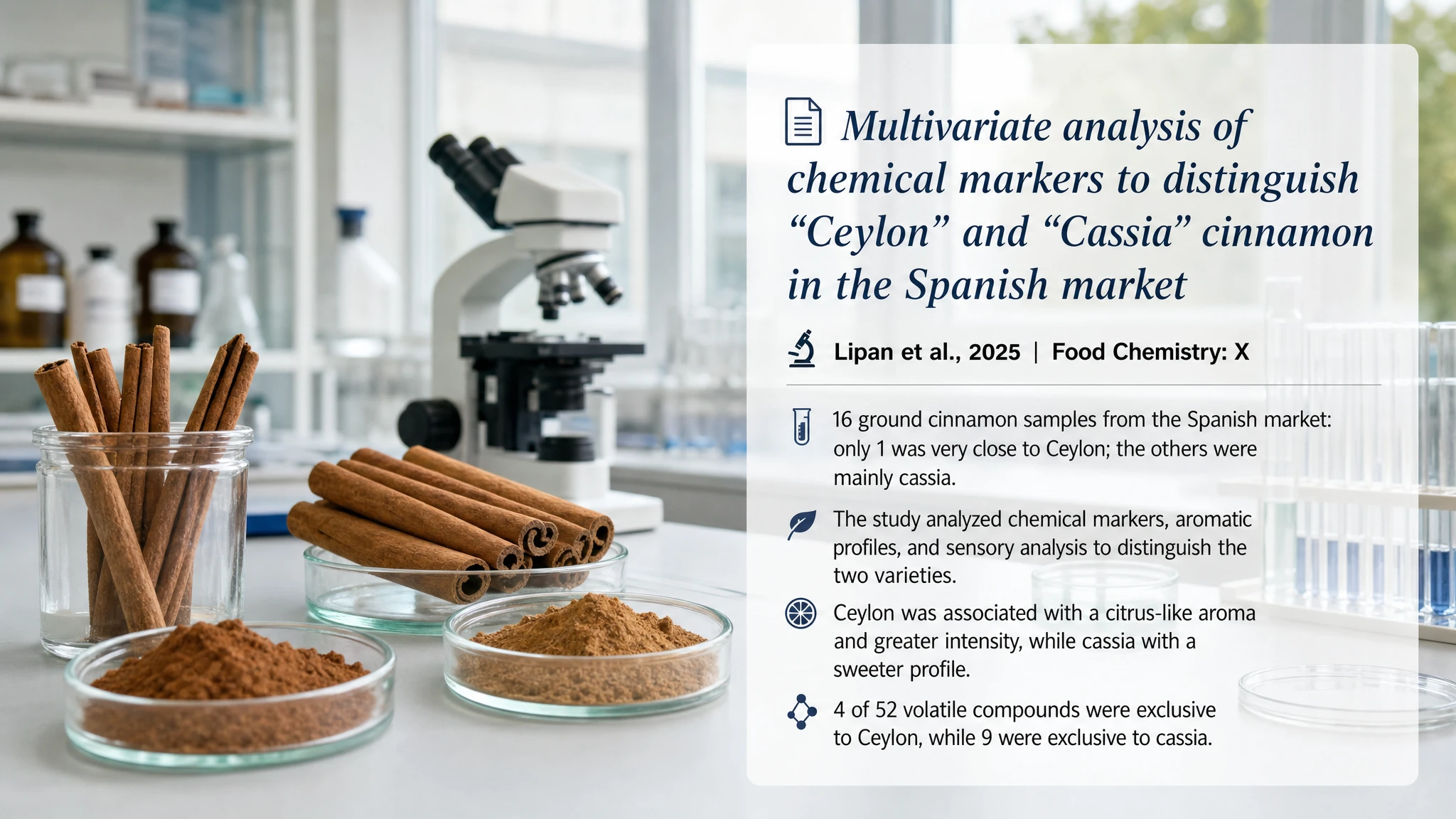
In 2025, Spanish researcher Lipan and colleagues studied commercial products in the journal Food Chemistry: X. The goal was to distinguish Ceylon cinnamon from cassia. The research used chemical markers (substances that help identify a species), sensory tests, and samples purchased at the supermarket. The data show that the two varieties are not equivalent. Labeling, aroma, and the form of the product therefore remain key elements for distinguishing them more carefully.
Multivariate analysis of chemical markers to distinguish "Ceylon" and "Cassia" cinnamon in the Spanish market
- Out of 16 samples of ground cinnamon from the Spanish market, only 1 was very close to the Ceylon type; the others were primarily cassia.
- The study evaluated chemical markers, aromatic profiles, and sensory test data to distinguish between the two varieties.
- Ceylon was primarily linked to a citrusy and more intense aroma, while cassia was linked to a sweeter profile.
- Out of 52 volatile compounds, 4 were exclusive to Ceylon, while 9 were exclusive to cassia.
Aroma and intensity: how culinary use changes
The scent and taste of cinnamon can significantly change the final result of a recipe. When comparing Ceylon cinnamon vs. cassia, it is not just the name on the label that matters. The strength and longevity of the aroma, as well as how it pairs with other ingredients, are also important. For this reason, choosing between types of cinnamon requires balance and does not depend solely on personal taste.
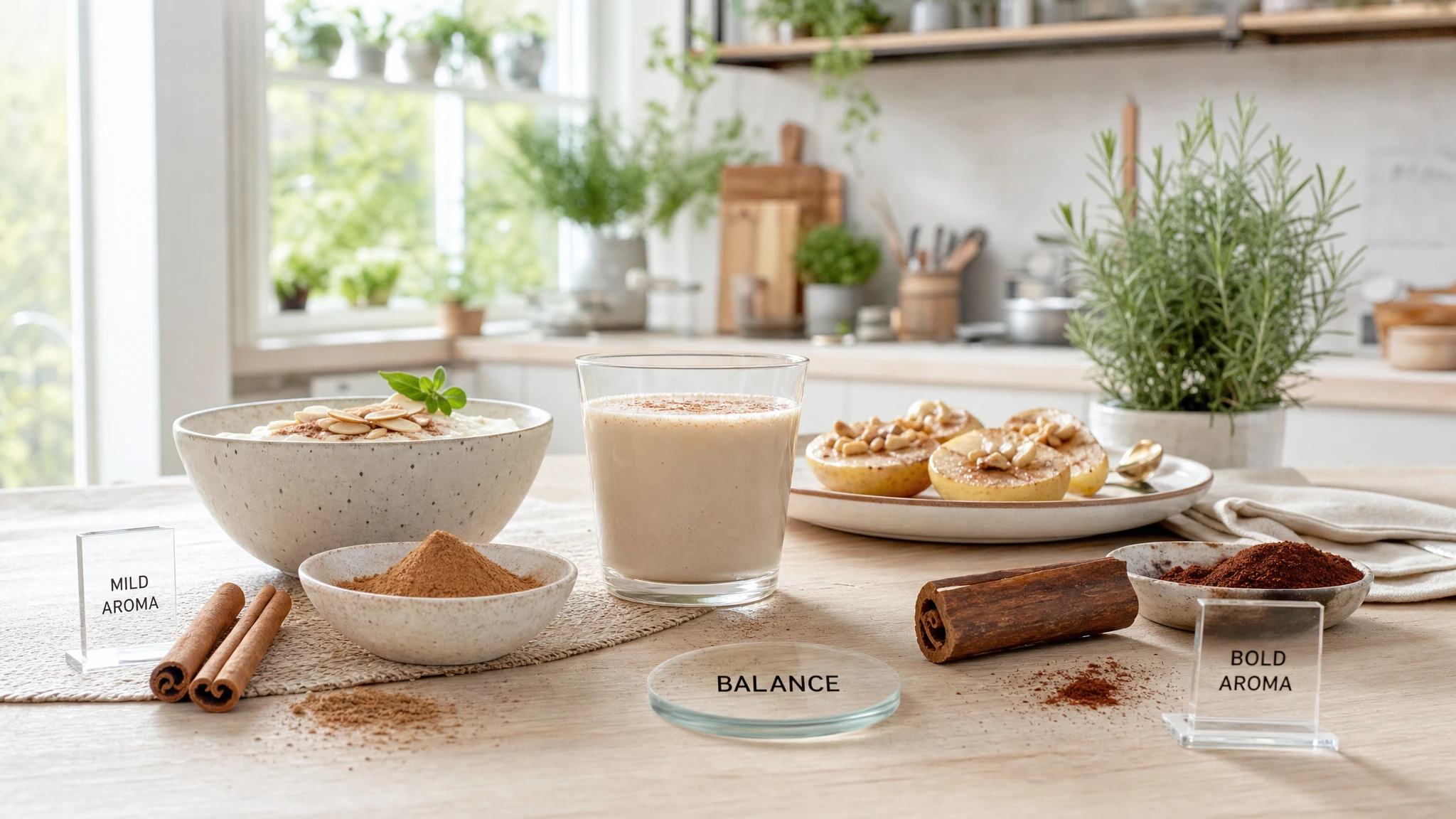
In the kitchen, cinnamon is not just for flavoring. It can change the aroma of a dessert, a drink, or a savory dish. The result varies based on the dosage, freshness, and the recipe. A delicate spice leaves room for other ingredients, while a more intense one can dominate the final taste.
Before choosing, it is helpful to clarify the desired result. You might be looking for a mild, well-rounded aroma or a sharp, immediately perceptible note. This difference leads to evaluating four practical aspects:
- Understanding which aromatic profile is more delicate or more bold.
- Choosing the most suitable cinnamon for desserts and drinks.
- Evaluating how often the spice is used in your diet.
- Reading the packaging and food label more carefully.
The choice starts with the sensory profile (what we perceive with our senses) and extends to the individual recipe. The following steps show how the aroma, daily use, and frequency of consumption change.
Ceylon is more delicate, cassia is more intense: the aromatic profile
The aromatic profile immediately distinguishes the two types of cinnamon when we use them in the kitchen. A softer note blends well with other flavors in light recipes. A bolder aroma remains evident even with milk, butter, or rich doughs. This difference does not indicate which spice is better. Instead, it shows whether the cinnamon complements or masks the other ingredients.
Sensory and chemical composition analyses show differences between samples of the two cinnamons. The latter do not have the same set of volatile compounds (molecules that provide odor and taste). One study examined 16 samples of ground cinnamon sold in the Spanish market. Researchers identified 52 volatiles, with 4 exclusive to C. zeylanicum and 9 exclusive to C. cassia [7]. Another study on methods to distinguish between cinnamons confirms that the aromatic profiles do not match. However, the results can vary based on origin, storage, and grinding [8].
Which cinnamon to use for desserts, drinks, and everyday recipes
In everyday cooking, ground cinnamon should be chosen based on the desired effect: more subtle in delicate desserts, more prominent in spiced drinks or recipes that can handle a bold flavor. The practical difference is not just sensory, but also culinary: a more intense spice can alter the balance of the dish, while a milder one tends to remain in the background.
Available evidence shows that identifying commercial samples is possible even in powder blends, so the choice of product truly influences the final result. The limitation is that the culinary yield also depends on dosage, cooking, and freshness, not just the species [9].
Frequent use of cinnamon: why the choice of variety matters
When cinnamon frequently appears in breakfasts, drinks, or homemade desserts, the quality of the spice becomes part of your diet. It is not just about the taste of the moment, but also how it performs over time. A strong variety can become repetitive or overpower other flavors. A more delicate one, however, may be easier to use regularly.
Frequent use requires attention, as it increases exposure to certain substances present in the spice. The European Food Safety Authority has established a tolerable daily intake for coumarin (a natural aromatic substance found in some types of cinnamon). The dose is equal to 0.1 mg/kg of body weight per day [10]. The reference expressed per kilogram therefore links the tolerable amount to the person's body weight. Research on the risk indicates that habitual consumption can push exposure levels to a point that requires careful consideration [11]. Therefore, when use is habitual, the assessment concerns repeated exposure over the course of one's diet. This data does not forbid the spice, but encourages choosing the product used frequently more carefully.
How to read labels and packaging without getting confused
To choose between Ceylon and Cassia cinnamon, the label provides the most reliable information. Packaging, format, and price offer other useful clues, but on their own, they do not identify the product with certainty.
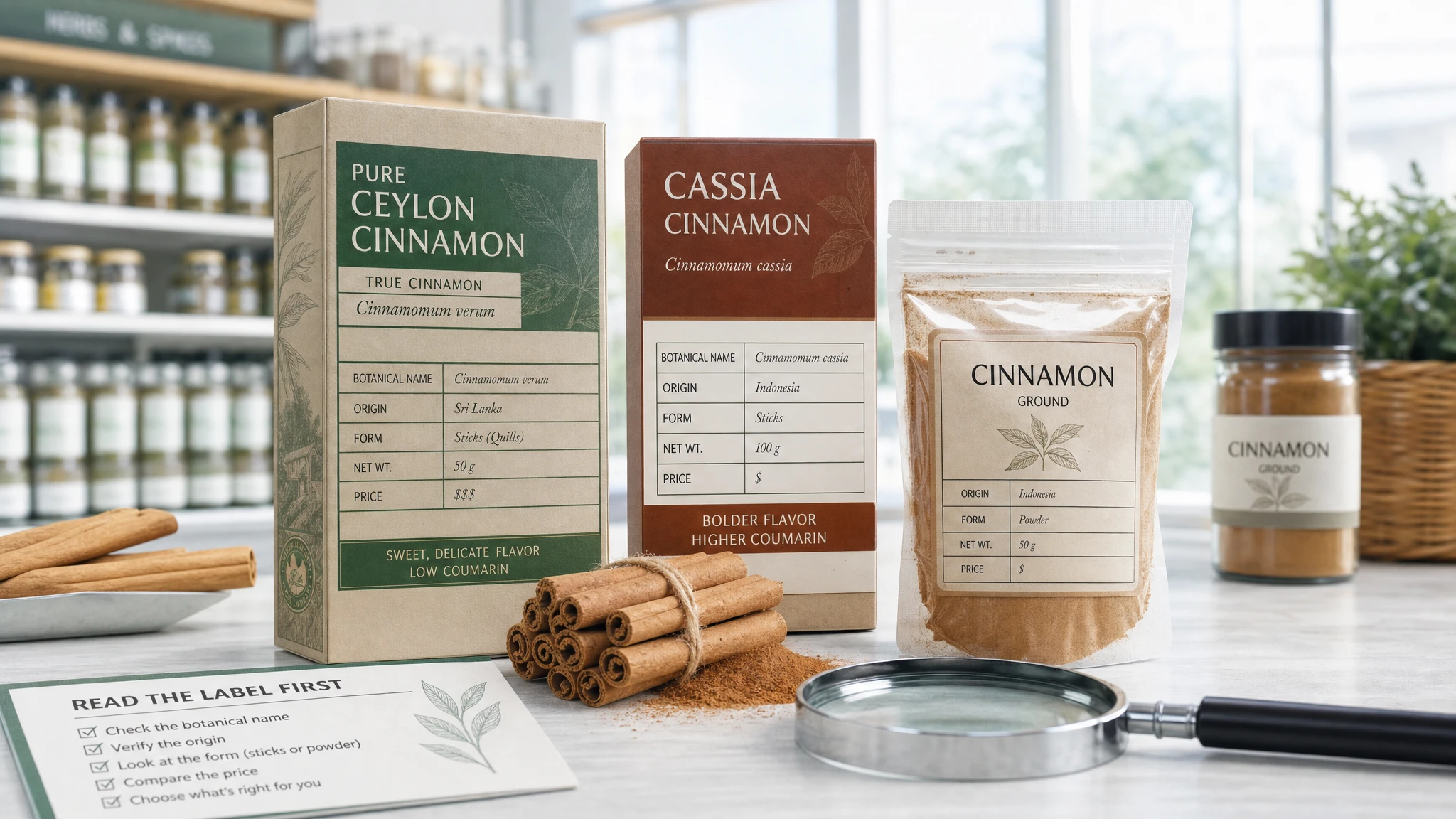
To distinguish between types of cinnamon, you must carefully read the information provided by the manufacturer. The most useful piece of data is the botanical name (the scientific name of the plant), which reduces ambiguity between products labeled as "cinnamon." The packaging should indicate the identity and quality of the spice, rather than just having an appealing appearance.
Visual inspection can provide other clues, but it does not replace the information written on the packaging. You must therefore separate clues from verifiable data. The packaging guides your choice, while the label better describes the product.
The following sections show how the botanical name, packaging, and format help to avoid common mistakes. These elements, however, should not make certain details seem definitive when they remain only clues.
This check is even more important for ground cinnamon, because its appearance reveals very little. Before purchasing, it is therefore useful to check a few practical aspects:
- Verify the botanical name written on the packaging.
- Read the label of pre-ground cinnamon more carefully.
- Use price and color only as initial clues.
- Prefer packaging that clearly indicates origin and format.
After seeing what to look for on the packaging, you need to understand which data is reliable and which requires caution.
Botanical name on the label: the most reliable data
Among all the elements printed on the packaging, the botanical name remains the most solid reference for navigating between Ceylon cinnamon and cassia. A precise designation limits the ambiguities of the commercial term "cinnamon" and helps to better assess the quality of the spice. This is particularly useful when the product is frequently part of your dietary routine or when you are looking for a choice consistent with a specific goal. The strength of this indicator is simple: it does not depend on subjective perceptions, but on verifiable text.
The limitation is that not all packaging is equally explicit: when the name is incomplete or generic, the information loses practical value. For this reason, if the data is present, it should be considered the most reliable way to distinguish products even before evaluating their external appearance. In practice, the botanical name allows you to know with certainty whether it is Cinnamomum verum or Cinnamomum cassia. This distinction is important because the two species have different coumarin profiles. Coumarin is a natural substance that, in high doses, can strain the liver. Ceylon cinnamon contains very little of it, while cassia has more. For those who use cinnamon every day, this difference can matter. Therefore, reading the botanical name is not a formality, but a concrete step toward a safer choice.
Packaging, price, and color: useful but not decisive clues
Price, packaging design, and the color of the powder can offer an initial orientation, but they are not robust enough criteria to reliably identify the highest quality cinnamon or the desired variety. A more expensive product is not automatically better, and a lighter or darker shade alone does not guarantee a specific origin.
These signals should therefore be read as context, not as proof. This is precisely the practical limitation: in the store, you only have visual clues, so it is best to use them with caution and not turn them into certainties. For example, Ceylon cinnamon often has a lighter color and a more crumbly texture. Cassia, on the other hand, tends to be darker and harder. However, these differences are not constant: they depend on many factors, such as the harvest season or processing. Even the price can be misleading: authentic Ceylon cinnamon usually costs more, but a high price is not a guarantee. It could be a product with good marketing, but not necessarily of superior quality. For this reason, price and color should only be used as initial clues, to be verified later with the label.
Sticks or powder: which format helps most with your choice
The format significantly affects how easy it is to understand what you are buying. With sticks, you can observe the structure, compactness, and regularity, whereas in selected cinnamon powder, these references almost entirely disappear.
For this reason, those who buy sticks have an extra visual check; those who buy ground cinnamon must rely primarily on the transparency of the label and the quality of the information provided. The limitation, therefore, is not the format itself, but the reduced practical readability of the product once it has been ground. Ceylon sticks are made of thin layers rolled together, like a cigar. They break easily with your fingers and have a delicate scent. Cassia sticks, on the other hand, are thicker, harder, and consist of a single rolled layer. These differences are noticeable to the naked eye, but only if the product is whole. In powder form, everything blends together: color, texture, and aroma change little between varieties. For this reason, the stick format offers a real advantage to those who want to check for themselves. However, not everyone uses sticks in the kitchen: powder is more convenient for desserts and drinks. In that case, the label becomes the only reliable tool.
How to choose between Ceylon and Cassia consciously
The most conscious choice comes from combining three simple questions: how often the spice is used, in what form it is purchased, and how clear the packaging is. There is no single answer that applies to everyone, because the decision depends on daily usage and the level of precision you want to have at the time of purchase.
In practice, the goal is to prevent a generic label from making different products appear the same. This does not mean that every choice has to become complicated, but that the consumer should prefer clear packaging, especially if they use the spice often. The limitation is that packaging alone does not tell the whole story: for this reason, the best choice remains one guided by the botanical name, format, and frequency of use. For example, those who use cinnamon only occasionally can settle for a product without a botanical name. But those who add it every day to their coffee or yogurt should look for Ceylon, to reduce coumarin Intake. The format also matters: if you want visual control, sticks are better. If you prefer convenience, powder is fine, but only with a clear label. Ultimately, a conscious choice is not a perfect one, but one that combines reliable information with personal habits.
Summary of scientific evidence
This summary brings together the most useful sources from the list. It shows which aspects have the strongest evidence and which depend on the type of study, format, and usage.
| Publication year | Area studied | What the studies indicate |
|---|---|---|
| 2012 | coumarin safety | evidence indicates that exposure can become significant with frequent use [10] |
| 2014 | botanical nomenclature and species identity | evidence indicates that the botanical name is the most reliable data for distinguishing products [1] |
| 2018 | nomenclature confusion between cinnamon and cassia | results are not uniform, but sources report frequent commercial ambiguities [2] |
| 2019 | authentication and species classification | evidence indicates that botanical and chemical markers are needed, in addition to the trade name [3] |
| 2022 | analytical differentiation between true and false cinnamon | evidence indicates differences in chemical markers and coumarin content [8] |
| 2024 | adulteration of cinnamon powder | the data appears consistent: powder is distinguished by specific analyses, not by appearance alone [5] |
| 2025 | distinction between Ceylon and cassia in the actual market | different aromatic and chemical profiles emerged in samples for sale [7] |
Editorial interpretation of the evidence
Conclusions and editorial summary
Final critical note
Sources clearly distinguish the two varieties from a botanical perspective and in laboratory analyses. However, they offer less data on practical choices during purchase. I therefore see a gap between what science identifies and what the customer sees on the shelf.
The evidence requires caution: some studies examine specific samples, while others are reviews or evaluate methods to verify origin. They do not, therefore, provide evidence of the same level. If the label is vague, a concrete doubt remains, especially for powder and products without a clear origin.
References
[1] Community herbal monograph on Cinnamomum verum J. Presl, cortex
[2] Cinnamon and Cassia Nomenclature Confusion: A Challenge to the Applicability of Clinical Data
[3] Cinnamon – Differentiation of Four Species by Linking Classical Botany to an Automated Chromatographic Authentication System
[4] Authentication of true cinnamon (Cinnamon verum) utilising direct analysis in real time (DART)-QToF-MS
[5] Application of HPLC-UV combined with chemometrics for the detection and quantification of ‘true cinnamon’ adulteration
[6] Differentiating True and False Cinnamon: Exploring Multiple Approaches for Discrimination
[7] Multivariate analysis of chemical markers to distinguish “Ceylon” and "Cassia” cinnamon in the Spanish market
[8] Application of spectroscopic techniques and chemometric methods to differentiate between true cinnamon and false cinnamon
[9] Cassia Cinnamon as a Source of Coumarin in Cinnamon-Flavored Food and Food Supplements in the United States
[10] Scientific Opinion on Coumarin in Flavorings and Other Food Ingredients with Flavoring Properties
Editorial note
Artificial Intelligence was used solely as a tool to support editorial and documentary work. All content, interpretations, bibliographic citations and conclusions have been verified, reviewed and approved by the author, who assumes full scientific responsibility for them.
The manuscript was also subject to independent peer review prior to publication.
To ensure maximum transparency, the article's complete history — including the dates of submission, review, acceptance and publication, as well as information on the peer review process — is available on the dedicated Article History page.