


Cinnamomum genus: phytochemical diversity, biological activities, and limitations of the evidence
In 2020, Chinese researcher Wang and colleagues, in the journal Fitoterapia, examined the traditional uses, chemical composition, and reported pharmacological activities for twelve species of the genus Cinnamomum. The work correlates botanical variety with differences between plant parts, isolated molecules, extracts, and the quality of available evidence.
- Published 09/11/2026
- Updated 10/11/2026
- Article history
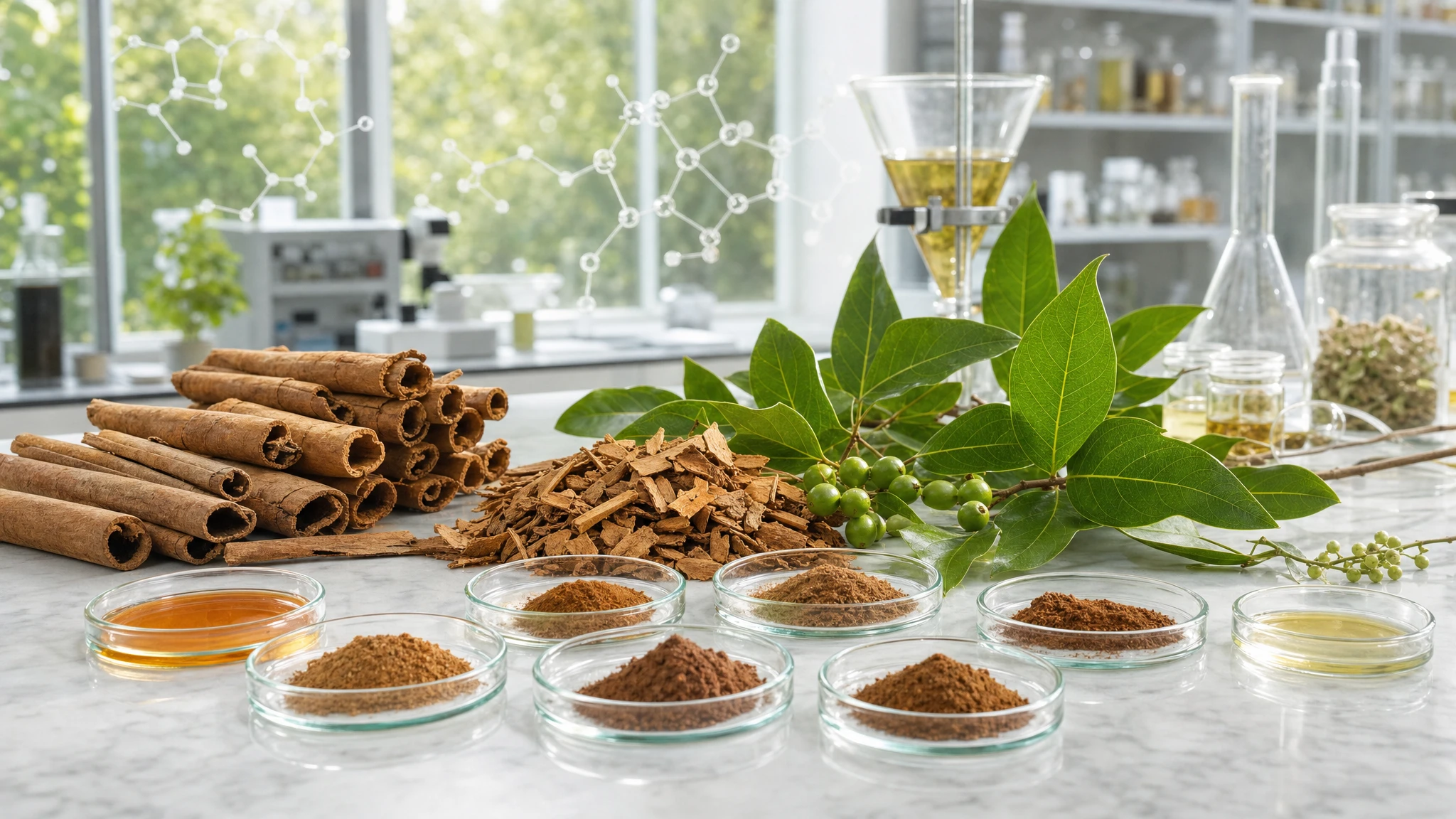
ABSTRACT : WHAT THE SCIENCE SAYS
The review by Wang and colleagues examines twelve species of the Cinnamomum genus, known for aromatic plants used as spices, traditional plant materials, and sources of essential oils. The work demonstrates a wide variety of compounds and experimental activities, but also cautions against treating all species as if they were equivalent.
The authors' synthesis collected studies published primarily between 2015 and 2019 on the traditional uses, isolated substances, and pharmacological evidence of twelve Cinnamomum species. A total of 306 compounds were cataloged, obtained from bark, leaves, roots, stems, buds, and fruits. The most represented categories are terpenes (often aromatic molecules found in essential oils), phenylpropanoids, lignans, and flavonoids. The research considered reports antimicrobial, antioxidants, anti-inflammatory, metabolic, and other biological activities. However, most of the evidence is derived from experiments in test tubes, on cells, or on animals, and often concerns complex extracts rather than a single molecule. The authors also note that studies focus primarily on a few species, such as C. cassia, C. camphora, and C. subavenium. The review highlights deficiencies in quality control, the identification of the actual active principles, and direct clinical verification. The central message is therefore botanical and methodological: the common name is not enough to transfer chemical or biological data from one species, plant part, or extract to another product.
What this research analyzed
To understand why two products labeled as cinnamon may not be interchangeable, Wang and colleagues in 2020 examined the entire Cinnamomum genus, rather than just a single commercial spice. The review included twelve species and gathered data on botanical names, the parts of the plant used, traditional uses, isolated molecules, and activities observed in the laboratory.
The scientific detail is important: the substances were not derived solely from the bark, but also from roots, stems, twigs, leaves, buds, and fruits. The authors classified 306 chemical constituents, including terpenes and phenylpropanoids, two families of molecules that contribute to the aromatic profile and experimental biological activity, respectively. However, this inventory does not imply that all these molecules are present in common culinary cinnamon, nor that they act in the same way within the human body.
Research data
Traditional uses, phytochemistry and pharmacological activities of the genus Cinnamomum (Lauraceae): A review
- Literature review on 12 species of Cinnamomum, with data regarding traditional uses, isolated compounds, and pharmacological evidence.
- 306 compounds cataloged: 111 terpenes, 44 phenylpropanoids, 51 lignans, 17 flavonoids, 53 aromatic compounds, and other classes.
- The authors note primarily preclinical evidence, still limited quality control, and an absence of direct clinical trials for the genus as a whole.
What results emerge from the study
The most useful takeaway for the reader is that Cinnamomum does not refer to a single material. Different species, and even different parts of the same plant, can have different compositions. Among the twelve species considered, C. cassia, C. camphora, and C. subavenium were among the most studied, while information for many others was much more limited.
The review describes antimicrobial, antioxidants, anti-inflammatory, antitumor, and metabolic activities. In simple terms, these results indicate that extracts or molecules from certain species have modified bacteria, cells, enzymes, or laboratory animals. The limitation is decisive: an activity observed in a cell or an animal model does not demonstrate clinical efficacy, safety, or a useful dose in humans. The authors themselves point out that the component responsible for the effect had often not been identified with certainty.
Why this study is relevant
This review is relevant because it avoids a common oversimplification: attributing results obtained with a specific species, plant part, or extract to the word "cinnamon" in general. From a biological perspective, the botanical species is the first factor that helps determine which molecules may be present; processing, the origin of the sample, and the extraction method can further modify the final profile.
This step is also essential for interpreting health research. An essential oil is a concentrated aromatic fraction; an aqueous or alcoholic extract may contain different proportions of substances; a food-grade powder is yet another matrix. Therefore, the activities reported for the genus are not evidence that can be automatically transferred to every product sold as cinnamon. The review offers a map of the literature, not a unified clinical demonstration.
Study limitations and what it does NOT demonstrate
As a narrative review, the 2020 study by Wang and colleagues depends on the quality, heterogeneity, and completeness of the available studies. It does not provide a single quantitative estimate of efficacy, does not directly compare all species, and does not apply a meta-analysis protocol—that is, a combined statistical analysis of comparable studies.
Furthermore, the count of 306 compounds describes substances identified in the literature, not the composition of a single package or a single sample. The presence of a compound does not prove that it is absorbed, that it reaches a target organ, or that it produces a benefit in people. The authors themselves report the absence of direct clinical evidence for the genus considered as a whole. Consequently, the work does not demonstrate that all Cinnamomum species have the same effects, nor that they can replace medical treatments.
Independent confirmatory evidence
The need to distinguish between species is confirmed by an experimental study on 50 authentic samples of four economically important species. Chen, Sun, and Ford used flow injection mass spectrometry, a technique that detects the chemical fingerprint of a sample, to separate C. burmannii, C. verum, C. cassia, and C. loureiroi. The result supports shifting from species to chemical profiling: botanically different samples did not have overlapping compositions. This is direct confirmation, but it concerns analytical authentication rather than health effects [1].
A second experimental study examined the physical and functional properties of four species using multivariate analysis, a method that evaluates multiple characteristics simultaneously. The model separated the groups and achieved correct predictions in the verification sample. This reinforces the idea that multiple variables, rather than just the trade name, help to identify the material. The confirmation remains limited to the samples and the model analyzed [2].
An independent review then gathered data on biodiversity, compounds, safety, and preclinical and clinical research for various species. It confirms that the genus includes heterogeneous plant materials and that biological indications depend on the species, preparation, and experimental context. Its limitation is that it shares the descriptive nature of the sources considered, without transforming them into equivalent clinical evidence [3].
Conflicting evidence
No directly conflicting evidence sufficiently relevant to the central observation that different Cinnamomum species may have different chemical profiles has been identified; this does not prove the absence of contradictory results. However, there is data that complicates the identification process. In an analysis of 14 commercial products, Wang and colleagues found metabolic differences between four species, but DNA barcoding—that is, identification using short genetic sequences—did not reliably distinguish between C. cassia and C. loureiroi using the available database. Furthermore, some labels were ambiguous or inconsistent with the results. This limits the use of a single method as definitive proof [4].
A further study on barks and commercial preparations showed that species, geographical origin, processing, and product form influence chemical fingerprints. The authors identified 74 secondary metabolites and had to combine multiple analytical techniques to characterize the samples. This data does not contradict the original review, but it indicates that the composition does not depend solely on the species name and that the results from one method or one batch are not automatically generalizable [5].
Comparative overview
Independent publications support variability between species, but also show the limitations of identification based on a single method or a single label.
| Publication | Model and sample size | Main result | Relationship to the Wang study |
|---|---|---|---|
| Chen, Sun, and Ford, 2014 [1] | Experimental study; 50 authentic samples of four species | Mass spectrometry fingerprints distinguished the four examined species. | Direct confirmation of chemical differences between commercially relevant species. |
| Rana et al., 2021 [2] | Experimental study on four species; statistical model with verification set | Physical and functional characteristics separated the analyzed groups. | Direct confirmation that identification benefits from multiple variables measured together. |
| Sharifi-Rad et al., 2021 [3] | Literature review; sample size not applicable | Brings together heterogeneous data on species, compounds, experimental activities, and safety. | Indirect confirmation of the botanical and pharmacological complexity of the genus. |
| Wang et al., 2020 [4] | Experimental study on 14 commercial products of four species | DNA did not reliably separate two species, and some labels were ambiguous. | Contextual evidence: a single authentication method may be insufficient. |
| Farag et al., 2022 [5] | Experimental study on barks and four commercial preparations | Complementary analytical techniques were needed to describe complex profiles. | Contextual evidence: species, origin, and processing influence the chemical profile. |
Editorial conclusion
References
[1] Differentiation of the Four Major Species of Cinnamons ( C. burmannii , C. verum , C. cassia , and C. loureiroi ) Using a Flow Injection Mass Spectrometric (FIMS) Fingerprinting Method
[2] Discrimination of Four Cinnamomum Species with Physico-Functional Properties and Chemometric Techniques: Application of PCA and MDA Models
[3] Cinnamomum Species: Bridging Phytochemistry Knowledge, Pharmacological Properties and Toxicological Safety for Health Benefits
[4] Metabolomic profiling and comparison of major cinnamon species using UHPLC–HRMS
[5] Comparative Metabolite Profiling and Fingerprinting of Medicinal Cinnamon Bark and Its Commercial Preparations via a Multiplex Approach of GC–MS, UV, and NMR Techniques
Editorial note
Artificial Intelligence was used solely as a tool to support editorial and documentary work. All content, interpretations, bibliographic citations and conclusions have been verified, reviewed and approved by the author, who assumes full scientific responsibility for them.
The manuscript was also subject to independent peer review prior to publication.
To ensure maximum transparency, the article's complete history — including the dates of submission, review, acceptance and publication, as well as information on the peer review process — is available on the dedicated Article History page.