


What is cinnamon: botanical origin and the species from which the spice is derived
Research shows that cinnamon has a precise botanical origin. It is a spice obtained from the dried inner bark of plants of the Cinnamomum genus. Studies distinguish between the common name, the species of origin, and the product for sale. This explains why Ceylon cinnamon and cassia are not the same thing. These classification data help in interpreting sources, labels, and names without confusing different plant materials.
- Published 05/10/2026
- Updated 08/10/2026
- Reviewed 30/09/2026
- Article history
ABSTRACT : WHAT THE SCIENCE SAYS
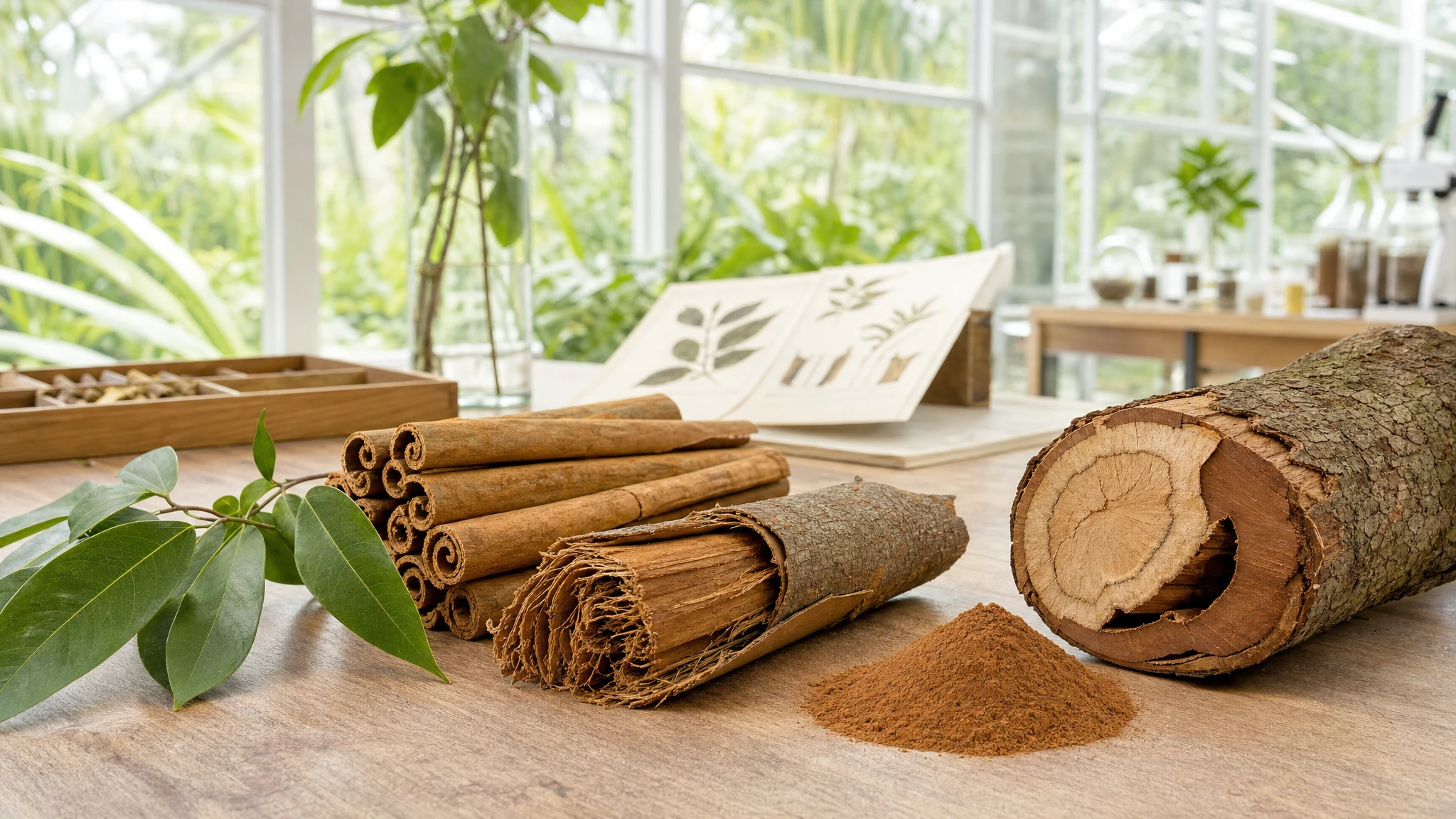
Cinnamon is a well-known spice, but it has a more complex botanical origin than it might seem. To understand what cinnamon is, it is not enough to talk about its taste or its use in the kitchen. It comes from the dried inner bark of certain plants of the Cinnamomum genus, in the Lauraceae botanical family. This definition distinguishes the part of the plant from the product on sale and explains why different types of cinnamon exist.
On labels and in more precise descriptions, the common name does not always indicate the true botanical origin. It is therefore useful to understand where cinnamon comes from and which species are used to produce it. It is also necessary to look at how the bark is processed to obtain a spice ready for use. To clarify all these aspects, the following in-depth analysis covers five central points in a simple way:
- Botanical origin of cinnamon and the part used
- Cinnamomum genus and the Lauraceae family
- Differences between Ceylon cinnamon and cassia
- Different species, common names, and the market
- Processing, drying, and commercial product
Cinnamon is the dried inner bark of certain plants
To understand what cinnamon is, you need a basic fact: the whole plant is not used. The spice is derived from the inner bark, the tissue of the stem closest to the wood. This explains its shape and texture. It also helps to understand the origin of the product before comparing the various species.
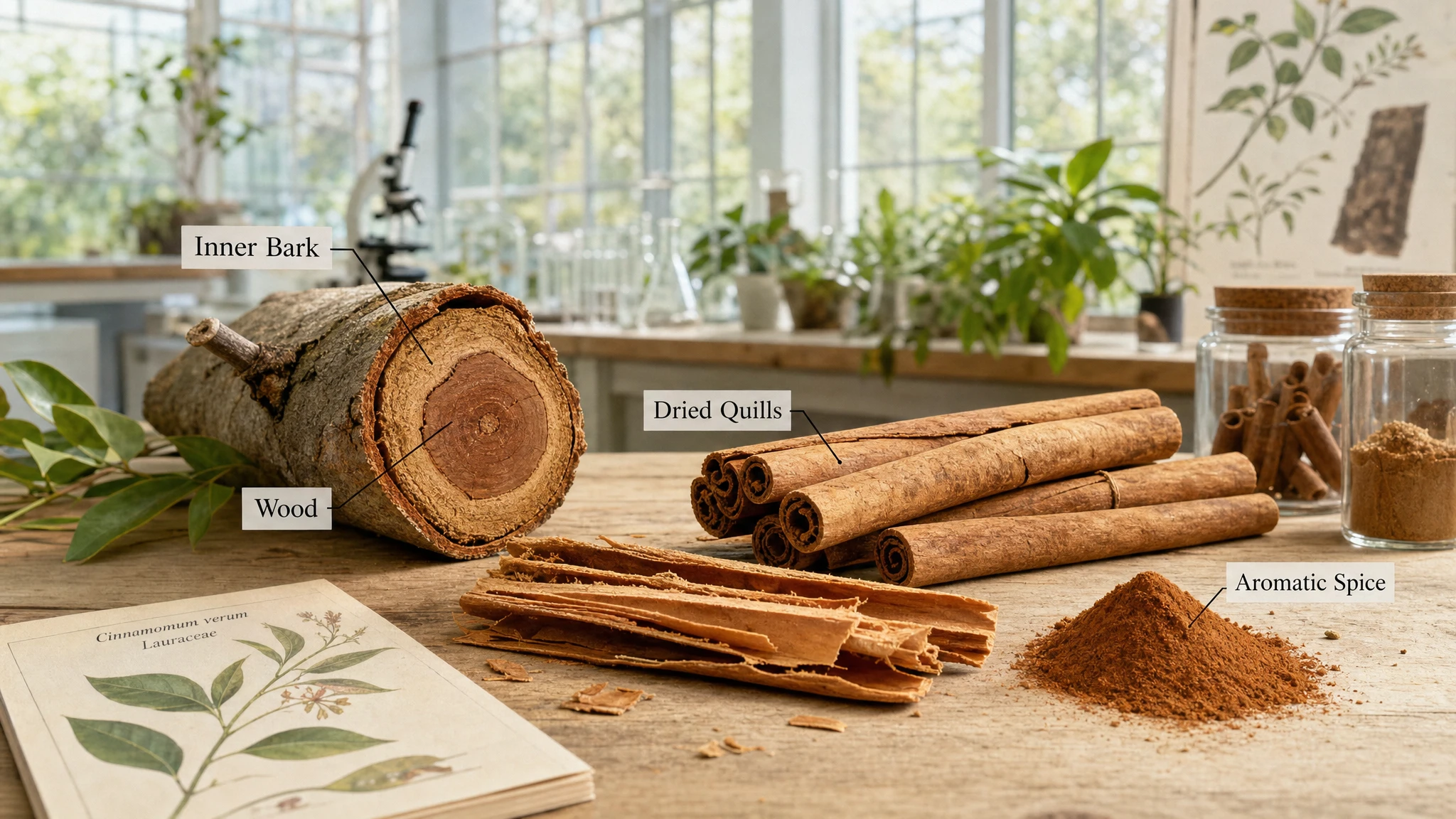
To truly understand what cinnamon is, you must start with the plant. The spice comes from the inner bark of certain species. This part is harvested, separated from the stem, and then dried. The definition distinguishes the spice from the whole plant. It also helps to better read labels, recipes, and informative texts. Cinnamon is therefore classified as an aromatic spice. It is not a generic powder or just another dried plant product.
These points also help in practical life. They allow you to understand where the spice comes from and to distinguish the plant from the product on sale. They also explain the typical shape of cinnamon bark. The next step concerns the Cinnamomum genus and the Lauraceae family, which indicate its botanical origin.
Before examining the individual species, it is useful to establish the steps that give rise to the product:
- Cinnamon is derived from the inner bark of the stem.
- The material is separated and then dried.
- The part used does not correspond to the entire plant.
- The common name is not enough to identify the species.
The first step clarifies what the word cinnamon indicates in botany. Next, we will see which part of the plant is used. Finally, the taxonomy (scientific classification) will help place these plants in the correct group.
What cinnamon is from a botanical perspective
In botany, cinnamon is a spice obtained from certain plants of the genus Cinnamomum. These plants are cultivated and selected for their aromatic bark. This definition separates the final product from the whole plant. It also clarifies that the spice has a precise plant origin. The name therefore indicates a material recognizable by its tissue of origin, processing, and use in food. In other words, the term describes the material used first and the product only afterwards.
Sources on plant materials used in medicine start with correct botanical identity. They evaluate both the part used and the way it is prepared. These aspects influence the preservation and recognition of the product for sale [1][2]. However, this definition does not distinguish between individual species. It is therefore necessary to understand which part of the stem is used and why it is dried. The central point remains the link between the plant, the tissue, and the final spice. For this reason, identification and preparation must be considered together when correctly describing cinnamon.
Why we talk about dried inner bark
When discussing cinnamon bark, the correct specification is inner bark: it is the layer closest to the wood, separated from the rest of the trunk or young branches and then left to dry. This choice is not secondary, because the inner part has a structure more suitable for being rolled, stored, and processed into sticks or powder. Furthermore, drying reduces water content and stabilizes the material.
The monographs of the World Health Organization describe the herbal drug precisely as dried bark, emphasizing that the traditional preparation is an integral part of the spice's identity [2]. Quality control texts on plant materials also indicate that tissue separation and drying affect the appearance, shelf life, and uniformity of the product [1]. The limitation, however, is that morphological description alone is not enough to attribute the botanical origin with certainty: the genus and family level are still required.
The Cinnamomum genus and the Lauraceae family
The plants from which cinnamon originates belong to the Cinnamomum genus and the Lauraceae family. This classification places the spice in a group of aromatic plants that are similar, but not identical. It organizes these similarities and differences without erasing the unique identity of individual species. It also provides precise data for interpreting technical texts and labels. The genus name is therefore the first step from common language to botanical classification.
Studies on phylogeny (evolutionary relationships) and taxonomy of the Cinnamomum-Ocotea group reveal a complex history. Research has examined many closely related species. The group is therefore diverse and cannot be treated as a single entity [3]. Work on global diversity confirms many species in different areas. This data is also important for identifying and protecting them [4]. However, the genus does not indicate which species is present in a specific product for sale. For this reason, knowing the genus narrows down the identification, but does not yet allow it to be concluded.
Where the commercial name "cinnamon" comes from
The trade name "cinnamon" stems from the common practice of selling materials obtained from different Cinnamomum species under a single label. From a popular science perspective, this creates a simplification that is useful for the market, but less precise than botanical nomenclature. For those reading a label or a technical data sheet, the common name only provides general guidance: it is not enough to rigorously identify the origin of the spice.
Reviews on the confusion between the nomenclature of cinnamon and cassia show that commercial terminology can overlap different materials, with implications for scientific communication and product recognition [5]. Summaries on the Cinnamomum genus also point out that there are many aromatic species, which are often treated inconsistently on the market [6]. The limitation of the common name is therefore its ambiguity: useful for discussing the spice, but insufficient for precisely stating its botanical origin.
Recent research and updates

In 2024, Iranian researcher Methiye Mancak and colleagues published a review in the Turkish Journal of Medical Sciences. The work examines cinnamon derivatives and their safety in type 2 diabetes. It also evaluates the relationship between species, products on the market, and the interpretation of clinical data. The review confirms that botanical identity matters when studying this spice.
Are cinnamon derivatives effective and safe for diabetes?
- The review links the use of cinnamon to the correct identification of the species.
- The work confirms that the trade name does not always distinguish between different botanical materials.
- The analysis reiterates that cinnamon is derived from the bark of various species of the genus Cinnamomum.
- The data call for caution when comparing products with generic labels.
The most well-known cinnamon species are not equivalent
The most well-known cinnamon species belong to the same genus, but they are not the same. Ceylon cinnamon and cassia, therefore, are not synonyms. The plant of origin, the aroma, and the use of the name on the market differ.
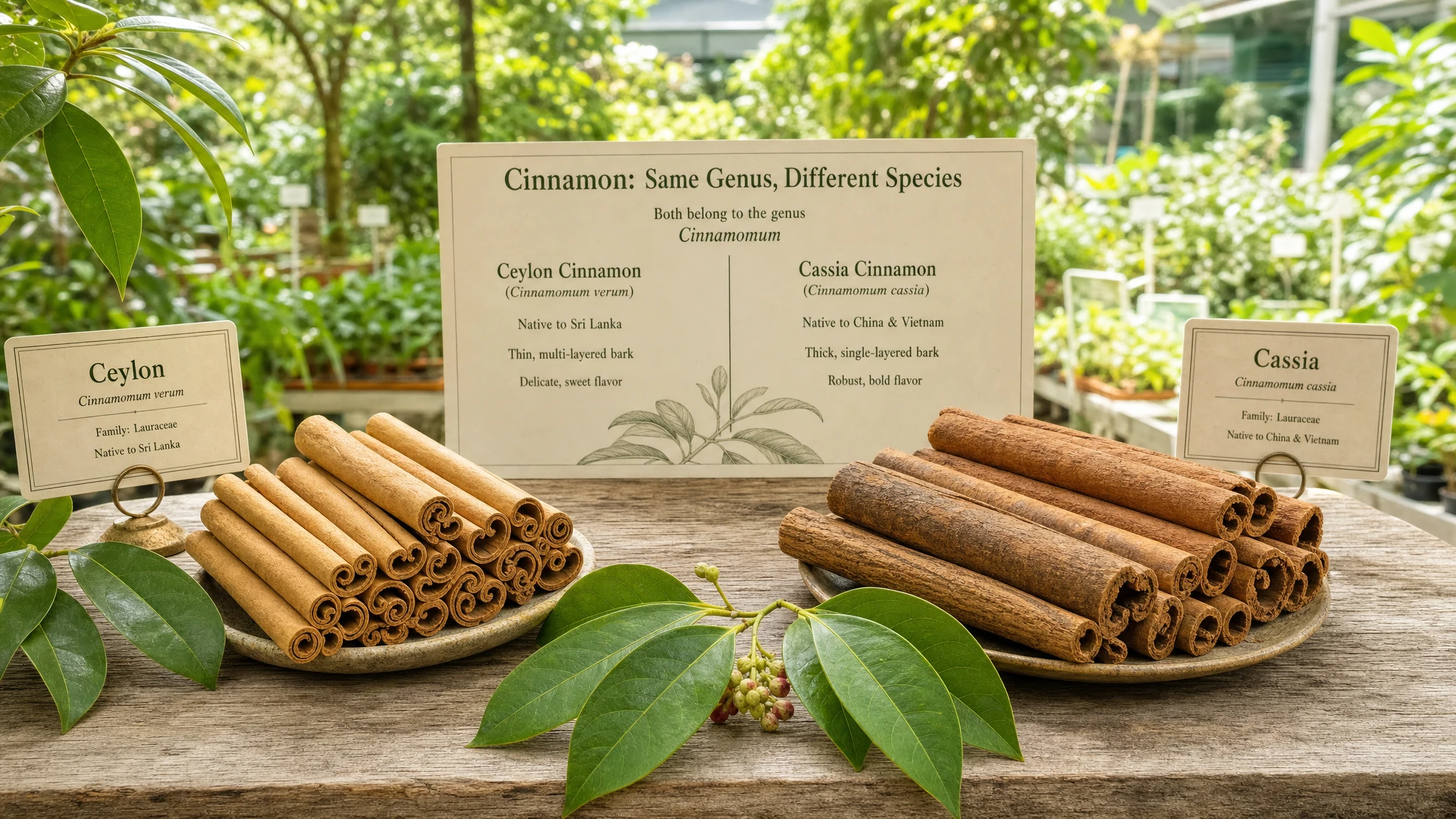
To distinguish between cinnamon species, what matters most is the botanical origin, i.e., the plant from which they are derived. The most well-known forms belong to the Cinnamomum genus and the Lauraceae family, which includes various aromatic plants.
The name "cinnamon" is not enough, because the dried inner bark can come from species with different structures, aromas, and uses. This is why it is useful to read labels carefully, especially when comparing products of various origins.
This distinction explains why two products sold as cinnamon are not always the same. The following sections show how to distinguish between Ceylon and cassia.
They also clarify which species fall within the botanical framework and why the name cinnamon can indicate different origins.
To understand the most commonly used names, it is helpful to keep a few points in mind:
- Ceylon cinnamon is derived from a specific species of the Cinnamomum genus.
- Cassia cinnamon is derived from another species and has a different botanical origin.
- The commercial name does not always indicate the same plant species.
- The structure of the bark and the strength of the aroma also vary.
The most well-known species are distinguished first and foremost by their botanical identity, i.e., the plant of origin. The comparison starts with the two most cited forms on the market and then examines the general picture.
Ceylon cinnamon and cassia: botanical differences
Ceylon cinnamon and cassia cinnamon are not the same plant material. In fact, they come from different species of the Cinnamomum genus. The difference lies in the plant from which the cinnamon bark is obtained, not just the name. Two spices can therefore have similar uses but a different botanical origin. In practice, the same word on a label does not always indicate a single species. The botanical distinction is therefore used to link each product to the specific plant species from which it originates.
Reviews on Cinnamomum verum and Cinnamomum cassia report clear differences in shape and composition. The first species provides Ceylon cinnamon, while the second provides cassia [7][8]. The bark, leaves, and essential oils (aromatic substances extracted from the plant) also show different chemical profiles. More than 160 compounds have been found in C. cassia [8]. These data, however, are mainly derived from reviews, not from a single direct comparative study.
How many cinnamon species actually exist
There is no single "official" species of cinnamon. The name encompasses various species of the Cinnamomum genus, which are used in different ways. On the market, however, only a few are common and well-known to the public. The number of species cataloged in botany, therefore, does not coincide with the types that consumers encounter most often. This distinction prevents confusing the total number of botanical species with that of the most widespread commercial forms.
Asking how many species exist helps to move from a generic name to a true classification. In this way, cinnamon no longer appears as a single ingredient devoid of differences. It is not just a matter of how many types are cataloged, but also which ones reach the market and under what name. The question therefore requires two different answers: one botanical and one related to the products available on the market. The picture is therefore less simple than it seems. It now remains to be understood why a single name can indicate different origins.
Why the name cinnamon covers different origins
The term cinnamon is an umbrella term, meaning a word that encompasses different products. It simplifies language, but can hide real differences between species. This often happens with plant-based products. The common name helps in daily use, while the botanical name precisely identifies the plant. In the case of cinnamon, the term includes different materials that have a similar use as a spice. Knowing this avoids imprecise comparisons between products, descriptions, and sources.
The precision of the name therefore becomes essential when comparing materials from different species. In short, the common name helps with orientation, while the species allows for a more exact distinction. This rule often applies in botany. A single word can therefore group different materials together without making them identical. This is why reading the general name on the label is not enough. It is also useful to look for the more precise botanical reference. The next step concerns the commercial product and its link to species, processing, and origin.
The commercial product depends on species, processing, and origin
The cinnamon available for sale does not depend solely on the plant species from which it originates, i.e., its botanical origin. The cut, drying process, form of sale, and the name chosen by the market also matter. For this reason, two samples can have very different appearances and labels. To understand the cinnamon on the market, one must distinguish the source plant from the final product.
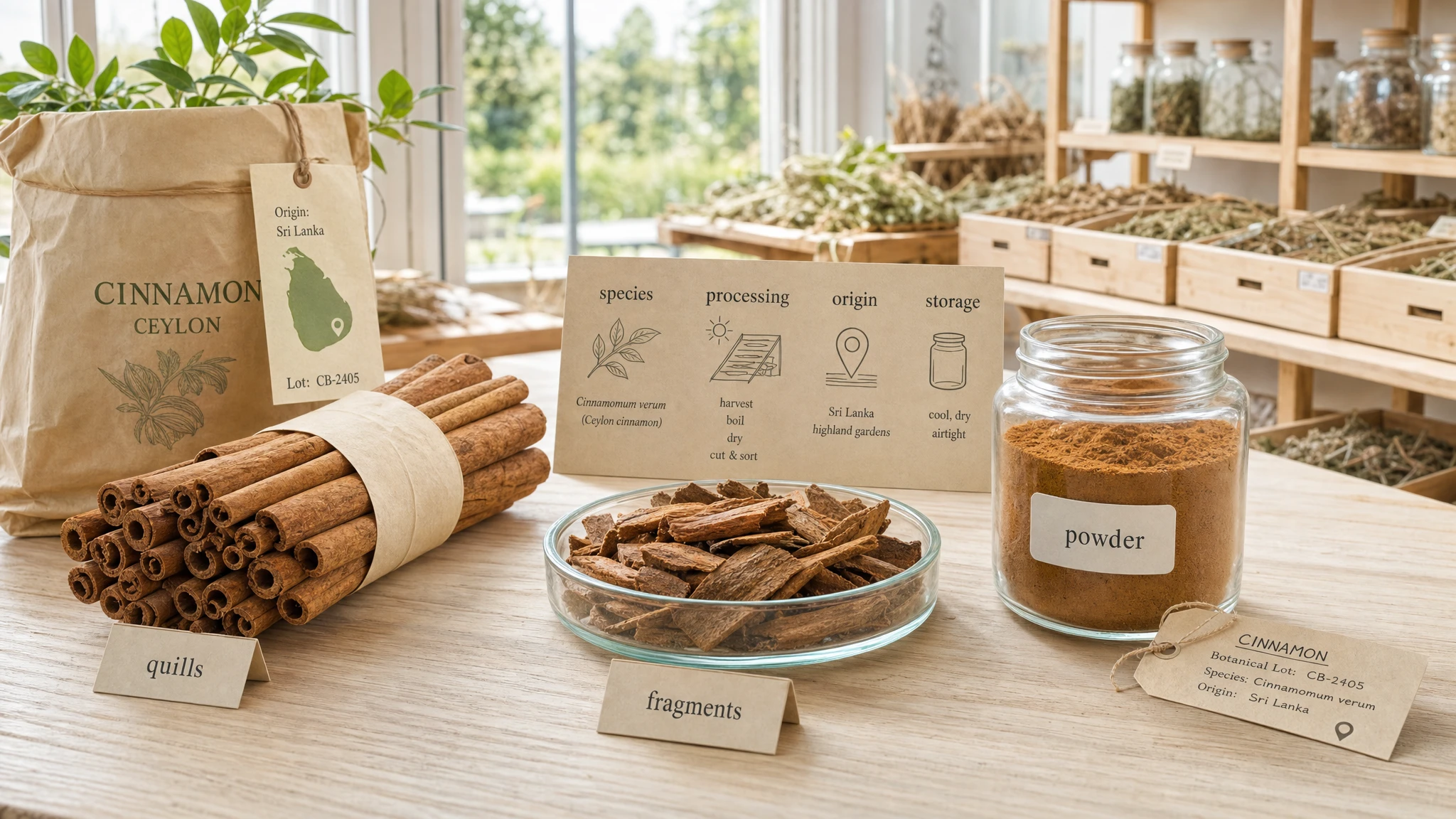
Commercially, cinnamon bark never reaches the consumer as raw material: it is harvested, separated, dried, and prepared in various forms. This means that the final appearance depends not only on the source plant but also on processing, selection, and packaging.
In other words, cinnamon sold as a spice is not a uniform object, but a processed plant product. For this reason, a commercial name alone is not enough to describe it precisely: the species, preparation method, and sales context are always needed.
In the following sections, we will see how these aspects change the interpretation of the product and how to avoid the most common points of confusion.
The same spice can therefore appear as sticks, fragments, or powder, with different effects on recognizability and the perception of quality. To properly interpret the product, it is useful to consider several elements together:
- The starting species determines the botanical origin of the material.
- Processing modifies shape, texture, and visual appearance.
- Commercial origin influences the information on the label.
- Storage affects aroma, freshness, and stability.
The final product changes even as it is being prepared, because it originates from plant material that undergoes multiple steps. The following three points explain how the form, the market, and the label change what we find for sale.
How processing changes the appearance of cinnamon
Processing includes harvesting, detaching the inner bark, drying, and the final preparation phase. These steps change the shape, texture, and how easy it is to recognize the spice for sale. After treatment, the raw material no longer looks like a part of the plant. It becomes an ingredient ready for sale and for use in the kitchen.
Each phase therefore contributes to transforming the inner bark into the form we observe in the final product. Knowing this process helps to see cinnamon as an agricultural and food product, not as raw material. The appearance can change even when the starting plant species remains the same. Sticks, fragments, and powder are created through different methods, but on their own, they do not reveal the full botanical origin. Looking at the shape, therefore, is not enough to understand with certainty which plant the product comes from. The place of origin and the way the market presents the cinnamon must also be evaluated.
Why origin and market are not neutral details
The origin can change the way cinnamon is described, recognized, and sold. In fact, various markets do not always use the same criteria to describe the product. This does not mean that the place of origin alone determines its value. However, the sales context can make the available data more or less precise.
When faced with the word cinnamon, it is therefore worth asking which plant it comes from and how it is presented. For this reason, origin and market should be read together, without considering them equivalent to the botanical species. This care helps to compare products without giving the name a more precise meaning than it actually has. The place of origin and the market guide the description, the choice, and the way the spice is perceived. However, caution is needed, because the same name can provide data with different levels of detail. To read the product correctly, one must therefore avoid confusing the species with the form of sale.
How to read the product without confusing species and form
A common mistake is recognizing cinnamon only by the form in which it is sold, without evaluating the species of origin. Sticks, powder, and bark fragments only show how the product is presented. Therefore, they are not enough on their own to establish with certainty which species we are dealing with. To read a package correctly, one must distinguish the botanical origin from the form chosen for sale. These are related pieces of information, but they describe different aspects and should not be used as synonyms. This distinction avoids overly simplistic judgments and helps to better understand labels and descriptions.
The form, therefore, does not tell the whole story: to understand the product, one must also evaluate its origin. The appearance on sale helps to recognize the spice, but it does not always allow for its scientific identification. When comparing different products, the reader should keep the form shown and the origin separate. In summary, cinnamon has a precise botanical origin, but it can have different forms and names on the market.
Summary of scientific evidence
This summary brings together the most relevant sources from the list. It shows how the selected literature describes the botany, classification, and trade name of cinnamon.
| Publication year | Area studied | What the studies indicate |
|---|---|---|
| 1999 | monographs on medicinal plants | evidence indicates that it is essential to distinguish the species from the plant raw material [2] |
| 2011 | quality control of plant materials | studies indicate botanical criteria useful for identifying cinnamon as a vegetable drug (the part of the plant used) [1] |
| 2016 | evolutionary origin of the Cinnamomum group | evidence shows a complex botanical group, which helps to understand the diversity of cinnamon [9] |
| 2020 | review of the Cinnamomum genus | data consistently describe multiple species used as aromatic spices [6] |
| 2021 | Cinnamomum verum species | studies indicate a defined botanical origin for Ceylon cinnamon [7] |
| 2022 | phylogeny and taxonomy | observed results indicate a classification that cannot be reduced to a single species [3] |
| 2018 | nomenclature and derived products | results vary when the trade name does not clearly indicate the species [5] |
| 2026 | global diversity of the genus | data consistently describe a broad genus with a complex classification [4] |
Editorial interpretation of the evidence
Conclusions and editorial summary
Final critical note
The most useful sources I found clarify the botanical origin and classification of cinnamon. Those that describe the spice only in a generic way are less decisive. The main limitation I noticed is not a lack of data, but their diversity.
Some sources deal with the genus, others with a single species, and others still with the product on the market. This distance between botany and the market makes simplifications unreliable. Therefore, the common name alone is not enough for me. Editorial caution thus helps me avoid misinterpretations.
References
[1] Quality control methods for medicinal plant materials
[2] WHO monographs on selected medicinal plants
[3] Phylogeny and taxonomy of Cinnamomum (Lauraceae)
[4] Global Diversity and Conservation Challenges of Cinnamomum Schaeff. (Lauraceae): A Synthesis of IUCN Red List Taxa
[5] Cinnamon and Cassia Nomenclature Confusion: A Challenge to the Applicability of Clinical Data
[6] Traditional uses, phytochemistry and pharmacological activities of the genus Cinnamomum (Lauraceae): A review
[7] Phytochemical and pharmacological review of Cinnamomum verum J. Presl-a versatile spice used in food and nutrition
[8] Cinnamomum cassia Presl: A Review of Its Traditional Uses, Phytochemistry, Pharmacology and Toxicology
Editorial note
Artificial Intelligence was used solely as a tool to support editorial and documentary work. All content, interpretations, bibliographic citations and conclusions have been verified, reviewed and approved by the author, who assumes full scientific responsibility for them.
The manuscript was also subject to independent peer review prior to publication.
To ensure maximum transparency, the article's complete history — including the dates of submission, review, acceptance and publication, as well as information on the peer review process — is available on the dedicated Article History page.