


Cinnamon every day: uses and limits in your diet
Research indicates that cinnamon can be useful when it makes breakfasts, snacks, and simple recipes more enjoyable. Its value is primarily practical: it can help reduce added sugar without complicating meals. However, results vary, and the benefit depends on the recipe, the context, and consistency of use.
- Published 02/11/2026
- Updated 10/11/2026
- Reviewed 10/11/2026
- Article history

ABSTRACT : WHAT THE SCIENCE SAYS
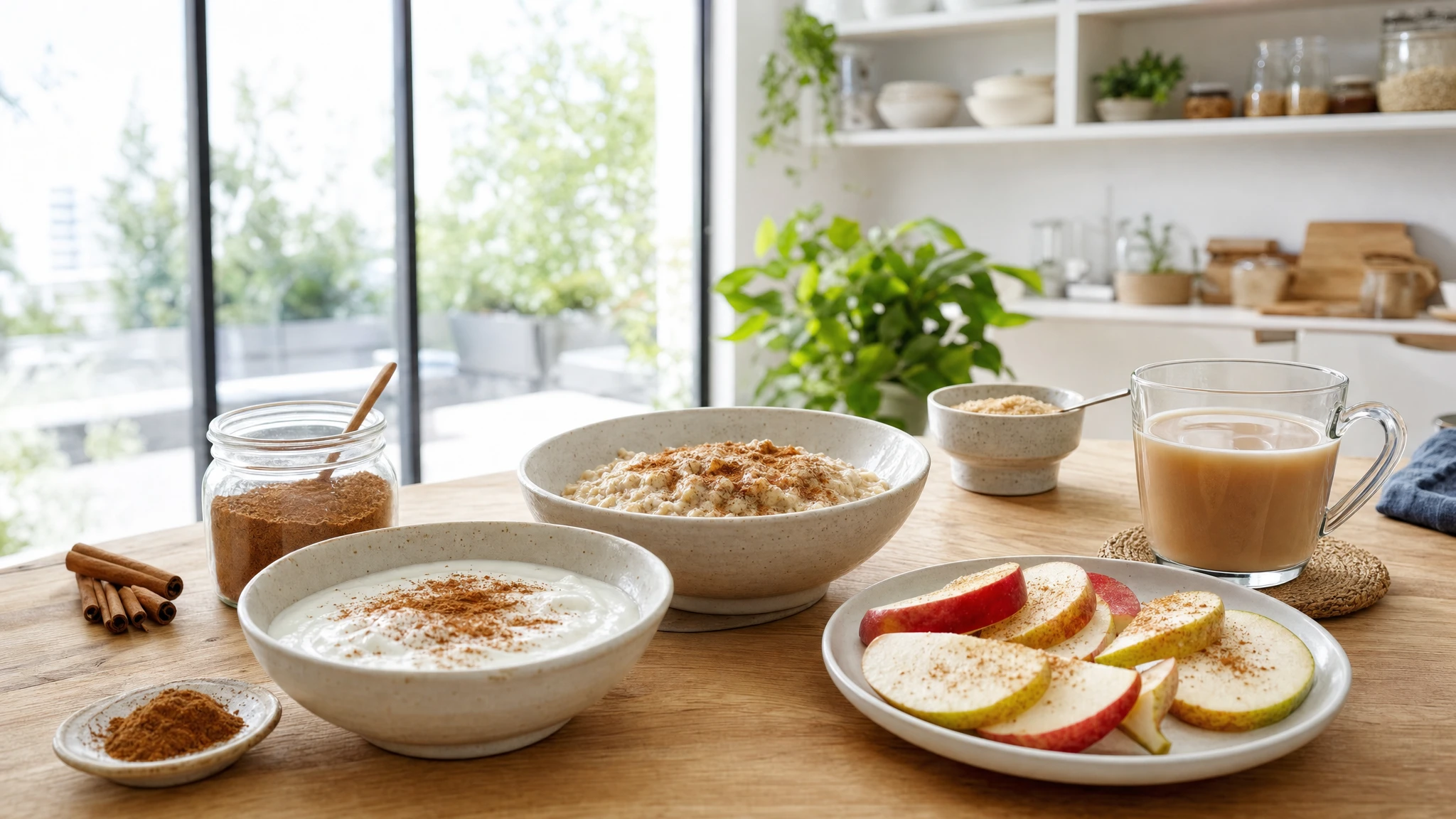
Cinnamon is a common spice: using it every day is a great way to add flavor without complicating your diet. It is not so much about the dose: what matters more is the food you choose and the reason for its use. In the right cases, it can add flavor to simple recipes and help limit added sugars in your meals. It can also help you create habits that are easy to follow and maintain every day.
It is not a cure-all: its value depends on the recipe, frequency of use, and your routine. Guidelines recommend a balanced diet and limiting free sugars in your diet. These are added sugars as well as those already present in honey, syrups, and juices. Some studies show that spices can make recipes prepared with less sugar more palatable [1] [2]. This guide explains when to use it, which foods to pair it with, and which practical limits to consider in the following topics:
- The times of day when cinnamon is most useful
- Breakfasts and snacks where it improves taste and simplicity
- Using cinnamon to reduce added sugar
- Daily recipes that are easy to repeat without effort
- Practical limits to consider for daily use
When it makes sense to use cinnamon in daily meals
The daily use of cinnamon makes sense primarily when it facilitates a choice that we can repeat over time. It acts more as an aid for flavor than as a “curative” ingredient: it can help reduce sugar, make meals more enjoyable, and help you stick to your diet more consistently.
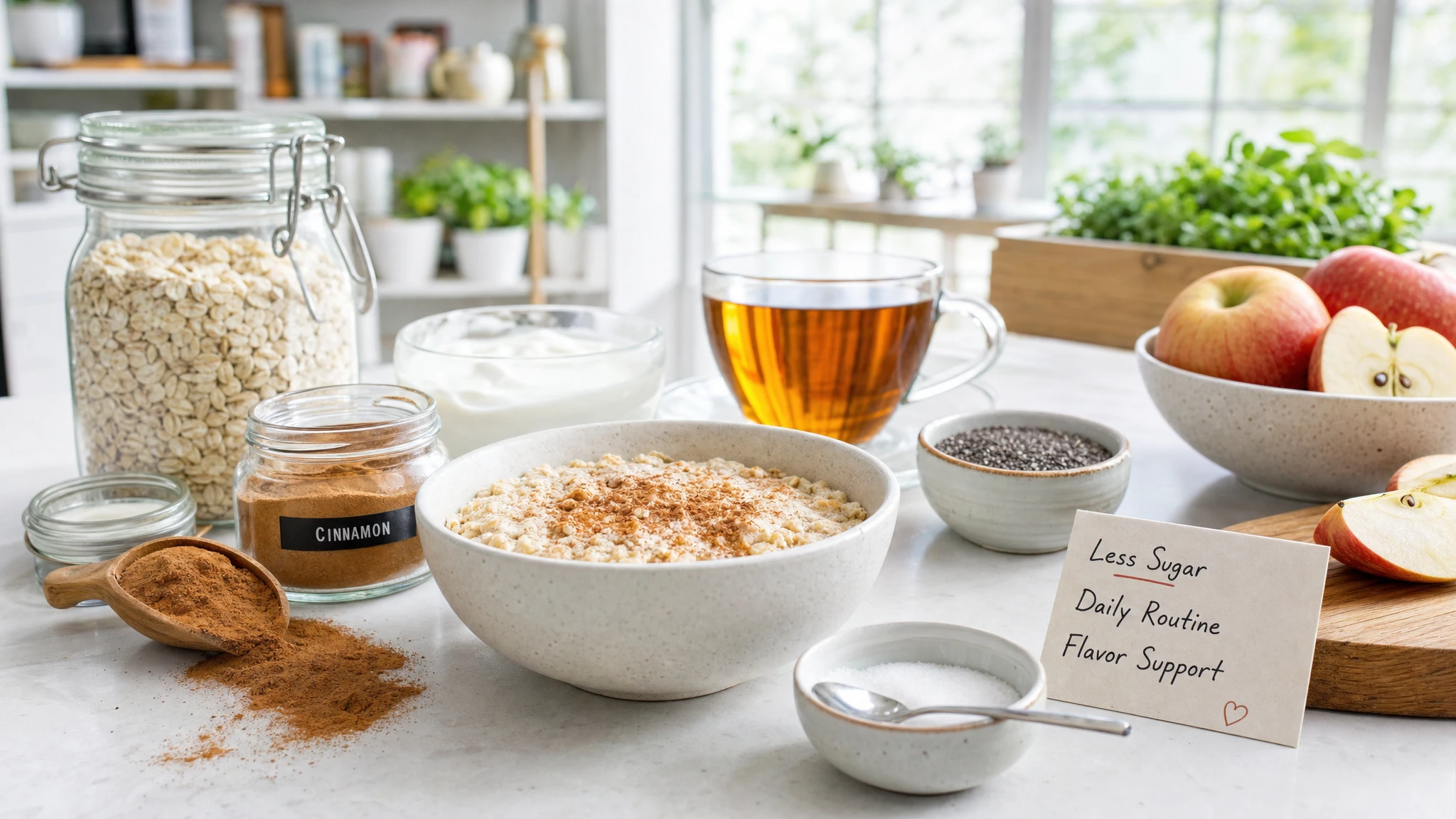
Cinnamon is useful in daily meals when it makes a recipe more pleasant without complicating it. Its role is primarily practical: it adds flavor without significant calories and helps maintain more consistent habits. It works well in simple culinary preparations that are easy to make and repeat. It can therefore help those who want to use less sugar without changing their way of eating too much.
In this logic, cinnamon supports daily choices, but it should not be added without a reason. It is best to use it when it improves flavor and makes it easier to follow a diet over time. In the following steps, we will see how to include it in the most common cases, without making meals more difficult to manage [1].
However, there is no need to add it to every dish. It is more useful when it adds flavor to neutral food and helps you stick to your diet. It can also replace part of the sugar in drinks or quick recipes. Its use makes the most sense in these cases:
- It makes simple dishes that we eat often more tasty.
- It helps reduce sugar without losing too much pleasure.
- It pairs well with recipes that are already healthy, easy, and complete.
- It is useful when taste matters as much as ease of use.
In daily meals, cinnamon works best when it has a clear purpose: enhancing an already well-thought-out recipe. The following three cases show when it offers a concrete advantage and when it remains just an extra aroma.
Cinnamon in simple meals: when it adds real value
The spice offers a real advantage in simple recipes, rather than being added to every food. Its benefit is primarily related to taste: it makes yogurt, oats, fruit, and hot drinks more enjoyable. Furthermore, it does not require long or difficult preparation. This aspect matters in everyday habits, because a small, easy action lasts longer than a rare and complex choice. In this way, the spice enhances common foods without altering the overall structure of the meal.
In a test on foods with less sugar, spices provided an overall acceptable taste to 61 people [2]. Flavor can therefore make it easier to reduce sweetness. The test, however, does not prove that the same effect applies to every spice and recipe. This use makes more sense within an already healthy and complete meal. Breakfast offers a good example, as it includes many foods with a neutral taste. The key point is to use the aroma where the flavor can truly support a repeatable choice.
Cinnamon at breakfast: oats, yogurt, and fruit
This spice pairs well with foods that have a neutral or mild flavor, typical of breakfast. Oats, yogurt, and fruit are common examples: its aroma makes them tastier without adding sugar. Furthermore, it does not require long recipes or difficult steps. It can therefore help those looking for a pleasant, simple, and nutritionally balanced breakfast. Their practical value therefore depends on the ease with which they fit into one's personal routine.
A clinical study included 18 adults with obesity and prediabetes. After 2 weeks of a diet low in polyphenols and fiber, a 10-week test began. The design was a randomized, double-blind, crossover trial (each person tried the treatments in random order) [3]. Another trial followed people with prediabetes for 12 weeks at two academic centers [4]. These studies show its use in humans, but they do not make breakfast a cure. The daily benefit remains linked primarily to taste and habits.
Cinnamon instead of sugar: where it really works
Using cinnamon instead of sugar only makes sense in certain preparations, especially when the goal is to reduce sweetness without losing too much palatability. The spice does not completely replace sugar, but it can help make a food seem richer and more satisfying. This is why it is useful in simple recipes, such as porridge, yogurt, fruit, or hot drinks, where a little goes a long way in changing the perception of flavor.
In a study of 58 adults with type 2 diabetes, cinnamon was evaluated for 12 weeks, and the authors observed possible improvements in glycemic and lipid parameters; however, this concerns clinical use and not simple daily cooking [5]. In everyday life, therefore, cinnamon is a transitional tool: it supports the shift toward less sweet preparations without promising a perfect sugar substitute.
Recent research and updates
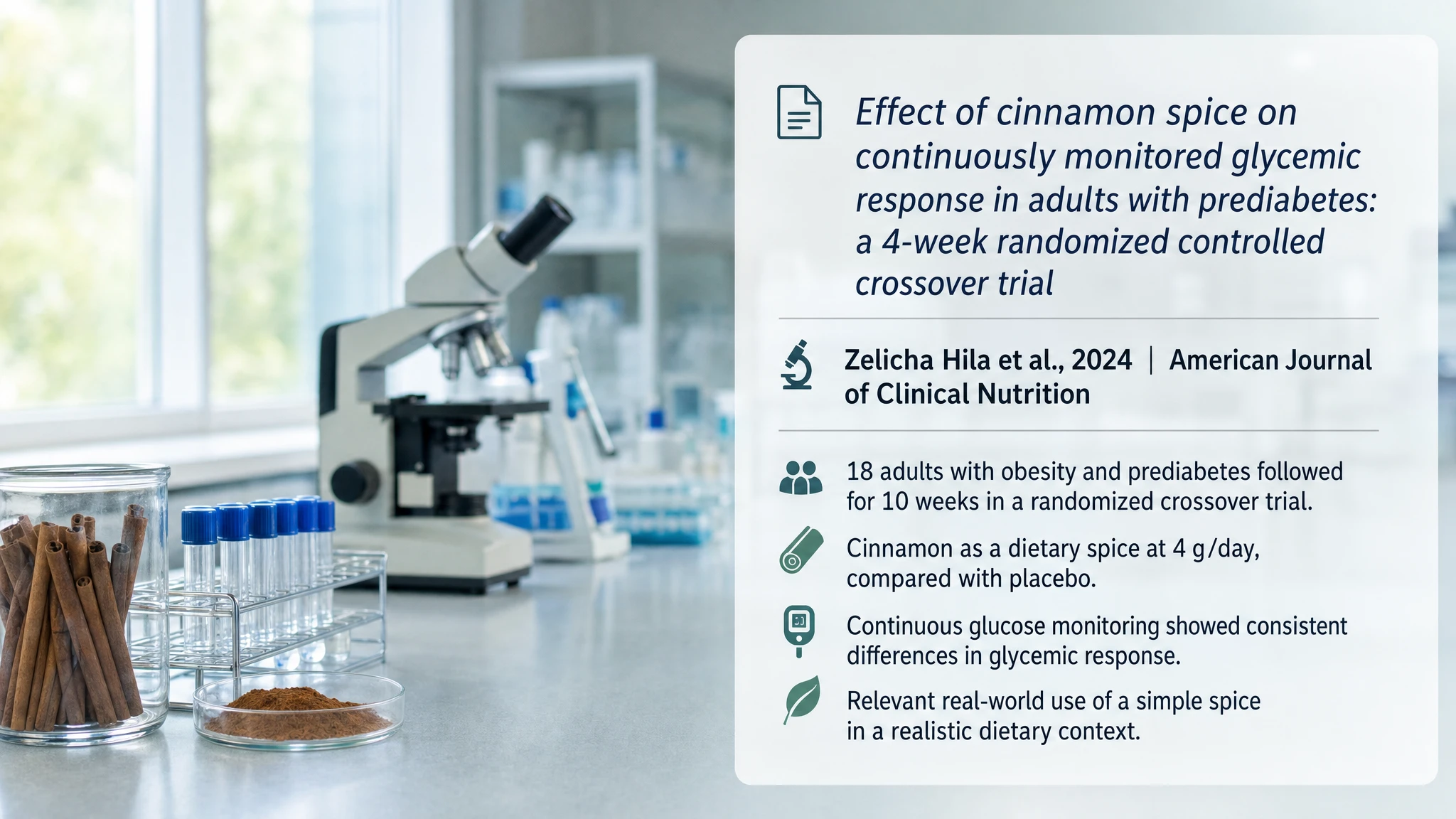
In 2024, Zelicha, who was working in the United States, and colleagues published a study in the American Journal of Clinical Nutrition. The research evaluated how a daily dose of cinnamon affects glycemia in adults with prediabetes and obesity. The study examines a realistic use of the spice, in a simple form and over a defined period. The results do not make cinnamon a cure, but they clarify when it may make sense as a practical aid.
Effect of cinnamon spice on continuously monitored glycemic response in adults with prediabetes: a 4-week randomized controlled crossover trial
- 18 adults with obesity and prediabetes were followed for 10 weeks in a randomized controlled crossover trial, after 2 weeks on a diet low in polyphenols and dietary fiber.
- Cinnamon was provided as a food spice at 4 g per day, divided throughout the day and compared with a placebo.
- The research continuously measured glycemia with a dedicated device, detecting consistent differences compared to the control.
- The data links daily, simple, and repeatable use to a real-world diet rather than a complex intervention.
How to use cinnamon without complicating your diet
The benefits of cinnamon emerge primarily when it remains a simple addition, suited to your habits and easy to repeat. In practice, how to use cinnamon depends more on consistency than on creativity. A few uses, realistic doses, and choices that do not make your dietary regimen more difficult are all that is needed. If it serves to add flavor without calories, simplicity helps you stick to your diet over time.
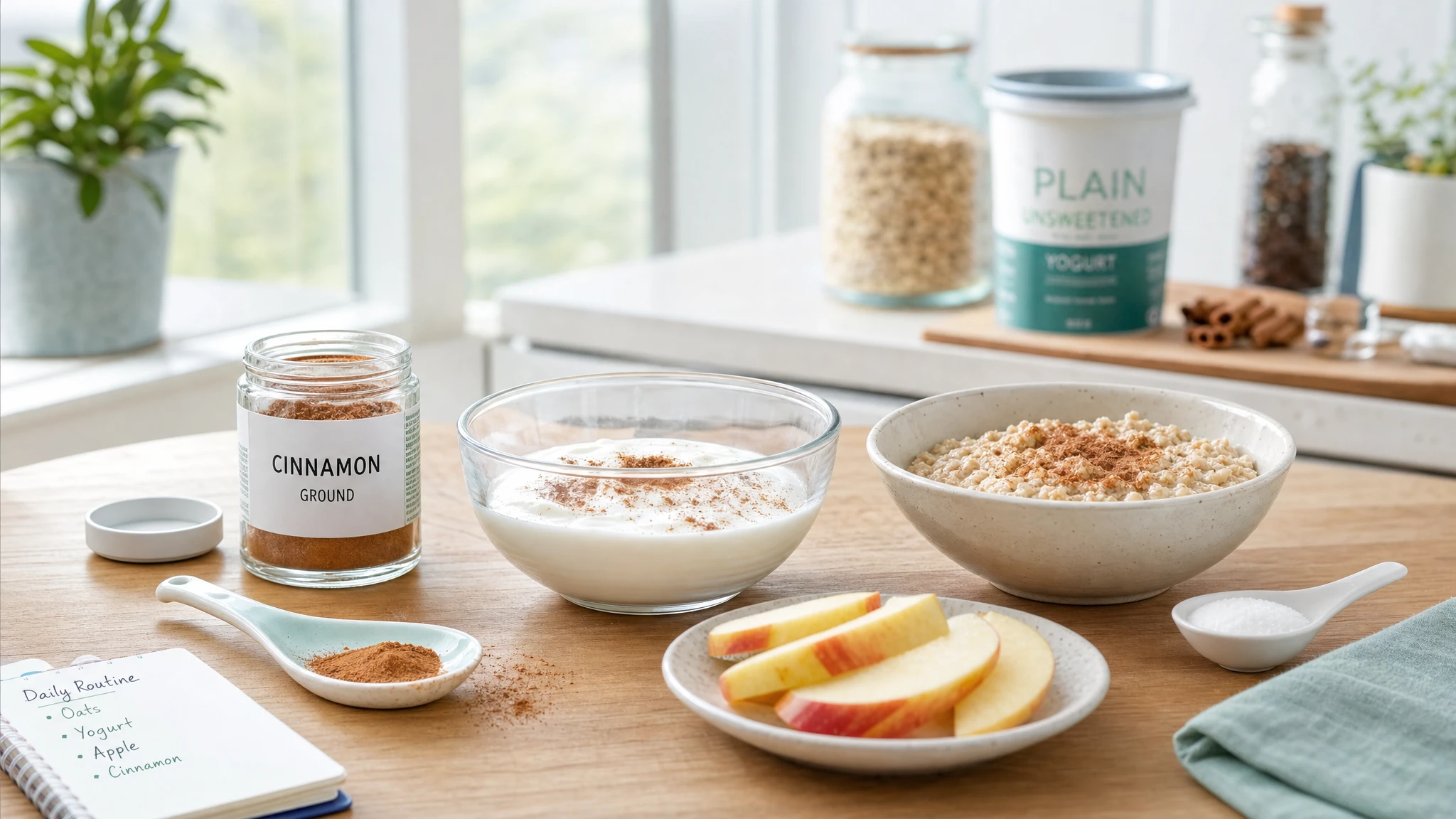
To avoid complicating your diet, it is best to use cinnamon as a practical aid rather than an ingredient to obsess over. It can add flavor to already simple recipes and encourage daily choices that are easy to maintain. For this reason, the daily use of cinnamon works best with simple habits that are easy to repeat. It requires very few steps and does not significantly change your everyday meals.
There is no need to use it everywhere: choose it when it adds flavor without making the recipe more complicated. This method can promote the reduction of sugars (less sugar in the diet) and leave a pleasant, less sweet taste. The following examples show its uses in the kitchen, common mistakes, and the most sensible cases.
The most practical uses are as follows:
- Use cinnamon in the kitchen to add aroma to simple recipes.
- Use cinnamon at breakfast for more flavor without adding sugar.
- Add cinnamon to yogurt, with a quick gesture that is easy to repeat.
- Use cinnamon instead of sugar in your simplest habits.
The following three steps show cinnamon as a practical aid, not as a solution that works in every case. Each section explains how to incorporate it into your routine without making your diet more difficult.
Cinnamon in the kitchen: pairings that are easy to repeat
The most useful combinations are those that can be repeated effortlessly. Cinnamon in the kitchen lends itself well to basic preparations such as yogurt, oats, fruit, milk, herbal teas, and some homemade desserts with less sugar. The point is not extreme variety, but simplicity: when a use requires few steps, it is more likely to truly become part of your routine. The spice adds aroma without calories and helps to gradually reduce added sugar. This makes it a practical ally for those seeking pleasant flavors without complicating meal preparation.
In another trial with 3 grams of cinnamon alongside a high-fat breakfast, the intervention did not significantly change the meal response [6]. The practical takeaway is clear: cinnamon helps primarily as an aromatic finishing touch, while the metabolic effect is not automatic. For this reason, it is best to use it where it improves the meal experience without promising more than it can deliver. Consistency in simple use matters more than the quantity or complexity of the recipe.
Common mistakes in the daily use of cinnamon
One of the most frequent mistakes is using cinnamon as if it could single-handedly fix an unbalanced meal. In reality, the spice works best when it accompanies a meal that is already sensible, not when it is called upon to correct excessive sugar, fat, or portion sizes. Cinnamon cannot balance an excess of calories or unhealthy ingredients. Its role is that of an aromatic support, not a metabolic corrector.
Another mistake is overdoing the quantity, thinking that more aroma means more benefit: from a practical standpoint, an excess can make the flavor unpleasant and reduce the recipe's palatability. In a meta-analysis of 16 randomized studies, the overall picture was described as interesting but inconsistent [7]. This means that daily use may be reasonable, but it should not be turned into an expectation of consistent results. The main limitation lies right here: a spice can support a diet, but it cannot replace its balance. Therefore, a measured approach is needed, one that does not burden cinnamon with meanings it cannot sustain.
Cinnamon and a balanced diet: when use remains sensible
Using cinnamon remains sensible within a sober diet that is well-organized and free of unrealistic expectations. The spice is primarily useful for adding flavor to meals, which should remain simple and well-regulated. It can therefore support an orderly routine, but it cannot compensate for poorly balanced dietary choices. Summaries of available studies also suggest exercising the same caution. Reviews gather diverse results and help evaluate them together, without turning them into certainties. In an updated review on people with type 2 diabetes, its use may be helpful, but not definitive [8].
Another summary examines body mass index (the ratio of weight to height). It also evaluates glycemic status (blood sugar control) and detects possible effects [9]. However, these effects are not enough, on their own, to change a diet. The choice remains sensible if it helps keep breakfasts, snacks, or recipes simple. In this way, cinnamon supports the diet without making it more difficult. Daily supplementation works when it is a natural habit, not an obligation to remember.
Cinnamon in everyday breakfast and snacks
In an easy-to-follow diet, the use of cinnamon depends primarily on the context. Breakfast and snacks are the most practical times to try it. Here, the spice adds flavor, helps reduce added sugars, and makes certain daily choices simpler.
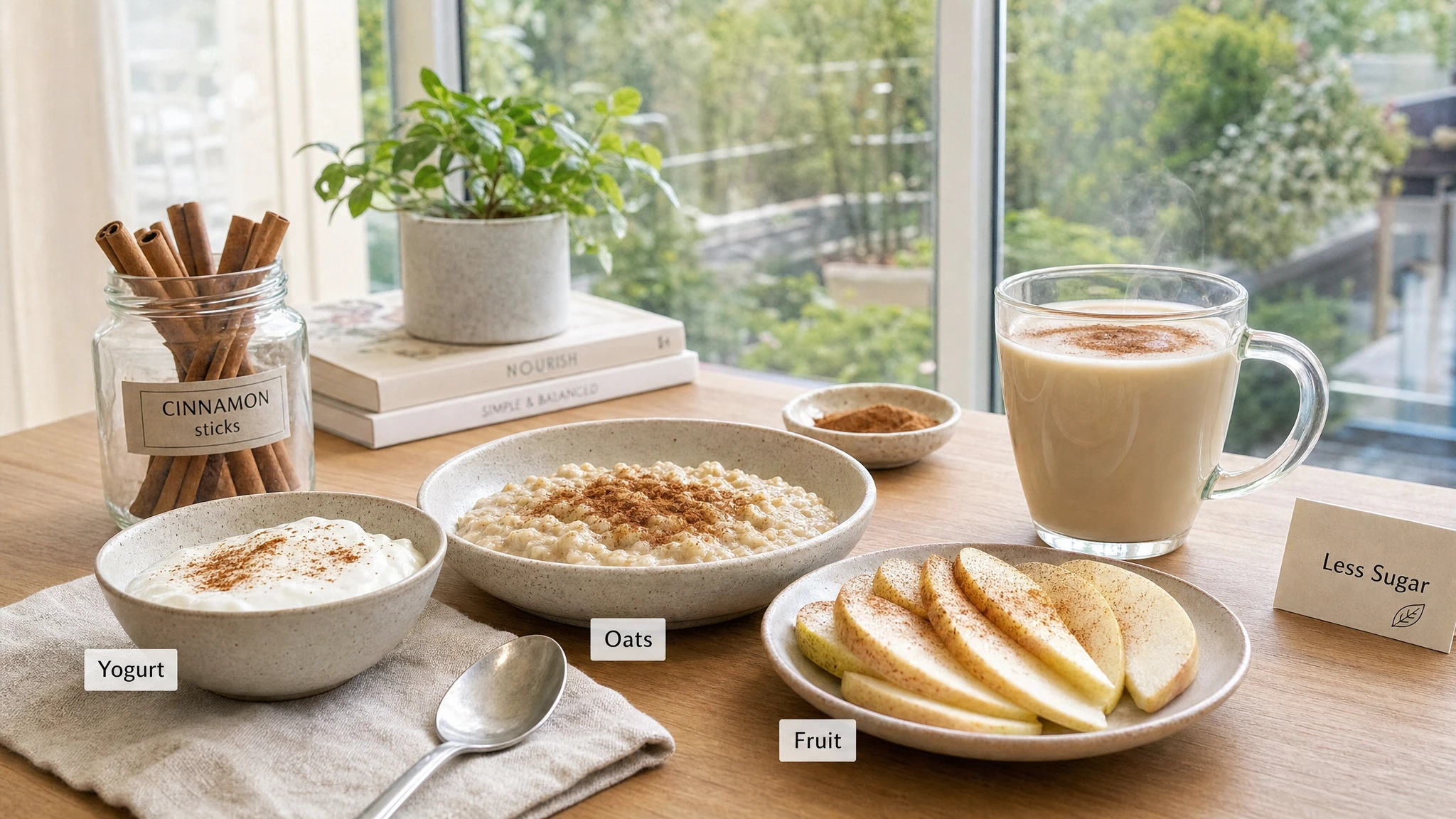
At breakfast and during snacks, cinnamon primarily offers practical help. It provides aroma and makes simple foods more enjoyable, encouraging the reduction of added sugars. However, it does not change the nutritional value of the diet on its own. It pairs well with yogurt, oats, fruit, and hot drinks. These are foods suitable for daily use, which is consistent and undemanding.
The goal is not to seek miraculous effects, but to support daily choices that are easy to maintain. If the spice makes a meal more pleasant, it can help you stick to your diet consistently. This benefit relates to habits, not a guaranteed health effect. Let's look at the most practical contexts for using it.
You can incorporate it into your routine in these ways:
- In yogurt, to add flavor without adding sugar.
- With oats and porridge, to vary the taste of your breakfast.
- On fruit and hot drinks, for a fuller aroma.
- Instead of sugar, when a less sweet taste is sufficient.
In the three most common cases, cinnamon fits into your day without requiring difficult recipes. The food chosen may change, but the logic remains the same.
Cinnamon in yogurt: a simple and frequent use
Yogurt is one of the foods where cinnamon fits in most easily. The neutral base of the dairy product leaves room for the spice's aroma and allows for a more interesting flavor without adding sugar. It is a use consistent with a quick breakfast or snack, which is repeatable and easy to adapt to your dietary habits. The spice does not alter the structure of the yogurt, but it does change its sensory perception. This makes it useful when you are looking for a bolder taste without changing the basic preparation.
The data does not directly concern yogurt, but it is useful because it shows how a strong aroma can make less sweet preparations more acceptable. In one study, participants who received a meal flavored with cinnamon reported greater satiety and a lower desire for sugar in the following hours. The limitation is clear: cinnamon does not replace the quality of the yogurt nor does it transform the nutritional profile on its own, but it can make it easier to maintain a simple and pleasant daily choice.
Cinnamon with oats, cereals, and porridge
Oats, cereals, and porridge are very suitable contexts for cinnamon because they have a soft, neutral base that is easily flavored. In these preparations, the spice adds character without introducing complexity, making it useful for breakfasts that need to be practical but not mundane. The texture of these foods holds cinnamon powder well and distributes its aroma evenly. The result is a warm, fragrant dish that does not require added sugars to be enjoyable.
It is also a simple way to use cinnamon instead of sugar when you want to maintain a richer taste with less sweetness. Research has observed that adding cinnamon to a cereal-based meal reduces the post-prandial glycemic response by up to 20% compared to the same meal without the spice [1]. In practice, cinnamon adapts well to these foods, but the effect depends on the rest of the breakfast and the general context. The limitation is important: the main value remains its help in maintaining dietary consistency, not a guaranteed metabolic result for every preparation.
Cinnamon with fruit and hot drinks
Fruit and hot drinks are two contexts in which cinnamon is easily used, because its aroma integrates without requiring complex preparation. On fruit, it can enhance the perception of sweetness and make a simple snack more interesting. In hot drinks, such as herbal teas or milk, it adds character to the flavor and can reduce the need to immediately seek out a sweeter taste. Cinnamon releases its aromatic compounds with heat, which makes it particularly effective in hot preparations. However, even on fresh fruit, the aroma spreads rapidly and transforms an ordinary snack into a more satisfying moment.
This means that fruit and hot drinks are very practical ways to incorporate it into your dietary habits, especially when the goal is to add flavor without calories. Available data suggest that repeated exposure to foods with intense aromas but no sugar can reduce the preference for sweet flavors over the course of a few weeks [2]. The limitation remains the same: the most reliable benefit is behavioral and sensory, not an identical response in all people or in all quantities.
Summary of scientific evidence
This summary collects the most important evidence from the literature and distinguishes the most solid data from indirect findings regarding daily use.
| Publication year | Area studied | What the studies indicate |
|---|---|---|
| 2011 | Postprandial response to a high-fat meal | results vary and cinnamon does not always show a measurable effect after the studied meal [6] |
| 2015 | Reduction of free sugars | studies indicate that an aromatic aid can be useful when it makes recipes less sweet and simpler [1] |
| 2018 | Palatability of preparations with less sugar | evidence indicates that spices can maintain a pleasant taste even when less sugar is used [2] |
| 2020 | Prediabetes and glycemic control | studies also evaluate cinnamon in a clinical setting, but daily use does not guarantee a therapeutic effect [4] |
| 2024 | Glycemic control in prediabetes | evidence indicates that 4 g per day, used as a spice, can influence glycemia in a controlled context [3] |
| 2024 | Meta-analysis in type 2 diabetes | studies provide an interesting but varied picture, with different results for the measures examined [7] |
Editorial interpretation of the evidence
Overall, the studies I have reviewed here better support cinnamon as a practical aid to diet quality, rather than as a standalone remedy. The most consistent data I found concerns its ability to add flavor to recipes with less sugar. The spice can thus be incorporated into simple, realistic, and easy-to-repeat meals. There are also clinical studies on metabolism, but they concern a different scope than common kitchen use.
The main limitations I encountered concern the differences between individuals, dosages, types of cinnamon, and meals studied. Furthermore, many studies measure metabolic values or experimental effects, not real daily habits. Therefore, overly broad conclusions should be avoided. A practical benefit may exist, but it does not appear to be the same across all studies or in every recipe.
Conclusions and editorial summary
Cinnamon makes sense in a daily diet when it remains a simple aid, not the center of the meal plan. Its most credible role, in my view, is practical: it can improve certain meals, especially breakfasts and snacks. It can also help reduce added sugars without complicating your routine. Therefore, it fits into a sober diet that is easy to follow and linked to realistic goals.
The studies I have collected also show that context matters more than the individual action. The same spice can be useful in a simple recipe but irrelevant in another. The most solid conclusion I have drawn is therefore practical: cinnamon is useful when it improves taste, simplicity, and consistency. This vision keeps the diet at the center, without giving the spice a role that studies do not always confirm.
Final critical note
Comparing the studies reveals a key point. Cinnamon is often studied for its metabolic effects, but here I have seen it primarily as an aid in dietary choices. This shift is useful, but it makes direct conclusions less robust. Many studies measure short-term effects or clinical values, not real-world habits. Its practical value is therefore possible, but not always measurable with precision. Caution is needed to avoid confusing a benefit in taste with a certain and constant effect.
References
[1] Guideline: Sugars intake for adults and children
[2] The Influence of Adding Spices to Reduced Sugar Foods on Overall Liking
[3] Effect of cinnamon spice on continuously monitored glycemic response in adults with prediabetes: a 4-week randomized controlled crossover trial
[4] Influence of Cinnamon on Glycemic Control in Individuals With Prediabetes: A Randomized Controlled Trial
[5] Efficacy of cinnamon in patients with type II diabetes mellitus: A randomized controlled clinical trial
[6] Effect of cinnamon on gastric emptying, arterial stiffness, postprandial lipemia, glycemia, and appetite responses to high-fat breakfast
[7] The effect of cinnamon supplementation on glycemic control in patients with type 2 diabetes mellitus: An updated systematic review and dose‐response meta‐analysis of randomized controlled trials
[8] Cinnamon Use in Type 2 Diabetes: An Updated Systematic Review and Meta-Analysis
Editorial note
Artificial Intelligence was used solely as a tool to support editorial and documentary work. All content, interpretations, bibliographic citations and conclusions have been verified, reviewed and approved by the author, who assumes full scientific responsibility for them.
The manuscript was also subject to independent peer review prior to publication.
To ensure maximum transparency, the article's complete history — including the dates of submission, review, acceptance and publication, as well as information on the peer review process — is available on the dedicated Article History page.