


Cinnamon supplement: differences between powder, extract, and capsules on the label
Research on cinnamon supplements shows that the various forms are not equivalent. Powder, extract, and capsules differ in composition, concentration, and use. Therefore, they should not be considered interchangeable versions of the same product. Clinical studies indicate potential favorable effects on certain metabolic markers. However, the results are not uniform. The chosen form matters just as much as the amount stated on the label. Distinguishing between dietary use and supplementation helps to better interpret the data. It also helps to avoid incorrect comparisons.
- Published 09/11/2026
- Updated 11/11/2026
- Reviewed 11/11/2026
- Article history

ABSTRACT : WHAT THE SCIENCE SAYS
When talking about cinnamon, it is easy to confuse the culinary spice with supplements. In reality, powder, extract, and capsules are not equivalent. Their composition, the quantity of compounds, the method of use, and the purpose all differ. This distinction helps in reading labels, commercial texts, and research without confusing different products.
Powder is primarily used as a food, while extracts and capsules are common in supplementation. The latter involves defined doses and can offer more controlled amounts of certain compounds. Understanding these differences avoids unrealistic expectations and helps in evaluating data with caution. Regulatory sources remind us that supplements and foods have different purposes. For this reason, a careful reading of the label is always necessary. In particular, this article describes the most common forms and explains why they are not interchangeable:
- Powder, extract, and capsules are not equivalent products
- The chosen form changes composition and concentration
- Culinary use is different from supplementation
- Labels always require context
- Studies do not always evaluate the same form
Why cinnamon powder, extract, and capsules do not coincide
The potential benefits of cinnamon depend heavily on the form used. Powder, extract, and capsules, in fact, serve different purposes. The method of use, dosage, concentration level, and ease of measuring the product all vary. For this reason, a cinnamon supplement is not equivalent to the culinary spice sold in a different package.
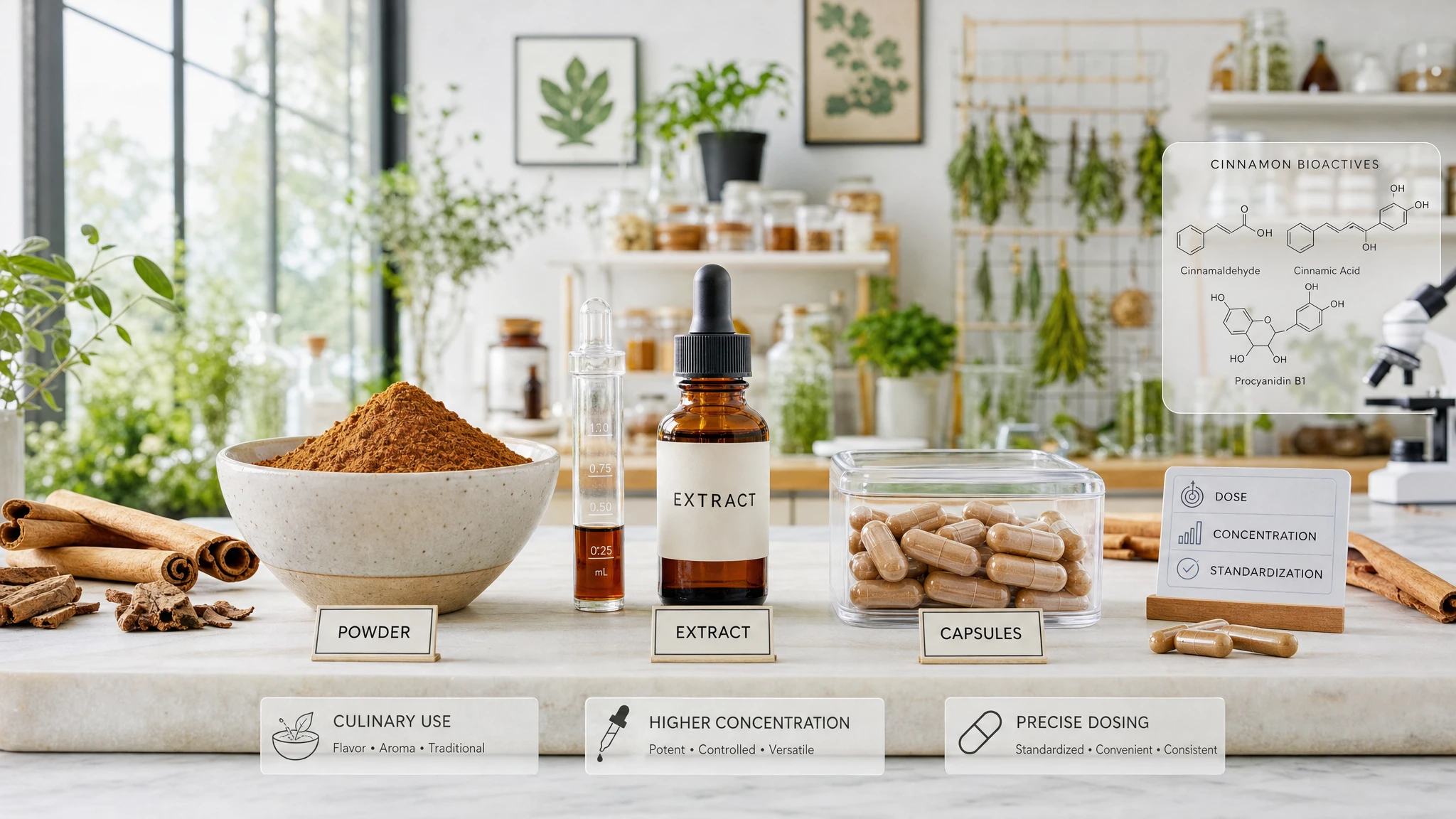
When talking about cinnamon supplements, it is necessary to distinguish between forms with different uses. Cinnamon powder remains linked to everyday cooking. Cinnamon extract, on the other hand, concentrates a portion of the plant material. Cinnamon capsules offer an oral form designed to supplement the diet. The type of product changes its use and how it should be evaluated.
This framework helps to avoid inaccurate comparisons. A kitchen spice, a concentrate, and a capsule do not have the same application. Furthermore, products on the market may be standardized or not. Standardization indicates a defined quantity of one or more components. This information helps to understand what is being taken and for what purpose.
Composition, concentration, and standardization therefore explain why products with similar names can yield different results.
Before examining the studies, it is useful to understand what truly distinguishes these three forms:
- Powder follows the typical use of a food rather than that of a concentrate.
- Extract changes the product's profile and can increase its concentration.
- Capsules help to use a more regular and easy-to-measure dose.
- The difference between a spice and a supplement also depends on the intended purpose.
The three forms of cinnamon perform different functions and are not equivalent variants. The following paragraphs explain the powder first, then the extract, and finally the capsules.
Cinnamon powder: why it is the form most closely associated with cooking
Cinnamon powder is the most well-known form because it is commonly used in cooking. It is added to food to provide aroma and flavor without creating a concentrated product. For this reason, it is more similar to an ingredient than a supplement. If it is used to supplement the diet, both the dose and the method of intake matter. Therefore, the indicated quantity alone does not describe the entire product.
A crossover study, in which each patient tried multiple options, involved 19 patients with type 2 diabetes. A drink containing 3 or 6 g of raw spice reduced the post-meal glucose spike more effectively than hard capsules [1]. Hyperglycemia is a blood glucose level that is too high. However, the systematic review suggests evaluating preparation, dose, and use [2]. The data, therefore, does not apply to every powder, but it shows that the form can change the outcome.
Cinnamon extract: what a concentrated form really means
A cinnamon extract is created through a process that isolates or concentrates specific components of the spice. Powder, on the other hand, retains the general structure of the plant material. The word "extract" therefore indicates a selection of components, not just a change in form. The final product may have dosages and profiles that differ significantly from the spice used in food. To evaluate it, one must know how it was obtained and what it contains.
Clinical studies show results linked to the type of preparation. In a meta-analysis that combined 24 trials and compared different dosages, the use of the spice reduced fasting glycemia and glycated hemoglobin compared to the control group [3]. Glycated hemoglobin estimates the average glycemia over the last few months. Another analysis that brought together 16 randomized studies found a decrease of about 0.5 mmol/L and lower insulin resistance, while other outcomes were less clear [4]. The data refer to specific formulas and do not apply to every product.
Cinnamon capsules: when the oral form changes the meaning
Cinnamon capsules shift the product from the culinary realm to that of supplementation. The capsule is not just a container: it often serves to make the dosage more convenient, uniform, and repeatable. This can be useful for those seeking a defined amount of an ingredient or extract, but it radically changes the context of use compared to the spice sprinkled into meals. Therefore, the capsule should be viewed as a pharmaceutical form designed for oral intake, not as a simple extension of the kitchen.
The data suggests that the form of administration matters, even with the same declared dose. The limitation, however, is that not all capsules contain the same preparation and not all pursue the same goal: some aim for convenience, others for standardization, and still others for the protection of the contents. For this reason, the word "capsule" alone is not enough to describe the product.
Recent research and updates
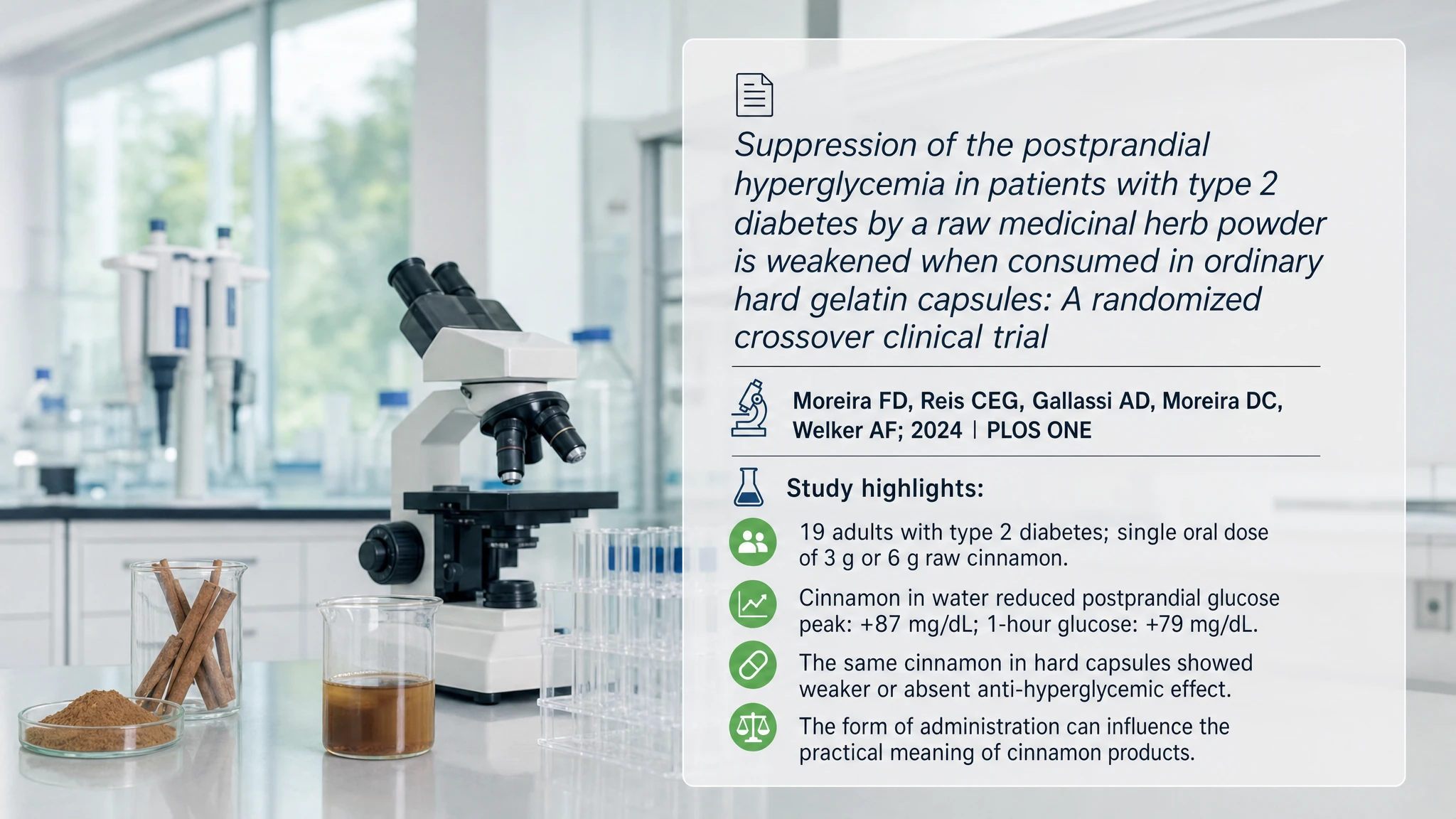
In 2024, Moreira, a Brazilian researcher, and his colleagues published a study in the journal PLOS ONE. The research clarified a practical point. Cinnamon can act differently depending on the form taken. The authors compared a single dose of raw cinnamon dissolved in water with the same amount in hard capsules. They then measured the glycemic peak (maximum increase in glycemia) after a meal. The study therefore shows that the form and context of use can change the measured result.
Suppression of the postprandial hyperglycemia in patients with type 2 diabetes by a raw medicinal herb powder is weakened when consumed in ordinary hard gelatin capsules: A randomized crossover clinical trial
- The study involved 19 people with type 2 diabetes. It evaluated a single oral dose of 3 g or 6 g of raw cinnamon.
- Cinnamon dissolved in water reduced the post-meal glycemic peak. The peak was +87 mg/dL and the glycemia at 1 hour was +79 mg/dL.
- With the same cinnamon in hard capsules, the effect against the rise in glycemia was reduced or disappeared compared to the beverage.
- The result shows that the form of intake can change the practical significance of a cinnamon-based product.
How composition, concentration, and standardization change
The composition of a cinnamon supplement depends on the material used, the processing, and the quality controls. Powder, extract, and capsules can vary in terms of concentration, uniformity, and actual content. Standardization therefore helps in comparing a spice with a product used as a supplement.
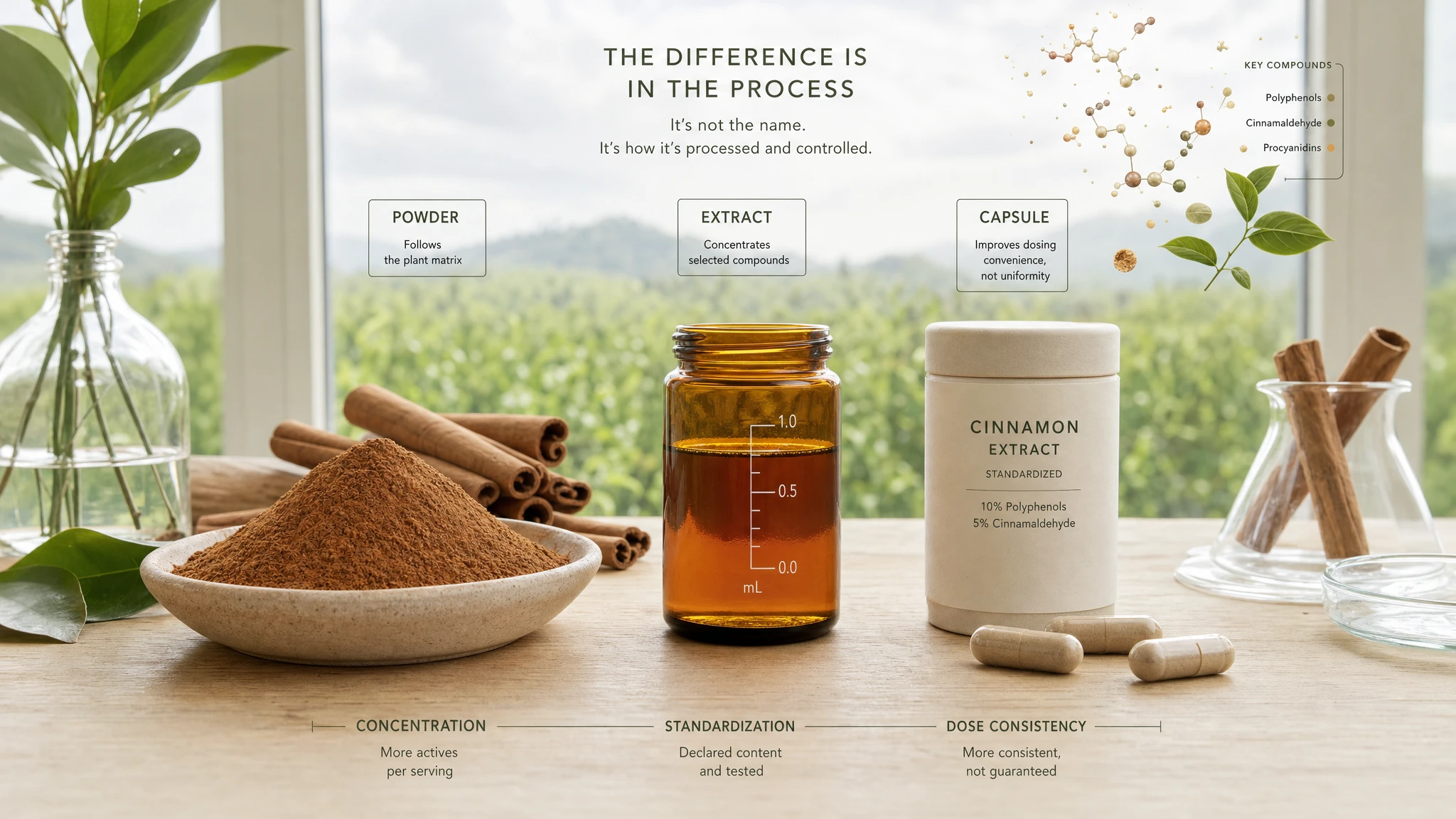
In a cinnamon supplement, both the plant and the way it is processed matter. The composition can remain similar to the raw material or become more concentrated and targeted. The galenic form—that is, how the product is prepared—also counts. Powder, extract, and capsules can provide different doses of various compounds. Therefore, a comparison must evaluate concentration, uniformity, and label data, not just the name.
These differences explain why similar products can have very different actual content. The food matrix, concentration, and batch controls indeed change the final profile. Knowing these aspects helps in evaluating supplementation and reading labels more effectively.
To understand if two products are truly similar, one must distinguish between these aspects:
- Powder maintains the structure and various elements of the plant material.
- Extract selects and concentrates a portion of the compounds present.
- Standardization makes the content indicated on the label more stable.
- Capsules make it easier to dose the product, but do not guarantee its uniformity.
To understand the topic, one must distinguish between matrix, standardization, and the differences between various products. The following three steps explain why the same name can indicate very different preparations.
Cinnamon food matrix: why it matters in powder
In cinnamon powder, the compounds remain within a complex food matrix. This includes fiber, plant tissues, and natural substances present in the starting material. Therefore, the product does not act as a single isolated ingredient, but as a whole food. This means that each component remains bound to the others. Nothing is isolated or made more concentrated than in the original plant. Its structure influences the texture, taste, and release of the various components. Even the way it is chewed or cooked can change this release. This is the main difference compared to an extract, where some elements are separated instead.
In the powder, the composition follows that of the original plant. It therefore remains linked to the plant from which it comes, without targeted modifications. In the extract, however, some elements can be selected and concentrated. This substantially changes the final content of the product. The difference between spice and supplement therefore does not depend only on the name, but on the structure of the product. Regulatory sources on supplements distinguish between foods and supplements based on form, use, and content control [5]. This distinction is not just formal: it reflects different production processes. Cinnamon powder should therefore be viewed as a culinary ingredient, not as a substitute for a concentrated preparation. The limitation is clear: the powder, on its own, does not guarantee constant doses of compounds with every use.
Standardization of extracts: what it is really for
Standardization makes a cinnamon extract more predictable from one batch to another. It aims to keep the quantity of certain selected components stable. It does not change the nature of the product, but it makes the control of its composition more precise. This aspect matters in supplementation, because the stated dose must remain fairly uniform over time. Products sold as cinnamon capsules often follow this logic. They offer a practical and more controlled form compared to the spice. However, they do not become identical to the powder used in cooking because of this.
In a 2022 meta-analysis of studies on people with metabolic diseases, cinnamon extracts were associated with an improvement in HDL cholesterol and blood pressure [6]. The trials, however, used different formulations. The 2020 review on blood pressure also showed favorable results [7]. Nevertheless, the preparations examined were not entirely comparable. These data indicate that concentration and content control play a role. Standardization, however, does not eliminate all differences between products. It does not make the doses, duration, and quality of the studied preparations equal either.
Why two cinnamon products can have different profiles
Two products with the same trade name may have different profiles in terms of origin, processing, and content. The reason is simple: cinnamon powder, cinnamon extract, and cinnamon capsules are derived from different processes. Therefore, they can reach non-comparable concentration levels. Even with the same plant, the final content changes based on the raw material. The treatment used and the degree of concentration also matter. To evaluate a cinnamon supplement, one must therefore read the label, dosage, and potential standardization. The generic name of the product alone is not enough.
Clinical reviews clearly show this variability. A 2019 analysis of controlled studies found overall favorable effects on glycemia [8] [9]. However, the results were not uniform across trials. The 2012 review described a similar picture [10]. Outcomes varied based on the type of preparation and the context of use. Two products that look similar on the packaging can therefore be very different in substance. However, an important limitation remains: the studies show strong variability, meaning marked differences between them. Without clear data on composition and standardization, direct comparison between preparations remains approximate.
Bioavailability and daily use: how to interpret the practical difference
To understand the daily use of a cinnamon supplement, one must evaluate how the body absorbs the spice, extract, and capsules. The plant is the same, but in practice, the actual dose and intended use matter. The galenic form (type of preparation) then clarifies the practical difference between the spice and the supplement.
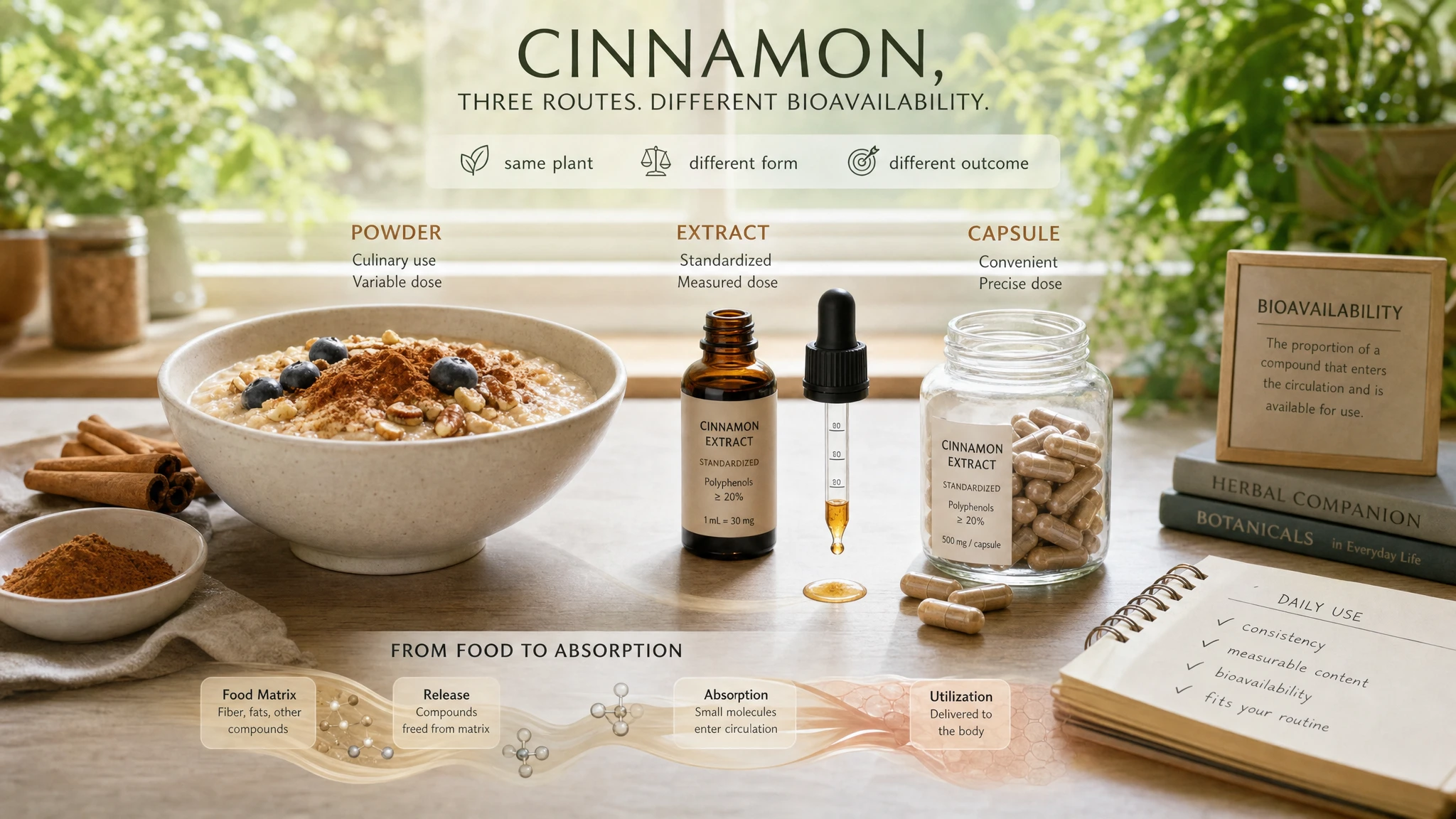
To evaluate a cinnamon supplement, you need to know what it contains, how much of the substance reaches the body, and in what form. Bioavailability indicates the portion of a substance that the body is able to absorb and use. Therefore, a spice in meals, an extract, and capsules can have different effects. The comparison must consider the dose, the type of use, and its consistency over time.
These points help in reading data on effects without confusing food with supplements. Cinnamon can play a different role in a meal versus a more concentrated product. This difference matters when we read studies and estimate which effects are realistic.
Before choosing a product, it is useful to distinguish a few simple but important aspects:
- The chosen form changes the amount of substance that can actually reach the body.
- The indicated dose does not always coincide with that usually used in meals.
- Standardization indicates more clearly the quantity of compounds present in the product.
- The method of daily use changes the practical value of the observed results.
To understand the practical effect of cinnamon, one must distinguish between absorption and its mere presence in a product. The following three steps show how form, usage, and studies change the true meaning of supplementation.
Cinnamon bioavailability: why form matters
Bioavailability describes how much of a substance actually becomes available to the body after intake. This means that the same cinnamon can provide different practical exposure if taken as an ingredient in meals, as a concentrated extract, or in capsules. The galenic form—that is, the preparation method used to make the product usable—influences the passage of compounds and, therefore, how the real effect is interpreted. A 2024 study measured the bioavailability of procyanidin A2, a key compound in cinnamon. Researchers compared the powdered spice with an extract in capsules. They observed that the capsule released the compound more slowly. The peak in the blood was lower, but the presence lasted longer. This data helps explain why the chosen form modifies the body's exposure to the substance [5].
The limitation is clear: this was an acute test, involving few participants and a preparation that was not standardized like a true supplement. For this reason, bioavailability helps in interpreting practice, but it does not allow for the automatic transfer of results from one form to another.
Dietary use and supplementation: two non-overlapping contexts
Using cinnamon in cooking and taking a product as supplementation are not equivalent actions. In the first case, the spice is consumed as part of a meal along with other foods; in the second, the dose is designed to be more controlled and repeatable. This practical difference changes the meaning of any recommendation: advice for dietary use cannot be automatically translated into a galenic form to be taken every day. The typical daily dose in cooking is one or two grams. A supplement, on the other hand, can provide a precise and constant amount of active compounds. The 2024 study used capsules with 200 mg of extract. This dose is much more concentrated than what is obtained with the common spice. For this reason, the two uses should not be confused when reading the data [5].
This is why a cinnamon supplement should be viewed as a product distinct from the daily condiment: the same word does not describe the same context of use. The limitation remains that of a single short-term study, which is useful for guiding practical interpretation but not sufficient to define a universal rule for all preparations.
How to read studies on cinnamon without confusing the forms
Many misunderstandings arise because studies do not always evaluate the same form of the product. A result obtained with a standardized extract does not necessarily describe cinnamon powder, and vice versa. To interpret the data correctly, one must check which preparation was used and at what dosage. It is also necessary to know the context in which the researchers administered it to the participants. These elements matter, because the form changes the intervention and the extent to which the results are applicable in other contexts.
Without this attention, there is a risk of extending conclusions derived from very specific products to everyone. A correct interpretation does not require advanced technical skills, but simply a basic habit. One must always verify whether the study concerns the food spice or a concentrated preparation. Only in this way does the comparison between different forms remain accurate and useful. The most extensive clinical sources include meta-analysis that combined multiple studies from 2019, 2020, and 2022. These works show positive, but inconsistent signals, in line with different formulations [4] [11] [6]. In conclusion, it is therefore necessary to bring the overall picture back to a criterion of caution.
Summary of scientific evidence
This summary collects the most representative studies from the received bibliography. It includes clinical research, reviews, and meta-analysis. It shows which results are most consistent and which aspects remain unclear.
| Publication year | Area studied | What the studies indicate |
|---|---|---|
| 2011 | Comprehensive review of cinnamon | results vary based on preparation, dosage, and context of use [2] |
| 2012 | Glycemic control | results are not uniform and should be interpreted with caution [10] |
| 2019 | Glycemia and insulin resistance | results vary, but some metabolic values show a consistent signal [4] |
| 2020 | Effects on body weight | studies indicate potential benefits, but results vary across research [11] |
| 2020 | Blood pressure | results vary, although some studies show a favorable trend [7] |
| 2022 | Metabolic indicators in metabolic disorders | data indicate favorable effects on some metabolic values, but with differences between preparations [6] |
| 2024 | Form of intake and glycemic response | data indicate that the oral form can change the observed effect on glycemia [1] |
| 2024 | Glycemic control in type 2 diabetes | studies indicate possible improvements in some glycemic values with supplementation [3] |
Editorial interpretation of the evidence
Reading the studies collected in this article, I found a possible but inconsistent picture. Researchers used different forms of cinnamon, and often dosages, timing, and objectives are difficult to compare. Meta-analyses and clinical trials show favorable signals regarding certain metabolic values, especially glycemia. In some cases, the data also concerns blood fats or blood pressure. However, the most solid element I observed is not a constant effect, but the role of the product's form: it seems to influence the results and can change the possibility of applying that data to other products or contexts.
Many studies I have reviewed have few participants, are short in duration, and poorly describe the preparation used. Furthermore, they do not always clearly report standardization, composition, or method of intake. It therefore becomes difficult to attribute the same meaning to powder, extract, and capsules. These limitations also make comparing results less direct and reliable.
Conclusions and editorial summary
From this reading, I have reached a conclusion: for a cinnamon supplement, the form used is what matters most. Powder usually belongs to dietary use, while extracts and capsules relate to supplementation and may have more controlled contents. Therefore, the body does not always receive the same amount of compounds, and research does not always evaluate the same product.
The data I examined show a genuine scientific interest, especially for certain metabolic values, but they do not make the various forms equivalent. To interpret the results correctly, I suggest you evaluate the preparation, dosage, and context of use. Cinnamon demonstrates why nutrition and metabolism should be studied together: one must not confuse common foods with concentrated products. The first step is to understand the quality of the form, not just the name of the plant.
Final critical note
The general picture I have gathered is useful, but remains incomplete. Studies do not describe every preparation in the same way, and the most robust data show that the form of the product changes the interpretation of the effect. However, they do not indicate an absolute best choice between powder, extract, and capsules. Differences between research methods, dosages, and duration also make direct comparison difficult. The scientific signal should therefore be viewed as a guide, not as final proof. Caution is needed: the most interesting results do not always agree and often concern different products.
References
[1] Suppression of the postprandial hyperglycemia in patients with type 2 diabetes by a raw medicinal herb powder is weakened when consumed in ordinary hard gelatin capsules: A randomized crossover clinical trial
[2] An Evidence-Based Systematic Review of Cinnamon ( Cinnamomum spp.) by the Natural Standard Research Collaboration
[3] The effect of cinnamon supplementation on glycemic control in patients with type 2 diabetes mellitus: An updated systematic review and dose‐response meta‐analysis of randomized controlled trials
[4] Efficacy and safety of cinnamon in type 2 diabetes mellitus and pre-diabetes patients: A meta-analysis and meta-regression
[5] Dietary Supplements
[6] The beneficial effects of cinnamon among patients with metabolic diseases: A systematic review and dose-response meta-analysis of randomized-controlled trials
[7] Anti-hypertensive effects of cinnamon supplementation in adults: A systematic review and dose-response Meta-analysis of randomized controlled trials
[8] The impact of cinnamon on anthropometric indices and glycemic status in patients with type 2 diabetes: A systematic review and meta-analysis of clinical trials
Editorial note
Artificial Intelligence was used solely as a tool to support editorial and documentary work. All content, interpretations, bibliographic citations and conclusions have been verified, reviewed and approved by the author, who assumes full scientific responsibility for them.
The manuscript was also subject to independent peer review prior to publication.
To ensure maximum transparency, the article's complete history — including the dates of submission, review, acceptance and publication, as well as information on the peer review process — is available on the dedicated Article History page.