


Clove essential oil against Staphylococcus: what a laboratory study shows
In 2025, Moroccan researcher Hajar Boughroud and colleagues, in the journal Chemistry & Biodiversity, evaluated the chemical profile of the essential oil and two extracts of Syzygium aromaticum, along with their antioxidant activity, action against Staphylococcus isolates, and compatibility with red blood cells under laboratory conditions.
- Published 22/10/2026
- Updated 26/10/2026
- Reviewed 26/10/2026
- Article history
ABSTRACT : WHAT THE SCIENCE SAYS
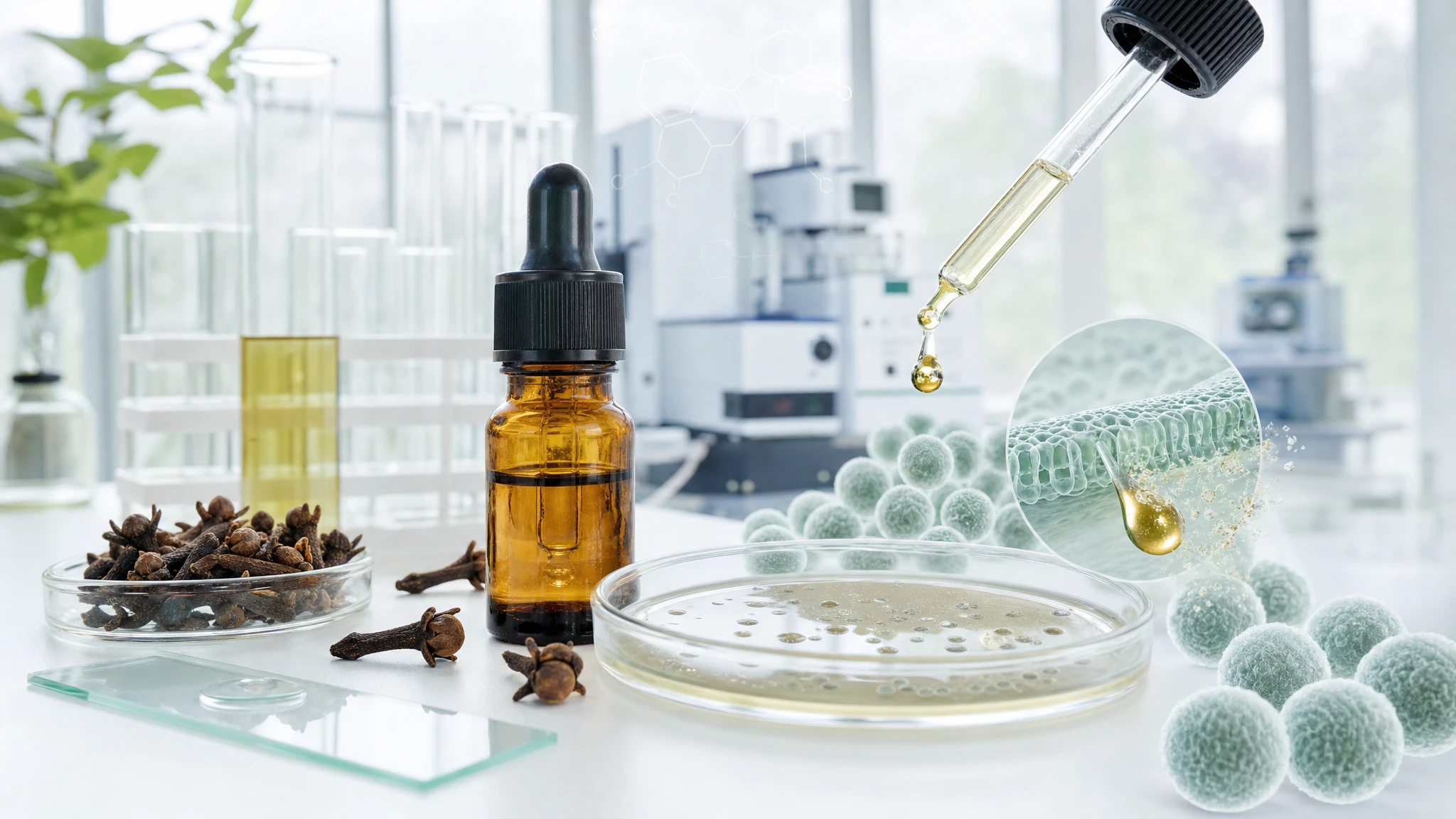
The study compared the essential oil, aqueous extract, and ethyl acetate extract of Syzygium aromaticum. The authors examined the chemical composition, antioxidant activity, effect on Staphylococcus isolates, and interaction with red blood cells. The results describe laboratory activity, not a validated treatment for humans.
The authors' summary reports that the essential oil obtained from clove buds primarily contained eugenol, an aromatic molecule from the phenolic compound family. The oil, aqueous extract, and ethyl acetate extract were analyzed using different techniques because they represent preparations with non-overlapping compositions. The aqueous extract showed the highest values of phenols and flavonoids, plant substances capable of reacting in chemical oxidation tests. The essential oil, on the other hand, showed activity in the TAC and FRAP antioxidant assays, while the aqueous extract showed activity in the DPPH and nitric oxide tests. Against sensitive and resistant clinical isolates of Staphylococcus, the oil inhibited growth at minimum concentrations ranging from 0.316 to 1.266 mg/mL. Hemolytic effects, i.e., the rupture of red blood cells, were also measured: under the observed experimental conditions, the oil caused little hemolysis. These results indicate bioactivity in a test tube and compatibility limited to a single cell model. They do not establish clinical efficacy, a safe dose in the body, or utility against human infections.
What this research analyzed
The 2025 study by Boughroud and colleagues investigated three preparations derived from cloves: essential oil, aqueous extract, and ethyl acetate extract. In practical terms, it asked whether these preparations differ in terms of their constituent substances and observable activity in a test tube. The oil was analyzed using GC-MS, or gas chromatography-mass spectrometry, which is useful for identifying volatile compounds; eugenol was found to be predominant. The extracts were evaluated using chemical antioxidant assays, tests on clinical isolates of Staphylococcus, and a hemolysis test on red blood cells. This design allows for the comparison of experimental activities, not the verification of a therapeutic effect in humans.
Research data
Assessing Syzygium Aromaticum: From Chemical Profiling to Antioxidant, Antistaphylococcal, and Biocompatibility Attributes
- The essential oil was obtained via hydrodistillation and analyzed using GC-MS, a technique that separates and identifies volatile molecules; eugenol was the main component.
- Activity against staphylococci was observed in test tubes: the minimum inhibitory and bactericidal concentrations ranged from 0.316 to 1.266 mg/mL.
- In chemical tests, the oil achieved an IC50 of 84.63 ± 1.94 µg/mL in the TAC assay and 52.88 ± 1.44 µg/mL in the FRAP assay; hemolysis was low under the examined conditions.
What results emerge from the study
The main result is that the essential oil limited the growth of staphylococci under controlled conditions. The minimum inhibitory concentration, which is the lowest concentration that prevents visible growth, and the minimum bactericidal concentration, which is the concentration associated with killing bacteria in the test, ranged between 0.316 and 1.266 mg/mL. Activity therefore varied among the isolates. In chemical assays, the oil showed TAC and FRAP activity, tests that estimate the ability to reduce or neutralize oxidizing reagents outside of cells. The aqueous extract showed DPPH activity and activity against nitric oxide. Finally, the low hemolysis observed indicates that, in the red blood cell model, the oil did not cause marked cell rupture under the experimental conditions tested.
Why this study is relevant
The research is useful because it avoids treating cloves as a uniform material. It shows that essential oil and extracts contain different fractions and can yield different results. Eugenol may contribute to the oil's biological profile, but the product is a mixture of molecules, and the study does not prove that a single component explains every effect. The greatest relevance concerns microbiological research: clinical isolates include bacteria with varying sensitivity, so the data is more informative than a test performed on a standard strain alone. However, it remains an initial step in the chain of evidence: inhibition in a test tube does not indicate that the oil reaches an infection in the body at effective and tolerable concentrations.
Study limitations and what it does NOT demonstrate
The study is experimental and conducted outside of a living organism. Therefore, it does not measure healing, symptom reduction, infection prevention, or safety in humans. The antioxidant tests describe chemical reactions and are not equivalent to demonstrating a reduction of oxidative stress in tissues. Similarly, low red blood cell hemolysis does not rule out effects on the skin, mucous membranes, liver, endothelium, or other cell types. Data on absorption, distribution, metabolism, elimination, or safe dosages are not available in the paper. Furthermore, antibacterial activity depends on the composition of the oil, which can vary based on botanical origin, harvesting, storage, and extraction. The data do not justify the independent use of the essential oil to treat infections.
Independent supporting evidence
Initial confirmation of the chemical and microbiological narrative comes from Xu and colleagues, who analyzed clove bud oil in a test tube, identifying 22 components, with eugenol accounting for 76.23%. Against Staphylococcus aureus ATCC 25923, a reference strain, the minimum inhibitory concentration was 0.625 mg/mL. The authors also observed membrane alterations and the loss of intracellular components: a process consistent with damage to the bacterial cell [1]. This confirmation is direct regarding activity and composition, but remains limited to a single strain and in vitro tests.
Li and colleagues expanded on this line of research by studying S. aureus in culture and within a food matrix. The oil damaged the bacterial cells, increased the leakage of intracellular material, and reduced by 31.23% the metabolic activity linked to the Krebs cycle, a pathway that helps the bacterium derive energy. It also reduced the expression of virulence genes and limited the bacterium in pork for seven days [2]. This is an indirect mechanistic confirmation of the antibacterial action, not a clinical demonstration.
A third study separated eugenol, unmodified oil, and acetylated derivatives. In the test tube, eugenol was the main constituent of the oil, at 70.14%, and against S. aureus, it showed a minimum inhibitory concentration of 0.58 mg/mL [3]. The result supports the possible contribution of eugenol, but it does not prove that it acts alone within the oil, nor that the data is transferable to human infections.
Conflicting evidence
The most cautious aspect concerns biocompatibility. Prashar and colleagues exposed cultured human skin cells, including fibroblasts and endothelial cells, to clove oil and its components. The oil proved to be highly cytotoxic at just 0.03% volume/volume after one hour; the authors attributed up to 73% of the effect to eugenol [4]. This does not directly contradict the low hemolysis observed by Boughroud and colleagues, because red blood cells and skin cells respond differently. However, it shows that a single cell test does not define overall safety.
A second signal of caution comes from a study in mice: after intraperitoneal administration of eugenol, doses of 400 and 600 mg/kg increased micronuclei in the bone marrow, an indicator of chromosomal damage [5]. The animal model, the route of exposure, and the doses do not correspond to the dietary use of the spice or the red blood cell test. Nevertheless, the research reinforces the idea that effects may depend on dose, formulation, and tissue. No directly conflicting evidence sufficiently relevant to anti-staphylococcal activity has been identified; this does not prove the absence of contrary results.
Comparative overview
Independent research shows convergence on in vitro activity, but also significant limitations regarding safety and transferability to humans.
| Publication | Model and main result | Relation to Boughroud study | Interpretative limitation |
|---|---|---|---|
| Xu et al., 2016 [1] | Bud oil and S. aureus ATCC 25923; eugenol 76.23%, MIC 0.625 mg/mL. | Direct confirmation of predominant eugenol and in vitro anti-staphylococcal activity. | Single strain; no clinical data. |
| Li et al., 2022 [2] | S. aureus cultures and pork; cell damage, reduced metabolism, and lower virulence. | Supports a possible antibacterial mechanism of the oil. | Food matrix, not human infection. |
| Achraf et al., 2023 [3] | Oil, eugenol, and derivatives against bacteria in vitro; eugenol MIC against S. aureus 0.58 mg/mL. | Supports the contribution of eugenol to the antibacterial profile. | Does not prove that eugenol is the sole component responsible in the oil. |
| Prashar et al., 2006 [4] | Cultured human fibroblasts and endothelial cells; oil cytotoxicity already at 0.03% v/v. | Downsizes the interpretation of low hemolysis as general safety. | Cell cultures and short exposure. |
| Ellahueñe et al., 1994 [5] | Mice treated intraperitoneally; increased micronuclei at 400 and 600 mg/kg. | Indicates that eugenol safety may depend on dose and context. | Animals, high doses, and route not comparable to culinary use. |
Editorial conclusion
The 2025 study by Boughroud and colleagues compared the essential oil, aqueous extract, and ethyl acetate extract of Syzygium aromaticum. The oil, obtained by hydrodistillation, had eugenol as its main component and limited the growth of Staphylococcus isolates in a test tube. The minimum inhibitory and bactericidal concentrations ranged between 0.316 and 1.266 mg/mL. Chemical tests also showed antioxidant activity, while the aqueous extract was richer in phenols and flavonoids. Testing on red blood cells revealed little hemolysis under the conditions tested. Independent studies support the consistency of the antibacterial effect and indicate damage to the bacterial membrane and energy processes. However, other data show cytotoxicity in human skin cells and genotoxic signals in mice at high exposure levels. This evidence does not demonstrate clinical efficacy, systemic safety, or the appropriateness of essential oil intake. Therefore, the correct interpretation remains preclinical, limited, and cautious.
References
[1] Chemical Composition, Antibacterial Properties and Mechanism of Action of Essential Oil from Clove Buds against Staphylococcus aureus
[2] Antibacterial mechanisms of clove essential oil against Staphylococcus aureus and its application in pork
[3] Antibacterial Potent of Acetylated and Non‐Acetylated Clove Bud Essential Oils and Their Main Compounds
[4] Cytotoxicity of clove (Syzygium aromaticum) oil and its major components to human skin cells
Editorial note
Artificial Intelligence was used solely as a tool to support editorial and documentary work. All content, interpretations, bibliographic citations and conclusions have been verified, reviewed and approved by the author, who assumes full scientific responsibility for them.
The manuscript was also subject to independent peer review prior to publication.
To ensure maximum transparency, the article's complete history — including the dates of submission, review, acceptance and publication, as well as information on the peer review process — is available on the dedicated Article History page.