


Cloves and metabolic syndrome: what the research says
Research on polyphenol extract from cloves indicates a potential interest for metabolism. Studies evaluate glycemia, fats, oxidative stress, and inflammation, processes that are often linked to one another. However, most of the data comes from laboratory tests or small human studies. Therefore, while there is a possible biological basis, there is no solid evidence of clinical benefit.
- Published 12/11/2026
- Updated 19/11/2026
- Reviewed 19/11/2026
- Article history


ABSTRACT : WHAT THE SCIENCE SAYS
Metabolic syndrome involves glycemia, blood fats, inflammation, and oxidative stress. It is from this complex framework that interest in cloves has emerged. A polyphenolic extract is a preparation rich in plant compounds and is not the same as the common spice. Its more defined form allows for a better study of its effects. However, the data must be interpreted with caution. The most interesting signals come from laboratory tests. Studies on humans are still few and do not prove a certain benefit. A critical reading is therefore needed, one that separates hypotheses from proven real-life effects.
The article explains why the extract is of interest to metabolism and how it can act on oxidation and inflammation. It also helps to interpret the results without giving them excessive weight. Here are the central aspects on which this in-depth analysis focuses:
- What distinguishes the extract from the common spice
- Why polyphenols are of interest for glycemia and blood fats
- How oxidative stress and inflammation are linked
- What signals emerge from the available studies
- Why the limitations of the studies require caution
Polyphenolic clove extract: what it means and why it interests research
When studying cloves and metabolic syndrome, research does not evaluate the spice in a generic way. Instead, it examines polyphenolic extracts, preparations rich in plant compounds called polyphenols. These products are more uniform and help in studying metabolism and oxidative stress (damage linked to reactive molecules). This does not yet prove a clinical effect, but it explains why research is following this path.

In the context of cloves and metabolic syndrome, research primarily focuses on the polyphenolic extract, a preparation in which the compounds of interest are concentrated and made more measurable compared to the whole spice. This approach allows for a more precise study of how certain phytonutrients—natural plant components with potential biological effects—can interact with complex biological processes.
The point is not to replace dietary use, but to distinguish what is observed in the laboratory or in small studies from daily use in the kitchen. The difference between a food matrix and a standardized preparation is methodologically important: it helps to understand which component is actually being analyzed and why the data can be compared across different studies.
This approach does not prove that the product works as an intervention, but it explains why it is chosen for studies on metabolism, dyslipidemia, and inflammatory signals. The value of the polyphenolic extract lies in its utility as a research tool: it allows for the observation of clearer mechanisms, without confusing the variability of the spice with the effect of a single fraction. This explains why the topic is useful for interpreting, with caution, the relationship between cloves and cardiometabolic health.
Before delving into the results, it is useful to keep a few key points in mind:
- The polyphenolic fraction clarifies the experimental rationale.
- Standardization reduces variability between samples and batches.
- Oxidative stress is one of the targets observed with the greatest interest.
- Systemic inflammation is assessed in conjunction with cardiometabolic risk.
- Glucose and lipid metabolism remain the central focus.
The following paragraphs first explain what distinguishes the preparation from the whole spice. Then, they show why standardization and polyphenols matter in nutrition studies.
What distinguishes a polyphenolic extract from the whole spice
A polyphenolic extract is a preparation obtained by concentrating a selected portion of compounds, whereas the whole spice maintains a broader and less uniform profile. In cloves, this distinction is useful because it allows for the study of a more defined chemical fraction, rather than attributing generic effects to the whole food.
Research thus looks at a better-characterized matrix, suitable for verifying whether certain phytonutrients have measurable biological signals. The advantage is primarily interpretive: a standardized extract makes it easier to compare different studies. It also reduces the effect of differences in origin, drying, or processing. In fact, every plant grows under different conditions, and this changes its chemical composition. A well-described extract limits this type of variability between batches. This does not imply that the extract is more useful in the daily diet. It only means that it is more suitable for rigorous experimental analysis. The limitation remains clear: data obtained on a precise preparation do not automatically transfer to the spice used in everyday meals. The real clinical value must always be verified with studies conducted on humans, on an adequate number of participants, and cannot be taken for granted just because a mechanism appears plausible in the laboratory.
Why standardization is decisive in nutritional studies
Standardization makes it easier to compare results between studies and research groups. Each plant batch can, in fact, vary in composition, ripeness, processing, and storage methods. If the compound profile changes, the biological effect being studied may also vary. This is why researchers often use carefully described preparations. This is especially true when examining glycemia, blood fats, or oxidative stress.
A safety study on Wistar rats used the standardized product for 90 days. The doses were 0.25, 0.5, and 1 g/kg. No toxicologically relevant changes emerged up to the highest level tested [1]. However, a more precise chemical composition alone does not make clinical evidence stronger. Standardization helps in interpreting data, but it does not replace well-conducted human studies. In practice, it is a useful rule for methodology, not a guarantee of efficacy. On this basis, we can better understand why these compounds and their effects on metabolism are studied.
In what sense polyphenols are of interest to metabolism
These plant compounds can act on multiple body processes simultaneously. This is particularly relevant in metabolic syndrome, where multiple interconnected alterations are present. Research is investigating potential effects on oxidative stress, inflammation, glucose control, and fat utilization. These processes, in fact, can influence one another. However, interest in these actions does not imply that a proven treatment already exists.
In a small pilot study on humans, 13 volunteers took 250 mg per day for 30 days. By the twelfth day, post-meal glycemia dropped by 13.29 mg/dL in one group. In the other group, the observed decrease was 16.67 mg/dL. In the final two measurements, fasting glycemia also decreased in the prediabetic group [2]. The potential action on multiple pathways makes these substances useful for studying metabolic processes. Research can thus indicate plausible mechanisms and a possible direction for effects. It cannot, however, promise certain health outcomes. This passage introduces the clinical framework in which the topic is receiving the most attention today.
Recent research and updates
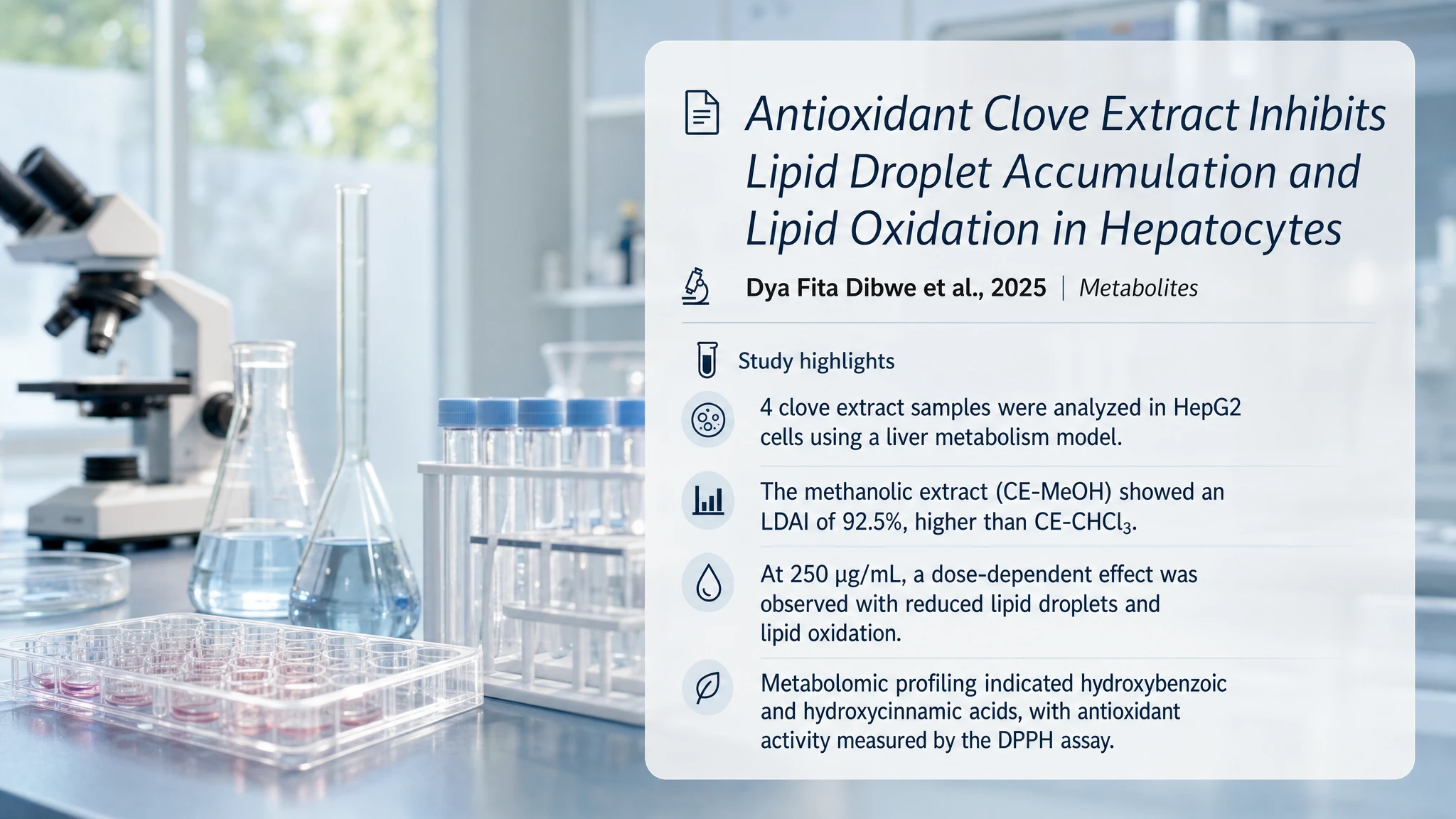
In 2025, Japanese researcher Dya Fita Dibwe and colleagues studied a clove extract in the journal Metabolites. The group used liver cells to evaluate fat accumulation and oxidation. Both processes are linked to metabolic disorders. The research used HepG2 cells as a laboratory model and compared various extracts. The results showed signs of a possible effect on fat utilization.
Antioxidant Clove Extract Inhibits Lipid Droplet Accumulation and Lipid Oxidation in Hepatocytes
- Four extract samples were analyzed in HepG2 cells, which are used as a model for liver metabolism.
- The methanolic extract CE-MeOH showed an LDAI index of 92.5%, which is higher than that of the CE-CHCl3 extract.
- At 250 µg/mL, an increase in dosage was associated with fewer lipid droplets and reduced lipid oxidation.
- The metabolomic profile (the set of detected molecules) showed many hydroxybenzoic and hydroxycinnamic acids, with antioxidant activity measured in the DPPH assay.
Metabolic syndrome and oxidative stress: why the extract is being studied in this context
The study of cloves in metabolic syndrome starts from a clear hypothesis. The extract may act on certain processes linked to heart and metabolic risk. These include oxidative stress (too many reactive molecules relative to defenses) and systemic inflammation (long-term active immune signals). Both can alter glycemia, blood fats, and the response to insulin. The polyphenolic extract, rich in active plant substances, is therefore being studied as a possible theoretical support. It is not proposed as a standalone cure.

In metabolic syndrome, it is not just one value that changes: multiple signals influence each other. For this reason, researchers are studying cloves for their potential effects on two processes. These are oxidative stress and systemic inflammation, which affect the entire body. Both can accompany dyslipidemia (altered blood fats) and hyperinsulinemia (high blood insulin). They may also appear alongside an excess of visceral fat, located around the organs.
The link between metabolism, oxidation, and inflammation explains the research interest. However, the available data require caution in their interpretation. Scientists are evaluating whether an extract rich in polyphenols can act on multiple processes. Nevertheless, a possible mechanism alone does not demonstrate a clinical effect in humans.
Research primarily studies the polyphenolic extract, which is rich in active plant substances. Compared to the whole spice, this extract is easier to analyze. Before examining the studies, it is useful to understand which aspects make this picture so complex:
- Alterations in glycemia and blood fats often appear together.
- Oxidative stress can increase cell damage.
- Persistent inflammation creates unfavorable conditions for the heart and metabolism.
- The composition of the polyphenolic extract guides the hypotheses to be verified.
The following three sections clarify why research is studying this topic. They examine the complexity of the syndrome, the link between oxidation and inflammation, and the potential role of polyphenols.
Which components make metabolic syndrome complex
Metabolic syndrome is complex because it brings together different alterations that are not limited to a single parameter. Generally, glycemia, lipid profile, visceral fat accumulation, and certain signs of metabolic dysfunction—that is, an alteration of normal energy and inflammatory regulation—are considered. These elements are not isolated: they tend to influence each other, creating a biological context that can worsen over time. Each alteration can make the appearance of the others more likely. The picture thus becomes more difficult to interpret and treat. This is why it is necessary to observe multiple factors together, rather than a single value.
For this reason, a compound is evaluated not only for its possible effect on a laboratory value, but for its theoretical ability to intervene on multiple interconnected nodes. This perspective helps to understand why a polyphenolic extract is observed as a potential support rather than an isolated intervention. The limitation, however, is evident: the complexity of the clinical picture does not guarantee that a single phytonutrient will produce measurable clinical effects. This is where the link with oxidative stress and inflammation arises, as they often reinforce each other [3,4].
Why oxidative stress and inflammation fuel each other
Oxidative stress describes an imbalance between the production of reactive species and antioxidant capacity, while systemic inflammation indicates persistent activation of immune and metabolic signals. In cardiometabolic conditions, these two processes can reinforce each other: a more oxidative environment promotes cellular damage and an inflammatory response, while inflammation contributes to maintaining the redox imbalance. The result is a self-perpetuating cycle. Cells suffer more damage, and signals remain active for longer. This makes the condition more unstable and harder to control.
This cycle is relevant because it can interfere with the regulation of glucose and lipids, contributing to the worsening of the metabolic profile. In an animal and experimental model, an aqueous extract of cloves at 1 g/kg reduced lipid peroxidation and increased catalase and glutathione peroxidase, with effects observed in contexts of acute and chronic inflammation [5]. This data supports the biological rationale, but it remains far from clinical practice: it is a controlled model, not a trial on humans.
How polyphenols are interpreted as theoretical support
Polyphenols are considered interesting because they may help modulate multiple processes simultaneously, particularly those related to oxidative stress, inflammation, and metabolic regulation. In the case of cloves, this interest stems from the idea that a concentrated fraction might offer a more measurable profile compared to the general use of the spice. However, theoretical support should not be interpreted as proof of clinical efficacy.
Literature on botanical substances always requires caution when transitioning from mechanisms observed in the laboratory to real-life relevance. A safety analysis of a standardized polyphenolic extract in Wistar rats showed an acute dose of 5 g/kg for 14 days and repeated doses of 0.25, 0.5, and 1 g/kg for 90 days, with a maximum dose without adverse effects equal to 1000 mg/kg per day [6].
Studies on glycemia, lipids, and inflammation: what really emerges from the research
Studies on cloves in metabolic syndrome evaluate three aspects: glycemia, lipids, and inflammation. The data show useful signals but still indicate hypotheses rather than certain clinical evidence. It is therefore necessary to understand what the studies show and what limitations affect the results.

In research on cloves and metabolic syndrome, studies measure glycemia, blood fats, and widespread inflammation. These values help to understand how metabolism changes as a whole. The polyphenolic extract contains plant substances studied for their effects on glucose, lipids, and oxidative stress (damage caused by unstable molecules). Overall, the data indicate possible effects on glycemia, fats, and inflammation.
Overall, the results indicate a possible avenue for research, but do not prove a certain benefit. Some studies on humans, cells, and animals show useful metabolic responses. The signals primarily concern glycemia and antioxidant defenses. However, different products and small groups of people do not allow the results to be generalized to everyone.
However, caution is needed, as there are still few studies and they are very diverse. The following sections explain the results, the weight of the number of studies, and the limitations of the evidence:
- The most studied outcomes concern glucose and insulin resistance (reduced response to insulin).
- The number of available studies remains very low.
- Initial data do not yet demonstrate a clinical effect.
- Lipid and inflammation values complete the picture.
The data do not show a single clear effect, but rather various signals across different metabolic values. It is therefore advisable to examine them one at a time and assess how solid the evidence is.
What outcomes are observed in available studies
Studies evaluate glycemia, blood fats, redox balance (the ratio between oxidizing substances and defenses), and inflammation. This choice follows the logic of metabolic syndrome, which includes multiple interconnected alterations. No single value can describe the entire picture. Experiments therefore assess whether the polyphenolic extract can act on these aspects, without proving a certain benefit. For this reason, each outcome shows only a part of the metabolic response observed in the studies. Comparing multiple values helps to interpret different but linked changes together.
A study on C2C12 muscle cells detected increased glucose consumption. Another study used mouse muscle cells and live mice. It detected less insulin resistance caused by free fatty acids [4][7]. Data on glycemia and glucose use remain exploratory. Those on fats and inflammation are still preliminary. In fact, tests on cells and animals do not predict effects in humans with certainty.
Why the number of studies affects the robustness of the conclusions
Few studies, which are either small or highly heterogeneous, make it difficult to draw robust conclusions. This is especially true for plant-based products, which can vary in dosage, form, and duration of use. The individuals involved may also have different characteristics. For cloves, the limited human data do not turn an initial signal into a practical certainty.
An open-label pilot study (an initial study without a control group) involved 13 healthy and prediabetic volunteers. Participants took 250 mg per day for 30 days. The research found decreases in fasting and post-meal glycemia. Another human trial used 250 mg per day for 30 days. Catalase increased by an average of 33% and SOD by 66%. GPx also increased by 56% and GSH by 167%. Oxidative damage to fats was reduced by an average of 81% [3][8]. The small group size and the absence of a control group do not rule out short-term or individual effects.
How to distinguish between preliminary signals and clinical confirmation
An initial signal indicates that a hypothesis merits further testing, but it does not demonstrate a certain benefit. Clinical evidence requires more robust studies, with large groups and a comparison with a control group. The control group helps to distinguish the effect being studied from changes that would occur regardless. Repeated measurements and outcomes that are significant for actual health are also needed. In the case of cloves, this distinction prevents treating initial data as definitive conclusions.
A laboratory test on the polyphenol extract showed an antioxidant action and a restraint on protein glycation. Glycation is the binding between sugars and proteins, which over time can promote metabolic damage [9]. This data helps explain a possible mechanism, but it does not prove clinical effects on glycemia, lipids, or inflammation. Therefore, a mechanism observed in the laboratory remains a possible explanation, not a therapeutic confirmation. The transition from laboratory tests to human use therefore remains to be verified.
Cloves in dietary practice: how to interpret the topic without overestimating it
In everyday life, cloves should be approached with caution. The spice is not equivalent to the extracts studied for metabolic syndrome. This syndrome brings together factors that increase the risk of diabetes and heart disease. The useful question is not whether they work in an absolute sense. It is necessary to understand what role they can play in a varied diet, without attributing excessive effects to them.

In the kitchen, cloves are used in small, highly variable amounts. Research, however, often evaluates standardized extracts (products with defined quantities of substances) or concentrated preparations. It is therefore necessary to separate culinary use from the studied dose. One cannot confuse flavor with a biological effect.
Cloves can therefore find a place in the diet. However, experimental data require a distinct interpretation. The spice remains part of the dietary pattern, not the decisive lever for regulating metabolism. This approach avoids excessive conclusions. It also helps to understand the possible uses and limitations of nutritional support.
This distinction does not diminish the interest in the topic. However, it avoids presenting an aroma as a complete nutritional intervention. From this difference arise some practical criteria, useful for better evaluating the results:
- Culinary use is not equivalent to the doses used in studies.
- Concentrated extracts do not always represent the whole spice.
- The type of meal significantly changes the nutritional value.
- A possible effect does not replace a healthy and varied diet.
- The safest interpretation remains cautious and proportionate to the data.
To fully understand the topic, it is necessary to separate daily use from the preparations used in research. This distinction also shows why the entire diet matters more than a single ingredient.
How to distinguish between culinary use and research-based use
In the kitchen, cloves are added to meals in small doses. Research often evaluates more concentrated extracts, with defined and easily measurable quantities. This difference changes the actual dose, the frequency of use, and the value of the results. Therefore, a culinary spice is not equivalent to a standardized product.
If an extract shows an effect, it is not certain that the same will happen in a daily diet. In the same study, postprandial glycemia (blood sugar after a meal) dropped as early as day 12. The decrease was 13.29 mg/dL in one group and 16.67 mg/dL in the other. In one group, preprandial glycemia (before a meal) decreased by 13.00 mg/dL by day 24. By day 30, the drop was 13.67 mg/dL in the same group. However, this data concerns a defined extract and few participants. It does not concern the spice used as a seasoning.
Why the overall diet remains the main factor
Even when an ingredient shows an interesting rationale, its real impact depends on the overall dietary framework. In metabolic syndrome, total energy, the quality of fats, fiber intake, and meal distribution matter more than any single flavoring agent.
For this reason, cloves can be viewed as a potentially useful detail, but not as the core of a nutritional strategy. Metabolism responds primarily to the dietary pattern, not to a single isolated phytonutrient. The practical limitation is clear: without changes to the dietary context, the potential benefits of a spice remain marginal and difficult to attribute with certainty.
How to avoid generalizing beyond the available data
Overgeneralization is a frequent error when a scientific topic becomes popular. A result observed under specific conditions, with a certain extract, and in a limited population cannot be automatically extended to everyone. This also applies to cloves in metabolic syndrome, where the biological rationale may be interesting but not universal.
To avoid overinterpreting data, it is necessary to distinguish between associations, plausibility, and robust confirmation. In the study on healthy adults, the improvement in the antioxidant profile—that is, the ability to counteract oxidative stress processes—after 30 days concerns a specific extract and does not imply that any clove-based product will produce the same effect [10]. Furthermore, individual differences, dietary context, and the presence of any ongoing therapies must be considered. The most accurate interpretation is a cautious one: the topic deserves attention, but it does not authorize conclusions stronger than those supported by the available evidence. It is this methodological caution that makes the content reliable. The final summary concerns precisely the boundary between nutritional support and therapy.
Cloves, metabolic syndrome, and nutritional support: limitations, utility, and critical interpretation
The relationship between cloves and metabolic syndrome requires caution. The data help in asking the right questions, but they do not prove a definitive therapeutic effect.

To evaluate the role of cloves in metabolic syndrome, we must understand whether the data holds true in real life. Nutritional support (dietary aid that complements a diet) can be part of a broader plan. It may act on sugar utilization, blood fats, and oxidative stress (damage caused by unstable molecules). However, it is not equivalent to a cure. Therefore, it is necessary to distinguish interest in phytonutrients (active plant substances) from a proven effect.
The relationship between cloves and metabolic syndrome therefore remains a research hypothesis, not definitive proof. Studies indicate possible effects on metabolism and oxidative stress. But the quality of the evidence, the short duration of the research, and the distance from real-life application require caution. A critical reading helps to understand which data are solid and which are still preliminary. Further confirmation is needed before speaking of real clinical value.
To interpret the data correctly, some clear criteria are needed:
- Evaluate the extent to which results depend on studies on cells or animals.
- Distinguish early signals from benefits measurable over time.
- Separate normal dietary use from therapeutic use.
- Consider the differences between the products and doses studied.
To understand the topic, it is necessary to separate scientific interest from use in clinical practice. The following points show the limitations of the data and the still uncertain role of nutritional support.
What limitations prevent us from claiming a certain effect
The polyphenolic extract (an extract rich in active plant substances) may influence fat utilization and oxidative stress. However, the available evidence does not yet allow for a stable clinical conclusion. Much of the data comes from experimental studies, short-term tests, or different products. We therefore do not know if the effects are beneficial for those with visceral fat, dyslipidemia (altered blood fats), or excess insulin. The data is interesting, but it does not offer certainty. These limitations concern both the type of evidence and its practical application. Differences between products also make it more difficult to compare the available results.
A meta-analysis that combined several studies on polyphenols and metabolic syndrome described a picture that is still general and inconclusive [11]. The observed effects are not consistent enough to support a precise recommendation. Research is often short-term, includes very diverse groups, and does not always measure outcomes useful for health. The analysis therefore shows how difficult it is to translate this data into real life. Speaking of certain efficacy would go beyond the available evidence [11].
Why nutritional support is not the same as therapy
Dietary polyphenols (active substances found in plants) can complement a varied diet, but they do not replace medical treatment. Metabolic syndrome involves weight, blood fats, blood pressure, glucose utilization, and risks to the heart and metabolism. Therefore, a single ingredient cannot act as a standalone solution. This spice can be part of a dietary plan, but it is not an independent therapy. For this reason, the dietary context remains essential for correctly interpreting any observed associations.
A study of 676 Danish residents linked a higher intake of polyphenols to two favorable findings. It detected a lower probability of high systolic blood pressure (the upper value) and low HDL-c ("good" cholesterol) [12]. The result shows the importance of the diet as a whole, but it does not prove an effect of the spice alone. Furthermore, an observed link does not demonstrate causation. Those who consume more polyphenols may also follow other healthy habits. Nutritional support therefore complements the clinical pathway, without replacing it [12].
What questions remain open in research
The phytonutrients in cloves (the plant's active substances) raise questions regarding dosage, duration, and method of use. Knowing that a substance works in a test is not enough. It is necessary to understand when it works, for whom, for how long, and with what benefit. Furthermore, the link between antioxidant action and effects on inflammation, blood fats, and sugar metabolism must be clarified. Longer and better-controlled studies are needed. Every answer requires clear comparisons between doses, timing of intake, and the groups studied. Only in this way can an experimental signal be distinguished from a truly measurable benefit.
Future research will need to determine whether the effects depend on the product, individual compounds, or test conditions. It will also need to measure outcomes relevant to real life, not just laboratory values. This distinction is also necessary to avoid drawing conclusions that are stronger than the collected data. Initial results therefore help to formulate new hypotheses, but do not yet define clinical use.
Summary of scientific evidence
The table summarizes the main sources already present in the bibliography. It links potential biological mechanisms to initial results and study limitations.
| Publication year | Area studied | What the studies indicate |
|---|---|---|
| 2012 | Oxidative stress and inflammation | in experimental models, certain measures related to oxidation and inflammation changed [5] |
| 2014 | Muscle energy metabolism | in muscle cells, signs of increased glucose utilization emerged [4] |
| 2015 | Antioxidant status in humans | some antioxidant markers (cellular defense values) increased, while fat oxidation decreased [8] |
| 2016 | Preclinical safety of the extract | results vary, but in the models tested, safety appears reassuring overall [6] |
| 2019 | Pre- and post-prandial glycemia | studies indicate a possible decrease in glycemia with a standardized polyphenolic extract [3] |
| 2021 | Review on polyphenols in metabolic syndrome | data agree on a possible role for polyphenols, but clinical utility remains limited [11] |
| 2025 | Integrated clinical approach | evidence indicates that management requires multiple skills, not just a single intervention [2] |
| 2026 | Cardiometabolic profile | studies indicate that metabolic risk arises from multiple interconnected factors [1] |
Editorial interpretation of the evidence
Overall, the studies I have reviewed here show a consistent but still preliminary picture. Those most relevant to the topic indicate potential effects on glucose, fats, oxidation, and inflammatory signals. These effects emerge primarily from laboratory tests conducted under controlled conditions. Studies on humans are few, small, and often lack a control group. Consequently, they only offer initial indications. The potential effect has a biological basis, but the evidence remains weak.
The main limitations I have identified are the small number of subjects, the different extracts used, and the short duration. Furthermore, many studies use cells or animals instead of humans. They often evaluate surrogate outcomes (indirect values) rather than long-term health effects. Therefore, I cannot say whether other studies would achieve the same result. It is also difficult to separate the effect of the test from what might happen in daily life.
Conclusions and editorial summary
Clove polyphenol extract is of interest in research on nutrition, metabolism, and metabolic syndrome. From the studies I have reviewed, a potential role emerges in processes related to glucose, fats, oxidative stress, and inflammation. However, most of the evidence comes from laboratory tests and early-stage studies. This limitation does not diminish the value of the topic, but it helps in interpreting the results correctly.
Future studies will need to verify these effects in humans, using well-described extracts and appropriate methods. For now, I consider the extract a possible nutritional support, but not a therapy. It may help in studying a complex metabolic profile. However, the data do not yet prove a clinical effect.
Final critical note
References
[1] 2026 AHA/ACC/ADA/ASN Guideline for the Prevention, Detection, Evaluation, and Management of Cardiovascular-Kidney-Metabolic Syndrome: A Report of the American College of Cardiology/American Heart Association Joint Committee on Clinical Practice Guidelines
[2] ASN Kidney Health Guidance on the Cardiovascular-Kidney-Metabolic Syndrome
[3] Water-soluble polyphenol-rich clove extract lowers pre- and post-prandial blood glucose levels in healthy and prediabetic volunteers: an open label pilot study
[5] Aqueous extract of dried flower buds of Syzygium aromaticum inhibits inflammation and oxidative stress
[6] Safety assessment of a standardized polyphenolic extract of clove buds: Subchronic toxicity and mutagenicity studies
[7] Clove and Its Active Compound Attenuate Free Fatty Acid-Mediated Insulin Resistance in Skeletal Muscle Cells and in Mice
[8] Beyond the flavour: a de-flavoured polyphenol rich extract of clove buds (Syzygium aromaticum L) as a novel dietary antioxidant ingredient
[10] In vitro inhibition activity of polyphenol-rich extracts from Syzygium aromaticum (L.) Merr. & Perry (Clove) buds against carbohydrate hydrolyzing enzymes linked to type 2 diabetes and Fe2+-induced lipid peroxidation in rat pancreas
[11] Natural Polyphenols in Metabolic Syndrome: Protective Mechanisms and Clinical Applications
Editorial note
Artificial Intelligence was used solely as a tool to support editorial and documentary work. All content, interpretations, bibliographic citations and conclusions have been verified, reviewed and approved by the author, who assumes full scientific responsibility for them.
The manuscript was also subject to independent peer review prior to publication.
To ensure maximum transparency, the article's complete history — including the dates of submission, review, acceptance and publication, as well as information on the peer review process — is available on the dedicated Article History page.