


Cloves, extract, and essential oil: comparing differences, use, and concentration
Research shows that cloves do not form a single type of product. Whole spice, standardized extract, and essential oil have different dosages, uses, and biological effects. Sources help, above all, to avoid incorrect comparisons between culinary products and concentrated forms. The key point is simple: the format changes exposure and guides the reading of labels, studies, and uses.
- Published 22/10/2026
- Updated 23/10/2026
- Reviewed 23/10/2026
- Article history
ABSTRACT : WHAT THE SCIENCE SAYS
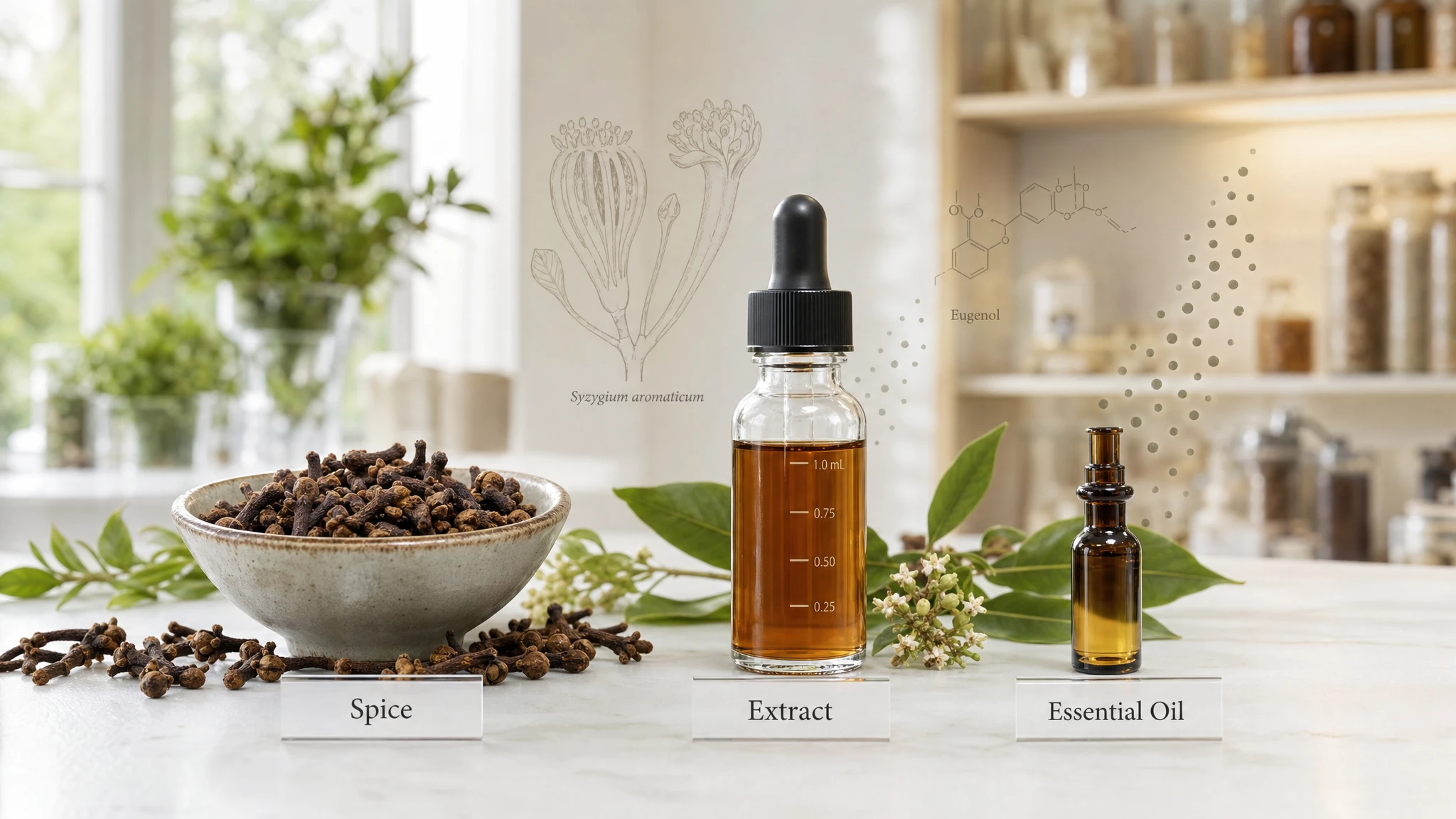
Cloves are a spice, but they are also available as a standardized extract or essential oil. The standardized extract has a more stable content, while the essential oil contains many aromatic molecules. These forms are not the same: the dosage of the various compounds changes in each one. Their use and how to interpret sources also differ. The whole spice is used in cooking, while extracts and oils are much more concentrated products. Understanding these differences helps avoid mistakes regarding dosages, exposure levels, and methods of use.
We will look at the differences between the formats, how to read labels, and what standardization is for. This process helps keep the product's content more stable from one batch to another. In summary, these are the key points:
- Spice, extract, and essential oil are different forms and cannot be considered equivalent.
- Concentration changes the dosage, the level of exposure, and the practical use of the product.
- The label helps distinguish common ingredients from products with a more concentrated content.
- The amount of eugenol, an aromatic compound, varies depending on the chosen format.
- Dietary use requires careful reading of sources and the specific format studied.
Spice, extract, and essential oil: three non-equivalent forms
In the case of clove extract and essential oil, the form changes the value and type of use. The whole spice, the standardized extract (made more uniform in content), and the essential oil have different doses, concentrations, and uses. Even though they come from the same plant, they must therefore be evaluated as three distinct products.
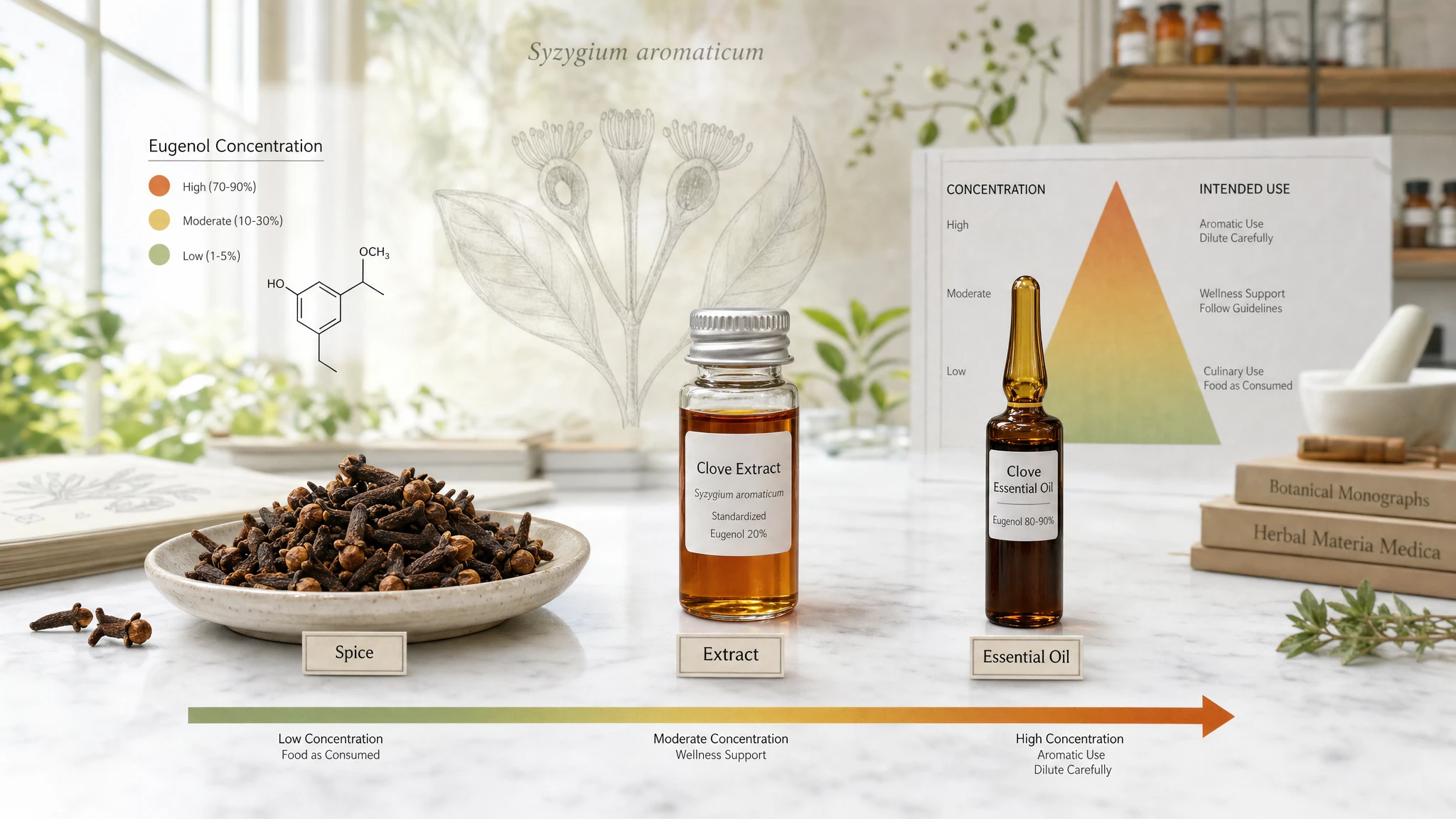
To understand clove extract and essential oil, one must start with the form, not just the plant. Whole spice, extract, and essential oil have the same origin, but differ in dose and type of use. In the kitchen, the spice remains a food. The other forms are more concentrated and offer very different amounts of active compounds.
This distinction avoids incorrect comparisons between forms with different bioavailability (the portion that reaches the body and can act) and exposure. It is a useful step before discussing dose, eugenol content, and food use. The meaning of these data, in fact, changes based on the chosen form.
It is therefore not correct to place a food, a plant extract, and a concentrated aromatic product on the same level. To navigate this, it is useful to distinguish the three levels immediately:
- The whole spice is mainly used as an ingredient in cooking.
- The standardized extract concentrates a selected part of the plant.
- The essential oil requires even more careful evaluation.
The three formats have different concentration levels and distinct methods of use. The following paragraphs explain what each form indicates and why it is incorrect to treat them as equivalent products.
Whole cloves: what the spice really represents in the kitchen
The whole spice is the form most closely associated with the culinary use of cloves. In this case, the active compounds remain within the phytocomplex, which is the natural set of substances found in the plant. Exposure depends on normal dietary consumption rather than a forced concentration. The intact plant matrix modulates the release and absorption of the active ingredients during digestion.
Therefore, this is not a technical concentrate, but an aromatic ingredient that contributes to the profile of a dish without solely defining its overall effect. This helps to understand why a recipe using cloves is not equivalent to a concentrated product: the amount ingested is much lower and less uniform compared to an extract or an essential oil. Available data indicate that the eugenol content in the whole spice can vary significantly based on origin and seasonality [1]. The limitation is simple: the whole spice does not allow for the automatic deduction of effects observed in standardized preparations or high-density aromatic products.
Clove extract: what changes compared to the spice
Clove extract is not the same as the whole spice, because part of the plant material is selected and concentrated. This means that the product's profile changes in terms of intensity, uniformity, and the relative proportion of the compounds present. In practice, the extract is closer to a technical preparation than a traditional cooking ingredient [2]. The extraction process can isolate specific fractions, increasing the yield of some molecules over others.
Standardization can make the content more homogeneous across different batches, but it does not automatically make its dietary use equivalent. This is why an extract must be interpreted with caution when comparing studies, labels, or formulations. The central point is not just "what it contains," but also "to what extent" and "in what context it is taken." Some research shows that an extract standardized to 30% eugenol offers a different absorption profile than ground spice [3]. This logic leads to the essential oil, which is even further removed from the original food [4].
Clove essential oil: why it is not the same as the food
Essential oil is the most concentrated format among those considered and should not be viewed as simply a more intense version of the spice. Here, the selection of aromatic molecules is much more pronounced, with a strong emphasis on the concentration of eugenol, which is one of the main characteristic compounds of cloves. In a high-quality essential oil, eugenol can account for over 80% of the total composition, a value unattainable with the whole spice.
For this reason, the product must be interpreted using a logic different from the culinary one, especially when it is included in a technical formulation or used for non-food purposes [5]. The critical point is the relationship between quantity and exposure: an essential oil does not represent a food, and therefore does not allow for direct comparisons with the spice or a standardized extract. The high concentration requires a careful assessment of the dose, because even small variations in volume can significantly change the intake of active compounds. The limitation is that the richness of molecules does not automatically translate into simpler or safer use.
Recent research and updates
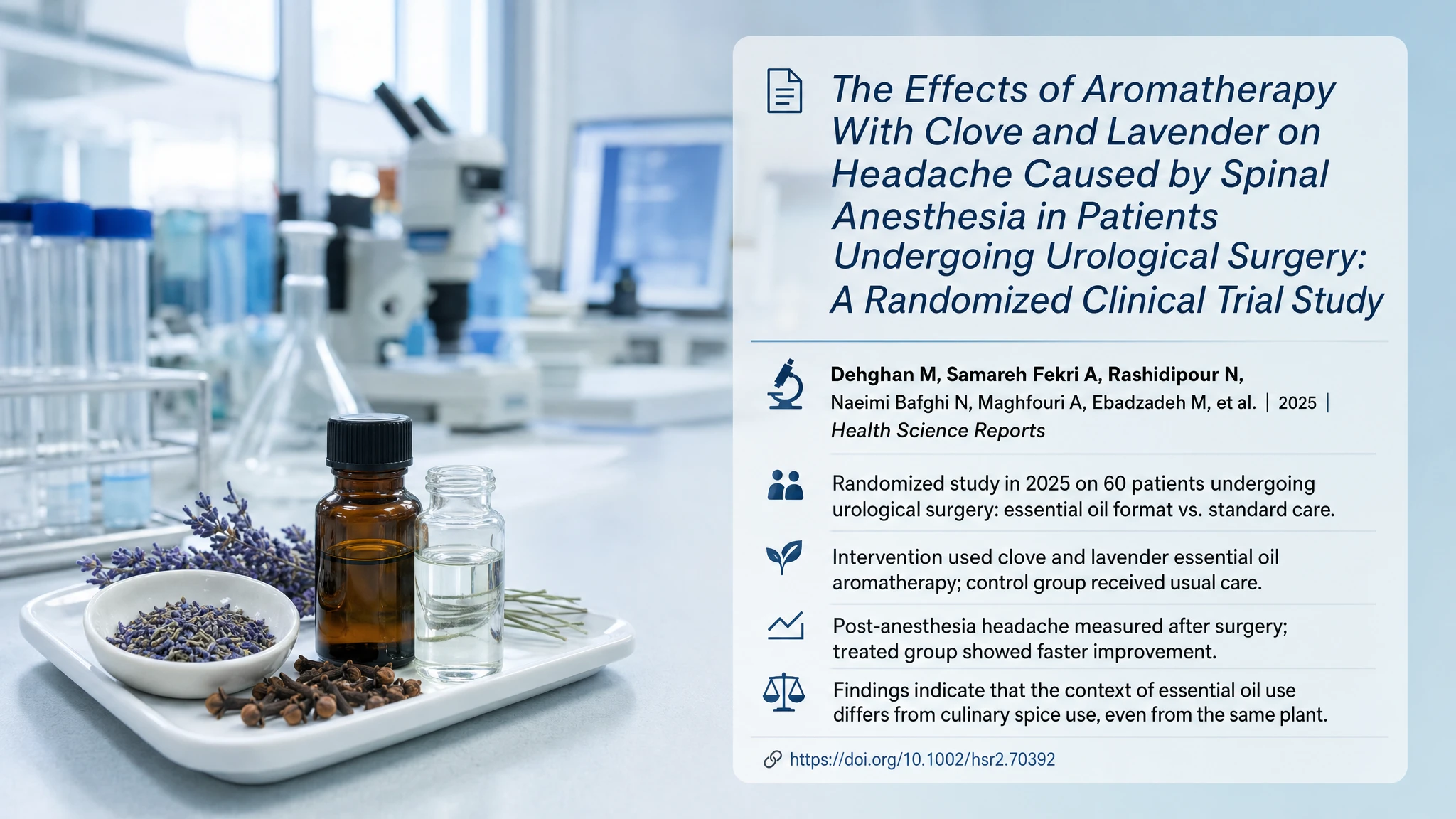
In 2025, Dehghan and colleagues published a study in the journal Health Science Reports. The authors studied aromatherapy with clove and lavender essential oils. The treatment followed a urological procedure performed under spinal anesthesia. Essential oil is a highly concentrated part of the plant and is not equivalent to the spice. The research verified whether the treatment could act on a common symptom after surgery. The data confirm that the format changes exposure, even when the source plant remains the same.
The Effects of Aromatherapy With Clove and Lavender on Headache Caused by Spinal Anesthesia in Patients Undergoing Urological Surgery: A Randomized Clinical Trial Study
- The 2025 randomized study involved 60 patients undergoing urological surgery and included a control group.
- The treatment used clove and lavender essential oils. The control group received standard care instead.
- After the procedure, the researchers measured headaches. The treated group improved faster compared to the control group.
- The result suggests that the essential oil has a different use than the food spice, despite being derived from the same plant.
Concentration, dose, and exposure: why the format changes the meaning
Even with the same plant, the format changes the exposure, meaning how much of the substance actually reaches the body. Therefore, a spice, a standardized extract, and an essential oil do not expose the body to the same dose. To understand cloves, extracts, and essential oils, one must evaluate concentration, the amount taken, and the type of use. It is not enough to know that the product contains eugenol, the typical aromatic molecule. This is why it is important to read labels carefully.
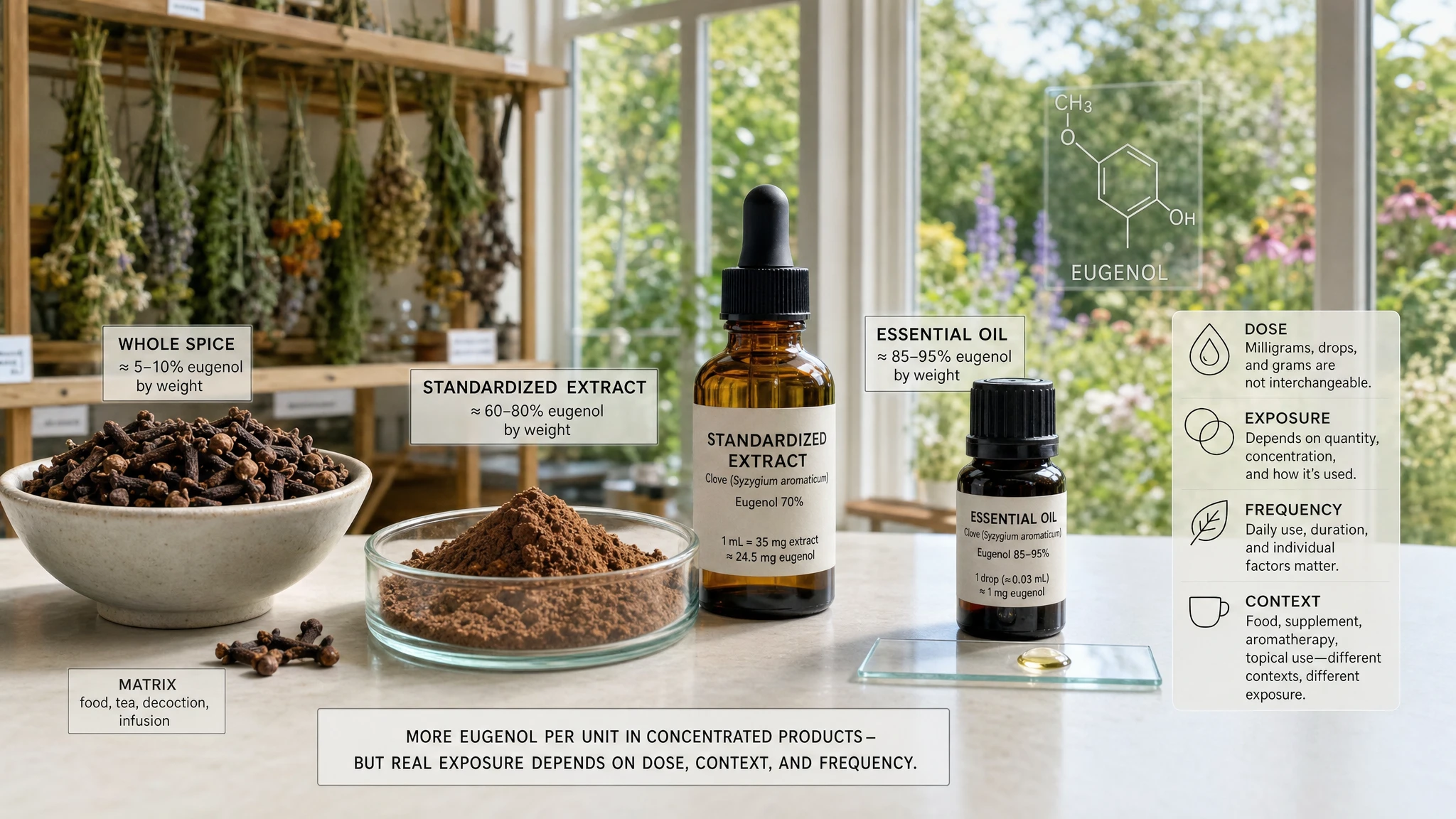
The concentration indicates how much of a compound a product contains, but it does not, by itself, measure the body's actual exposure. A concentrate may provide more active substance per gram or milliliter. However, it is not equivalent to the spice used in dishes.
These differences matter: an experimental result does not apply directly to cooking or supplements.
In plant concentrates, the relationship between dose and effect also changes with quantity, frequency, and format. To orient yourself, it is best to evaluate the format before the individual ingredient:
- The whole spice retains a broader nutritional profile.
- The standardized extract offers a more stable composition between batches.
- The essential oil contains a higher proportion of the active compound.
- Exposure also changes based on the type of daily use.
To understand a product, you must start with the format and then evaluate the active compound. In the following three cases, the concentration, uniformity, and quantity that reaches the body change.
Why higher concentration does not equal the same exposure
Higher concentration does not automatically mean greater practical utility, because the effect depends on the actual dose-exposure. A product can be very rich in an active substance and, at the same time, be taken in different quantities compared to the spice or another concentrate. For this reason, the same plant should not be interpreted as a single biological unit: the ingested volume, frequency, and dietary context change. Concentration, on its own, therefore does not describe the total amount taken during the period considered. A concentrated supplement is taken in measured doses, while the spice is distributed throughout meals. The matrix also matters: a solid food releases compounds differently than a capsule. Therefore, two products with the same percentage of eugenol can result in very different exposures.
In the water-soluble polyphenolic extract of cloves, 250 mg once a day for 30 days in 13 healthy volunteers resulted in a reduction of post-meal glycemia, which was unlikely to be due to chance, as early as day 12 [3]. The data shows that the concentrated format can have a precise clinical reading, but it does not authorize direct comparisons with the whole spice or the essential oil. The main limitation is precisely the extrapolation: the result describes a specific exposure, not a universal effect of the clove [3].
What a standardized extract means in cloves
A standardized extract is a product prepared to contain a more consistent amount of one or more characteristic components. This makes the batch more uniform and facilitates comparisons between products or studies. Standardization, however, describes the quality of the formulation, not its equivalence to the whole spice or its daily dietary use. In practice, it helps to know what is inside, but it does not by itself indicate how that content will behave within a diet. The whole spice varies by origin, season, and storage. The extract reduces this variability and sets a known concentration, for example, of total polyphenols. This allows a study to be repeated with the same dose. However, the body does not receive the fiber, sugars, and other compounds present in the raw material.
In the case of cloves, standardization is useful primarily when one wants to read repeatable and comparable doses. A stable extract allows for reduced variability between batches, but it remains a concentrate, so the meaning of the exposure changes compared to the raw material. The caution lies here: a compositional data point is not equivalent to a biological dose that is identical in all contexts.
How to read eugenol content without confusing formats
The eugenol content must be interpreted in relation to the format, as the relative weight of the same molecule changes depending on whether it is in the form of a spice, extract, or essential oil. In food, the compound remains immersed in the overall nutritional profile; in a nutraceutical formulation or a concentrate, its proportion becomes more central relative to the total volume.
This is why the number on the label is not enough: it is necessary to understand how much product is being consumed and in what context. The limitation is that a high percentage does not indicate how much, or how, the compound will actually be exposed to the body.
Dietary use and practical label reading
When it comes to cloves, extracts, and essential oils, the label clarifies the type of product. Reading the name of the plant is not enough. It is necessary to verify the intended use, the standardization (controlled composition), and the indicated concentration. These data help to avoid confusing a culinary spice with more concentrated products.
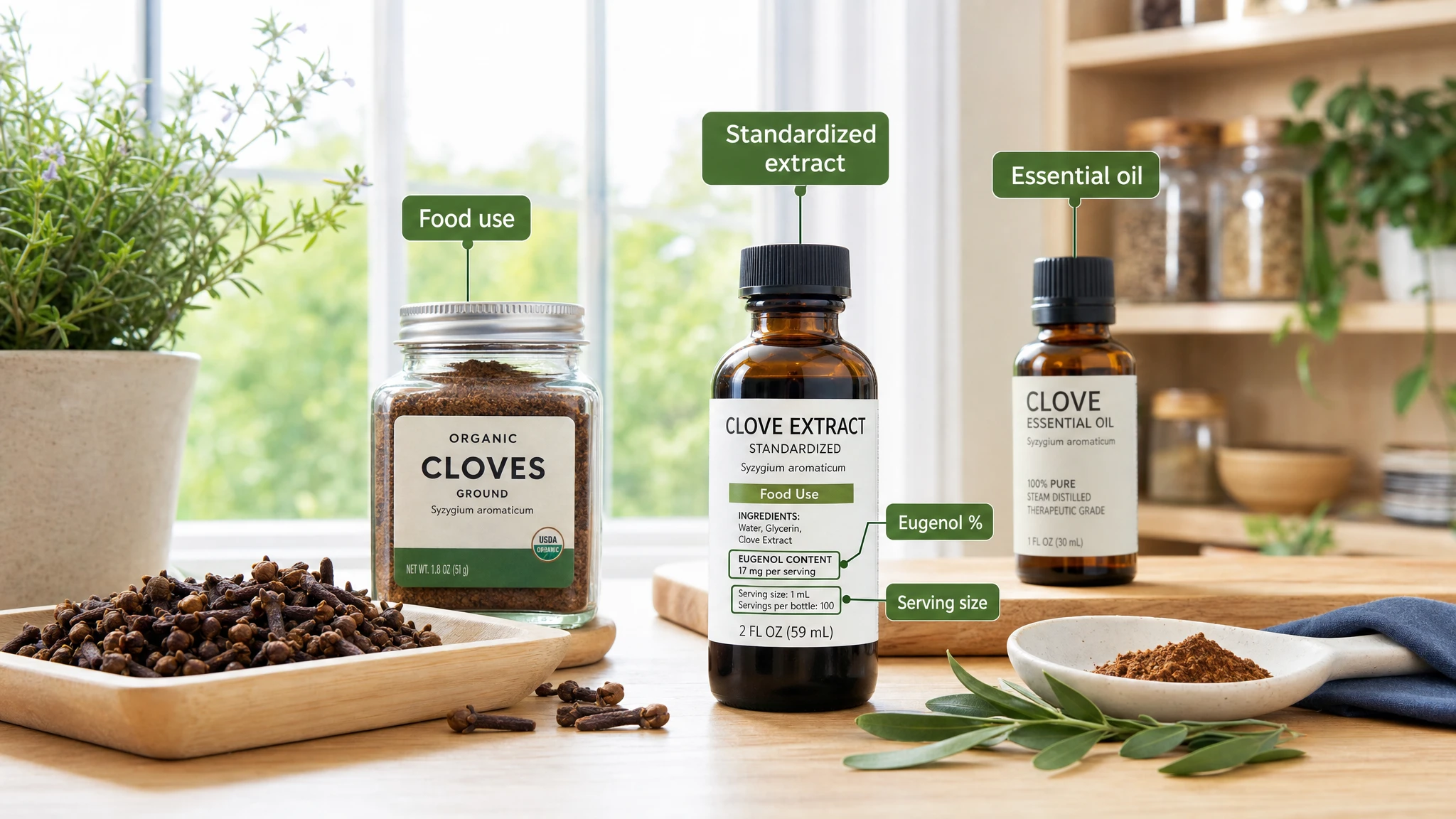
Before purchasing, it is necessary to understand whether the product is suitable for food or technical use. The label, format, and composition data help to evaluate what you are buying. This way, you will not confuse a spice with a concentrated plant product.
Reading the label carefully prevents you from considering a spice and a concentrated product to be the same. If the food use is clear, the product is part of the recipe. If the words standardized extract or essential oil appear, the product has different characteristics instead. Consequently, the caution required during use also changes.
For cloves, the name alone does not indicate the intended use or concentration. Before making a choice, it is useful to check some practical data:
- The format indicates whether the product is a whole spice.
- Standardization signals an extract with a controlled composition.
- The presence of essential oil requires more caution.
- The eugenol concentration helps to compare products.
Labels do not just state the product name; they help you understand its intended use. The following steps explain how to distinguish an ingredient, an extract, and a concentrate without confusing their functions.
What to look for on the label to distinguish between a spice and an extract
To distinguish between a spice and an extract, the label should first be read to identify the format and any standardization, which refers to the controlled composition of the product. If the product is described as a culinary ingredient, it remains within the realm of food use. If, however, it lists a controlled composition, it enters a more concentrated domain that is not interchangeable with the whole spice. Standardization indicates that the manufacturer has measured and guaranteed the presence of one or more specific compounds. This information is missing in common spices, where the composition can vary based on the harvest and origin.
This distinction is also useful for understanding whether the product is intended for flavoring or for providing a more defined amount of active components. The point is not just botanical, but functional: a clear label prevents attributing the role of a concentrate to a spice, or vice versa. General dietary quality guidelines remind us that reading the product within its context of use is essential [1]. The limitation of this approach is that the label, by itself, does not reveal everything about the actual bioavailability of the compounds.
When cloves remain a food ingredient
Cloves remain a food ingredient when used as a spice in cooking, that is, to provide aroma, fragrance, and sensory support to a dish. In this case, the product should not be viewed as a nutraceutical formulation, but as part of a recipe and normal home consumption. The amount is dictated by taste and culinary tradition, not by a specific intake goal. This usage does not require standardization because the natural variability of the spice is accepted and expected.
Literature describes cloves as a precious spice traditionally used in culinary settings, useful primarily for its aromatic profile [6]. This helps to understand that the whole spice has a different function than a concentrated extract. The practical limitation is that the name alone is not enough to estimate the quantity of compounds ingested: portion size, frequency, and the context of the meal matter, not just the botanical origin.
When a clove-based product is a concentrate
A clove-based product becomes a concentrate when the raw material is processed to achieve a higher presence of specific compounds compared to the spice itself. This group includes extracts and, even more significantly, essential oil—the plant's volatile aromatic fraction—which should not be viewed as a simple culinary variant. The extract is obtained using solvents and then reduced to a powder or liquid. The essential oil, on the other hand, is the product of steam distillation of the buds.
Reviews on the subject describe clove essential oil specifically as a preparation rich in volatile components and chemically distinct from the spice, with practical implications for use and caution [7]. In other words, the concentration changes the meaning of the product even before it is used. The limitation is that, without a precise declaration of the formulation, the consumer may underestimate the density of eugenol and improperly interpret a plant concentrate.
Summary of scientific evidence
This summary considers only the sources received and the most useful studies. The goal is to distinguish between the spice, the extract, and the essential oil.
| Publication year | Area of study | What the studies indicate |
|---|---|---|
| 2014 | Traditional spice | sources describe historical and dietary uses of the spice, distinct from those of concentrated forms [6] |
| 2019 | Polyphenolic extract and glycemia | evidence indicates that a concentrated extract can produce measurable effects on glycemia in healthy volunteers [3] |
| 2020 | Spice, extracts, and essential oil | results vary, but overall they consistently distinguish between the various forms of the product [8] |
| 2024 | Essential oil and chemical composition | results vary, but they consistently describe the essential oil as a distinct and concentrated form [4] |
| 2024 | Essential oil and practical applications | evidence indicates that the essential oil is studied primarily as a technical formula, not as an equivalent to the spice [5] |
| 2024 | General review on essential oil | studies suggest that the concentrated form should be interpreted differently than its use in cooking [7] |
Editorial review of the evidence
In the studies I examined for this article, I found a clear distinction between the whole spice, the extract, and the essential oil. These forms are not equivalent: their composition, the dosage of active compounds, and the type of use all change. Reading carefully which product was used in each study helped me avoid incorrect comparisons. Cooking, standardized preparations, and concentrated formulas belong to different contexts, and the literature confirms this. The picture I have drawn from this is consistent: the form modifies exposure and, consequently, the interpretation of the results as well.
The limitations I encountered are primarily the many narrative reviews, the scarcity of large clinical trials, and the differences between the tested products. Dosage, matrix (the base of the preparation), and the purpose of the research often vary. For this reason, direct comparison between the various forms still seems weak to me. Furthermore, data on essential oils cannot be automatically transferred to the spice we use in the kitchen. Caution is needed before attributing the effects observed with one form to another.
Conclusions and editorial summary
From the studies collected here, I have learned that cloves should always be evaluated based on their format. Whole spice, standardized extract, and essential oil are different, non-equivalent products. The concentration of compounds, the level of exposure, and the context of use all change. Keeping this distinction in mind helps me avoid attributing effects observed in one form to a different product.
On a nutritional level, the most solid data I found suggests separating the food from the concentrated product. This criterion combines diet quality, label reading, and the necessary caution when evaluating evidence. This topic has taught me how research presents, uses, and describes these compounds.
Final critical note
Many sources I have read describe the various forms well, but they do not resolve all practical doubts. The literature distinguishes between the spice, the extract, and the essential oil, yet some questions remain open. It is not clear to me whether the results apply to other products or how much the different concentrations matter. The observed effects also require caution: they often concern specific formulas, not the spice in general. The evidence currently available is therefore useful, but it does not yet offer a complete picture.
References
[1] Healthy diet
[2] Cloves
[3] Water-soluble polyphenol-rich clove extract lowers pre- and post-prandial blood glucose levels in healthy and prediabetic volunteers: an open label pilot study
[4] Clove Essential Oil: Chemical Profile, Biological Activities, Encapsulation Strategies, and Food Applications
[5] Clove essential oil and eugenol: A review of their significance and uses
[7] Bioactive properties of clove (Syzygium aromaticum) essential oil nanoemulsion: A comprehensive review
Editorial note
Artificial Intelligence was used solely as a tool to support editorial and documentary work. All content, interpretations, bibliographic citations and conclusions have been verified, reviewed and approved by the author, who assumes full scientific responsibility for them.
The manuscript was also subject to independent peer review prior to publication.
To ensure maximum transparency, the article's complete history — including the dates of submission, review, acceptance and publication, as well as information on the peer review process — is available on the dedicated Article History page.