


Cordyceps species: origin, meaning of the name, and differences between the fungi used in studies
Research shows that the name cordyceps is only a starting point. Without the species, the part of the fungus, and the type of extract, its meaning changes significantly. Studies describe a broad genus, made up of many different species and materials. Mycelium, fruiting body, and fermented products can, in fact, have distinct profiles. To properly interpret the data, taxonomic precision and attention to the method used to obtain the product are required.
- Published 13/10/2026
- Updated 15/10/2026
- Reviewed 15/10/2026
- Article history
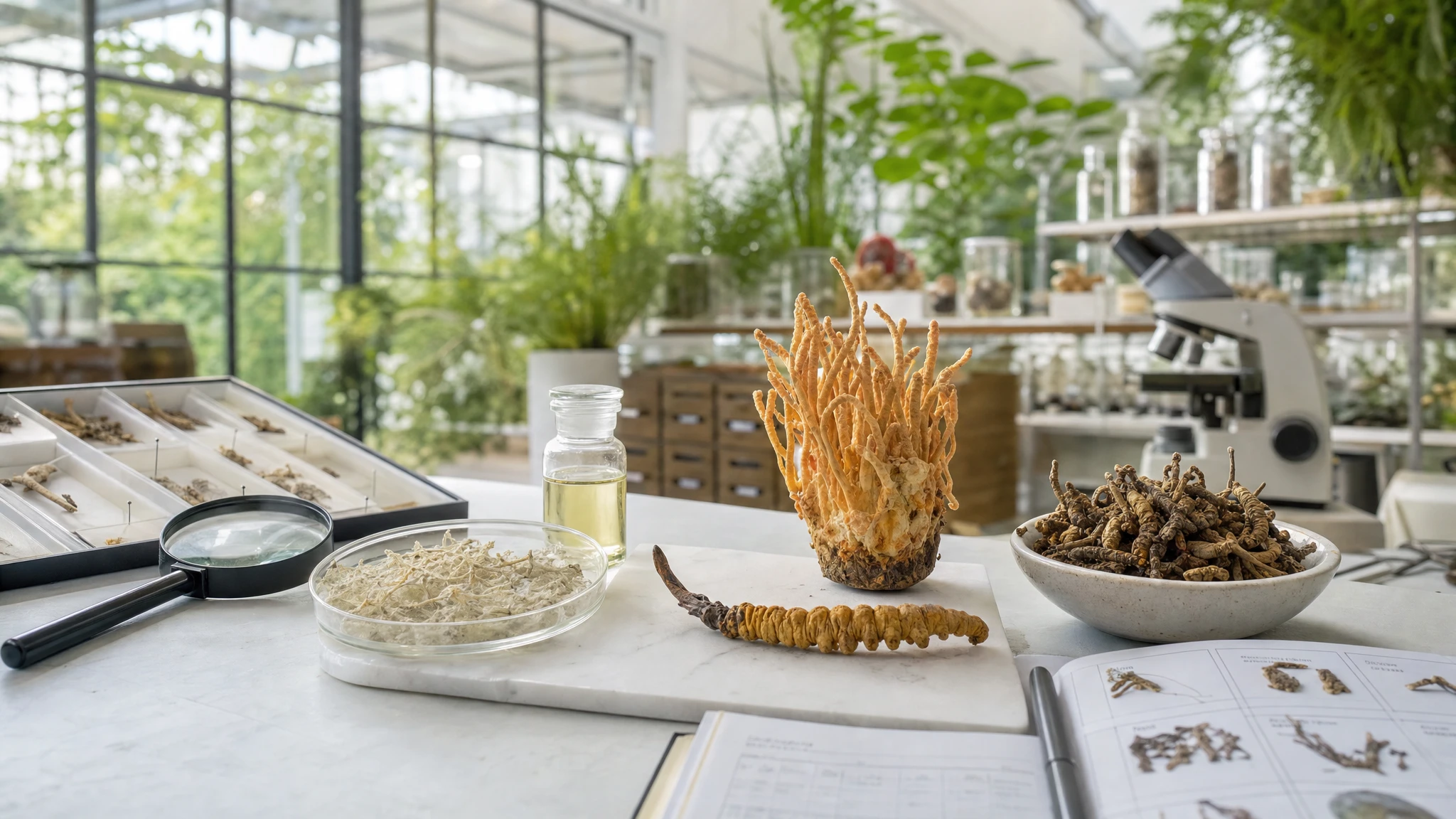
ABSTRACT : WHAT THE SCIENCE SAYS
The term cordyceps often appears in articles, product sheets, and educational texts, but it does not refer to just one fungus. It refers to a fungal genus, which is a group made up of related species. These species can vary in their origin, the part used, and the content of the extract. Making this distinction helps in reading studies without assigning too precise a meaning to the name. In common language, the trade name is often confused with the biological identity. In research, however, these two aspects must remain distinct. Other terms also help to understand which material was studied. Among these are mycelium (the fungus's growth network) and fruiting body (the reproductive structure). Standardization—the process that makes the composition of the extract more consistent—also matters.
In the case of cordyceps, taxonomic precision (related to biological classification) plays a central role. Similar products, in fact, can contain different materials. Some species appear more often than others in products and studies. The part used can also change the meaning of the data. In this in-depth analysis, we will see why the name alone is not enough. We will examine the most common species in products and how to read labels and studies with caution. In particular, the article will address:
- Cordyceps refers to a genus made up of multiple species, not just a single species
- Species, strain, and the part of the mushroom used indicate different biological aspects
- Cordyceps sinensis and militaris indicate different species and are not synonyms
- A commercial label is not enough if clear taxonomic data are missing
- Origin and standardization change how we interpret a product
What the name cordyceps really indicates
The name cordyceps does not refer to a single mushroom, but to various organisms of the fungal genus Cordyceps and related groups. Understanding the meaning of the name cordyceps helps to better interpret labels, studies, and products. Without specifying the species, part used, and origin, the term remains too vague.
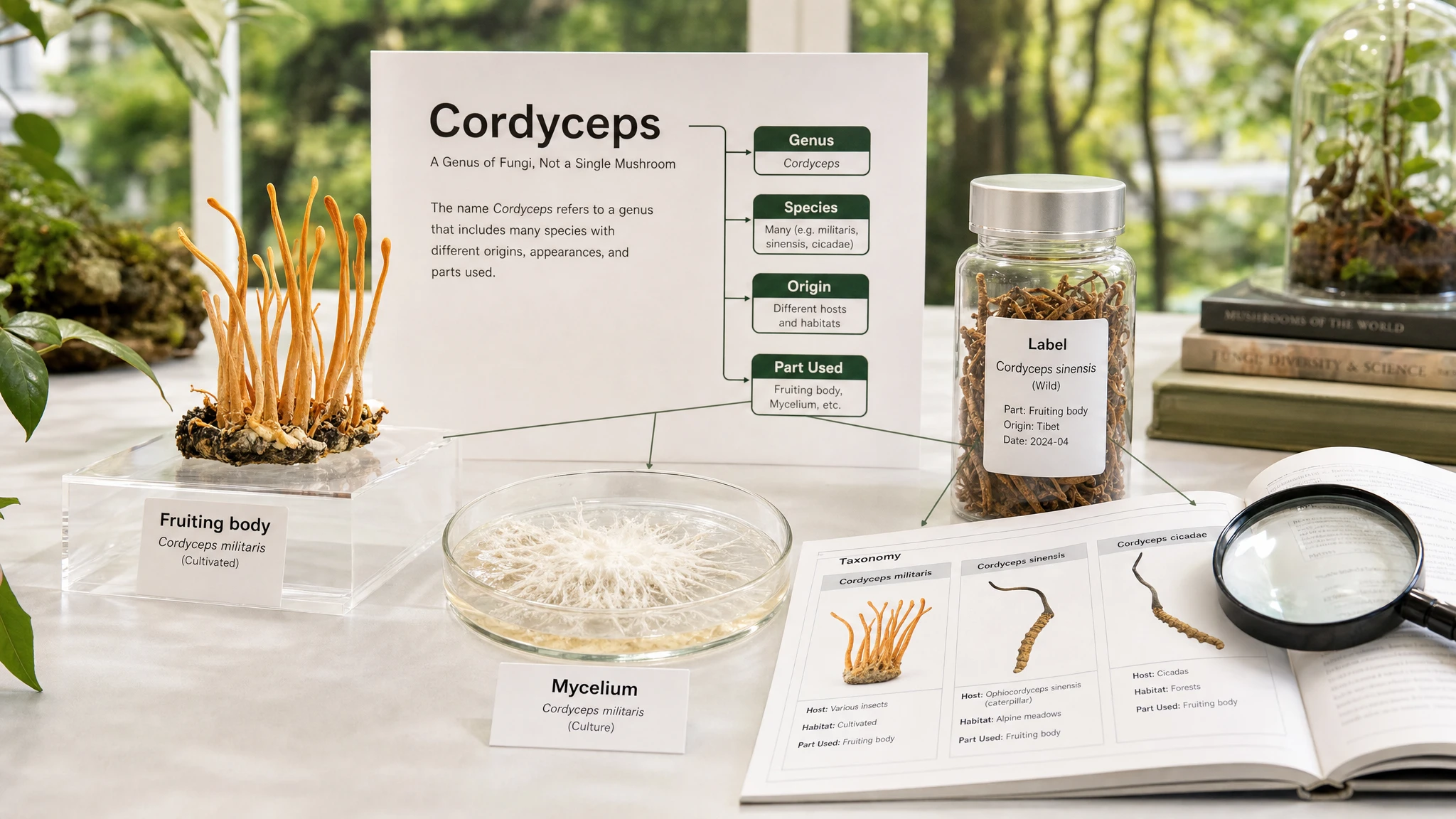
When we talk about cordyceps, the name refers to a taxonomic group (used to classify living beings). Therefore, it does not indicate just one single fungus. To understand a product or a study, the cordyceps species and the part used are necessary. It is also essential to know the type of harvesting or cultivation.
This distinction matters because the name cordyceps alone does not clarify composition, origin, or the possibility of replicating data. In scientific reporting, the term is therefore a primary label, useful but incomplete. To understand it, other elements are needed.
In the following paragraphs, we will see which species are most common in products. We will also see why the name does not always guarantee the same composition.
The origin of cordyceps matters, because the same commercial name can refer to different samples. To navigate this, it is useful to keep these points in mind:
- The name cordyceps indicates a broad taxonomic group, not a single fungus.
- The species listed on the label changes how the product should be interpreted.
- The fruiting body and the mycelium are different parts.
- The origin of the material affects the comparison between results.
To understand the name cordyceps, one must distinguish scientific classification from the language used in commerce. The following two steps explain what the genus is. They also clarify why species and strain make the name more precise.
Cordyceps is a fungal genus, not a single species
Cordyceps is a taxonomic name that groups together several related fungi; therefore, it does not identify a single organism. When the term is used without further specifications, information regarding biology, origin, and comparison between samples is lost. In other words, the name indicates that we are talking about a fungal genus, but it is not enough to understand which material has actually been analyzed or sold. It is somewhat like saying "feline" instead of specifying a cat or a tiger: the general meaning is there, but the useful details are missing.
The historical reconstruction of the genus shows a complex classification that is constantly being revised [1]. New species are described over time, and some are reclassified into related groups. The most comprehensive reviews report approximately 750 identified species within the genus, with 35 species cited in relation to medicinal properties or bioactive compounds [2]. This number shows how vast the group called cordyceps is. It also highlights its interpretative limitation: without a precise species, the term remains too general for reliable comparisons. Two products with the same name can therefore derive from organisms that are very different from each other. The name, on its own, guarantees nothing about the actual composition. It is therefore a starting point, useful for orientation, but not a conclusive definition of what is actually being analyzed or purchased.
Why species and strain change the meaning of the name
Within the same genus, there can be different species, and within the same species, there can be strains with non-identical characteristics. The strain is a more specific variant, while the species is a broader taxonomic level. This distinction matters because the common name alone is not enough to reliably understand what a product contains or what material was used in a study. The meaning of the name Cordyceps therefore changes based on the precision with which it is described.
The differences become concrete when comparing materials of Cordyceps militaris, where the fruiting body, mycelium, and mycelium from in vitro cultures do not coincide in composition and use [3]. Authentication technologies also show that correct identification requires additional verification, not just the trade name [4]. The limitation of the data is precisely this: a complete description of the mushroom part and the level of identification is often missing, and without these elements, the comparison between products remains weak.
Recent research and updates

In 2024, Thai researcher Atcharaporn Ontawong and colleagues studied a beverage fermented with Cordyceps militaris. The study was published in Scientific Reports. The research evaluated the potential effects on the immune system response of healthy adults. The work links the species, the type of product, and the biological data measured. It therefore shows that the name cordyceps alone does not describe all the material studied.
A randomized controlled clinical trial examining the effects of Cordyceps militaris beverage on the immune response in healthy adults
- 28 healthy adults: 2 groups of 10 women and 10 men, treated for 8 weeks with a fermented beverage or placebo.
- The beverage provided 2.85 mg of cordycepin per serving, a natural molecule produced by the fungus.
- In men, NK cell activity (defense cells) increased from the baseline value up to the 4th week; in women, it was higher compared to the control group after 8 weeks.
- In the female group, certain markers of inflammation, including IL-6, decreased compared to the start of the study; glycemia, lipids, and safety indices showed no significant changes.
How many species exist and which are the best known in products
There are many more Cordyceps species than the few names that appear on products. Labels primarily feature Cordyceps sinensis and Cordyceps militaris, the two most well-known names. However, the name alone does not clarify the origin, content, or the part of the mushroom used.

The fungal genus Cordyceps (a group of related species) includes a large number of species. In products and sales texts, however, only a few are found. The name might suggest a single mushroom, but the group is much more diverse. It is therefore necessary to distinguish between all known species and those cited in studies or on labels.
The material sold may be derived from the mycelium (the network of fungal filaments). It may also come from the fruiting body (the part that produces spores) or from various cultures. In any case, different sources can yield products with different contents. The key points to remember are:
- The species described are far more numerous than those used in products.
- Cordyceps sinensis and Cordyceps militaris are the names that appear most frequently.
- The same species can yield different materials, which are not always equivalent.
- The content also depends on the origin and standardization of the extracts.
The described species do not all carry the same weight in the product market. Some dominate labels, while others appear rarely or not at all. The following three points explain how many species are known, which names recur, and why they are not equivalent.
How many cordyceps species have been described
The fungal genus (a group that brings together related species) includes many species, beyond the few most well-known names. Taxonomic revisions (studies that classify living beings) often update this picture. New analyses, in fact, separate species that once seemed very close to each other. The total therefore describes the variety of the group, not the species found in products. Using cordyceps species in the singular is a shorthand, but it poorly represents such a varied reality.
The total number, however, requires caution because many species have little use on the market. Furthermore, not all have the same weight in practice or history. The total does not show which are more studied, sold, or verified for their content. We must therefore separate the variety of species from their actual presence in products. This distinction avoids confusing the taxonomic number with commercial prevalence. We cannot extend data concerning only a few names to the entire group.
Cordyceps sinensis and Cordyceps militaris in products
Among the most common names found on labels and in health communication texts are Cordyceps sinensis and Cordyceps militaris. The public encounters them often, but they should not be considered synonymous. In the first case, the market often offers cultivated mycelium (the fungus's network of filaments). In the second, it may also use the fruiting body (the part that produces spores) and material cultivated in vitro. This difference matters, because the trade name alone does not indicate the part used or the chemical content.
For Cordyceps sinensis, a review on fermentation notes that natural complexes containing the fruiting body are rare and expensive. Most recent studies, instead, concern cultivated mycelium [5]. The limitation is clear: the same name can indicate different types of materials. This distinction helps to better understand what was actually examined in individual studies. For this reason, without precise data on the material, comparing various products remains difficult.
Why not all species are interchangeable
Even within the same fungal genus, species can have different compositions, hosts, and growth environments. Therefore, it is not correct to directly apply data and technical specifications from one species to another. In the market, these differences may seem less distinct, but for science, they remain essential. When discussing Cordyceps species, similar names do not indicate mushrooms that can be freely substituted.
A review on polysaccharides (complex sugars) indicates that these compounds change according to the species and the source. Their value also depends on the method used to obtain the material [6]. Another study on the host of Ophiocordyceps sinensis shows how precise its biological origin is. Researchers examined 91 insect names and identified 57 potential hosts [7]. These details are necessary to establish whether two materials can be compared correctly. The limitation is clear: without species, origin, and the part used, evaluating and comparing products becomes unreliable.
Why the same name does not guarantee the same composition
Even if the label says Cordyceps, the content can vary significantly from one product to another. The differences depend on the species, the part used, and how the extract is prepared and standardized.

The same name does not ensure the same composition. In fact, cordyceps species, the part used, and the extraction method significantly change the final product. Two products may have similar names but contain different compounds, making them difficult to compare.
This care is necessary because the name cordyceps alone does not describe the quality of the product. Two similar packages may use different parts of the fungus, distinct species, or extracts standardized in different ways. To read the label correctly, one must therefore look beyond the name. It is necessary to distinguish the identity of the material from the actual possibility of comparing the extracts.
The term cordyceps therefore says little if clear data on the origin and part used are missing. Standardization (a method that keeps the content more stable) is also necessary. Before reading a label, it is advisable to check three pieces of information: the part used, the species indicated, and the uniformity of the extract. These are the key points to keep in mind:
- Mycelium and fruiting body are two different biological parts.
- The species can change the type and quantity of the compounds.
- Extraction and standardization help in comparing labels.
To understand why the name is not enough, it is necessary to distinguish the part of the fungus from the final chemical profile. The following three aspects show where the main differences arise.
Mycelium and fruiting body are not the same thing
Mycelium is the network of filaments through which the fungus grows and absorbs nutrients. The fruiting body, on the other hand, is the visible part of the fungus that produces spores. These two biological forms are different and should not be considered the same. If the part used is missing, we cannot determine if two materials are truly similar. This distinction helps in reading labels and evaluating different extracts.
Reviews report that many polysaccharides (complex sugars) studied in C. sinensis over the last 15–20 years are derived from cultivated mycelium [5]. For C. militaris, however, studies compare various materials: the fruiting body, the mycelium, and mycelium grown in vitro (outside the organism) [3]. Specifying which material was studied therefore allows for a better interpretation of these comparisons. The part used changes the base material, making it more difficult to compare products. Many data sheets, however, do not clearly indicate this information, so the name "cordyceps" remains too vague.
The species can modify the compound profile
Different species can have a different chemical profile, meaning they may contain different molecules. Therefore, the same brand name does not guarantee the same content. The problem arises when the label only states "cordyceps" without specifying the exact species. In that case, we cannot know if the materials are truly similar. The species is not just a formal detail: it defines the identity of the mushroom and helps to understand which compounds it may contain.
According to the review on Cordyceps militaris polysaccharides, their activities depend on three aspects: the type of sugars, the molecular weight, and the glycosidic bond (the bond between sugars) [8]. If the species changes, the qualities of the molecules present may also change. The final profile, however, also varies based on the cultivation, the part used, and the processing method. The species alone does not explain everything. It must be read in conjunction with other data, without assuming that the products are identical.
Extract, standardization, and label comparison
An extract indicates the source mushroom, but also the method used to separate its compounds. The standardization of extracts keeps the quantity of certain substances more stable and helps in comparing products. Without this data, the name Cordyceps leaves important questions unanswered. It does not state what has been extracted, how concentrated it is, or which method was used. Label clarity therefore helps in evaluating the product.
Reviews on polysaccharides of the Cordyceps genus describe the link between the source and the structure of the compounds [6]. This data matters, because standardization does not make different base materials equal. Even preclinical studies (on cells or animals) on Cordyceps militaris show an important point: the material used changes how the results are interpreted [9]. A precise label helps with comparison, but it does not eliminate differences due to species, part of the mushroom, and processing method. Two packages with the same name can therefore remain difficult to compare.
Summary of scientific evidence
This summary presents the most useful sources from the bibliography. It shows how taxonomy, composition, and type of material can change the meaning of the data.
| Publication year | Area studied | What the studies indicate |
|---|---|---|
| 2004 | physical performance | results are inconsistent: in one study, the supplement did not improve aerobic endurance or time-trial performance [10] |
| 2014 | genus taxonomy | evidence indicates that Cordyceps is a broad genus with a complex historical classification [1] |
| 2014 | mycelium and starting material | for Cordyceps sinensis, many studies examine cultivated mycelium rather than natural fruiting bodies [5] |
| 2018 | species diversity | studies describe many species in the group, but only a few appear frequently in products [2] |
| 2021 | Cordyceps militaris and biological forms | results vary because fruiting bodies, mycelium, and in vitro cultures (grown in the laboratory) are not equivalent [3] |
| 2022 | polysaccharide structure | studies indicate that composition, molecular weight, and chemical bonds affect the observed activities [8] |
| 2024 | immunomodulation in humans | a controlled study found favorable immune signals, but in small samples and specific contexts [6] |
| 2025 | species authentication | the trade name is not enough; molecular analyses are needed to correctly identify the material [4] |
Editorial interpretation of the evidence
Conclusions and editorial summary
When I talk about Cordyceps species, using precise language means respecting scientific data. The genus includes diverse organisms, and this variety changes how products, studies, and data sheets are interpreted. Species, mycelium, fruiting body, and standardization are not secondary details. They are useful data points for understanding exactly what has been observed. If these are missing, Cordyceps remains a label that is too broad to offer truly useful information.
The literature I have reviewed shows that a common name is not enough to define a biological material. Growth form, origin, and processing can change how data is compared. They can also alter the meaning of the results. An evidence-based site must therefore combine taxonomy, composition, and critical reading of sources. This method also helps to better address subsequent topics. These include bioactive compounds and the quality of extracts.
Final critical note
The general picture I have gathered is consistent, but an important problem remains. The literature often uses cordyceps in a broad sense, while the data require more precision. This creates a gap between nomenclature (naming system) and the interpretation of results. Even if a study is solid, I cannot automatically extend the data to the entire group. The sources I consulted mainly include reviews and studies that describe the characteristics of the materials. Conversely, there remain few direct comparisons between truly equivalent materials. Caution does not limit research, but protects scientific accuracy.
References
[1] A Brief Chronicle of the GenusCordycepsFr., the Oldest Valid Genus in Cordycipitaceae (Hypocreales, Ascomycota)
[2] The genus Cordyceps : An extensive review of its traditional uses, phytochemistry and pharmacology
[3] Cordyceps militaris: An Overview of Its Chemical Constituents in Relation to Biological Activity
[4] Molecular Identification Technologies in Authentication of Chinese Caterpillar Mushroom Ophiocordyceps sinensis (Ascomycota) and Related Species: A Review
[5] Recent advances in Cordyceps sinensis polysaccharides: Mycelial fermentation, isolation, structure, and bioactivities: A review
[6] Cordyceps Polysaccharides: A Review of Their Immunomodulatory Effects
[7] Host insect species of Ophiocordyceps sinensis: a review
[8] Structural Elucidation and Activities of Cordyceps militaris-Derived Polysaccharides: A Review
[9] Cordyceps militaris polysaccharides can enhance the immunity and antioxidation activity in immunosuppressed mice
Editorial note
Artificial Intelligence was used solely as a tool to support editorial and documentary work. All content, interpretations, bibliographic citations and conclusions have been verified, reviewed and approved by the author, who assumes full scientific responsibility for them.
The manuscript was also subject to independent peer review prior to publication.
To ensure maximum transparency, the article's complete history — including the dates of submission, review, acceptance and publication, as well as information on the peer review process — is available on the dedicated Article History page.