


Distinction between soluble and insoluble fiber and digestive effects
In 2019, affiliated researcher Barbara A. Williams and colleagues in Australia examined in the Journal of Animal Science and Biotechnology why the distinction between soluble and insoluble fiber is not enough to predict fermentation, interactions with the gut microbiota, and fiber behavior during digestion.
- Published 05/11/2026
- Updated 08/11/2026
- Article history
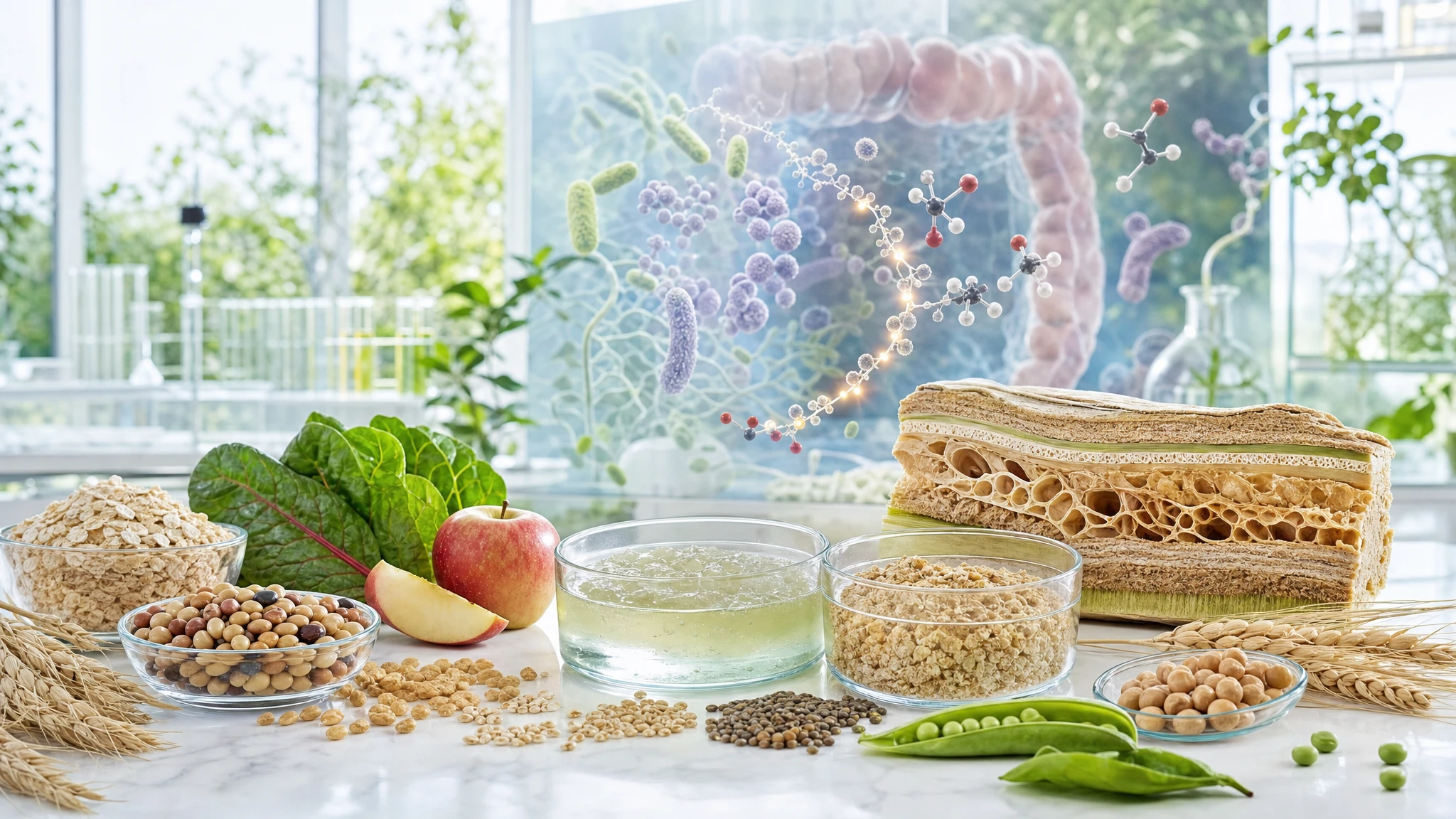
ABSTRACT : WHAT THE SCIENCE SAYS
The review by Williams and colleagues examines why the traditional distinction between soluble and insoluble fiber is useful, yet incomplete. The authors explain that fermentability, viscosity, plant structure, and food processing all contribute to determining the path of fibers through the digestive system and their interaction with the gut microbiota.
The authors' synthesis examines fibers from grains, legumes, fruits, and vegetables, with reference to both human and swine nutrition. The core message is simple: two fibers with the same solubility label can behave differently during digestion. Some retain water or increase the density of intestinal contents; others reach the colon and are transformed more rapidly by microorganisms; others remain poorly fermented. The authors link these differences to chemical composition, particle size, plant cell wall structure, and food processing technology. Fermentation products are also discussed, including short-chain fatty acids, which are molecules produced by gut bacteria when they utilize certain non-digestible carbohydrates. The review does not measure a single clinical effect nor compare people assigned to a treatment. Instead, it proposes an interpretive framework: to understand what a fiber does, it is necessary to describe multiple properties, not just determine whether or not it disperses in water.
What this research analyzed
Williams and colleagues conducted a narrative review of the literature, not a clinical trial. They compared the fibers present in various plant-based foods and discussed data obtained from humans, pigs, and fermentation models. The goal was to clarify what truly defines solubility—that is, a fiber's ability to disperse in water—and which characteristics are excluded from this definition.
The authors primarily considered fermentability, meaning how much and how quickly colon microorganisms can utilize a fiber; viscosity, or the ability to thicken liquids; and the food matrix, the physical structure that holds food components together. The next step concerns what these differences might mean within the digestive tract.
Research data
“Dietary fibre”: moving beyond the “soluble/insoluble” classification for monogastric nutrition, with an emphasis on humans and pigs
- A narrative review on fiber from cereals, legumes, fruits, and vegetables, using human, porcine, and experimental data.
- Solubility describes the interaction with water, but it does not, on its own, predict the rate, quantity, or products of fermentation.
- The authors propose also evaluating structure, viscosity, food matrix, and fermentation kinetics.
What results emerge from the study
The main finding is that "soluble" and "insoluble" are useful descriptive labels, but they do not explain biological behavior on their own. Simply put, a fiber that disperses well in water is not necessarily the one that is most fermented; likewise, a poorly soluble fiber is not necessarily inactive in the colon.
The authors provide examples of insoluble fibers with rapid, slow, or minimal fermentation. They attribute these differences to composition, chemical bonds, accessibility to bacteria, particle size, and food processing. The review also highlights that fermentation products, including acetate, propionate, and butyrate, depend on the type of substrate and the microbiota present. This describes a plausible mechanism, but it does not allow for predicting the effect of every food or supplement in an individual.
Why this study is relevant
This work helps to avoid a common simplification: treating all fibers in the same category as equivalent. To interpret a food, it is not just about how many grams of fiber it contains or whether the label defines it as soluble. Physical form, processing, and whether the fiber is part of a plant cell wall or isolated can also matter.
The relevance is therefore methodological. A more precise description allows for better hypotheses regarding digestive processes and for comparing studies that use different fibers. However, it does not prove that a particular classification directly improves health or is superior for every clinical goal.
Study limitations and what it does NOT demonstrate
As a narrative review, the study by Williams and colleagues does not have a single experimental protocol, its own study population, or a measured clinical effect. It brings together sources with very different models: foods, isolated fibers, incubations with microbiota, humans, and pigs. For this reason, it does not provide a single quantitative estimate nor does it establish a causal relationship between a fiber property and a health outcome.
Furthermore, some of the evidence cited involves experimental or animal models. While these can clarify biological processes, they do not replace human studies. The proposal to move beyond a binary classification is conceptually sound; however, its practical utility depends on the quality with which each fiber is characterized and studied.
Independent supporting evidence
A methodological publication by Poutanen and colleagues confirms the central step in the chain: physical properties, composition, structure, and matrix can modify the function of fiber. It is a review with recommendations for nutritional studies, not an experiment on participants. The authors indicate that solubility, viscosity, and fermentability must be measured and reported separately; the level of confirmation is direct on a methodological level, but it does not quantify a clinical benefit [1].
The review by Stephen and colleagues argues that solubility also depends on the measurement method and does not always predict fermentation or physiological response. It therefore confirms the link between fiber properties and function in the colon. It is a synthesis of the literature, without new sample sizes; the limitation is the heterogeneity of the included sources [2].
Bliss and colleagues add experimental data: in fermentations with human fecal microbiota, gum arabic, psyllium, and carboxymethylcellulose showed different extents of fermentation. The model involved samples from three healthy people and, in a second experiment, 52 people with fecal incontinence. It confirms that the specific substrate matters, but the model does not fully replicate the living human intestine [3].
Conflicting evidence
No directly conflicting evidence of sufficient relevance has been identified; this does not prove the absence of contrary results. However, studies are available showing how effects vary according to fiber type, dose, intestinal site, and the population studied.
In 19 people with irritable bowel syndrome, Gunn and colleagues observed that inulin produced more gas than psyllium and that the combination of the two fibers reduced gas compared to inulin alone. This finding shows that specific characteristics remain clinically informative, but it concerns a specific intestinal condition and acute intake [4]. In 17 healthy adults, Alhasani and colleagues detected an early reduction in exhaled hydrogen with psyllium and inulin, with no average reduction over 24 hours. This scales back the idea that a single indicator can describe all fermentation; the small sample size and short observation period limit generalizability [5].
Comparative overview
The following publications compare or clarify the thesis that solubility, on its own, does not describe all the functions of fibers.
| Publication | Model and sample size | Main result | Relationship to the Williams study |
|---|---|---|---|
| Poutanen et al., 2018 [1] | Methodological review; no new population | Requires description of structure, rheology, fermentation, and matrix | Direct confirmation on a methodological level |
| Stephen et al., 2017 [2] | Literature review; no new population | Solubility does not always predict fermentation or physiological effects | Direct conceptual confirmation |
| Bliss et al., 2013 [3] | In vitro fecal fermentation; 3 healthy individuals and 52 participants in the second experiment | Three fiber sources showed different fermentation | Indirect experimental confirmation |
| Gunn et al., 2022 [4] | Crossover RCT; 19 people with irritable bowel syndrome | Inulin and psyllium had different effects on gas | Qualifies generalizability |
| Alhasani et al., 2025 [5] | Crossover RCT; 17 healthy adults | Effects on exhaled hydrogen varied over time and between individuals | Qualifies the interpretation of a single indicator |
Editorial conclusion
The review by Williams and colleagues clarifies that fibers do not constitute a biologically uniform group. The distinction between soluble and insoluble retains descriptive value, because it indicates how a fiber interacts with water, but it is not enough to predict what happens along the digestive tract. Fermentability, viscosity, chemical composition, accessibility to microorganisms, particle size, and food structure can modify the result. The independent publications considered reinforce, above all, this methodological principle: studies should better characterize the fiber used and the dietary context. However, the available evidence does not authorize us to deduce a single health effect for all fibers belonging to the same category. Even studies in humans show variable responses, influenced by the type of fiber, the dose, the observation time, and the population. The most rigorous message is therefore to evaluate fibers by their properties and context, not through a single label.
References
[1] Recommendations for characterization and reporting of dietary fibers in nutrition research
[2] Dietary fibre in Europe: current state of knowledge on definitions, sources, recommendations, intakes and relationships to health
[3] In Vitro Degradation and Fermentation of Three Dietary Fiber Sources by Human Colonic Bacteria
[4] Psyllium reduces inulin-induced colonic gas production in IBS: MRI and in vitro fermentation studies
[5] Mode of Action of Psyllium in Reducing Gas Production from Inulin and its Interaction with Colonic Microbiota: A 24-hour, Randomized, Placebo-Controlled Trial in Healthy Human Volunteers
Editorial note
Artificial Intelligence was used solely as a tool to support editorial and documentary work. All content, interpretations, bibliographic citations and conclusions have been verified, reviewed and approved by the author, who assumes full scientific responsibility for them.
The manuscript was also subject to independent peer review prior to publication.
To ensure maximum transparency, the article's complete history — including the dates of submission, review, acceptance and publication, as well as information on the peer review process — is available on the dedicated Article History page.