


Drying oregano: effects on yield and essential oil composition
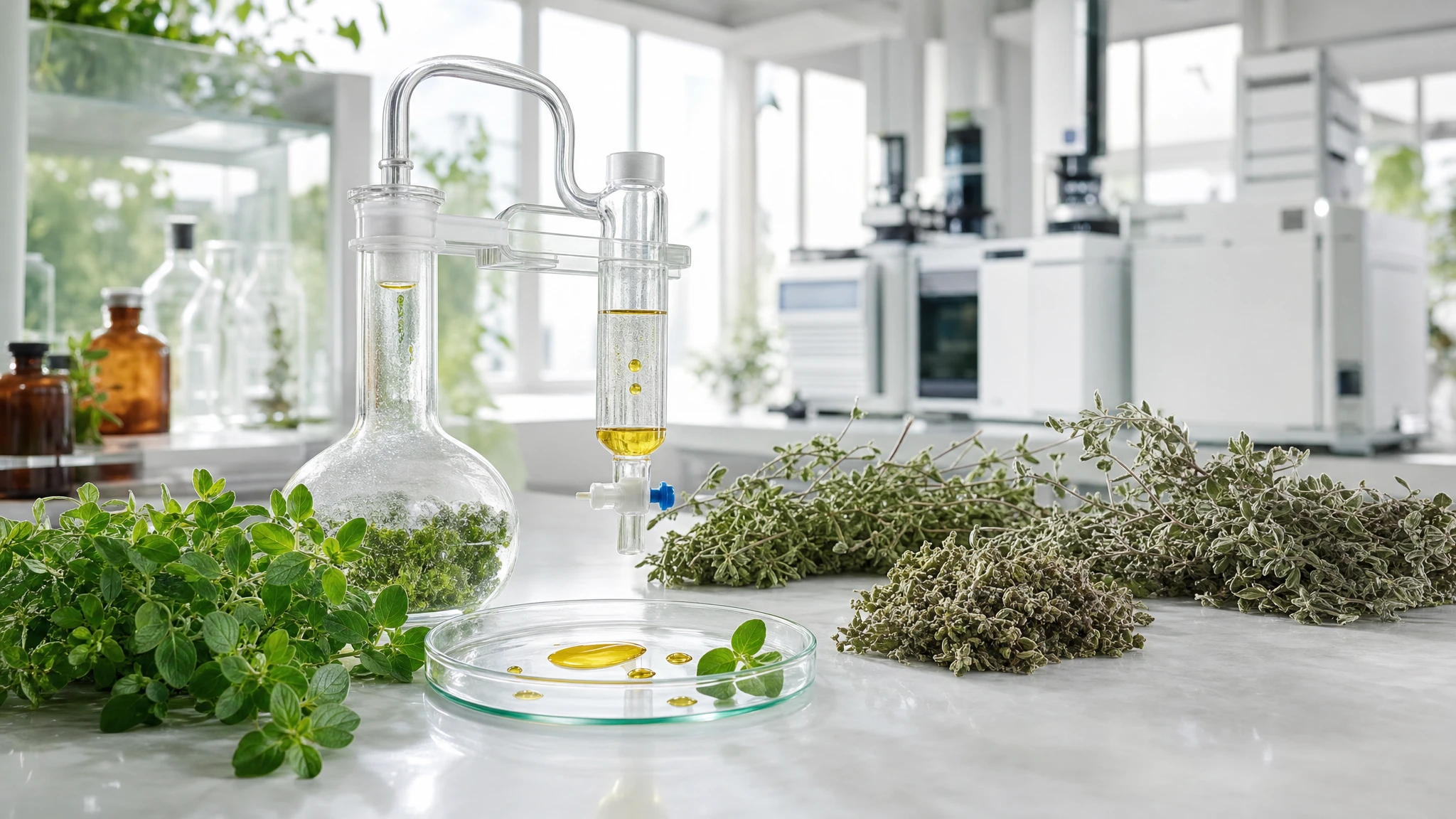
In 2022, Italian researcher Caputo and colleagues studied in the journal Scientific Reports how shade, hot air oven, microwave, and osmotic treatment modify the yield and chemical profile of the essential oil obtained from the aerial parts of Origanum vulgare. The study therefore compares fresh material with products subjected to different dehydration conditions.
- Published 02/11/2026
- Updated 03/11/2026
- Reviewed 03/11/2026
- Article history
ABSTRACT : WHAT THE SCIENCE SAYS
The study compared different drying methods for Origanum vulgare to understand how they alter the quantity and composition of its essential oil. The results show that there is no single outcome: yield, carvacrol, and other aromatic compounds change depending on the treatment applied.
The authors' summary describes an experimental study on the aerial parts of Origanum vulgare, which were harvested and subjected to shade drying, hot air oven drying, three microwave protocols, or osmotic treatment. The essential oil, which is the concentrated mixture of volatile aromatic substances, was then obtained via hydrodistillation and analyzed using GC-FID and GC-MS, techniques that separate and identify the chemical compounds present. 39 components were identified, accounting for 97.8-98.8% of the analyzed oil. Carvacrol, a volatile phenolic compound responsible for part of the characteristic aroma, was the main component in all samples, with percentages ranging from 56.2% to 81.4%. The highest yield reported by the authors was observed in the microwave treatment at lower power and longer duration: 2.20%. Drying also modified the relative proportions of the substances: p-cymene, gamma-terpinene, and alpha-pinene decreased in most of the dried samples, while carvacrol, isoborneol, and linalool increased in several treatments. These data describe plant material and distilled oil; they do not measure effects in humans nor do they establish which culinary form is better.
What this research analyzed
Caputo and colleagues investigated whether the method used to dry oregano could alter the composition of its distilled oil. In practical terms, they compared fresh material with oregano kept in the shade for five days, oven-dried at 50 °C for 24 hours, treated with three combinations of microwave power and time, or subjected to osmotic treatment. The latter uses a concentrated solution to facilitate the removal of water from plant tissues.
The comparison focused on both the oil yield and its relative composition. The authors also measured residual moisture and electrolyte leakage, an indirect indicator of the integrity of plant cell membranes. Each chemical measurement was performed in three independent determinations. The study therefore observes how a distilled product of the plant changes, not the effect of oregano consumed in meals.
Research data
Impact of drying methods on the yield and chemistry of Origanum vulgare L. essential oil
- The aerial parts of 20 kg of oregano were compared fresh and after six dehydration treatments.
- The analysis identified 39 compounds; carvacrol remained the main one, ranging from 56.2% to 81.4%.
- The 460 W microwave protocol for 35 minutes achieved a reported yield of 2.20%, with a residual moisture of 12.3%.
What results emerge from the study
The main finding is that drying did not produce an oil with a consistent composition. Microwave treatment at 460 W for 35 minutes yielded the highest result, 2.20%, while fresh material yielded 0.20%. However, that sample retained approximately 12.3% moisture: the authors themselves consider it only sufficiently suitable for microbiological preservation. Therefore, a higher yield does not automatically equate to an optimal product for every use.
Carvacrol remained prevalent in all oils, ranging from 56.2% to 81.4%. Compared to the fresh sample, it increased in all treatments except for the osmotic one; the differences indicated by the authors were statistically significant, with P < 0.0001. Conversely, alpha-pinene, p-cymene, and gamma-terpinene were generally lower after drying. In simple terms, drying can shift the balance between the molecules that contribute to the aroma, without transforming oregano into a standardized product.
Why this study is relevant
For those who use oregano as a spice, the most useful takeaway is that “dried oregano” does not necessarily identify aromatically identical products. Time, temperature, exposure to air, and the method by which water is removed can leave different proportions of volatile substances. This helps explain why aroma and intensity can vary between seemingly similar products.
This work is also relevant for those interpreting studies on essential oils. The percentage of carvacrol indicates the relative share in the analyzed oil, not the amount ingested in a culinary serving, nor is it a measure of health efficacy. The data support a relationship between the technological process and chemical composition; they do not allow for the attribution of clinical benefits to dried oregano, its oil, or any single component.
Study limitations and what it does NOT demonstrate
This is an experimental laboratory study on a collection of Origanum vulgare carried out in July 2020. It did not compare cultivars, seasons, cultivation areas, or post-drying storage conditions. These factors can influence the oil profile, making it prudent not to extend the results to all available products.
Furthermore, the percentages describe the oil obtained through distillation, not the complete composition of the spice nor what happens after human consumption. The study did not evaluate taste, final food safety, bioavailability, culinary doses, or clinical outcomes. The relative increase in carvacrol does not prove an absolute increase in its quantity on the plate and does not demonstrate a health benefit. Comparison with other research further clarifies this context-dependency.
Independent supporting evidence
Initial direct confirmation comes from Özer and colleagues, who studied O. vulgare subsp. hirtum at three stages of development and using sun, shade, or oven drying. They identified 37 compounds and observed differences in both yield and the proportions of carvacrol, gamma-terpinene, and p-cymene. The maximum yield, 2.8%, appeared in material at full bloom dried in an oven at 45 °C. This supports the statement that “the process and state of the plant influence the oil,” with direct confirmation, though limited to another subspecies and specific conditions [1].
Novák and colleagues obtained a convergent result using natural drying or dryers at 30, 40, and 45 °C on O. vulgare subsp. hirtum. Carvacrol varied from 82.75% with natural drying to 89.74% at 30 °C. The work confirms that even moderate temperature differences can modify certain oil parameters; however, it does not measure human exposure or the nutritional value of the spice [2].
A further experimental study on O. vulgare subsp. hirtum compared shade, sun, oven, and microwave drying. It reported the maximum oil content with an oven at 50 °C, at 2.5%, and the maximum carvacrol with a microwave at 560 W, at 81.9%. The result reinforces the conclusion that there is no single best method: the outcome depends on the chosen parameter, such as yield, a single compound, or activity measured in a test tube [3].
Conflicting evidence
Jerković and colleagues analyzed wild O. vulgare subsp. hirtum harvested in the same area during different seasons. Drying at room temperature only slightly reduced the yield and did not change the qualitative composition—that is, the set of main compounds identified; however, the harvest season strongly influenced both quantity and composition. This evidence does not invalidate the results of Caputo and colleagues, but it indicates that the harvest and chemotype—the plant's characteristic chemical profile—can be as significant as the drying method [4].
Figiel and colleagues observed that all the methods studied reduced the total concentration of volatile substances compared to fresh oregano, although with lower losses during vacuum-microwave drying. This finding suggests a distinction must be made between an increase in the relative percentage of a compound and the preservation of the overall amount of aroma. The research is relevant but uses different protocols and plant material, therefore it does not allow for a direct numerical comparison with Caputo and colleagues [5].
Comparative overview
Research converges on the fact that drying can modify oregano oil, but it shows that the direction of the change depends on the plant, the harvest, and the protocol.
| Publication | Model and comparison | Main result | Relation to Caputo study |
|---|---|---|---|
| Özer et al., 2018 [1] | O. vulgare subsp. hirtum; sun, shade, oven, and developmental stages | Yield and main compounds varied with drying and flowering. | Direct confirmation of process dependency. |
| Novák et al., 2011 [2] | O. vulgare subsp. hirtum; natural drying or 30-45 °C | Carvacrol and some oil parameters changed between treatments. | Direct confirmation, with a narrow thermal range. |
| Allahbakhshi et al., 2026 [3] | O. vulgare subsp. hirtum; shade, sun, oven, and microwave | Different maximums for yield, carvacrol, and in vitro activity. | Confirms that the result depends on the measured objective. |
| Jerković et al., 2001 [4] | Wild O. vulgare subsp. hirtum; seasons and ambient drying | Season had a greater impact than drying on qualitative composition. | Limits generalizability to all harvests. |
| Figiel et al., 2010 [5] | O. vulgare; hot air, vacuum-microwave, and combined treatment | All treatments reduced total volatiles compared to fresh. | Distinguishes relative percentages from overall aroma quantity. |
Editorial conclusion
References
[1] Effect of Different Drying Methods and Development Stages on the Essential Oil Chemical Composition of Aerial Parts of Origanum vulgare L. subsp. hirtum (link) Letsw
[2] Effect of the drying method on the composition ofOriganum vulgareL. subsp.hirtumessential oil analysed by GC-MS and sensory profile method
[3] Changes in the essential oil composition, phytochemical traits and antioxidant activity of Origanum vulgare ssp. hirtum as affected by drying methods
[4] The impact of both the season of collection and drying on the volatile constituents of Origanum vulgare L. ssp. hirtum grown wild in Croatia
[5] Composition of oregano essential oil (Origanum vulgare) as affected by drying method
Editorial note
Artificial Intelligence was used solely as a tool to support editorial and documentary work. All content, interpretations, bibliographic citations and conclusions have been verified, reviewed and approved by the author, who assumes full scientific responsibility for them.
The manuscript was also subject to independent peer review prior to publication.
To ensure maximum transparency, the article's complete history — including the dates of submission, review, acceptance and publication, as well as information on the peer review process — is available on the dedicated Article History page.