


Ginger and metabolic syndrome: effects and limitations of nutritional support for metabolism
Research on ginger and metabolic syndrome offers concrete, but not conclusive, data. In some clinical studies, its use is associated with improved glycemia, lower triglycerides, and reduced insulin resistance. The signals primarily concern people who are already at risk for heart and metabolic issues. However, the results vary with dosage, duration, and the group studied. Ginger can therefore support a healthy lifestyle, but it is not an independent or definitive cure.
- Published 13/10/2026
- Updated 24/10/2026
- Reviewed 24/10/2026
- Article history

ABSTRACT : WHAT THE SCIENCE SAYS
Metabolic syndrome combines health issues that often occur together: a large waistline, high glycemia, high triglycerides, low HDL, and high blood pressure. HDL is the cholesterol carried in the blood by lipoproteins known as high-density lipoproteins. In this context, ginger is being studied as a potential dietary aid, not as a standalone treatment. It may have effects on certain heart and metabolic factors, but the data are inconsistent.
This article explains what role it may play, which values have been studied in humans, and what limitations remain. The goal is to understand whether it can support prevention and treatment aimed at reducing metabolic risk. However, it should not be mistaken for a remedy that can solve all these problems on its own. In particular, the article addresses:
- What metabolic syndrome is and the risks it entails
- Possible effects on weight, glycemia, and blood fats
- Limitations of the evidence and differences between results
- The real role of ginger in lifestyle
- When nutritional support can be useful in prevention
What metabolic syndrome is and why it concerns cardiometabolism
The relationship between ginger and metabolic syndrome should be viewed within a broader context. It does not concern a single value, but rather multiple risks that affect the heart and metabolism. Abdominal obesity, impaired glycemia, dyslipidemia, and high blood pressure often appear together and reinforce one another.

Metabolic syndrome is not a single disease, but a cluster of imbalances often present in the same person. These increase the risk of heart damage and metabolic problems. The main ones are abdominal obesity, impaired glycemia, high blood pressure, insulin resistance (reduced response to insulin), and dyslipidemia (abnormal blood fats). When they appear together, the risk increases. Any nutritional aid must therefore be integrated into a broader strategy, without shortcuts.
This distinction clarifies the role of ginger. It does not cure the syndrome, but it can offer potential nutritional support within a well-defined lifestyle. Its value depends on the clinical picture and the factors present, not on an isolated data point. It is therefore necessary to understand which risks may accumulate over time.
To distinguish the clinical picture from individual factors, a few points help provide guidance:
- The combination of risk factors carries more weight than a single abnormal value.
- Abdominal obesity indicates an accumulation of fat that can be harmful to health.
- Dyslipidemia alters blood fats and increases vascular risk.
- High blood pressure adds to the other existing imbalances.
- Impaired glycemia indicates less effective sugar control.
In the following paragraphs, we will see how the clinical picture is defined and which factors can accumulate. We will also see why ginger is being studied in this field.
What is metabolic syndrome and which criteria define it
Metabolic syndrome is defined as the concurrent presence of alterations involving glycemia, blood fats, blood pressure, and adipose tissue distribution. Its clinical significance does not lie in a single parameter, but in the combination of multiple signals that indicate a more fragile cardiometabolic state. For this reason, prevention cannot focus solely on weight: the context of diet, physical activity, and risk factor management also matters. Each signal must be interpreted in conjunction with the others, because the clinical picture changes when multiple alterations appear in the same person. A value outside the normal range may remain isolated, but two or three signals together describe a different level of risk. Clinical evaluation is essential precisely to recognize this combination of factors.
NIH guidelines emphasize that the focus should be on dietary patterns, not on individual foods, while the Dietary Guidelines for Americans note that regular physical activity reduces the risk of high blood pressure, an unfavorable lipid profile, type 2 diabetes, and metabolic syndrome [1][2]. The limitation, however, is that these indications describe the preventive framework, not the individual patient's response to a supplement such as ginger: the clinical picture remains complex and multifactorial.
Which risk factors accumulate over time
The components of metabolic syndrome often do not appear in isolation. Abdominal obesity, impaired glycemia, dyslipidemia, and high blood pressure can reinforce one another. Together, they create a clinical picture with an increased risk for the heart and metabolism. Ginger has been studied because it may act on multiple factors simultaneously. Interest therefore stems from the complex nature of the syndrome, rather than a single direct effect. However, solid clinical data and well-conducted research are needed to confirm this hypothesis.
A randomized study of 37 patients with metabolic syndrome used 2 g/day of ginger for 12 weeks. Compared to the placebo, it found improvements in triglycerides, fasting glycemia, and insulin resistance that were unlikely to be due to chance [3]. A review of human studies had already indicated a possible improvement in the control of glycemia and the body's response to insulin [4]. However, sample sizes and research durations remain variable. The data are interesting, but they are not sufficient to extend the results to everyone.
Why ginger is being studied in this context
Ginger is being investigated because it is a common, well-tolerated food that is potentially useful as a cardiometabolic ginger within a nutritional support approach. In a complex context such as metabolic syndrome, the hypothesis is not to replace therapies or lifestyle changes, but to add an ingredient capable of influencing multiple indicators, from lipid metabolism to the regulation of glycemia. Research is therefore looking at a broad effect, not a single target. This approach reflects the very nature of the syndrome, which consists of multiple intertwined alterations. Useful support should act on several fronts at the same time, without promising isolated results.
The 2017 review described signs of improvement in hyperglycemia, hyperlipidemia, oxidative stress, and inflammation [5]; the 2022 review then summarized experimental studies linking ginger to various metabolic syndrome disorders [6]. These summaries are useful, but they do not equate to conclusive evidence: results vary with dosage, duration, and the population studied. For this reason, the topic remains promising but should still be interpreted with clinical caution.
Recent research and updates
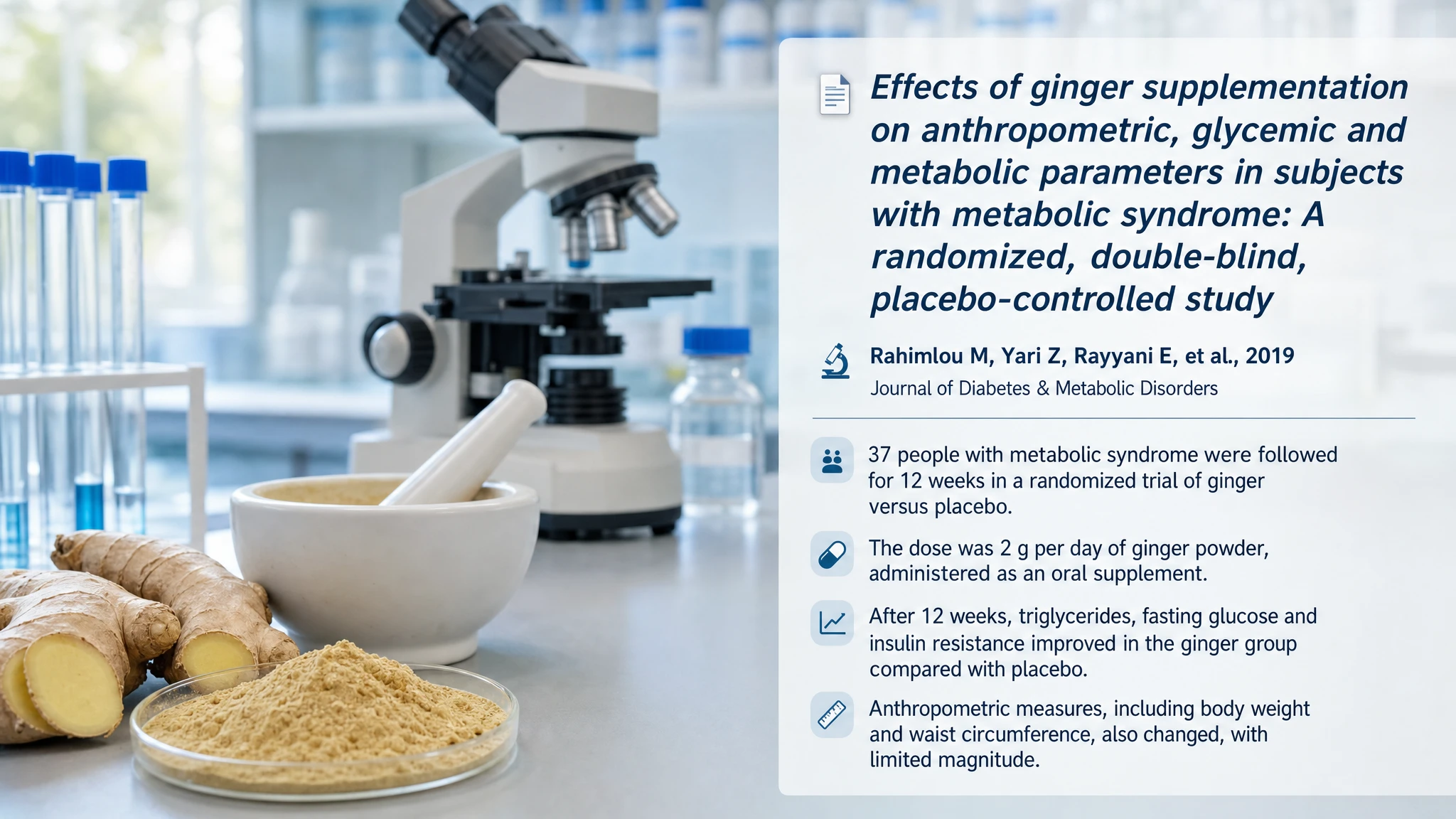
In 2024, Rahimlou and colleagues from Iran studied ginger in the Journal of Diabetes & Metabolic Disorders. The research involved people with metabolic syndrome and evaluated glycemia, blood fats, and body composition. The authors compared ginger powder and a placebo for 12 weeks, with measurements taken before and after the treatment. The results indicate a potential aid, not a standalone solution.
Effects of ginger supplementation on anthropometric, glycemic and metabolic parameters in subjects with metabolic syndrome: A randomized, double-blind, placebo-controlled study
- 37 people with metabolic syndrome were followed for 12 weeks. The study randomly compared ginger and a placebo.
- The dosage was 2 g per day of ginger powder, taken as an oral supplement.
- After 12 weeks, triglycerides, fasting glycemia, and insulin resistance improved in the ginger group compared to the placebo group.
- Weight and waist circumference also varied, but the observed effect remains limited.
What human studies show regarding weight, glycemia, and lipids
Clinical studies on ginger indicate potential support for certain risks, but not a definitive cure. Research shows signs of impact on weight, glycemia, and blood fats, especially in people with altered metabolism. It should therefore be used as nutritional support, alongside lifestyle changes and prescribed treatments.

In human studies, the relationship between ginger and metabolic syndrome primarily concerns weight, glycemia, and blood fats. The spice could complement diet and physical activity in those with certain metabolic issues. These include insulin resistance (low response to insulin), dyslipidemia (altered blood fats), and abdominal obesity (fat around the waist). Since results vary between studies, caution is needed: ginger does not replace medical treatment.
To better understand the data, it is useful to divide the studies into three areas:
- Research on weight evaluates body composition and potential assistance in weight loss.
- Research on glycemia measures fasting values, insulin response, and metabolic control.
- Analyses on lipids examine triglycerides, HDL, and total cholesterol present in the blood.
Clinical studies are better understood by separating the effects on weight, glycemia, and blood fats. The three areas show different signals, which should be interpreted while taking into account the limitations of each study.
Ginger and body weight: what clinical studies reveal
Regarding body weight, studies are evaluating whether this spice helps manage energy. They also examine body composition (the ratio of fat mass to lean mass) during its use. It can complement an ongoing diet, but it does not cause significant weight loss on its own. This is important for at-risk individuals, as abdominal obesity increases risks for the heart and metabolism. It can also make it more difficult to keep other values under control.
The 2024 randomized study included 120 people with or at risk of metabolic syndrome. For 12 weeks, participants took 3 g of spice powder per day. The research team measured glucose, lipids, and body composition during the trial [7]. The data indicate a possible supportive role, but do not prove an independent weight-loss effect. The test lasted a short time and used a spice blend. Therefore, it is impossible to determine the extent to which a single ingredient acted.
Ginger and glycemia: effects observed in metabolic profiles
The relationship between ginger and glycemia is among the most studied topics in metabolic disorders. Research measures fasting glycemia, glycated hemoglobin, and insulin resistance (low cellular response to insulin). These values help to understand how the body regulates the sugar present in the blood. The spice may offer extra support, but it does not replace medical treatments or a healthy lifestyle.
The 2013 randomized study involved 64 patients with type 2 diabetes. Every day, participants took 2 g of ginger or a placebo. Researchers measured glycemia, HbA1c (average glycemia over time), and insulin response [8]. A 2022 meta-analysis combined multiple trials on fasting glucose, HbA1c, and total cholesterol. It also evaluated triglycerides, LDL, HDL, and blood pressure [9]. Results vary between studies, dosages, and patient groups. The main limitation therefore remains the significant diversity of the protocols used.
Ginger and blood lipids: triglycerides, HDL, and lipid profile
Another relevant area is the lipid profile, which is the set of circulating fats such as triglycerides, HDL, and LDL cholesterol. Ginger is of interest here because dyslipidemia, or the alteration of fats in the blood, is one of the most frequent risk factors in metabolic syndrome and contributes to overall cardiovascular risk. In this case, too, the potential benefit should be considered as part of broader nutritional support.
The same 2022 meta-analysis also considered triglycerides, LDL, and HDL in patients with type 2 diabetes, showing that the topic has been explored systematically [10]. In this area, the results suggest that, in some contexts, ginger may accompany improvements in the lipid profile, but variability between studies remains high and the changes observed are not enough to correct a complex metabolic risk on their own. For this reason, the signal regarding lipids is useful, but it must be interpreted in conjunction with weight, glycemia, and daily habits.
When ginger can only be a support, not a solution
The limitations of ginger in metabolic syndrome emerge when the entire picture is considered. It does not correct risk factors on its own and does not replace a healthy lifestyle. It can provide nutritional support, but it remains part of a broader journey that should be followed over time.

When discussing ginger and metabolic syndrome, it is necessary to understand what role this food can play. Cardiometabolic ginger may help, but it does not act on every aspect of the problem with equal strength. If abdominal fat, dyslipidemia (altered blood fats), high blood pressure, and insulin resistance (poor response to insulin) coexist, one must act on multiple fronts. A single food is not enough. For this reason, ginger remains a nutritional support and not an independent cure.
Its value therefore lies in its role as an additional aid, not in the ability to correct a complex clinical picture. If the problem involves glycemia, blood fats, abdominal weight, and blood pressure, one must first address the root causes. Lifestyle also remains central. Ginger can complement this work, but it cannot replace it. Let us now see how to include it in a broader plan.
This distinction prevents unrealistic expectations: a functional food can help, but it does not replace a complete treatment. The key points are as follows:
- Ginger support does not replace diet, exercise, and therapy.
- Possible benefits often remain partial and vary between individuals.
- The response varies based on each person's metabolic profile.
- Ginger should be included in a plan for heart and metabolic health.
This section explains why ginger remains an extra aid and does not offer a shortcut. It is necessary to understand where it can be useful, without losing sight of the interventions that play a central role.
Why ginger is no substitute for diet, exercise, and therapy
Ginger can play a supportive role, but it cannot, on its own, correct a condition that arises from a combination of multiple factors. Metabolic syndrome is influenced by diet, sedentary lifestyle, visceral adiposity, alterations in glycemia and lipids, as well as blood pressure. For this reason, a single food cannot take the place of an intervention that addresses the overall clinical picture. In practice, ginger can accompany a treatment plan, but it cannot replace the primary levers of therapy.
This means that even a favorable effect of ginger should be interpreted as an addition, not an alternative. The limitation is primarily conceptual: if the problem is multifactorial, the remedy cannot be monofactorial. Hence the need to view every result as part of a broader strategy, rather than as evidence of a replacement. Available data show that ginger can improve certain parameters, but the magnitude of the change remains limited. For example, a meta-analysis that combined multiple studies observed reductions in fasting glycemia of approximately 12 mg/dL, a useful but not curative value [1]. Similarly, the effect on triglycerides appears variable and often linked to the dose and duration of the Intake. These numbers confirm that the contribution is real, but it must always be placed within a wider context.
How realistic is it to expect clinical improvements
Expectations regarding ginger must remain realistic: when a benefit appears, it tends to be modest and not always consistent. This is important because, in cardiometabolic health, small changes can only be useful if they are combined with other interventions. Speaking of support means exactly this: a possible aid for certain parameters, not a comprehensive and immediate correction of glycemia, lipids, or weight. A correct interpretation of the data avoids both excessive enthusiasm and a priori rejection.
The results are interesting, but they are not enough to call it a solution, because the benefit is not the same for everyone and does not affect every outcome in the same way. Clinical studies indicate that effective doses are often between 1 and 3 grams of ginger powder per day [2]. Within this range, some research has recorded modest drops in blood pressure, while others have not seen noteworthy differences. The variability also depends on the duration: interventions lasting less than eight weeks show less stable effects. For this reason, support should be understood as a gradual contribution that can be added to other measures without promising rapid breakthroughs.
Why differences between study participants matter
Metabolic syndrome does not present the same way in everyone: in some people, abdominal obesity dominates, while in others, dyslipidemia, high blood pressure, or insulin resistance prevail. This variety also changes how ginger is interpreted, because an effect observed on one metabolic profile does not necessarily coincide with that detected in another. For this reason, average results should not be read as individual promises. Nutritional support only makes sense if it is related to the actual clinical context.
The practical message is that the response depends on the starting profile, the duration of the problem, and lifestyle. This is why ginger should be considered a variable support, not a universal solution. The most recent research indicates that subjects with marked insulin resistance tend to show more evident benefits on glycemia [4]. Conversely, those with isolated dyslipidemia may see minimal changes in blood fats. Starting body weight also modulates the response: in people with severe obesity, the effect of ginger on weight loss is often negligible. These differences explain why the same supplement can yield different outcomes and why a tailored assessment is always necessary.
How to interpret ginger within a cardiometabolic strategy
In a strategy for heart and metabolic health, ginger is a nutritional support, not a shortcut. What matters most is the context, habits, clinical goals, and consistency throughout the journey. Its role can be practical, but it remains secondary to the changes that truly impact risk factors.

When discussing cardiometabolic ginger, one should not look for a miraculous effect. It is necessary to understand what place it can have in treatment and prevention. Ginger can offer nutritional support and complement a well-structured diet.
However, it cannot replace interventions for abdominal obesity, dyslipidemia (altered blood fats), blood pressure, and insulin resistance (poor response to insulin). Its practical value lies in its simple use, which is well-suited to daily life. It should not, however, be viewed as an intervention that works on its own.
Ginger thus remains a potential ally within a healthy lifestyle. The goal is to improve overall heart and metabolic health. Its benefit can increase when the journey is followed with consistency. It diminishes, however, if it is used to compensate for risk factors that remain out of control.
To evaluate the evidence, a clear hierarchy is therefore needed:
- Incorporate ginger without attributing a curative effect to it.
- Recognize that daily habits carry more weight.
- Understand when this support can be truly useful.
The following points clarify three practical aspects: how to use it, which habits matter, and when supplementation may make sense.
How to incorporate ginger without overestimating its benefits
Incorporating ginger into a dietary routine only makes sense if it remains consistent with the clinical goal. In practice, this means using it as a simple addition, not as a shortcut. It is a small piece of the puzzle, not the center of the journey.
Its place is that of an ingredient that can accompany a plan for impaired glycemia, lipids, and weight management. However, one must not forget that the result depends primarily on the sum of daily choices. These choices remain the main driver of change. This perspective is useful because it avoids confusing a potential contribution with a decisive effect. It also helps to give the supplement a realistic weight, neither null nor excessive. The data is interesting, but it does not change the big picture: the observed group is small and the result should be interpreted as support, not as proof that ginger is sufficient on its own. Therefore, caution is needed when generalizing this benefit to other clinical contexts. A small group means few participants followed in the study. With such small numbers, the result may also depend on chance. For this reason, researchers speak of a preliminary signal, not solid proof. Confirmation is needed in larger and more diverse groups. Only then will it be possible to say with certainty how much ginger really matters. Until then, it is better to treat it as an interesting hypothesis to be verified. This prudent approach protects against hasty conclusions and disproportionate expectations.
Which habits matter most for metabolic risk
The habits that matter most are those that consistently influence energy intake, physical activity, diet quality, and the monitoring of health parameters. Lifestyle means exactly this: a set of behaviors that, over time, influence abdominal obesity, lipid profile, impaired glycemia, and blood pressure. These are factors that reinforce each other, day after day.
Ginger can fit into this framework, but it does not replace it, nor does it change its underlying logic. It remains a secondary element compared to more solid daily choices. Data shows that dietary interventions can move multiple indicators at once, acting on different fronts in parallel. The limitation remains the same as for any nutritional support: it is not enough on its own to produce lasting change. The benefit only emerges if it is integrated into a broader strategy maintained over time. Without this foundation, its contribution remains minimal and clinically insignificant.
When nutritional support makes the most sense
Nutritional support is most effective when an individual is already following a well-defined plan. In such cases, it is best to look for tools that are easy to use and maintain over time. Ginger fits easily into daily life and allows for consistent use. However, it can only complement a strategy aimed at reducing risk factors. It cannot correct a complex clinical picture on its own. Its practical utility therefore depends on the continuity of the overall plan, not on the isolated presence of the ingredient.
One study evaluated a supplement in people with type 2 diabetes. Researchers observed an improvement in insulin resistance (a poor response to insulin) and certain metabolic markers [11]. However, this result stems from a specific clinical context and should be interpreted with caution. It concerns a specific group of patients followed under a defined protocol. It helps define the role of this support, but does not assign it a central position. If the foundation is solid, it can add consistency; if it is missing, its effect remains marginal. In other words, the clinical context determines how much the supplement can truly count. The data therefore describes a potential aid, without transforming it into an autonomous solution for everyone. It remains a useful piece only within a broader therapeutic design.
Summary of scientific evidence
This summary reorganizes the main evidence regarding ginger. It shows which results are most consistent and which remain uncertain or difficult to interpret.
| Publication year | Area studied | What the studies indicate |
|---|---|---|
| 2017 | Obesity and metabolic syndrome | results vary, but show consistent signals regarding high glycemia and altered blood fats [5] |
| 2018 | Glycemic control and metabolic syndrome | evidence indicates a possible drop in glycemia and an improved response to insulin [4] |
| 2019 | Anthropometric parameters, glycemia, and lipids in metabolic syndrome | studies indicate possible improvements in triglycerides, fasting glycemia, and insulin resistance [3] |
| 2022 | Metabolic profiles in patients with type 2 diabetes | evidence indicates benefits on various metabolic values, applicable only in part to metabolic syndrome [9] |
| 2022 | Metabolic syndrome disorders in in vivo studies | studies indicate effects on multiple aspects of metabolism, but models and results are highly varied [6] |
| 2024 | Glycemia, lipids, and body composition in people with or at risk of metabolic syndrome | results vary, but some metabolic values show consistent signals [7] |
Editorial reading of the evidence
By reviewing the studies collected in this article, I found that ginger may be a potential aid for glycemia, triglycerides, and insulin resistance. The most useful data emerge when considering the overall picture: weight, blood fats, and glycemic control, in fact, all influence one another. The most cautious interpretation I have drawn indicates an additive effect, which is useful in some cases but insufficient on its own to change risk levels.
I encountered several limitations in the studies examined: few participants, short duration, and significant differences in dosage, product type, and the groups studied. Furthermore, many studies focus on type 2 diabetes, not strictly on metabolic syndrome. Therefore, I cannot apply the results directly. Even when the signals are favorable, their strength varies and is not always confirmed.
Conclusions and editorial summary
Based on the studies examined here, I believe that ginger has a place in the nutritional management of metabolic syndrome. In this condition, weight, glycemia, blood fats, and insulin resistance tend to fluctuate together. Insulin resistance is the poor response of tissues to insulin. Evidence indicates that this food may promote small improvements in certain values related to heart and metabolic risk.
However, it does not offer a solution. It can complement a strategy based on a healthy diet, physical activity, and clinical check-ups. Therefore, it is not an alternative to medical treatment, but a possible part of a broader approach. The quality of daily habits remains the central point.
Final critical note
This topic requires a cautious approach. On one hand, studies show similar signals for certain metabolic values. On the other hand, they do not clarify who might benefit most, which form works best, or how long the effect lasts. This limitation matters, because a small benefit can seem greater if it is isolated from the general picture. The evidence therefore suggests measured language: the data are interesting, but remain incomplete and not definitive.
References
[1] Omega-3 Fatty Acids - Health Professional Fact Sheet
[2] Dietary Guidelines for Americans
[3] Effects of ginger supplementation on anthropometric, glycemic and metabolic parameters in subjects with metabolic syndrome: A randomized, double-blind, placebo-controlled study
[4] Effects of Ginger (Zingiber officinale Roscoe) on Type 2 Diabetes Mellitus and Components of the Metabolic Syndrome: A Systematic Review and Meta‐Analysis of Randomized Controlled Trials
[5] Beneficial effects of ginger Zingiber officinale Roscoe on obesity and metabolic syndrome: a review
[6] Zingiber officinale Rosc. in the Treatment of Metabolic Syndrome Disorders—A Review of In Vivo Studies
[7] The Effect of Therapeutic Doses of Culinary Spices in Metabolic Syndrome: A Randomized Controlled Trial
[8] Effects of ginger ( Zingiber officinale ) on plasma glucose level, HbA1c and insulin sensitivity in type 2 diabetic patients
[9] The effect of ginger supplementation on metabolic profiles in patients with type 2 diabetes mellitus: A systematic review and meta-analysis of randomized controlled trials
[10] Effectiveness of ginger in reducing metabolic levels in people with diabetes: a randomized clinical trial
Editorial note
Artificial Intelligence was used solely as a tool to support editorial and documentary work. All content, interpretations, bibliographic citations and conclusions have been verified, reviewed and approved by the author, who assumes full scientific responsibility for them.
The manuscript was also subject to independent peer review prior to publication.
To ensure maximum transparency, the article's complete history — including the dates of submission, review, acceptance and publication, as well as information on the peer review process — is available on the dedicated Article History page.