


Ginger and type 2 diabetes: effects on glycemia and HbA1c
In 2018, Chinese researcher Zhu and colleagues, writing in the journal Evidence-Based Complementary and Alternative Medicine, evaluated whether ginger preparations could modify glucose control, insulin response, and certain components of metabolic syndrome in controlled human trials. The research synthesized clinical results without examining a single standardized treatment.
- Published 17/11/2026
- Updated 17/11/2026
- Article history
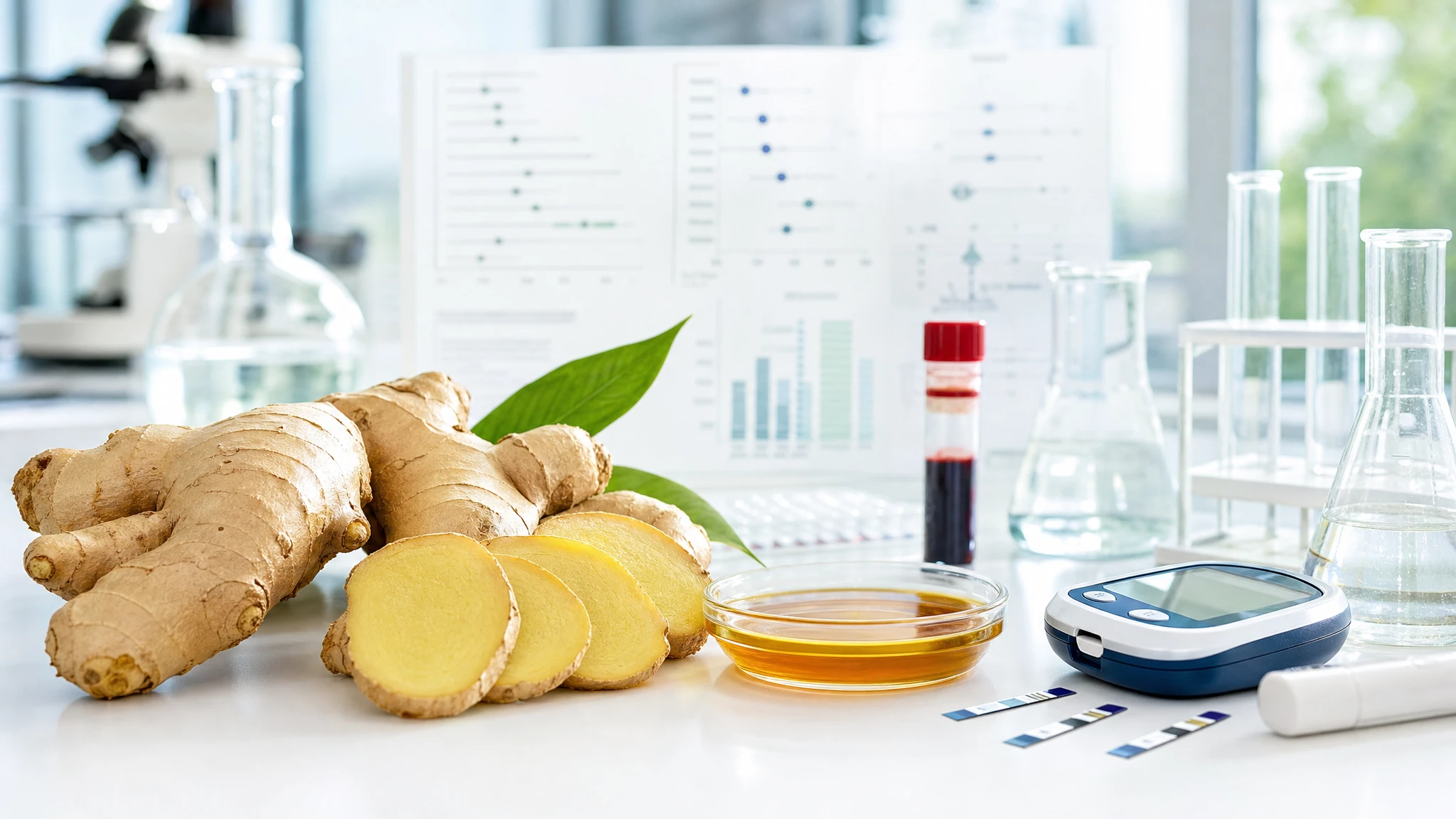
ABSTRACT : WHAT THE SCIENCE SAYS
This systematic review with meta-analysis gathered controlled studies on ginger in people with type 2 diabetes and other metabolic conditions. The main result is a potential average improvement in glycemia, HbA1c, and certain indicators of insulin action, though with significant differences between studies.
The authors' synthesis selected 10 studies, totaling 490 participants, from a broader systematic review of 12 publications. It compared ginger preparations with a placebo and evaluated fasting glycemia, HbA1c, insulin, HOMA-IR, lipids, and body mass index. HbA1c, or glycated hemoglobin, describes the average glucose exposure over the preceding months. The analysis estimated an average reduction in HbA1c of 1.00 percentage point compared to the placebo, with a confidence interval from −1.56 to −0.44 and P<0.001. It also detected a decrease in fasting insulin and HOMA-IR, an index that estimates insulin resistance. Results on lipids were favorable on average, while the body mass index did not change in a statistically significant way. The authors observed high heterogeneity for glycemia, HbA1c, and HOMA-IR: this means that the effects varied greatly based on the population, dose, duration, and initial conditions. Therefore, the publication points to a possible association with better metabolic values; it does not demonstrate that ginger prevents complications or replaces diabetes therapies.
What this research analyzed
For a person with type 2 diabetes, the practical point is to understand whether a change in laboratory values is repeatable and attributable to the intervention. Zhu and colleagues therefore examined randomized clinical trials, which are studies in which assignment to ginger or a control group occurs randomly. The preparations were mainly capsules or tablets, with different dosages and durations.
The primary outcomes were fasting glycemia, HbA1c, insulin, and HOMA-IR (a calculated index that estimates insulin resistance). Triglycerides, cholesterol, and body mass index were also included. Some studies concerned type 2 diabetes, while others involved obesity or peritoneal dialysis with metabolic alterations. This broadens the picture, but makes the application less direct for all people with type 2 diabetes.
Research data
Effects of Ginger (Zingiber officinale Roscoe) on Type 2 Diabetes Mellitus and Components of the Metabolic Syndrome: A Systematic Review and Meta‐Analysis of Randomized Controlled Trials
- The meta-analysis included 10 studies and 490 participants; the initial systematic review comprised 12 publications.
- HbA1c was reduced by an average of 1.00 percentage point compared to placebo: 95% CI from −1.56 to −0.44; P<0.001.
- Fasting insulin and HOMA-IR decreased, but glycemia, HbA1c, and HOMA-IR showed high heterogeneity between studies.
What results emerge from the study
Overall, the synthesis found more favorable mean values for glucose control. HbA1c decreased by 1.00 percentage point compared to the placebo, with a 95% CI from −1.56 to −0.44 and P<0.001. In simple terms, the result suggests a possible improvement in average glycemia over time in the treated groups, not the certainty of the same effect in an individual person.
Fasting insulin also decreased by 1.62 μIU/mL, with a 95% CI from −2.20 to −1.05 and P<0.001. HOMA-IR decreased by 0.59 points, with a 95% CI from −1.01 to −0.17 and P<0.01. The authors also noted favorable mean changes in triglycerides, total cholesterol, LDL-cholesterol, and HDL-cholesterol. Body mass index, however, did not change significantly: mean difference −0.27 kg/m²
Why this study is relevant
This publication is relevant because it does not interpret a single isolated value. It considers both momentary glycemia and HbA1c, which reflects a longer period, and pairs them with indicators of the insulin response. This approach helps to distinguish a possible transient effect from a more consistent metabolic change.
However, the work also shows that context matters. In subgroup analyses, fasting glycemia improved in people with type 2 diabetes or higher baseline values, while it did not change significantly in groups with obesity and normal baseline glycemia. This is a sign of possible dependence on the starting condition, not an individual clinical rule.
Study limitations and what it does NOT demonstrate
The main limitation is the variability of the studies. Diagnoses, dosages, product forms, duration, and participant characteristics all differed. For fasting glycemia, HbA1c, and HOMA-IR, there was high heterogeneity: the mean value summarizes results that are not entirely comparable.
Methodological quality was not uniform. Only four studies clearly described randomization, and five described allocation concealment, which is the procedure that prevents predicting the group assigned to each participant. Furthermore, some data came from populations other than those with type 2 diabetes. The study by Zhu and colleagues does not demonstrate the prevention of heart attack, nephropathy, or other complications, does not identify a dose valid for everyone, and does not prove that ginger can replace diet, physical activity, check-ups, or prescribed medications.
Independent confirmatory evidence
One step in the chain concerns the potential improvement of glycemia, HbA1c, and insulin resistance. In a randomized, double-blind, placebo-controlled clinical trial, Arablou and colleagues assigned 70 people with type 2 diabetes to 1,600 mg of ginger per day or a placebo for 12 weeks. The ginger group showed significant reductions in fasting glycemia, HbA1c, insulin, and HOMA compared to the control group [1]. This is a direct confirmation of the clinical signal observed by Zhu and colleagues, but it remains limited by a small sample size, short duration, and a single clinical setting.
On a larger scale, Ebrahimzadeh and colleagues gathered 10 randomized articles. They estimated a reduction in fasting glycemia of 18.81 mg/dL and in HbA1c of 0.57 percentage points [2]. Li and colleagues subsequently included 13 articles and 837 participants, obtaining favorable estimates for glycemia and HbA1c [3]. These summaries reinforce the consistency of the signal, but both report very high heterogeneity: the confirmation is moderate regarding the direction of the results, but not high regarding clinical precision.
Conflicting evidence
The evidence is not uniform across all outcomes. Chen and colleagues, analyzing 13 randomized trials with 837 participants, observed average reductions in glycemia and HbA1c, but no statistically significant effect on HOMA-IR, total cholesterol, LDL-cholesterol, diastolic blood pressure, or body mass index [4]. This scales back the idea of a consistent effect on insulin action and the cardiometabolic profile as a whole; the authors judge the certainty of the evidence to be low or very low.
A previous clinical study by Bordia and colleagues, conducted in people with coronary artery disease, including people with non-insulin-dependent diabetes, did not detect any changes in glycemia or lipids after 4 g per day of ginger for three months [5]. The result is relevant but indirect: the sample does not coincide with a population exclusively with type 2 diabetes, and the publication does not allow for an estimate applicable to modern trials to be derived. No directly conflicting evidence of sufficient relevance was identified beyond those reported; this does not prove the absence of contrary results.
Comparative overview
Subsequent publications show an overall favorable direction for some glycemic values, but also significant limitations in precision and generalizability.
| Publication | Model and sample size | Main result | Relationship with the Zhu study |
|---|---|---|---|
| Arablou 2014 [1] | RCT, double-blind; 70 people with type 2 diabetes | Significant reductions in glycemia, HbA1c, insulin, and HOMA compared to placebo | Direct confirmation, but short duration |
| Ebrahimzadeh 2022 [2] | Meta-analysis of 10 randomized articles | Lower average glycemia and HbA1c; no significant changes in lipids | Direct confirmation with more conservative estimates |
| Li 2026 [3] | Meta-analysis of 13 articles, 837 participants | Average reductions in glycemia, HbA1c, triglycerides, and LDL-cholesterol | Updated confirmation, with high heterogeneity |
| Chen 2026 [4] | Meta-analysis of 13 RCTs, 837 participants | No significant effect on HOMA-IR, LDL-cholesterol, total cholesterol, and BMI | Partial discordance on metabolic outcomes |
| Bordia 1997 [5] | Clinical study in people with coronary artery disease; sample size not available | No significant variation in glycemia or lipids with 4 g/day for three months | Indirect discordance due to population and design |
Editorial conclusion
References
[1] The effect of ginger consumption on glycemic status, lipid profile and some inflammatory markers in patients with type 2 diabetes mellitus
[2] The effect of ginger supplementation on metabolic profiles in patients with type 2 diabetes mellitus: A systematic review and meta-analysis of randomized controlled trials
[3] A meta-analysis of the effects of Zingiber officinale on metabolic indices among patients with type 2 diabetes
[4] Meta-analysis of the effects of ginger supplementation on glycemic control, blood pressure and lipid profile in patients with type 2 diabetes
Editorial note
Artificial Intelligence was used solely as a tool to support editorial and documentary work. All content, interpretations, bibliographic citations and conclusions have been verified, reviewed and approved by the author, who assumes full scientific responsibility for them.
The manuscript was also subject to independent peer review prior to publication.
To ensure maximum transparency, the article's complete history — including the dates of submission, review, acceptance and publication, as well as information on the peer review process — is available on the dedicated Article History page.