


Pharmacokinetics of oral piperine extract: what the Sahastara study shows
In 2020, Thai researcher Itharat and colleagues, in the journal Research in Pharmaceutical Sciences, studied how the piperine contained in Sahastara extract capsules is absorbed and remains detectable in the body after a single oral intake in healthy volunteers. The work therefore examines blood exposure, not the efficacy of the preparation on a disease.
- Published 27/10/2026
- Updated 30/10/2026
- Reviewed 30/10/2026
- Article history
ABSTRACT : WHAT THE SCIENCE SAYS
This phase 1 clinical trial measured piperine in the blood following a single dose of Sahastara capsules, a multi-plant herbal preparation. The main finding is that the compound was detectable in plasma for up to 48 hours. The study does not evaluate therapeutic benefits or common dietary black pepper.
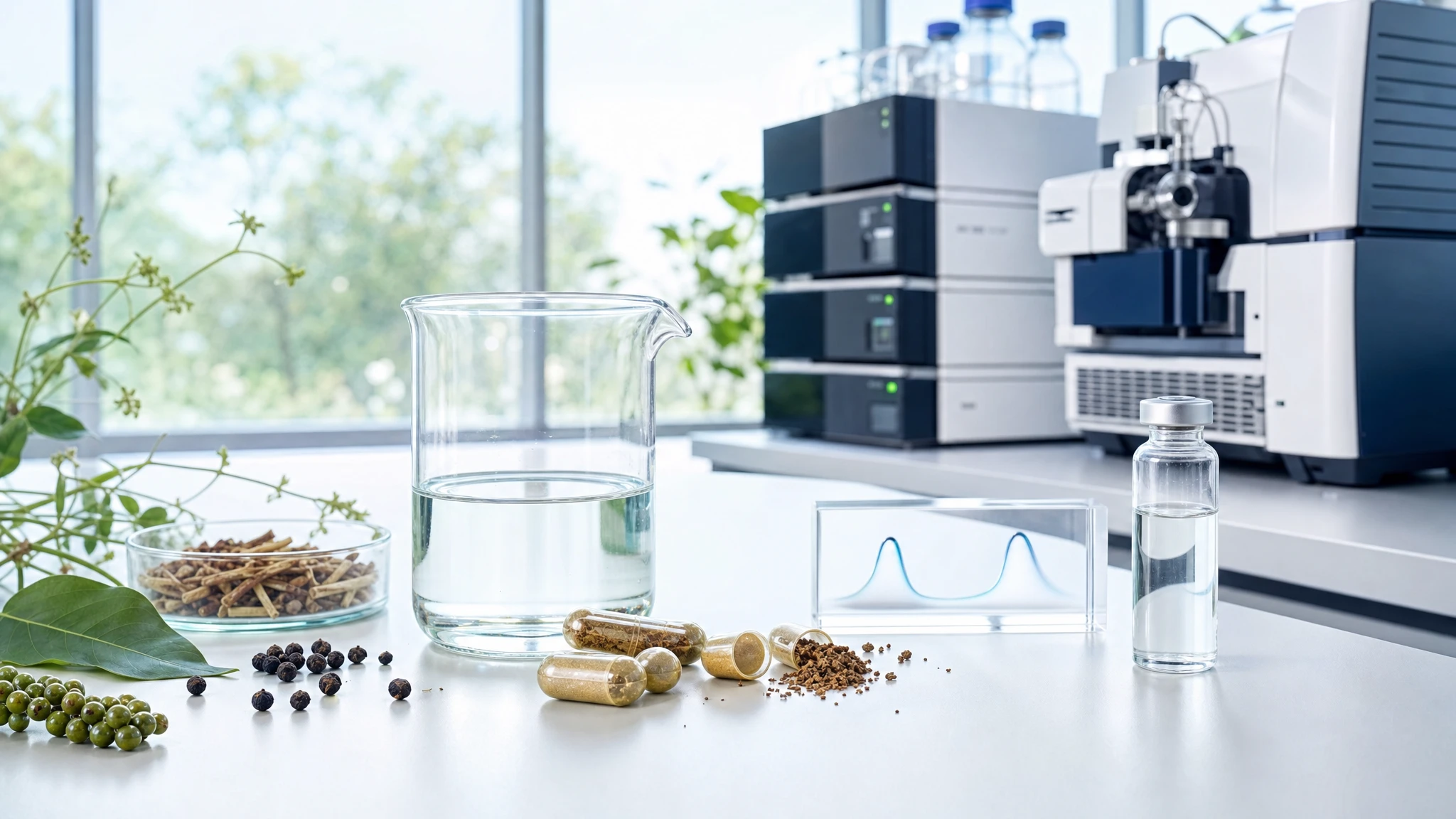
The authors' summary describes a study on 24 healthy volunteers, divided into two groups of 12 people. Participants took a single dose of 100 or 200 mg of Sahastara extract after fasting. Researchers collected blood samples for up to 48 hours and urine during the first 24 hours. Piperine was quantified using liquid chromatography-mass spectrometry, a technique that identifies and measures specific molecules in biological samples. Plasma concentrations increased to a peak about two hours after intake, then decreased without disappearing by the final measurement. The average peak reported was higher with 200 mg compared to 100 mg. The authors also observed a second increase in concentrations at some points on the curve, interpreted as possible enterohepatic recirculation: a portion of the substance or its derivatives may pass from the liver to the intestine and re-enter circulation. A negligible amount of unmodified piperine was detected in the urine. No serious adverse events emerged; one person reported transient abdominal pain. The data describe the behavior of piperine in this formulation, not the clinical efficacy of the preparation.
What this research analyzed
The 2020 study by Itharat and colleagues verified whether piperine present in a complex plant extract could be tracked in the blood after ingestion. In practical terms, it studied the molecule's temporal pathway in the body, not an effect on pain, metabolism, or other clinical conditions.
The capsules contained dried ethanolic extract of Sahastara, a formulation with 21 medicinal plants. After a single dose of 100 or 200 mg, the researchers collected blood at predetermined intervals and urine for 24 hours. They calculated maximum concentration, time to peak, area under the curve or AUC (a measure of overall exposure over time), half-life, and mean residence time.
Piperine was the marker analyzed, meaning the substance chosen to verify exposure to the preparation. This does not mean it was the only compound absorbed, nor that it alone explains any potential effects of the mixture. The quantitative results are derived from this.
Research data
Pharmacokinetics of piperine after oral administration of Sahastara remedy capsules in healthy volunteers
- Phase 1 clinical study on 24 healthy volunteers: 12 received 100 mg and 12 received 200 mg of Sahastara extract.
- Piperine was measured in plasma for up to 48 hours using liquid chromatography-mass spectrometry; it was almost absent in urine in its unmodified form.
- The mean plasma peak was higher with 200 mg; the authors observed a second rise in the curve consistent with possible enterohepatic recirculation.
What results emerge from the study
Piperine was measurable in plasma and reached its peak approximately two hours after intake. This indicates that, in this formulation, a portion of the compound crosses the intestine and enters systemic circulation. Concentrations remained detectable for up to 48 hours, but this data does not equate to demonstrating a biological effect for that entire duration.
With 100 mg, the mean maximum value reported was 3.77, while with 200 mg it was 6.59; the difference was statistically significant (P=0.008). However, the publication reports an inconsistency in the unit of measurement between the text and the table, specifically micrograms/mL and nanograms/mL. For the sake of accuracy, the comparison between the two groups is more robust than the absolute value of the reported unit.
The AUC from 0 to 48 hours was 54.58 ± 21.00 versus 77.73 ± 45.40 μg·h/mL; the difference was not statistically significant (P=0.178). A second elevation in concentrations suggests possible enterohepatic recirculation, but does not directly demonstrate the mechanism. Subsequent data help to contextualize this observation.
Why this study is relevant
The relevant finding is methodological: piperine can be identified in the blood even when it originates from an extract containing many other plant substances. This allows for the comparison of formulations and the planning of future studies on dosage, administration intervals, and safety.
The study also shows why black pepper, extracts, and supplements should not be considered interchangeable. The speed and extent of exposure depend on the actual dose ingested, the formulation, other components, and individual characteristics. A result obtained with Sahastara does not automatically describe piperine consumed in a standard culinary serving of pepper.
Independent literature observes similar profiles, but also differences linked to the product and the substance taken alongside piperine. This necessitates a cautious interpretation.
Study limitations and what it does NOT demonstrate
This is a small study involving 24 healthy adults and a single administration. It cannot estimate long-term safety, variability in people with chronic diseases, or the effects of repeated doses. The absence of serious adverse events in the short term does not prove the absence of risks in other contexts.
The preparation studied was a mixture of 21 plants, not purified piperine or culinary black pepper. Therefore, it is not possible to attribute all the observed pharmacokinetic characteristics to piperine alone. Furthermore, the possible enterohepatic circulation is a hypothesis based on the shape of the curve, not a demonstration obtained by measuring metabolites or bile.
Finally, the study was not designed to evaluate therapeutic efficacy, weight loss, prevention, or metabolic improvements. Measuring a molecule in plasma demonstrates systemic exposure, not a clinical benefit.
Independent confirmatory evidence
Direct confirmation comes from the study by Jumpa-ngern and colleagues on 20 healthy volunteers who received 100 or 200 mg of the Benjakul formulation. Here, too, piperine was measured in the serum after an oral dose, with an initial peak around one hour and a second peak in some of the participants [1]. This supports the progression of oral absorption → presence in the blood → possible double-peak pattern. The confirmation is moderate: the human model is relevant, but the plant mixture and the analytical method were different.
Two clinical studies on healthy volunteers indirectly confirm that ingested piperine can modify the systemic exposure of other molecules. After 20 mg per day, Bano and colleagues observed higher maximum concentrations and AUC for propranolol and theophylline in two groups of six people [2]. Bedada and Boga detected, in 12 volunteers, an increase in the maximum concentration and AUC of fexofenadine after 10 days of piperine [3]. These findings do not measure the pharmacokinetics of piperine itself, but they make it biologically plausible that oral exposure can affect intestinal transporters or metabolism. These are small, drug-specific clinical signals, not general rules.
Conflicting evidence
Interactions are not constant across formulations and substances. In a randomized, placebo-controlled, crossover study on eight volunteers, a preparation containing curcuminoids and 24 mg of piperine did not significantly alter the maximum concentration, AUC, clearance, or half-life of midazolam, flurbiprofen, and paracetamol [4]. This result limits the idea that piperine always increases absorption or always reduces metabolism.
A second randomized, double-blind study on 24 people found no statistically significant improvement in the pharmacokinetics of resveratrol when combining 5 or 25 mg of piperine with a single dose of resveratrol [5]. The response was not dose-linear. Both studies are relevant because they show a dependency on the associated compound, the dose, and the formulation; however, they do not directly contradict the detection of piperine in the blood in the Itharat study. Rather, they indicate that piperine exposure and the enhancement of another substance are different questions.
Comparative overview
Comparison between independent publications and the 2020 work by Itharat and colleagues.
| Publication | Model and key data | Main result | Relation to the study |
|---|---|---|---|
| Jumpa-ngern et al., 2013 [1] | Human experimental study; 20 volunteers; Benjakul 100 or 200 mg | Piperine detected rapidly in serum; second peak in some participants | Direct confirmation of oral absorption in another plant mixture |
| Bano et al., 1991 [2] | Human crossover study; two groups of 6 volunteers; piperine 20 mg/day | Increased exposure to propranolol and theophylline | Indirect confirmation of the pharmacokinetic relevance of oral piperine |
| Bedada and Boga, 2017 [3] | Human sequential study; 12 volunteers; piperine 20 mg/day for 10 days | Increase in maximum concentration and AUC of fexofenadine | Indirect confirmation, limited to one drug and repeated administration |
| Volak et al., 2013 [4] | Crossover RCT; 8 volunteers; curcuminoids plus piperine | No clinically relevant change in three probe drugs | Conflicting evidence: the interaction is not universal |
| Peters et al., 2021 [5] | Pilot RCT; 24 volunteers; resveratrol with 0, 5, or 25 mg of piperine | No statistically significant enhancement of resveratrol | Conflicting evidence: effect dependent on compound and dose |
Editorial conclusion
The study by Itharat and colleagues shows that piperine from Sahastara capsules can be measured in the blood after a single oral intake in healthy adults. The peak appeared approximately within two hours, and the molecule remained detectable for up to 48 hours. The trend showing a second peak is consistent with possible recirculation between the liver and the intestine, but it does not constitute direct proof of this. The value of the study is primarily pharmacokinetic: it helps describe exposure to a plant compound within a complex formulation. However, it does not allow for the establishment of therapeutic benefits, useful doses, or long-term safety. Other small human studies confirm that oral piperine can be relevant to exposure to certain substances, while controlled trials show that this effect is not consistent. The most balanced conclusion is that extracts containing piperine require specific evaluations of formulation, dose, and potential interactions, without equating them to black pepper used as a spice.
References
[1] Pharmacokinetics of piperine following single dose administration of benjakul formulation in healthy Thai subjects
[2] Effect of piperine on bioavailability and pharmacokinetics of propranolol and theophylline in healthy volunteers
[3] The influence of piperine on the pharmacokinetics of fexofenadine, a P-glycoprotein substrate, in healthy volunteers
[4] Effect of a herbal extract containing curcumin and piperine on midazolam, flurbiprofen and paracetamol (acetaminophen) pharmacokinetics in healthy volunteers
[5] A randomized, double-blind, dose-ranging, pilot trial of piperine with resveratrol on the effects on serum levels of resveratrol
Editorial note
Artificial Intelligence was used solely as a tool to support editorial and documentary work. All content, interpretations, bibliographic citations and conclusions have been verified, reviewed and approved by the author, who assumes full scientific responsibility for them.
The manuscript was also subject to independent peer review prior to publication.
To ensure maximum transparency, the article's complete history — including the dates of submission, review, acceptance and publication, as well as information on the peer review process — is available on the dedicated Article History page.