


Phytochemical composition of cloves: new evidence from 2025
In 2025, researcher Abdelmuhsin and colleagues, in the journal Pharmaceuticals, studied the chemical composition and radical-neutralizing capacity of an extract from dried Syzygium aromaticum buds. The study combined laboratory tests, identification of volatile molecules via GC-MS, and computer simulations of the interaction between plant compounds and target proteins.
- Published 30/10/2026
- Updated 30/10/2026
- Reviewed 30/10/2026
- Article history
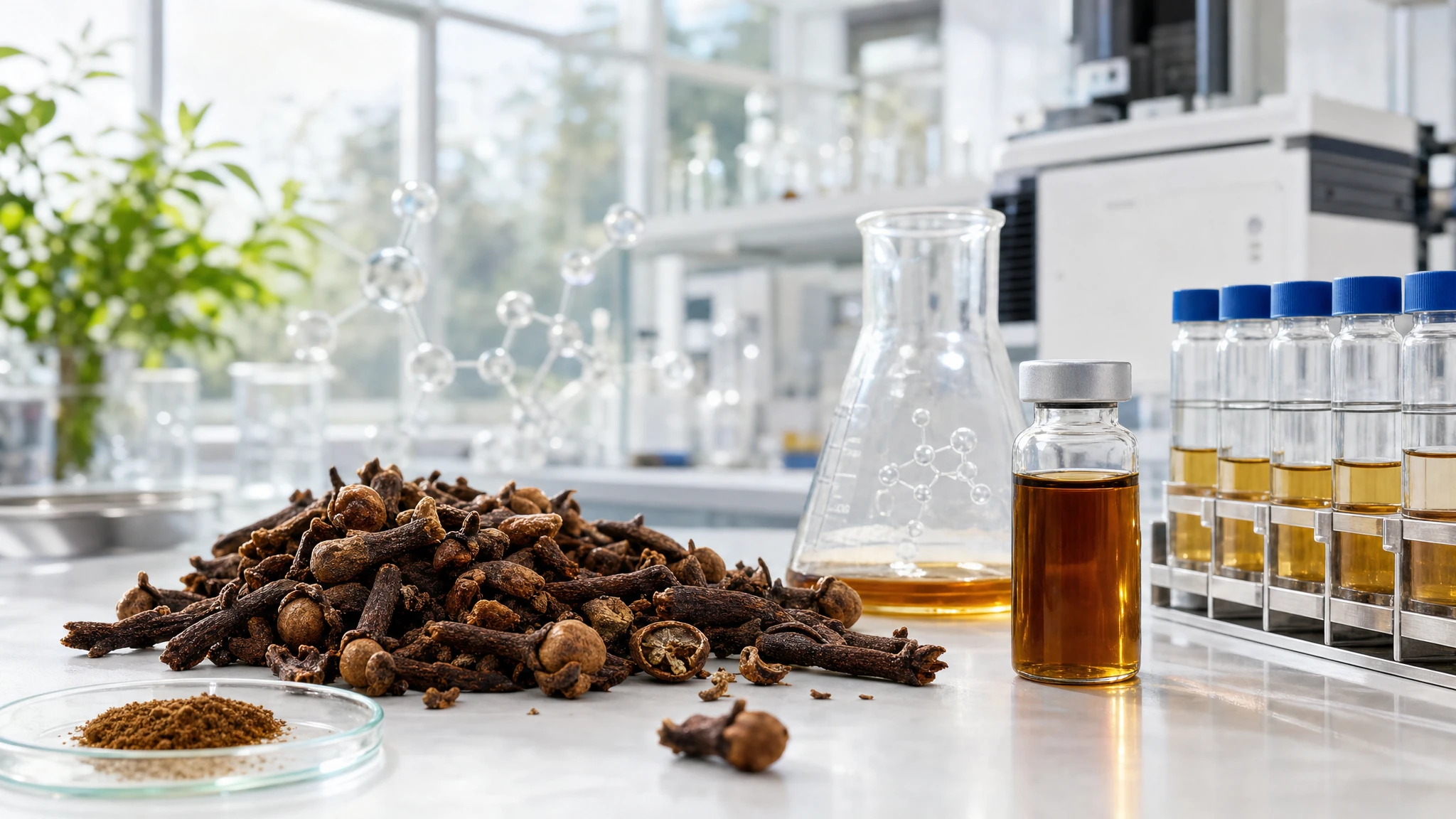
ABSTRACT : WHAT THE SCIENCE SAYS
The study examined an extract obtained from dried buds of Syzygium aromaticum. The authors measured several plant compounds, evaluated the ability to neutralize radicals in a test tube, and identified volatile molecules using GC-MS. The main finding is the predominance of eugenol in the analyzed sample.
The authors' summary describes experimental laboratory research, not a study on humans. The extract showed activity in the DPPH test, a method that verifies how well a substance can neutralize an artificial radical in a test tube. In this test, a lower IC50 (concentration required to reduce the signal by 50%) indicates greater activity in the analytical system. The IC50 of the extract was 0.08 ± 0.01 mg/mL; in the same comparison, ascorbic acid and BHT had lower values, therefore showing greater activity in this specific test. Gas chromatography-mass spectrometry, known as GC-MS (a technique that separates and identifies volatile molecules), detected 21 components. Eugenol accounted for 58.86% of the relative area of the identified signals. The authors also applied molecular docking, a simulation that estimates whether the shape of a molecule can fit into a specific area of a protein. This part generates hypotheses about interactions but does not prove antimicrobial, insecticidal, or therapeutic effects in living organisms.
What this research analyzed
The 2025 study by Abdelmuhsin and colleagues analyzed a sample of dried clove buds collected in Sudan. In practical terms, the question was whether the plant material retained measurable molecules capable of reacting with radicals in a test-tube assay. The authors quantified total phenols and flavonoids, two groups of plant substances that can contribute to the chemical behavior of the extract.
They then used GC-MS, a technique that first separates volatile compounds and then compares their characteristics with reference databases. Finally, they performed molecular docking on 21 identified compounds. This simulation is used to estimate possible fits between a molecule and a protein, not to demonstrate that the interaction occurs in a bacterium, an insect, or the human body.
Research data
Clove (Syzygium aromaticum) Pods: Revealing Their Antioxidant Potential via GC-MS Analysis and Computational Insights
- The reported content was 7.25 ± 0.12 mg gallic acid equivalents/g for total phenols and 57.22 ± 0.41 mg quercetin equivalents/g for flavonoids.
- In the DPPH test, the extract had an IC50 of 0.08 ± 0.01 mg/mL; in the same test, BHT and ascorbic acid showed lower values.
- GC-MS identified 21 components; eugenol was the most abundant, accounting for 58.86% of the identified relative area.
What results emerge from the study
The most immediate result is that the sample was not chemically uniform. Eugenol, an aromatic molecule from the phenylpropanoid family, was the main volatile component, accounting for 58.86% of the relative area detected. A total of 21 compounds were identified. This describes the profile of the analyzed sample, not a mandatory composition for every commercial product.
The extract neutralized the DPPH radical in a test tube with an IC50 of 0.08 ± 0.01 mg/mL. The practical significance is limited to the test: it indicates chemical reactivity toward that artificial radical. Since BHT and ascorbic acid had lower IC50 values in the same experiment, the extract was found to be less active than these references according to that measure. Docking data suggest theoretical affinities with selected proteins, but they do not replace microbiological, toxicological, or clinical tests.
Why this study is relevant
For those who want to understand the quality of the spice, this work is useful because it links a dried bud to concrete measurements: estimated quantities of plant compound groups, the footprint of volatile molecules, and performance in an anti-radical test. It also shows why eugenol is often used as a descriptive indicator of the aromatic profile of cloves.
The relevance remains primarily analytical and preclinical. The research does not evaluate dietary consumption, intestinal absorption, bioavailability (the portion of a substance that reaches the circulation), nor benefits or risks in people. It therefore helps to characterize the plant material, but does not allow for the deduction of health effects from the mere presence of eugenol or the value obtained in the DPPH test.
Study limitations and what it does NOT demonstrate
The study concerns a single plant sample and tests performed outside the organism. Harvesting, bud age, drying, storage, origin, and extraction technique can modify the final profile. There is no evidence available that the reported percentages represent all dried buds on the market.
The DPPH test measures chemical capacity under controlled conditions; it does not directly measure oxidative stress in human tissues and is not equivalent to a preventive or therapeutic effect. Molecular docking is also a mathematical prediction: it can guide subsequent experiments, but it does not prove activity against bacteria nor efficacy as an insecticide. The 2025 study by Abdelmuhsin and colleagues is not a clinical trial and does not provide dietary doses or instructions for use.
Independent supporting evidence
Initial confirmation concerns the biological variability of the bud. Alfikri and colleagues compared three developmental stages in young and mature plants: they collected buds from 9 young and 3 mature plants, with three replicates per condition. Using GC-MS, they found eugenol levels between 68.05% and 82.38%, while the DPPH IC50 varied from 15.80 to 108.85 µg/mL [1]. This experimental study supports the transition from bud state to composition and analytical response. The confirmation is direct regarding the oil profile, but it does not coincide with the extract nor does it demonstrate effects in humans.
A second experimental study identified eugenol as the major component of an essential oil, at 53.23%, and observed anti-radical activity in vitro for both the oil and isolated eugenol [2]. The chain supported is volatile composition → eugenol contribution → response in a chemical assay. The oil had an EC50 of 78.98 µg/mL, while eugenol showed 12.66 µg/mL. This is moderate-level confirmation for the analytical mechanism, with the limitation that essential oil and bud extract are not equivalent.
A third experiment identified eugenol at 60.5% in the oil obtained from buds and measured the ability to neutralize the ABTS radical, another artificial laboratory system [3]. The result reinforces the idea that a eugenol-rich profile may be associated with anti-radical reactivity in vitro. The confirmation is indirect compared to the 2025 study, because it uses a different method and includes synthetic derivatives; it does not clarify the effect of the spice in the diet.
Conflicting evidence
Available evidence indicates that activity and composition depend on the form examined. Politeo and colleagues compared volatile compounds released from sugar-bound forms with clove essential oil. Only eugenol was common to both profiles; the released fraction showed lower activity than the oil in both DPPH and FRAP tests, a method that measures reducing power [4]. This does not negate the results of Abdelmuhsin and colleagues from 2025, but it shows that the matrix and preparation method change the outcome.
Further evidence comes from an extraction experiment using pressurized carbon dioxide. Depending on pressure and temperature, the eugenol in the extracted oil ranged between 48.41% and 58.62%, with higher proportions of eugenyl acetate and beta-caryophyllene compared to the 2025 sample [5]. The model was a physicochemical system using ground buds, without biological tests and without a declared biological sample size. The discrepancy is relevant because it reduces the generalizability of a single GC-MS profile. No sufficiently relevant directly conflicting evidence regarding the identification of eugenol as an important component has been identified; this does not prove the absence of contrary results.
Comparative overview
The following research compares the consistency and limitations of the chemical profile and laboratory tests with respect to the 2025 publication.
| Publication | Model and main data | Relevant result | Relationship with the 2025 study |
|---|---|---|---|
| Alfikri et al., 2020 [1] | Buds at three stages; 9 young plants, 3 mature; GC-MS and DPPH | Eugenol 68.05–82.38%; variable DPPH activity | Direct confirmation of variability linked to bud development |
| Teles et al., 2021 [2] | Essential oil and eugenol; GC-MS and in vitro assays | Eugenol 53.23%; eugenol showed higher activity than the oil in the test used | Confirms the descriptive role of eugenol and its reactivity in test tubes |
| Gulcin et al., 2011 [3] | Bud oil and eugenol derivatives; GC-MS and ABTS | Eugenol 60.5%; antiradical activity measured in the laboratory | Indirect confirmation using a different analytical method |
| Politeo et al., 2010 [4] | Bound volatile fractions and essential oil; DPPH and FRAP | Bound fractions were found to be less active than the oil | Shows dependence of the outcome on the matrix and method |
| Zapata Noreña and Meireles, 1997 [5] | Ground buds; extraction with pressurized CO2 | Eugenol 48.41–58.62% depending on operating conditions | Shows that the extraction technique can change the profile |
Editorial conclusion
References
[1] Yield, Quality, and Antioxidant Activity of Clove (Syzygium aromaticumL.) Bud Oil at the Different Phenological Stages in Young and Mature Trees
[2] GC-MS Characterization of Antibacterial, Antioxidant, and Antitrypanosomal Activity of Syzygium aromaticum Essential Oil and Eugenol
[3] Scavenger Activity Evaluation of the Clove Bud Essential Oil (Eugenia caryophyllus) and Eugenol Derivatives Employing ABTS+ Decolorization
[4] COMPARISON OF CHEMICAL COMPOSITION AND ANTIOXIDANT ACTIVITY OF GLYCOSIDICALLY BOUND AND FREE VOLATILES FROM CLOVE (EUGENIA CARYOPHYLLATATHUNB.)
[5] THE EFFECTIVE DIFFUSIVITY OF CLOVE(Eugenia caryophyllus) ESSENTIAL OIL IN PRESSURIZED CO2
Editorial note
Artificial Intelligence was used solely as a tool to support editorial and documentary work. All content, interpretations, bibliographic citations and conclusions have been verified, reviewed and approved by the author, who assumes full scientific responsibility for them.
The manuscript was also subject to independent peer review prior to publication.
To ensure maximum transparency, the article's complete history — including the dates of submission, review, acceptance and publication, as well as information on the peer review process — is available on the dedicated Article History page.