


Soluble and insoluble fiber: practical differences and how to choose the right one for your diet
Research shows that distinguishing between soluble and insoluble fiber is useful, but not sufficient. More viscous fibers tend to affect satiety, glycemia, and lipids. Less viscous ones primarily impact transit and stool volume. However, the food matrix (food structure), dosage, and type of meal also change the outcome.
- Published 30/09/2026
- Updated 15/10/2026
- Reviewed 15/10/2026
- Article history

ABSTRACT : WHAT THE SCIENCE SAYS
Understanding the difference between soluble and insoluble fiber helps you read labels and make better food choices. Fibers act in different ways: some disperse in water, while others maintain a firmer structure. This distinction is useful, but the form of the food and the amount consumed also matter.
Viscosity (resistance to flow) and fermentability (how much gut microbes transform the fiber) also count. Dividing fibers into soluble and insoluble is a good start, but it does not provide a fixed rule. In this article, we will see when this distinction is helpful and why the same food can have different effects. Here are the key aspects of this in-depth look, useful for navigating the different types of fiber:
- Practical difference between viscous and non-viscous fibers
- Effects on transit and stool consistency
- Role of fiber in satiety and meals
- Food sources useful for everyday choices
- Choosing fiber based on nutritional goals
Why distinguishing between soluble and insoluble fiber is useful in practice
Understanding how soluble and insoluble fiber work helps you choose the type best suited to your meal and your goals. This is not just a theoretical distinction. The two types of fiber interact differently with water, digestion, and nutrient absorption. Therefore, the choice depends on the effect you are looking for during your meal.
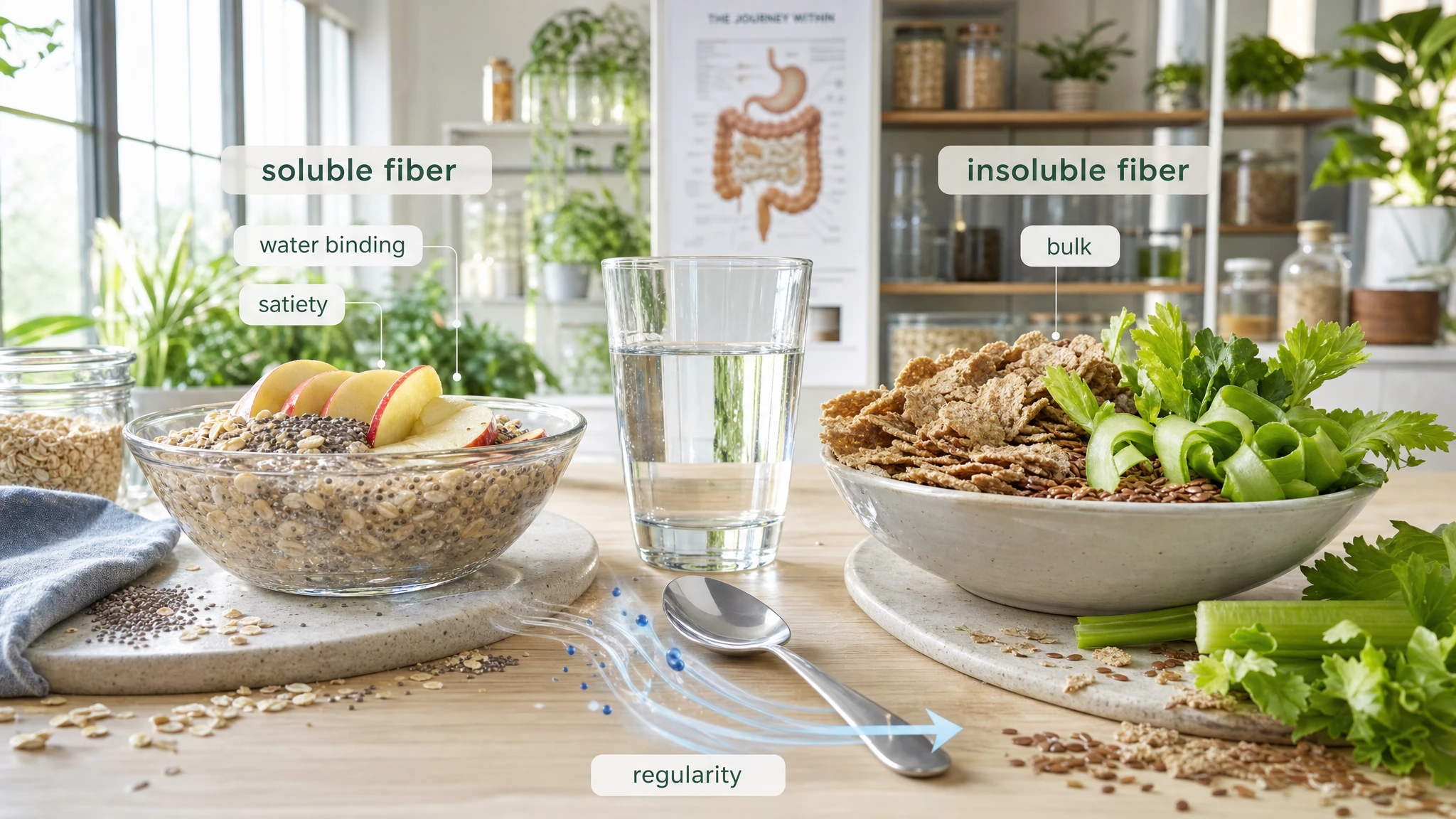
Distinguishing between soluble and insoluble fiber is useful because it is not just the amount consumed that matters. It also matters how the fiber acts in the gut and during the meal. This difference guides your daily choices.
This reading avoids overly simple conclusions. Not all viscous fibers (which form a gel) or non-viscous fibers act in the same way. The effect also changes with the quantity and the timing of intake.
The following paragraphs explain how these differences affect intestinal transit, satiety, and the response to a meal.
Some fibers modulate digestion, while others primarily increase stool volume or the feeling of fullness. To understand the effects in a concrete way, it is useful to keep three practical aspects in mind:
- some fibers form structures that retain water and slow down the digestion of the meal;
- others primarily increase stool volume and promote bowel regularity;
- the same fiber can be used in different cases, depending on the goal and individual tolerance.
In the following points, the distinction becomes practical. We move from classification to the effects to observe in meals and daily habits. Every choice depends on the concrete goal, not on a rigid label.
How to choose fiber based on the meal and the goal
Choosing the right fiber means connecting the type of soluble and insoluble fiber to the effect you wish to achieve. If the goal is to promote bowel regularity, you can pay closer attention to fibers that contribute to fecal volume and stool consistency. Insoluble fiber, such as the cellulose in whole grains, absorbs little water but increases the mass passing through the intestine. This mechanical stimulus promotes regular bowel movements. Soluble fiber, on the other hand, retains water and makes stools softer and easier to pass. For this reason, in many cases, both are used together for a complete and balanced effect.
If, however, you are interested in the post-meal response, the difference between more viscous and less viscous fibers becomes more relevant. Viscous soluble fibers, such as oat beta-glucans, form a gel that slows down stomach emptying. This delay reduces the speed at which sugars enter the bloodstream after a meal. Insoluble fibers do not have this direct effect on glycemia. In practice, the best criterion is to start from the context: one meal may require a more gradual effect on intestinal transit, while in other cases, individual tolerance matters most. The idea is not to find a perfect fiber for everyone, but to choose the one that best suits the goal of the moment. This approach helps to use classification as a decision-making tool rather than an abstract label.
Recent research and updates
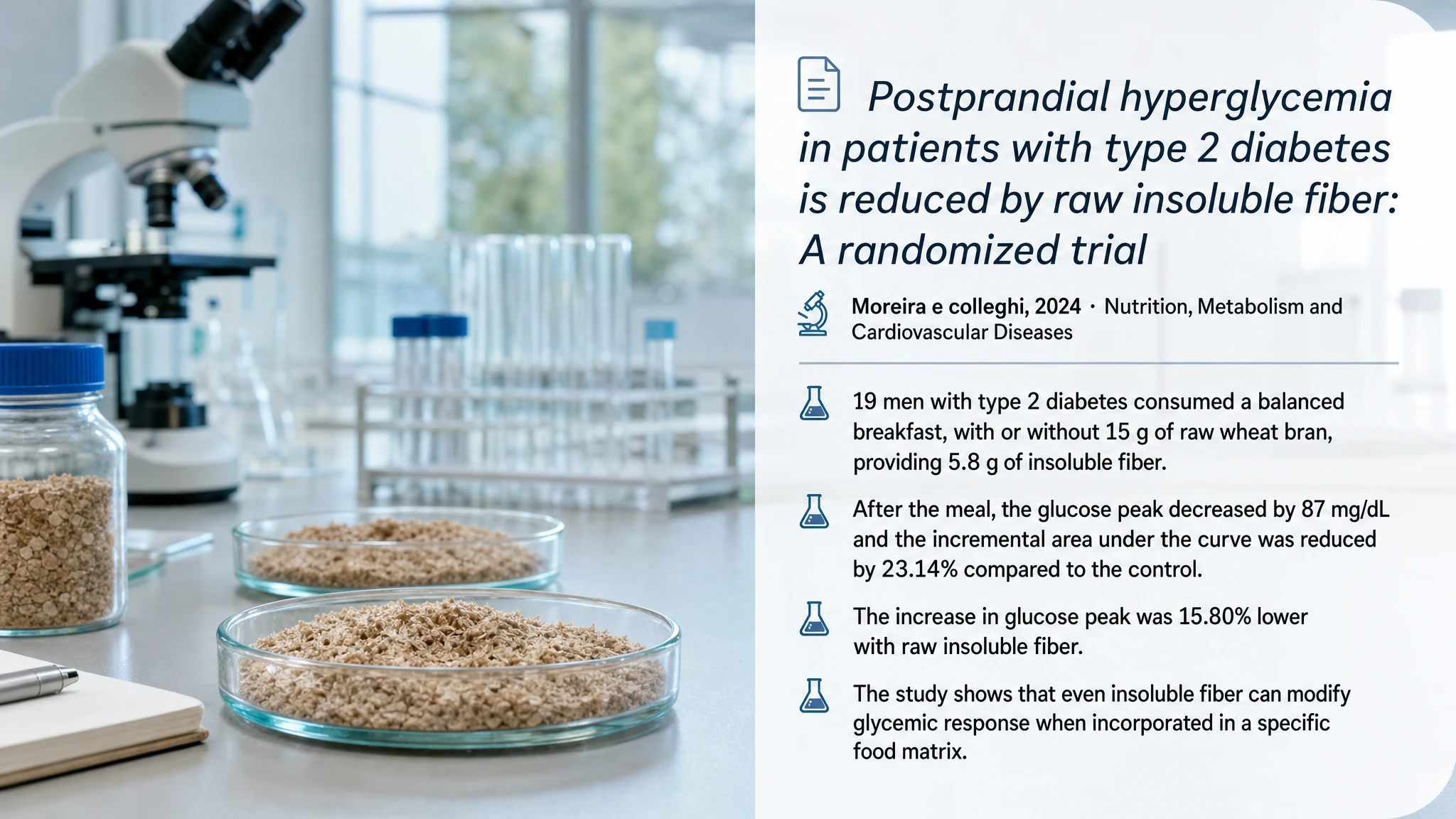
In 2024, Moreira, a Brazilian researcher, and her colleagues published a study in Nutrition, Metabolism and Cardiovascular Diseases. The group evaluated whether insoluble fiber could reduce the rise in glycemia after a meal. The fiber was not viscous, meaning it did not form a thick gel. However, it was present in a specific food: raw wheat bran. The study shows that the effect also depends on the food matrix, not just on the soluble or insoluble category.
*Postprandial hyperglycemia in patients with type 2 diabetes is reduced by raw insoluble fiber: A randomized trial*
- 19 men with type 2 diabetes consumed a balanced breakfast, with or without 15 g of raw wheat bran, equal to 5.8 g of insoluble fiber.
- After the meal, the glycemic peak dropped by 87 mg/dL and the incremental area under the curve was reduced by 23.14% compared to the control.
- With raw insoluble fiber, the increase in the glucose peak was 15.80% lower.
- The study shows that even an insoluble fiber can change the glycemic response if present in a specific food form.
Effects of soluble and insoluble fiber on digestion and satiety
The effects of soluble and insoluble fiber on digestion concern the passage of food and the feeling of fullness after meals. In practice, viscosity (the ability to create a dense mass), dosage, and the rest of the diet matter. It is therefore necessary to understand how fibers act on transit, nutrient utilization, and hunger.
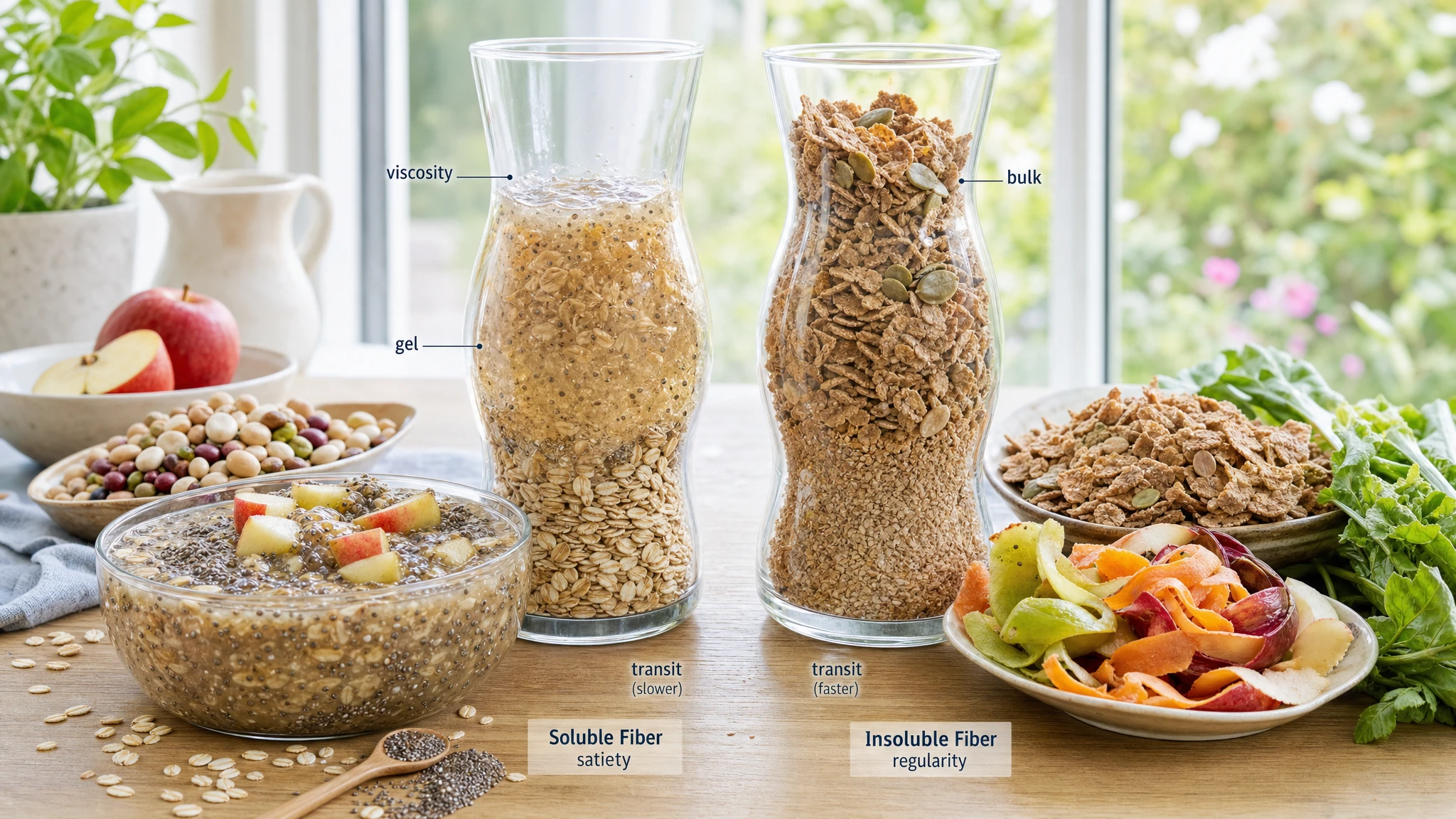
The effects of soluble and insoluble fiber depend on how food passes through the digestive tract. Some fibers form a thick intestinal gel, while others increase the volume of the contents and fecal mass. Both processes can influence fullness after meals and bowel regularity. However, they follow different pathways and may require different amounts of time.
This difference explains why viscous fibers and non-viscous fibers do not always produce the same effect. The former tend to slow down gastric emptying (the passage of food from the stomach to the intestine). The latter act primarily on the volume and consistency of the stool.
Overall, the type of fiber, the dose, and the other foods in the meal influence satiety. These factors also regulate the relationship between fiber and intestinal transit. The concrete effects, however, can vary from person to person.
To better understand these effects, it is useful to follow three key steps:
- Slower transit can prolong the feeling of fullness after a meal.
- Viscosity can change the absorption of nutrients and the course of glycemia over time.
- A greater volume of contents primarily helps to maintain daily bowel regularity.
Fullness between meals helps explain why some fibers are more satiating than others. This effect, on its own, does not always lead to weight loss. What matters most is how fiber changes the rhythm of the contents in the stomach and intestine.
Effects of fiber on the feeling of fullness between meals
The feeling of fullness between meals depends on many factors. Fiber can act directly on some of them. If it slows down the passage of food or increases the volume of the meal, hunger may return later. This support for satiety throughout the day does not automatically lead to weight loss. The type of fiber, the other foods in the meal, and personal habits remain decisive.
More viscous fibers tend to prolong fullness because they form a dense mass. The stomach and intestines take longer to process this mass. Less viscous fibers, on the other hand, act on the volume and shape of the intestinal contents. The result therefore depends on the meal as a whole, not just on the fiber chosen. The benefit can be tangible, but it varies from person to person. The most useful effect concerns hunger management, rather than weight loss that applies in every case.
Where to find soluble and insoluble fiber in foods
Knowing where to find soluble and insoluble fiber helps you make better choices, without looking for individual “superfoods.” What matters most is whole food, which provides fibers with different forms and functions. Legumes, whole grains, fruits, vegetables, seeds, and nuts offer varying amounts of viscous and non-viscous fibers. Viscous fibers absorb water and form a gel; non-viscous fibers primarily act on stool volume. It is therefore better to evaluate where the food comes from, not just the number shown on the label.
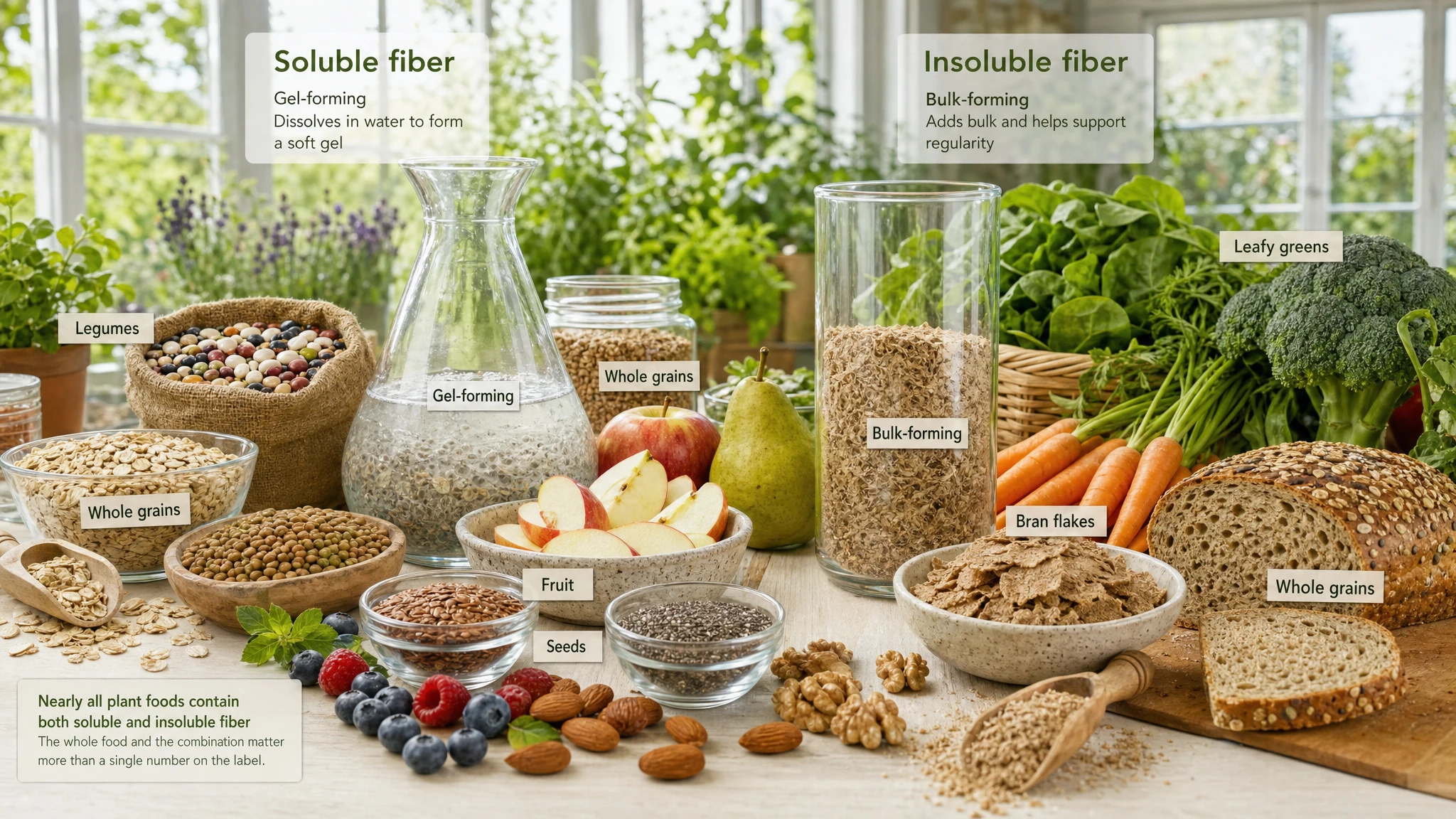
Sources of soluble and insoluble fiber are not clearly divided, as almost every plant-based food contains them in varying proportions. In practice, however, some groups tend to offer more components that form intestinal gel, while others primarily provide fractions that increase fecal bulk and support intestinal transit. For this reason, it is better to look at food as a whole, rather than just the total fiber figure listed on the label.
This practical approach also helps to understand why certain choices are more suitable when you want to work on dietary fiber and glycemia, satiety, or LDL cholesterol. In the following sections, the focus shifts to how to recognize useful sources by reading food, without reducing everything to a simple nutritional table.
When choosing what to put on your plate, it is useful to think about the most common sources and their practical use in a meal:
- Legumes, oats, and barley tend to offer more viscous fibers.
- Whole grains, bran, and many vegetables provide more non-viscous fibers.
- Fruit, seeds, and nuts provide useful and complementary combinations.
- The whole food matters more than the individual isolated fiber.
To choose a food well, it is not enough to find the word "fiber" written on its label. The type of food and the way we bring it to the table matter. Let us therefore look at some practical criteria for finding the most useful sources in everyday meals.
How to identify beneficial fiber when reading food labels
Identifying beneficial fiber means starting with the food itself rather than the total number on the label. A product may claim to contain fiber, but have a profile that is poorly suited to the goal of the meal. For this reason, it is advisable to check whether the source is a legume, whole grains, fruit, or vegetables, and also to assess how refined or processed the food is. This helps to better understand the difference between soluble fiber and insoluble fiber in practice, without turning it into a rigid rule.
In concrete terms, less refined foods tend to retain a larger share of viscous and non-viscous fibers in balance with each other, whereas processing can alter their behavior. This limitation is important: two products with the same grams of fiber can act differently on fiber and intestinal transit and on fiber and glycemia. The most reliable reading, therefore, remains one based on the type of food, the actual portion size, and the context of the meal, rather than on a single numerical value.
Summary of scientific evidence
This summary collects the available sources and shows how the various types of fiber act on viscosity, intestinal transit, and response to meals.
| Publication year | Area studied | What the studies indicate |
|---|---|---|
| 2016 | Physical properties of fibers and intestinal benefits | results vary: solubility and viscosity do not always coincide, so the product structure also matters [1] |
| 2023 | Viscosity and glucose and lipid metabolism | viscous fibers seem to have a more consistent effect on glycemia and lipids compared to non-viscous ones [2] |
| 2024 | Glycemic response after an insoluble fiber | even an insoluble fiber, when included in a suitable matrix, can reduce post-meal glycemia [3] |
| 2024 | Satiety and meal perception | the data are consistent: more viscous fibers tend to support satiety better than less viscous ones [4] |
| 2024 | Soluble fiber and lipid profile | more soluble fiber is associated with an average reduction in LDL cholesterol, which varies between studies [5] |
| 2024 | Fiber and intestinal transit | the effects on transit change according to the specific fiber component studied and the clinical context [6] |
Editorial reading of the evidence
Conclusions and editorial summary
Final critical note
Editorial note
Artificial Intelligence was used solely as a tool to support editorial and documentary work. All content, interpretations, bibliographic citations and conclusions have been verified, reviewed and approved by the author, who assumes full scientific responsibility for them.
The manuscript was also subject to independent peer review prior to publication.
To ensure maximum transparency, the article's complete history — including the dates of submission, review, acceptance and publication, as well as information on the peer review process — is available on the dedicated Article History page.