


Syzygium aromaticum essential oil: eugenol and compositional variability
In 2024, Spanish researcher Rafael Liñán-Atero and colleagues examined the chemical profile of Syzygium aromaticum essential oil in the journal Antioxidants, covering the methods used for its extraction, activities observed in experimental models, encapsulation strategies, and potential uses in the food industry.
- Published 20/11/2026
- Updated 20/11/2026
- Article history
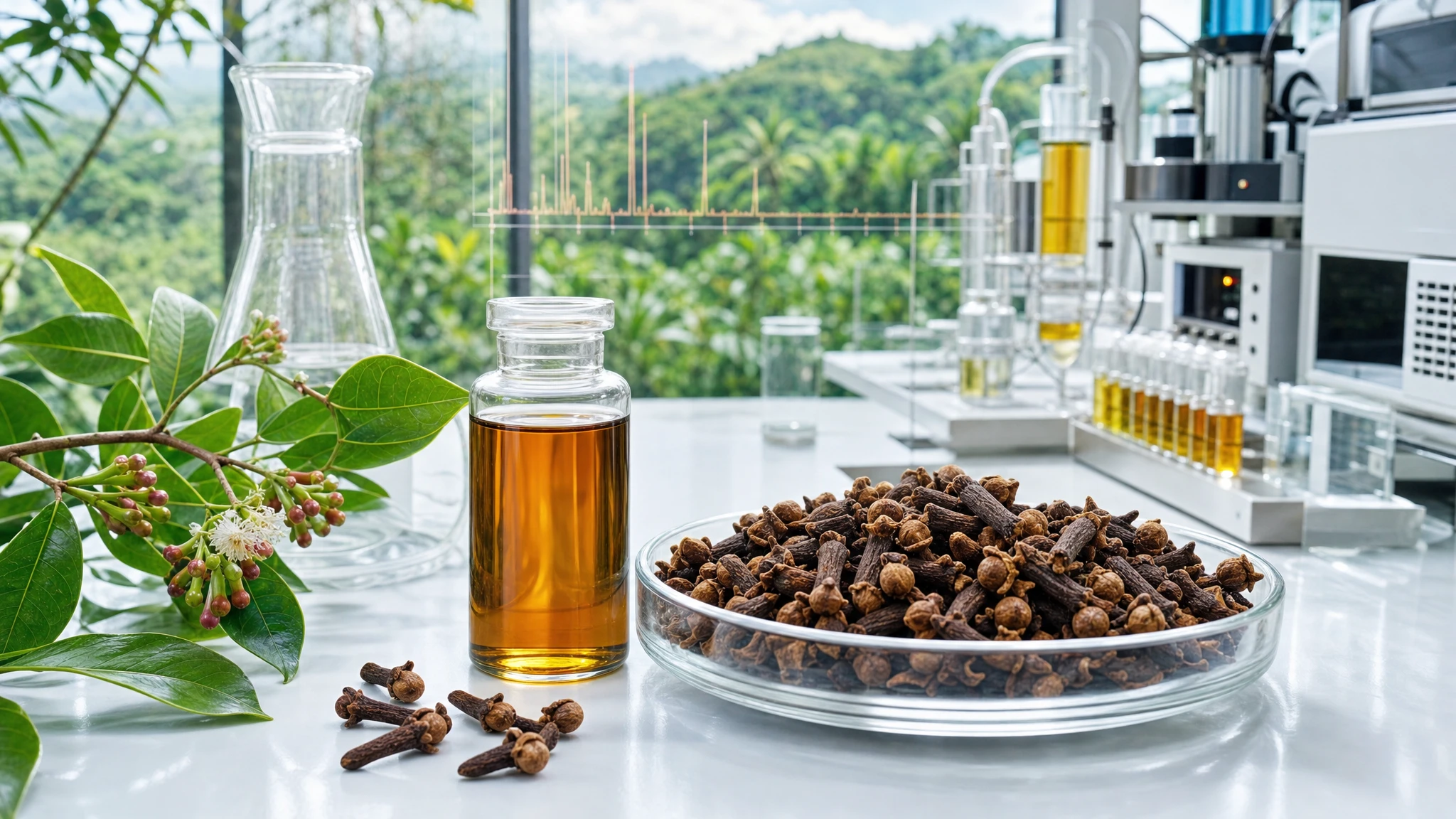
ABSTRACT : WHAT THE SCIENCE SAYS
This publication examines the essential oil obtained from Syzygium aromaticum, focusing on the compounds that define its aroma, stability, and potential food applications. The central message is that eugenol tends to predominate, but the proportions of other compounds change depending on the raw material and the extraction method.
The authors' summary describes clove essential oil as a mixture of volatile substances—molecules that evaporate easily and contribute to the aroma. Among those most frequently detected are eugenol, eugenyl acetate, b-caryophyllene, and a-humulene. Eugenol is a phenolic molecule, a plant-based substance with a chemical structure capable of interacting with oxidation processes in laboratory tests. The authors collect data obtained using various extraction methods, including hydrodistillation, steam distillation, and supercritical fluid extraction. The composition is not fixed: in four reported examples, eugenol varied from 55.28% to 97.98%, while b-caryophyllene and a-humulene were present in highly variable amounts. The publication also discusses experimental results regarding antioxidant and antimicrobial activity, as well as encapsulation techniques—systems that enclose the oil in a matrix to limit loss and degradation. These data explain why the oil is not equivalent to the whole spice. However, they do not demonstrate that a favorable chemical profile automatically produces clinical benefits in people.
What this research analyzed
To understand the aroma of cloves, it is not enough to name a single substance. Liñán-Atero and colleagues (2024) examined the essential oil as a complex mixture, evaluating which molecules are most frequently identified and why their quantities may change. The publication focuses primarily on eugenol, eugenyl acetate, β-caryophyllene, and α-humulene. Eugenol is the most characteristic aromatic component; β-caryophyllene and α-humulene are terpenes, which are volatile plant compounds that contribute to the scent profile. The authors also compared extraction procedures and encapsulation techniques. Encapsulation can help protect the oil from oxygen, light, and the loss of volatile compounds, but it does not turn its composition into a universal constant.
The publication is a narrative review. It brings together existing studies but does not present a unique experiment or a new cohort of participants. This also guides how the results should be interpreted.
Research data
Clove Essential Oil: Chemical Profile, Biological Activities, Encapsulation Strategies, and Food Applications
- This is a literature review on the composition, extraction, encapsulation, and food applications of the essential oil.
- In the summarized data, eugenol is generally the main compound, but its proportion varies between samples and procedures.
- The antioxidant and antimicrobial activities cited are primarily derived from laboratory tests, not clinical studies.
What results emerge from the study
The most useful takeaway for the reader is that clove essential oil has a recognizable profile, though it is not identical in every batch. In the examples included by the authors, eugenol was the primary compound by quantity, with values ranging from 55.28% to 97.98%. In a sample extracted using supercritical fluid, the reported proportions were 66.9% eugenol, 24.8% β-caryophyllene, 3.1% α-humulene, and 2.7% eugenyl acetate.
The authors link this variability to the origin of the plant material, agro-ecological conditions, the part of the plant used, storage, and the extraction method. They also describe antioxidant and antimicrobial activities observed in experimental systems. In antioxidant tests, the ability to react with oxidizing molecules in a test tube is measured; in antimicrobial tests, researchers observe whether the growth of microorganisms in a culture decreases. These are preliminary biological indications, not evidence of disease prevention or treatment in humans.
Why this study is relevant
This publication is relevant because it distinguishes between three elements that are often confused: dried bud, essential oil, and isolated eugenol. The whole spice contains a plant matrix; the essential oil is a concentrated aromatic fraction; pure eugenol is a single molecule. These are not interchangeable products in terms of composition, concentration, and exposure.
The work also helps to correctly interpret aroma intensity. A stronger scent may depend on a greater relative presence of volatile compounds, but it does not, by itself, measure overall quality, safety, or biological effect. The review also shows that extraction technology influences the final product. For this reason, two oils with the same botanical name may have different percentages of eugenol and terpenes, with practical consequences especially regarding standardization, stability, and food applications.
Study limitations and what it does NOT demonstrate
This publication is not a clinical trial and does not measure the benefits or risks of the essential oil when consumed by humans. It reports studies that are heterogeneous in terms of material origin, analytical methods, extraction, and biological testing; therefore, a direct numerical comparison between all samples is limited. No systematic study selection protocol with quantitative quality criteria is described.
Furthermore, strong activity in an antioxidant test does not prove that the oil reduces oxidative stress in the body. Similarly, the inhibition of bacteria in culture does not demonstrate efficacy against human infections. The chemical composition documents what is present in a sample, but it does not establish which component is responsible for each effect, nor whether the molecules act in synergy—that is, by reinforcing one another. The work does not authorize equivalencies between the culinary use of the spice and the use of concentrates.
Independent confirmatory evidence
An experiment on a commercial oil confirmed the initial step of the chain: the oil may be dominated by eugenol, but it also contains other terpenes. Kiki used GC-MS chromatography, a technique that separates and identifies volatile compounds, detecting 76.78% eugenol and 21.24% β-caryophyllene [1]. The same study measured antioxidant activity in a test tube using the DPPH assay, in which the oil reached 98.6% neutralization at a concentration of 800 µg/mL. This confirms the chemical and experimental plausibility discussed by Liñán-Atero and colleagues, but it does not provide human data.
A second experimental study supported the role of extraction in product variability. Hatami and colleagues obtained oil from buds using supercritical carbon dioxide extraction assisted by cold pressing: under the best conditions, the yield was 22.19 g per 100 g of buds, and the oil contained 57.7% eugenol, 12.6% eugenyl acetate, 8.3% β-caryophyllene, and 0.9% α-humulene [2]. The result is directly consistent with the review, as it shows that yield and proportions depend on the process.
A further test-tube study compared the antioxidant activity of the oil with reference substances and detected the ability to counteract oxidative reactions in chemical systems [3]. It only strengthens the analytical level: it does not clarify the absorption, metabolism, or clinical utility of the oil.
Conflicting evidence
The available evidence does not deny that eugenol is often abundant, but it shows how much the profile depends on the sample. Alves and colleagues analyzed an oil obtained from dehydrated inflorescences using GC-MS and detected 48.79% eugenol, 44.29% caryophyllene, and 4.87% α-humulene [4]. In this case, the gap between eugenol and caryophyllene was much smaller than in many samples included in the review.
The same study also observed different effects on biofilm, which is a community of bacteria adhering to a surface: at sub-inhibitory concentrations, the oil reduced formation in some strains of Corynebacterium diphtheriae, but increased it in others. This result suggests caution in attributing a uniform antimicrobial action to all oils and all microorganisms [4]. No directly conflicting evidence sufficiently relevant to the frequent predominance of eugenol has been identified; this does not prove the absence of contrary results.
Comparative overview
Comparison between independent publications and the narrative of the review by Liñán-Atero and colleagues.
| Publication | Model and main result | Relation to the study | Interpretative limitation |
|---|---|---|---|
| Kiki, 2023 [1] | Commercial oil; eugenol 76.78% and β-caryophyllene 21.24%; DPPH activity in test tube. | Confirms composition dominated by eugenol and experimental activity. | No clinical data. |
| Hatami et al., 2019 [2] | Buds and supercritical extraction; eugenol 57.7% in the best condition. | Confirms that extraction modifies yield and profile. | Evaluates a technological process, not human health. |
| Gülçin et al., 2012 [3] | Comparative chemical tests of the oil against oxidizing systems. | Confirms the antioxidant capacity measured in vitro. | A chemical test does not reproduce the organism. |
| Alves et al., 2024 [4] | Dehydrated inflorescences; eugenol 48.79% and caryophyllene 44.29%; variable biofilm response. | Shows a composition and effect dependent on the context. | Microbiological study, not clinical. |
Editorial Conclusion
The review by Liñán-Atero and colleagues describes the essential oil of Syzygium aromaticum as a concentrated aromatic mixture in which eugenol is often the most abundant component. However, its relative weight is not constant. The origin of the plant material, the part used, cultivation conditions, storage, and the extraction method can alter the ratio between eugenol, eugenyl acetate, β-caryophyllene, and α-humulene. Independent studies confirm both the frequent predominance of eugenol and the concrete variability between samples. They also confirm measurable activity in test tubes against chemical radicals and certain microorganisms. These observations are useful for interpreting the aroma, standardization, and potential technological applications of the oil. However, the evidence remains primarily analytical and preclinical. It does not allow for the deduction of clinical effects, effective doses, or equivalence between the essential oil, the extract, and the spice used in cooking. The most solid data, therefore, concerns the variable composition of the oil, not a proven therapeutic benefit.
References
[1] Supercritical fluid extraction assisted by cold pressing from clove buds: Extraction performance, volatile oil composition, and economic evaluation
[2] Antioxidant activity of clove oil – A powerful antioxidant source
[3] Gas Chromatography-mass Spectrometry analysis, Biotoxicity and Antibiofilm Activities of Syzygium aromaticum against Corynebacterium diphtheriae
[4] In Vitro Antiviral Potential, Antioxidant, and Chemical Composition of Clove (Syzygium aromaticum) Essential Oil
Editorial note
Artificial Intelligence was used solely as a tool to support editorial and documentary work. All content, interpretations, bibliographic citations and conclusions have been verified, reviewed and approved by the author, who assumes full scientific responsibility for them.
The manuscript was also subject to independent peer review prior to publication.
To ensure maximum transparency, the article's complete history — including the dates of submission, review, acceptance and publication, as well as information on the peer review process — is available on the dedicated Article History page.