


Turmeric and curcumin: differences, meaning, and correct use in products
Research indicates that turmeric and curcumin are not synonymous. The former is a spice, while the latter is its best-known compound. In clinical studies, it is primarily used in standardized extracts. These data help in reading labels and dosages without confusing a food with a concentrated preparation.
- Published 07/10/2026
- Updated 14/10/2026
- Reviewed 30/09/2026
- Article history
ABSTRACT : WHAT THE SCIENCE SAYS
Turmeric and curcumin are often mentioned together, but the two names refer to different things. Turmeric is a spice obtained from the rhizome of Curcuma longa, which is the underground part of the plant. It is primarily used in cooking; curcumin, on the other hand, is one of the compounds found in the spice. It is a bioactive compound (a substance that acts within the body); in concentrated products, it can be isolated or standardized.
This distinction helps in better reading labels and science articles for everyone. It also helps to understand the various product sheets for items on sale with greater care. A whole food, in fact, is never equivalent to just the single molecule found within it. This changes how we evaluate its content, function, and use.
To avoid confusion, it is also necessary to distinguish curcuminoids, a family of compounds similar to curcumin. Furthermore, one must clearly separate the use of the spice from that of its extract. This article breaks down these levels and helps to better understand what we read and buy. In summary, here are the key points we will cover in the rest of the article:
- Culinary turmeric and concentrated curcumin are not the same thing
- Curcuminoids are a family of similar compounds
- Standardization better defines the product's content
- The label helps distinguish the spice from the extract
- The context of use changes how the product should be interpreted
Author's video article
Video hosted on YouTube. By playing it you accept YouTube’s cookies, including advertising ones. Cookie policy
Turmeric and curcumin: what they are and why they are not the same
The comparison between turmeric and curcumin stems from a common misconception: the spice is not the same as its most well-known compound. Turmeric spice is the rhizome that has been dried and then ground into a powder. Curcumin as an active ingredient is one of its phytocompounds (active plant substances). Understanding this difference helps in reading labels and dosages correctly and in distinguishing between various culinary and health uses.
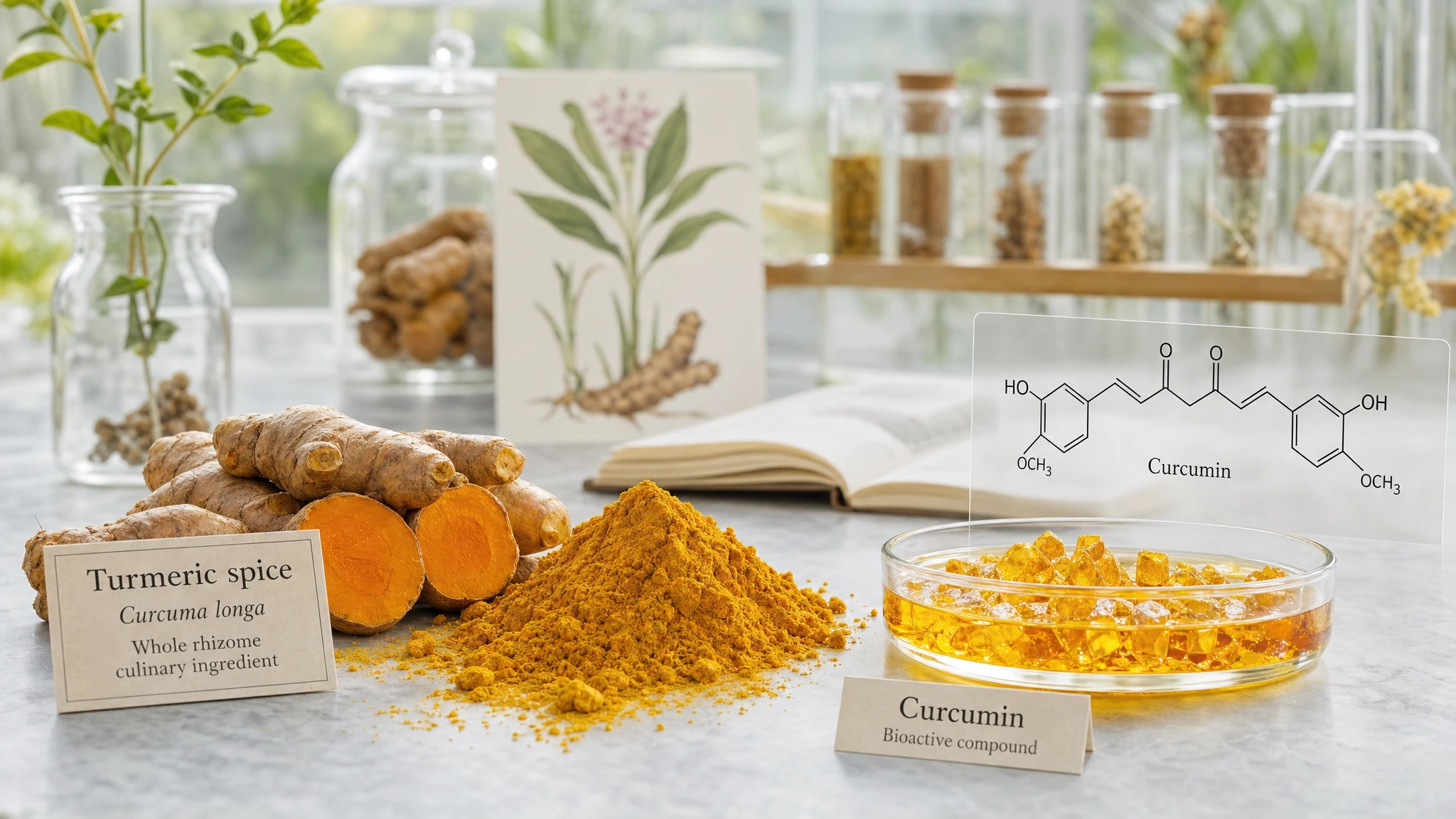
When talking about turmeric and curcumin, the point is simple: they are not the same thing. The turmeric spice is derived from the rhizome of Curcuma longa and is used to provide color, aroma, and flavor. Curcumin, the active ingredient, is instead one of the bioactive compounds present in the plant. Confusing the two terms can make the use of the spice in cooking seem the same as the use of concentrated extracts.
The difference also helps to understand the language used in products and studies. A spice is not equivalent to a standardized extract (with a defined amount of compounds). Curcuminoids, which are the main pigments in turmeric, can be present in varying amounts. The composition and dosage therefore change the practical meaning of what we buy or consume.
To navigate this, one must distinguish the food from the molecule and domestic use from concentrated products. The key points are:
- turmeric is the spice obtained from the plant's rhizome.
- curcumin is one of the bioactive compounds contained in the spice.
- the culinary use of turmeric is not equivalent to the use of an extract.
- this distinction helps to read labels correctly.
The following sections distinguish between the spice, its main compound, and the practical role of extracts.
Are turmeric and curcumin the same thing?
The confusion arises because the two terms often appear together, but they refer to different elements. Turmeric spice is derived from the rhizome of Curcuma longa and is widely used in cooking. Curcumin, the active ingredient, is instead a single phytocompound (an active plant substance) present in the spice. Distinguishing between the plant, the food, and the molecule helps to understand the content and the type of use.
The NIH fact sheet distinguishes between botanical ingredients and products that contain them in concentrated form [1]. The NCCIH page describes turmeric as a plant in the ginger family, long used in cooking [2]. A 2017 review also identifies turmeric as the primary dietary source of the compound [3]. However, the presence of curcumin in the spice does not make the two products equivalent. Sources therefore describe the spice as a food and curcumin as its specific component. The comparison must therefore be made between different categories and not between terms with similar names.
What is turmeric used for in the daily diet?
In a diet, turmeric spice primarily plays a culinary role. It adds color, aroma, and variety to dishes, but it does not provide large amounts of curcumin. Therefore, its dietary use is not equivalent to that of a concentrated product. This difference also matters when discussing benefits, because each type of use has a different purpose.
The systematic review on digestive disorders brings together clinical and observational studies conducted with different products [4]. It does not, therefore, concern the spice added to dishes without using precise doses. This work actually considers different interventions, which do not automatically correspond to normal use in the kitchen. From this use, we cannot deduce the same effect obtained with a studied formula. For this reason, the results must be referred to the formulas and doses evaluated in the individual studies. In everyday life, the role of turmeric remains primarily dietary and cultural. To evaluate a clinical effect, however, well-defined products and controlled doses are needed.
When should turmeric be distinguished from curcumin extract?
The distinction becomes necessary when comparing products or reading study results. Turmeric powder is a food, whereas a turmeric extract is a concentrated formula. This formula contains a selected portion of bioactive compounds, which are substances that act within the body. Therefore, it is not just the name that changes, but also the actual amount of active ingredient. With the amount, the purpose of use also changes.
A randomized study involved 101 adults with knee osteoarthritis. The researchers administered 500 mg twice a day for 8 weeks. The standardized extract improved pain and function compared to the placebo [5]. Another study involved 240 people with prediabetes. The capsules, taken for 9 months, reduced the progression to type 2 diabetes compared to the control group [6]. In both cases, the dose and duration were defined by the study protocol. These data refer to well-defined extracts, not the simple spice used in cooking.
What are curcuminoids and why do they matter
Curcuminoids are the main pigmented compounds in turmeric and include, among others, curcumin. Therefore, turmeric is not a single substance, but a plant matrix rich in similar molecules. Standardizing extracts makes the content of these compounds more stable. This allows for greater precision in knowing what the product contains.
In practice, the same word can refer to products with different compositions. This limitation also emerges in the 2024 review, which collected 103 randomized studies. The research included 7,216 participants and 42 measured outcomes, providing a broad but non-uniform picture [7]. The large amount of research does not eliminate the differences between products and results. The term curcuminoids, therefore, does not indicate a benefit, but a chemical family. This family makes turmeric more complex than the simple color for which it is known. This gives rise to the issue of standardization, which makes the content clearer and more consistent.
What a standardized turmeric extract means
A standardized extract contains a defined amount of one or more active compounds. In the case of turmeric, this process makes the content more stable compared to the whole spice. The quantity can, in fact, change based on origin, processing, and storage. The 2022 umbrella review brought together 161 analyses of randomized trials. These analyses were published in 76 articles and included 67 distinct outcomes. The picture described is broad, but also highly varied [8].
The point is not just about the number of studies, but also the different formulas used. The 2024 work on 54 study analyses reports a lot of data, but methods are not always robust [9]. We cannot, therefore, consider every extract as a solution equal to the others. Standardization, by itself, does not prove that a product works. However, it indicates how much bioactive compound it contains and allows for clearer comparisons. It remains to be understood how the content changes between the spice and the extract.
Recent research and updates
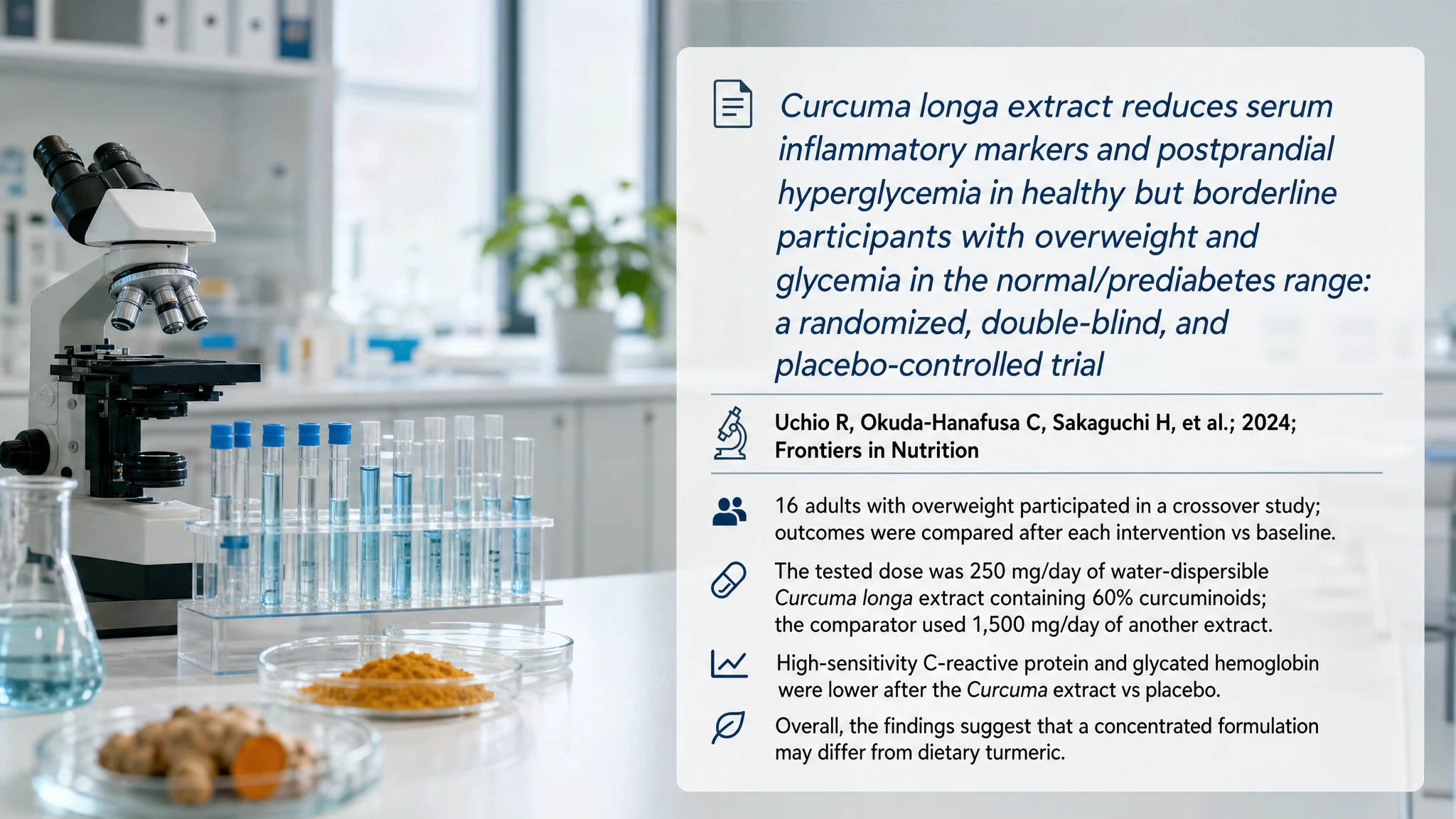
In 2024, Japanese researcher Uchio and colleagues published a study in Frontiers in Nutrition on individuals who are overweight and have borderline glycemia. The research evaluated an extract of Curcuma longa, which is a concentrated preparation of the plant. The authors measured several values related to inflammation and glucose utilization. The results help distinguish the culinary spice from the standardized products used in clinical trials.
Curcuma longa extract reduces serum inflammatory markers and postprandial hyperglycemia in healthy but borderline participants with overweight and glycemia in the normal/prediabetes value interval: a randomized, double-blind, and placebo-controlled trial
- 16 healthy but overweight adults took the extract in a crossover study (each person receives multiple treatments); the values after intake were compared with the initial ones.
- The dose tested was 250 mg per day of water-dispersible Curcuma longa extract with 60% curcuminoids; the comparison used 1,500 mg per day of another extract.
- After the intervention, high-sensitivity C-reactive protein (an index of inflammation) and glycated hemoglobin (an estimate of average glycemia) were lower compared to the placebo.
- Overall, the data suggest that a concentrated formula is not equivalent to simple dietary turmeric.
Curcuminoids, standardization, and real content in products
Seeing "turmeric" on a label is not enough to understand what a product really contains. You need to evaluate the curcuminoids, which are the plant's active compounds, and the standardization of the extracts (a measure of the amount of active ingredient). The actual declared dose of curcumin also matters. Let's look at how to read these items and why similar products are not always equivalent.
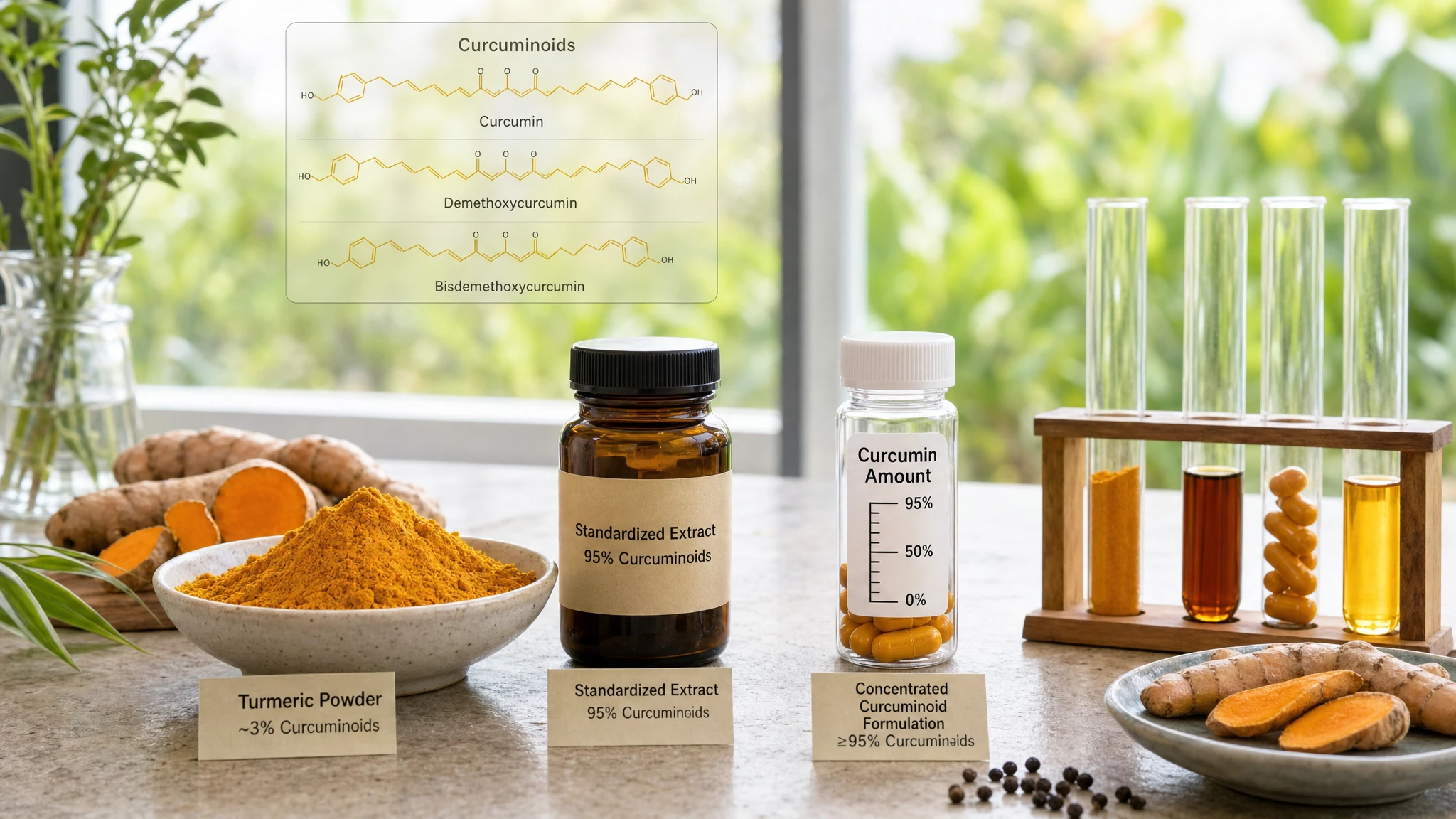
Turmeric-based products vary in terms of raw material, extraction method, and the quantity of phytocompounds (active natural substances). Curcuminoids and standardization therefore indicate the actual content, not just a theoretical difference. A spice, a dry extract, and a concentrated formula may have similar names but very different profiles. Understanding these differences helps avoid confusing a food item with a product that offers a measured dose of an active ingredient.
This data is useful because the label does not just list the botanical name of the plant. It also describes how the product was prepared and allows you to compare it with other extracts. Therefore, you must distinguish between the declared content and the actual content, and always evaluate the intended purpose.
Before making a practical comparison, four key points must be clarified:
- Curcuminoids are a group of active compounds that should be evaluated carefully.
- Standardization indicates how much active ingredient the product actually contains.
- The curcumin indicated on the label is not always equivalent to the spice used in cooking.
- Quality also depends on the form, dose, and intended use.
The following points explain what curcuminoids, standardization, and labels indicate. The focus is on the actual content of the products, not just their use in cooking.
What curcuminoids are and why they matter
Curcuminoids are the main colored compounds in the rhizome of Curcuma longa and include curcumin along with other related molecules. This chemical group matters because it helps us understand that we are not talking about a single substance, but a family of bioactive compounds present in varying proportions. In practice, when a product specifies curcuminoids, it provides more useful information than just the name "turmeric," because it indicates which phytocompounds have been concentrated or measured. Research distinguishes them precisely to evaluate biological activity and actual dosage. Without this reference, there is a risk of comparing preparations that have vastly different concentrations. For the consumer, this means having an extra tool when reading the label: not just knowing which plant the product comes from, but which molecules it contains in known quantities.
The very breadth of research makes it clear that preparations and doses are not uniform. The limitation, therefore, is not in the term itself, but in the fact that the presence of curcuminoids is not enough to determine how concentrated a product is or how it compares to another. Without standardization, the same word can describe very different preparations. This is why curcuminoids are a useful starting point, but they must always be accompanied by a quantitative indication that specifies the percentage present in the extract.
What a standardized turmeric extract means
A standardized turmeric extract is a preparation obtained to contain a defined amount of one or more constituents, usually expressed as a percentage of curcuminoids or curcumin. This information helps clarify the actual content compared to the whole spice, which can vary based on origin, storage, and processing. Standardization, therefore, does not just concern the product name, but its degree of concentration and the ability to compare it with other extracts. In practical terms, an extract titrated to 95% curcuminoids guarantees a very different amount of active ingredient than one at 10%. This percentage is the data that allows for the calculation of the effective dose taken with each capsule.
Such a range shows that research uses different and not always overlapping preparations. A review including trials with various titration levels confirms this: clinical results are linked to the specific dose of curcuminoids administered [1]. The practical limitation is clear: two standardized extracts may report similar percentages but behave differently due to formulation, stability, and absorption capacity. For this reason, standardization is a starting point, not a guarantee of absolute equivalence. It is always used to quantify the content, but on its own, it does not indicate whether the chosen matrix promotes its absorption.
Is the curcumin in the extract the same as that in the spice?
From a chemical perspective, we are talking about the same curcumin, but the context differs significantly between turmeric spice and extract. In the spice, the molecule is embedded in a complex food matrix and present in low quantities; in a concentrated preparation, however, it is measured and isolated more precisely. For this reason, the same substance can have a different practical significance depending on whether it is consumed with food or in a specially designed formulation.
Research demonstrates this clearly: a 12-week study on adults at high risk of type 2 diabetes evaluated curcumin and omega-3 in separate groups, specifically within the context of controlled supplementation [10]. The limitation is that the results of a formulation do not automatically transfer to the spice used in cooking. Even when the molecule is the same, the dosage, context, and absorption change. This makes it inappropriate to use data on extracts to describe the dietary use of turmeric, or vice versa.
Does standardization make all extracts equivalent?
No, because standardization does not mean that all turmeric extracts are the same. A standardized extract indicates how much active substance is present, but it does not guarantee that two products have the same overall quality, stability, or biological yield. The matrix, extraction technology, and final form of the preparation also matter. This is why two similar labels can hide very different performance levels. Given the same declared percentage, an extract with added phospholipids or phytosomes can achieve significantly higher blood levels of curcumin. This explains why the number next to the percentage on the label never provides all the information needed to compare different brands.
Available reviews clearly show this variability. The limitation is therefore methodological: standardization helps in reading the label, but it is not enough to consider different products equivalent. You must always look at the form, dose, and intended use. The percentage of curcuminoids is only the first piece of an assessment that must include the overall formulation and how the product was designed to be absorbed by the body.
Is culinary turmeric equivalent to a supplement?
No. The dietary use of turmeric involves a spice, whereas a supplement is a concentrated formulation with different objectives. Even when they feature the same plant, the two products are not interchangeable in terms of curcuminoid quantity, method of intake, and purpose. Cooking uses turmeric as an ingredient; a capsule product, on the other hand, aims to provide a defined dose of the active compound. A teaspoon of powder provides approximately 30-90 mg of curcumin, while a capsule of 95% standardized extract can contain up to 500 mg. The difference in dosage is enormous and changes the logic of use. In cooking, it is added for flavor and color, with variable intake that cannot be measured precisely. A supplement, however, follows a dosage regimen designed to maintain constant levels over time.
The limitation is clear: the results of supplements cannot be directly applied to cooking, because the dose and form of the product completely change the actual content and the context of intake. Even the presence of fats in a meal, which helps the absorption of dietary curcumin, is not enough to bridge this quantitative gap.
How to identify a curcumin extract on the label
The label is the primary tool for distinguishing a spice from an extract. A concentrated product usually includes information regarding the presence of curcumin or the percentage of curcuminoids, whereas turmeric powder is simply presented as a food ingredient. This difference is not just a formal detail: it changes how the packaging should be read. A number next to the word "curcuminoids" always indicates a concentrated product, intended for targeted use.
This helps you understand whether you are purchasing a culinary spice or a formulation intended for a different purpose. The limitation is that the label alone does not explain the effect, but it provides essential clues about the concentration level and the type of preparation. Understanding the term "curcumin" or "curcuminoids" does not automatically mean knowing the outcome, but it allows you to read the product information with greater precision. It is also necessary to check if the titration percentage is indicated, not just the name of the extract. This data, together with the dose per capsule, allows for a fairer comparison between different products. After this step, the way the product is used in daily practice matters even more.
Turmeric in the kitchen and concentrated extracts: practical differences
In practice, turmeric and curcumin vary depending on their intended use. The spice is used in recipes, while the extract offers a higher and more defined dose. Understanding the context helps in reading labels and dosages, without confusing a food with an active ingredient.
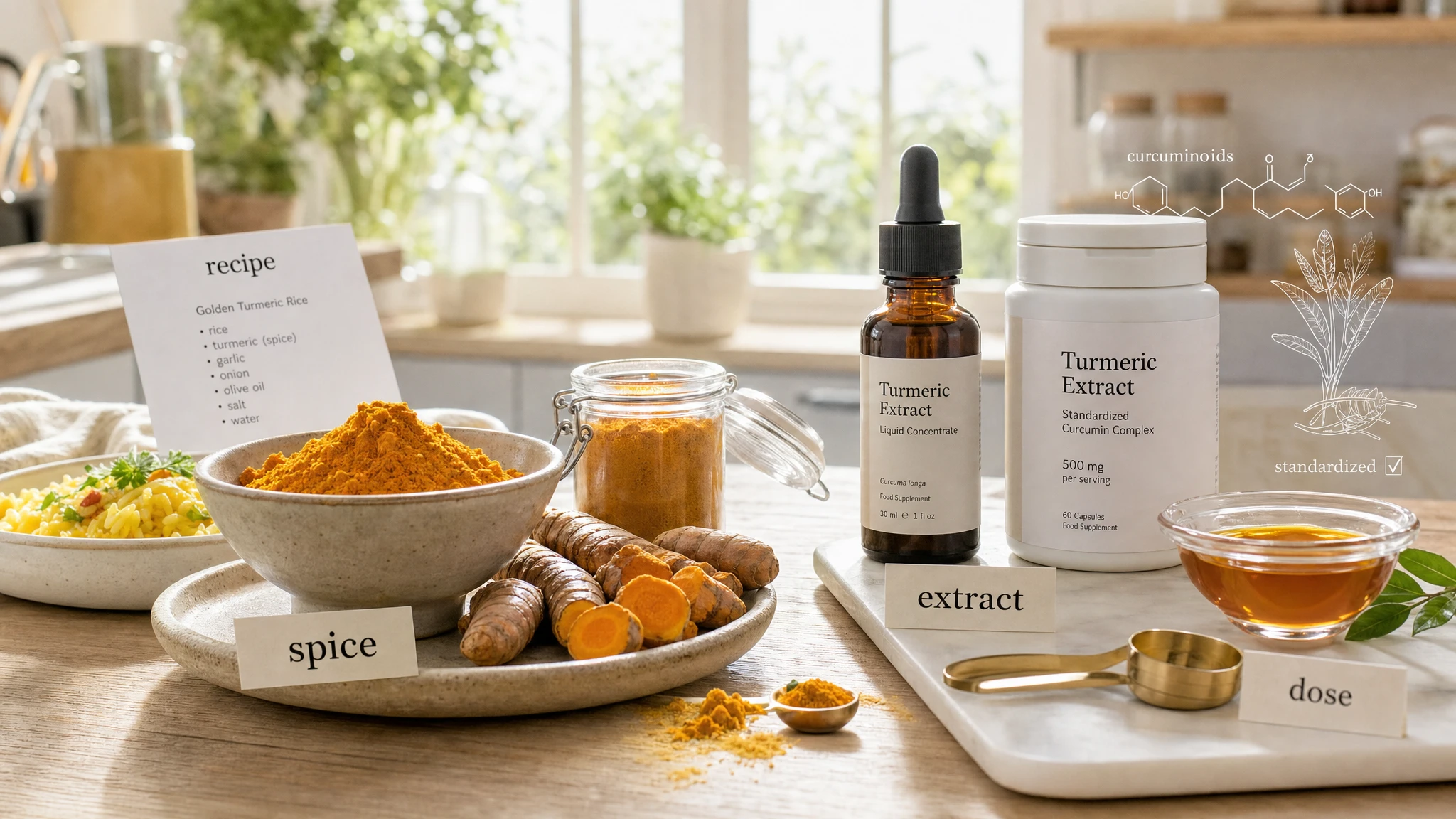
In everyday language, a single word can refer to very different uses. Turmeric spice is added to food to provide flavor and color. A turmeric extract, on the other hand, contains a higher and known amount of phytocompounds (substances present in plants). This difference matters because the dosage, method of use, and interpretation of data change. Therefore, seasoning a dish is not the same as taking a product with a standard dose.
These points distinguish the rhizome of Curcuma longa (the plant's underground stem) from a product with a standard dose. The two products have different purposes and should not be confused. This makes it easier to read the data and understand whether one is referring to an ingredient or a concentrated extract.
To understand which product we are looking at, it is useful to evaluate a few practical aspects:
- Culinary use of turmeric as part of a common recipe.
- Extract label and data on curcuminoids or concentration.
- Type of use, between home cooking and targeted supplementation.
- Limitations in applying study results to the common spice.
The following sections explain the differences between culinary use and concentrated extracts in a practical way.
Turmeric spice: how to use it in the kitchen
In the kitchen, turmeric spice is used in small quantities to add color, aroma, and a characteristic note to sauces, rice dishes, soups, and marinades. In this context, what matters most is the culinary use of turmeric, not its transformation into a concentrated product. Referring to it as a spice therefore means treating it as a traditional ingredient, included in a recipe alongside other foods, with a gastronomic function even before a nutritional one. The amount of curcumin consumed in a dish is very low and variable. For example, a teaspoon of powder contains approximately 30-50 milligrams of total curcuminoids. This dose is far from those used in clinical studies, which often start at 500 milligrams per day. Furthermore, the presence of fats and black pepper in the recipe can influence absorption, but in a non-standardized way.
This helps to interpret the product correctly: the amount present in the dish depends on the recipe, not on standardization, and the result should not be equated with that of a concentrated formula. The limitation remains clear: the dietary context is variable and does not allow for the automatic deduction of effects studied elsewhere.
How to recognize a curcumin extract on a label
A turmeric extract can be identified by the information provided on the label. In addition to the spice, it often indicates curcuminoids, which are the group of compounds typical of turmeric. It may also state the percentage of the preparation or indicate a standardized form. This data indicates that the product has been concentrated to offer a defined content of bioactive compounds. This content is different from that of the powder used in cooking. The trade name, composition, and form of presentation therefore help to identify the type of product. They allow you to understand whether it is a food ingredient or a supplement.
The wording alone does not clarify the effect, but it distinguishes a spice from a standardized extract. This distinction is useful because clinical studies more often use concentrated products. Turmeric in cooking, on the other hand, remains linked to food use, which differs in dose and purity. The limitation is simple: the label identifies the product, but does not automatically guarantee its bioactivity.
How the context of use between cooking and supplements matters
The context of use changes the practical meaning of turmeric and curcumin. In cooking, its role as an ingredient prevails; in a supplement, the logic of a defined dose and the standardization of extracts takes precedence. This means that two products may share the same basic name but have different functions, different levels of concentration, and very different expectations. Precision regarding the context is therefore essential to avoid confusing daily nutrition with supplementation. A supplement is designed to provide a precise and repeatable amount of an active ingredient. The spice in the kitchen, on the other hand, is one element of an overall diet. Its effect must be evaluated within a dietary pattern, not as an isolated intervention.
For this reason, results should be read with caution: they describe a defined product, often with doses repeated over time, and not the behavior of turmeric as a household ingredient. The limitation is methodological but important: automatically transferring those data to the kitchen risks altering the meaning of the results and oversimplifying the topic.
Why studies on curcumin do not automatically apply to turmeric in the kitchen
Studies on curcumin as an active ingredient almost always evaluate extracts or capsules, which are preparations designed to provide a measurable quantity of phytochemicals. This does not correspond to the turmeric used in cooking, where the dose is determined by the recipe and the final mixture depends on the other ingredients. Therefore, a scientific result obtained with a concentrated formulation should not be interpreted as automatically applying to the common spice. The formulations studied are often enriched with substances that improve absorption, such as piperine. The powdered spice does not have these modifications. Its bioavailability (the portion that the body actually absorbs and uses) is therefore very different and generally lower. In studies, capsules often reach doses of 1-8 grams per day. A dish seasoned with turmeric, on the other hand, contains only a few milligrams of curcuminoids. This explains why the effective doses seen in the laboratory are not achievable through simple culinary use. The difference concerns not only the quantity but also the chemical form and the presence of substances that aid absorption.
The limitation is clear: these data are solid for the extracts studied, but they do not authorize treating culinary turmeric as a clinical equivalent.
Summary of scientific evidence
This summary brings together the sources from our internal bibliography. It shows how to distinguish the spice from the concentrated compound and what data emerges from the most relevant studies.
| Publication year | Area studied | What the studies indicate |
|---|---|---|
| 2012 | Curcumin as a component of turmeric | studies describe this link [3] |
| 2017 | Review of aggregated studies on inflammatory and metabolic outcomes | the signal appears consistent [9] |
| 2021 | Turmeric in digestive disorders | results are not uniform [4] |
| 2022 | Curcumin extract and metabolic prevention | evidence indicates possible effects [6] |
| 2024 | Standardized extract and joint pain | some effects have been observed [5] |
| 2024 | Broad synthesis of randomized trials on curcumin | studies suggest possible effects [7] |
| 2026 | Institutional sources on spices and botanical supplements | sources clarify the distinction [1] |
| 2026 | Safety and use of turmeric | results are not uniform [2] |
Editorial interpretation of the evidence
Conclusions and editorial summary
Final critical note
References
[1] Dietary Supplement Fact Sheets
[2] Turmeric: Usefulness and Safety
[3] Curcumin: A Review of Its Effects on Human Health
[4] A systematic review of the efficacy and safety of turmeric in the treatment of digestive disorders
[5] An Investigation into the Effects of a Curcumin Extract (Curcugen®) on Osteoarthritis Pain of the Knee: A Randomised, Double-Blind, Placebo-Controlled Study
[6] Curcumin Extract for Prevention of Type 2 Diabetes
[7] Curcumin on Human Health: A Comprehensive Systematic Review and Meta‐Analysis of 103 Randomized Controlled Trials
[8] Zingiberaceae plants/curcumin consumption and multiple health outcomes: An umbrella review of systematic reviews and meta‐analyses of randomized controlled trials in humans
[9] Is Curcumin Intake Really Effective for Chronic Inflammatory Metabolic Disease? A Review of Meta-Analyses of Randomized Controlled Trials
[10] Curcumin and/or omega-3 polyunsaturated fatty acids supplementation reduces insulin resistance and blood lipids in individuals with high risk of type 2 diabetes: a randomised controlled trial
Editorial note
Artificial Intelligence was used solely as a tool to support editorial and documentary work. All content, interpretations, bibliographic citations and conclusions have been verified, reviewed and approved by the author, who assumes full scientific responsibility for them.
The manuscript was also subject to independent peer review prior to publication.
To ensure maximum transparency, the article's complete history — including the dates of submission, review, acceptance and publication, as well as information on the peer review process — is available on the dedicated Article History page.