


What is Reishi: composition and bioactive compounds of Ganoderma lucidum
Research shows that Reishi is not a single material, but includes preparations with different chemical profiles. The most studied classes are polysaccharides and triterpenes, along with sterols and phenolic compounds. Interpreting the data depends on the species, the part of the mushroom, and the processing method. Studies therefore require caution, because non-equivalent products cannot be compared directly.
- Published 13/10/2026
- Updated 20/10/2026
- Reviewed 20/10/2026
- Article history
ABSTRACT : WHAT THE SCIENCE SAYS
Reishi is among the most cited medicinal mushrooms, but its name is often misused. The term Reishi can refer to very different parts of the mushroom, processing methods, and chemical profiles. To understand what it is, one must distinguish between the common name, the biological class, and the actual composition of the product. This aspect matters because much of the data depends on the content, not just the appearance of the mushroom.
The article presents the most studied bioactive compounds, which are substances that act on biological systems. It also examines the significance of the form used and explains why certain substances appear repeatedly in studies. It then shows how the type of product can change the final research outcome. The goal is to provide a clear and precise guide for reading labels and evaluating scientific studies. In summary, here are the key points we will explore:
- Correct definition of Reishi and its classification
- Main bioactive compounds and relevant molecule families
- Differences between mycelium, fruiting body, and spores
- How extraction and processing change the composition
- Why similar labels can describe different products
What is Reishi and why name and classification matter
Understanding what Reishi is requires starting with its name and the material used. In fact, the same label can indicate very different products. To correctly interpret studies, the species, the part of the mushroom, and the type of preparation matter.
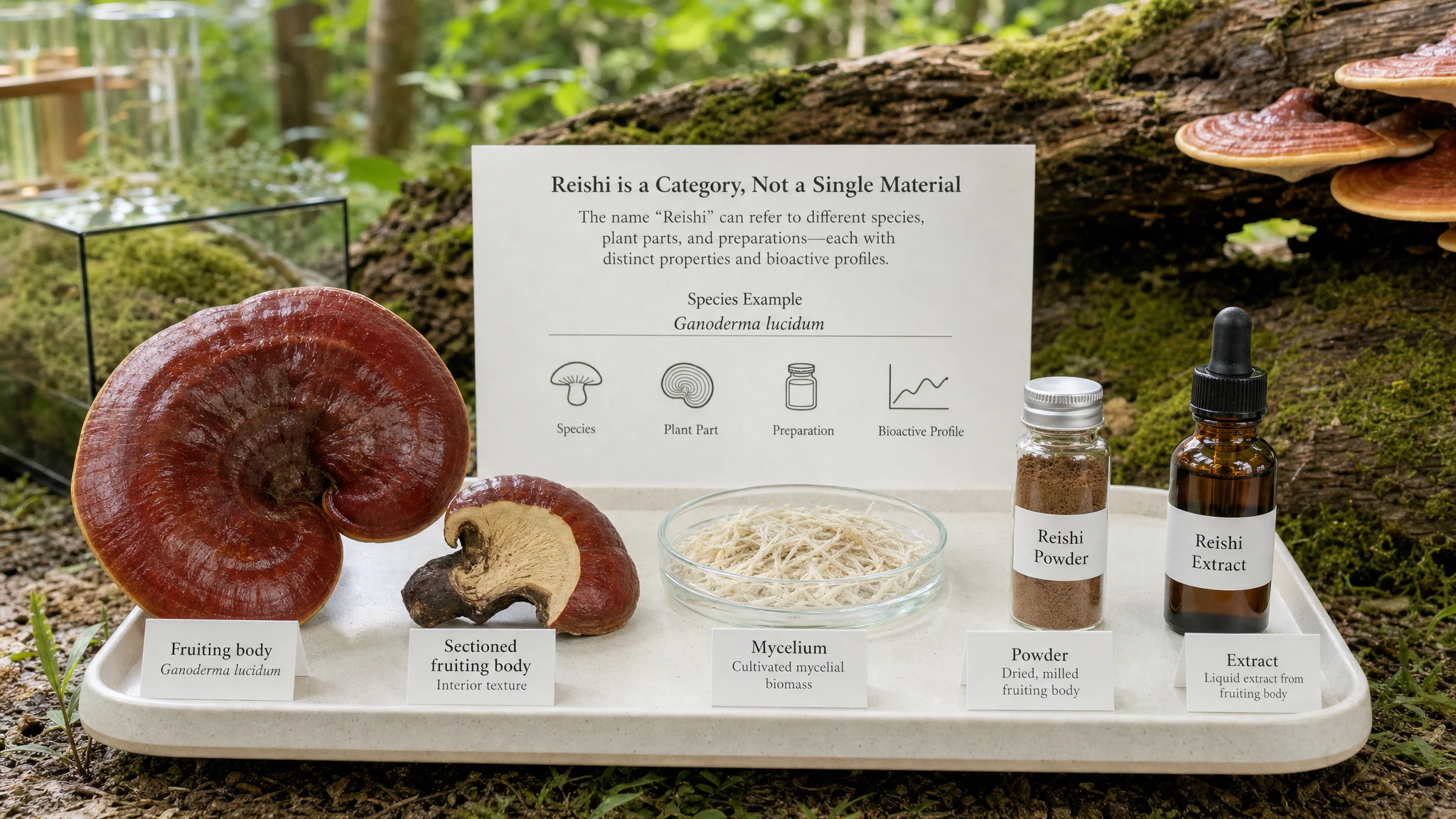
The name Reishi refers to a medicinal mushroom, also known as Ganoderma lucidum. However, this name does not always identify the same material. It can refer to extracts, powders, mycelium (the part from which the mushroom grows), or the fruiting body (the part that produces spores). These materials have different compositions. Therefore, to understand what Reishi is, the common name is not enough. It is necessary to know the species, the part used, and the preparation method. These factors change the chemical profile and the comparison between products and studies.
The first step is not just asking whether Reishi is "useful." One must first carefully define which material is being studied. Precision in names and classification helps in reading the literature on the composition of Ganoderma lucidum. From this foundation, one can then move on to the most studied compounds [1] [2].
This distinction avoids confusing tradition, commercial labels, and scientific data. Before examining individual components, some aspects must therefore be evaluated:
- The trade name can refer to different biological materials.
- The stated species guides the interpretation of studies.
- Mycelium and fruiting body have different profiles.
- Preparation changes the composition of the final product.
After clarifying the name and classification, one can examine the chemical profile without confusing the various families of molecules.
What is Reishi and what bioactive compounds does it contain
The chemical profile of Reishi includes various families of Reishi bioactive compounds (substances that act on biological systems). The most studied are Reishi polysaccharides (long chains of sugars) and Reishi beta-glucans (a type of polysaccharide). Triterpenes, sterols, nucleosides, bioactive proteins, and phenolic compounds are also present [3] [4]. The mushroom therefore contains many components with different properties, rather than a single molecule. Some parts dissolve better in water, others in fats. This difference affects extraction, product form, and the comparison between preparations.
Reviews (studies that summarize multiple research papers) show a rich, but not always uniform, composition. The profile changes based on origin, the part of the mushroom, and the processing method [5] [6]. The same label can therefore indicate products with very different chemical profiles. This makes comparing studies less straightforward. The terms used also matter, because the common name can group data on different substances. For this reason, before evaluating the effects, studies distinguish between molecular class, product form, and type of analysis.
Why Reishi is considered a medicinal mushroom and not a simple ingredient
Reishi is defined as a medicinal mushroom due to its traditional use and the interest in its components. This does not mean that it is a simple or uniform ingredient. Biological material, cultivation, and processing actually change the product's profile. Therefore, it is not enough to know that a supplement contains this mushroom. It is necessary to verify which part was used and how it was treated. Furthermore, a distinction must be made between an extract, a powder, or a preparation obtained through cultivation.
Available summaries advise caution, as quality and uniformity vary greatly between products [7] [8]. In a small controlled clinical trial of 48 patients, Ganoderma lucidum spore powder was taken for 4 weeks. The study found improvements in fatigue (intense tiredness) and well-being that were unlikely to be due to chance. However, this data only applies to that specific preparation and does not hold true for all products. A meta-analysis that combined 17 controlled clinical trials with 971 participants evaluated doses ranging from 200 to 11,200 mg per day for 1-24 weeks. It found modest effects on BMI, creatinine, GPx, and heart rate. The data show biological interest, but also significant differences between research studies and products.
Where Reishi fits into the classification of Ganoderma lucidum
The classification of Reishi avoids confusion between common names, trade names, and biological identity. The name Ganoderma lucidum is therefore not just a label used for sales. Instead, it serves to better define the mushroom being studied. A precise name makes data on composition clearer. It also reduces the risk of comparing materials with different origins or characteristics.
Reviews indicate two important sources of chemical differences between strains and preparations. These are secondary metabolism (the production of substances specific to the mushroom) and germplasm resources (genetic heritage) [9] [10]. Classification alone is not enough to define the composition. However, it provides the correct basis for interpreting it. If the name remains generic, the comparison between studies loses precision. If the species, part used, and process are clear, the product profile can be read more easily. It is therefore the first filter for understanding which material is being analyzed. This step makes the comparison between results obtained with different materials more robust.
Recent research and updates
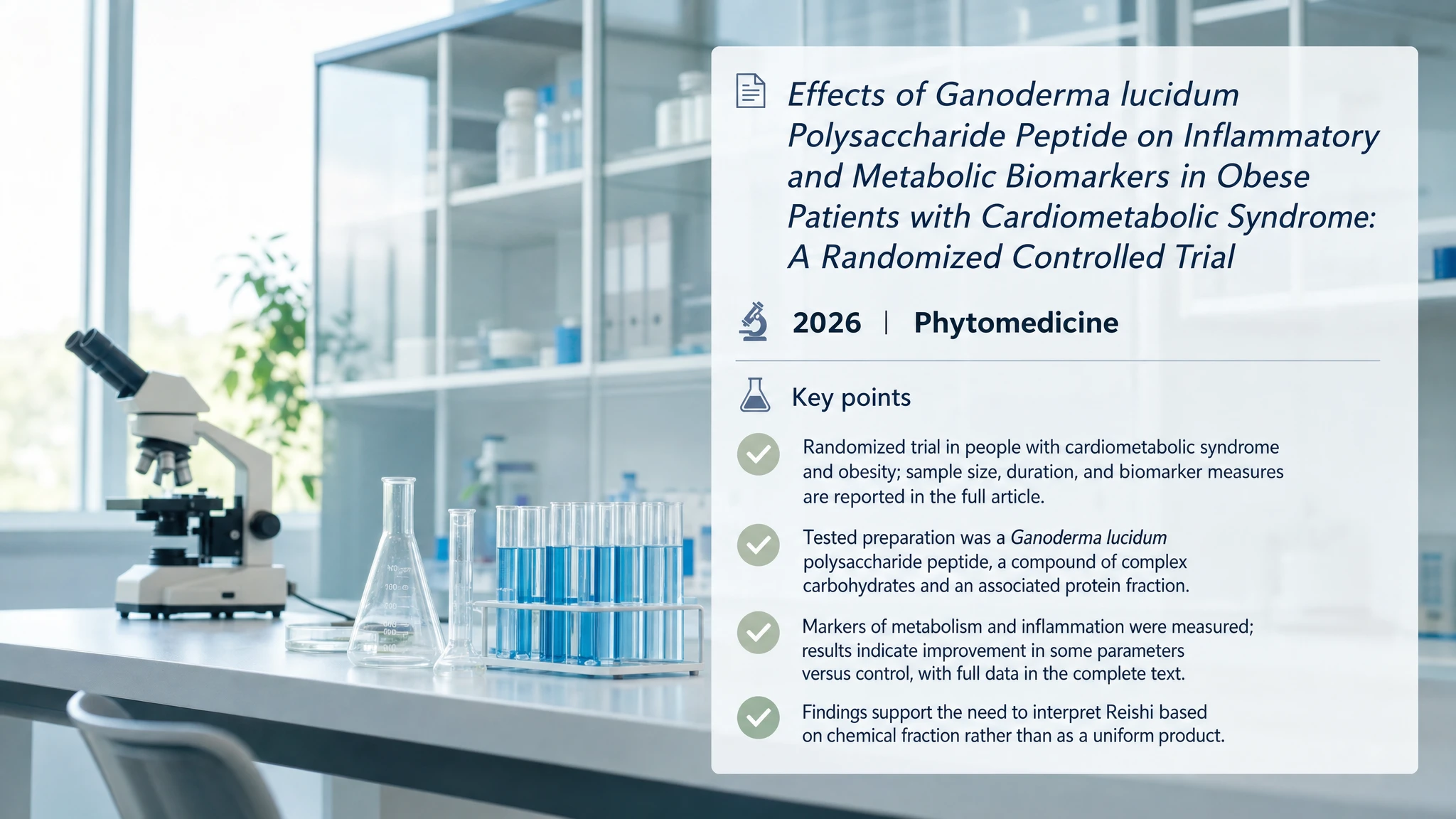
In 2026, a clinical study by Chinese researchers and colleagues was published in Phytomedicine. The work examined a polysaccharide-peptide from Ganoderma lucidum. This molecule combines complex sugars with a small portion made of proteins. The research included people with cardiometabolic syndrome linked to obesity. The work shows why Reishi must be studied as a specific preparation, not as a single material. Furthermore, it directly measures certain values related to metabolism.
Effects of Ganoderma lucidum Polysaccharide Peptide on Inflammatory and Metabolic Biomarkers in Obese Patients with Cardiometabolic Syndrome: A Randomized Controlled Trial
- The randomized trial involved people with cardiometabolic syndrome and obesity. The sample size, duration, and measurements of inflammatory and metabolic values are reported in the full article.
- The tested preparation was a polysaccharide-peptide from Ganoderma lucidum, consisting of complex sugars and an associated protein component.
- The research measured values related to metabolism and inflammation. It indicates improvements in certain parameters compared to the control, but the full numerical data require the complete text.
- The study supports the idea that Reishi should be evaluated based on its chemical composition, rather than as a homogeneous product.
What are the most studied bioactive compounds in Reishi
Reishi contains various families of molecules that can act on biological systems. The most studied are polysaccharides, beta-glucans, and triterpenes. Sterols, nucleosides, and phenolic compounds are also present in the mushroom. Knowing them helps to better understand studies and product labels.
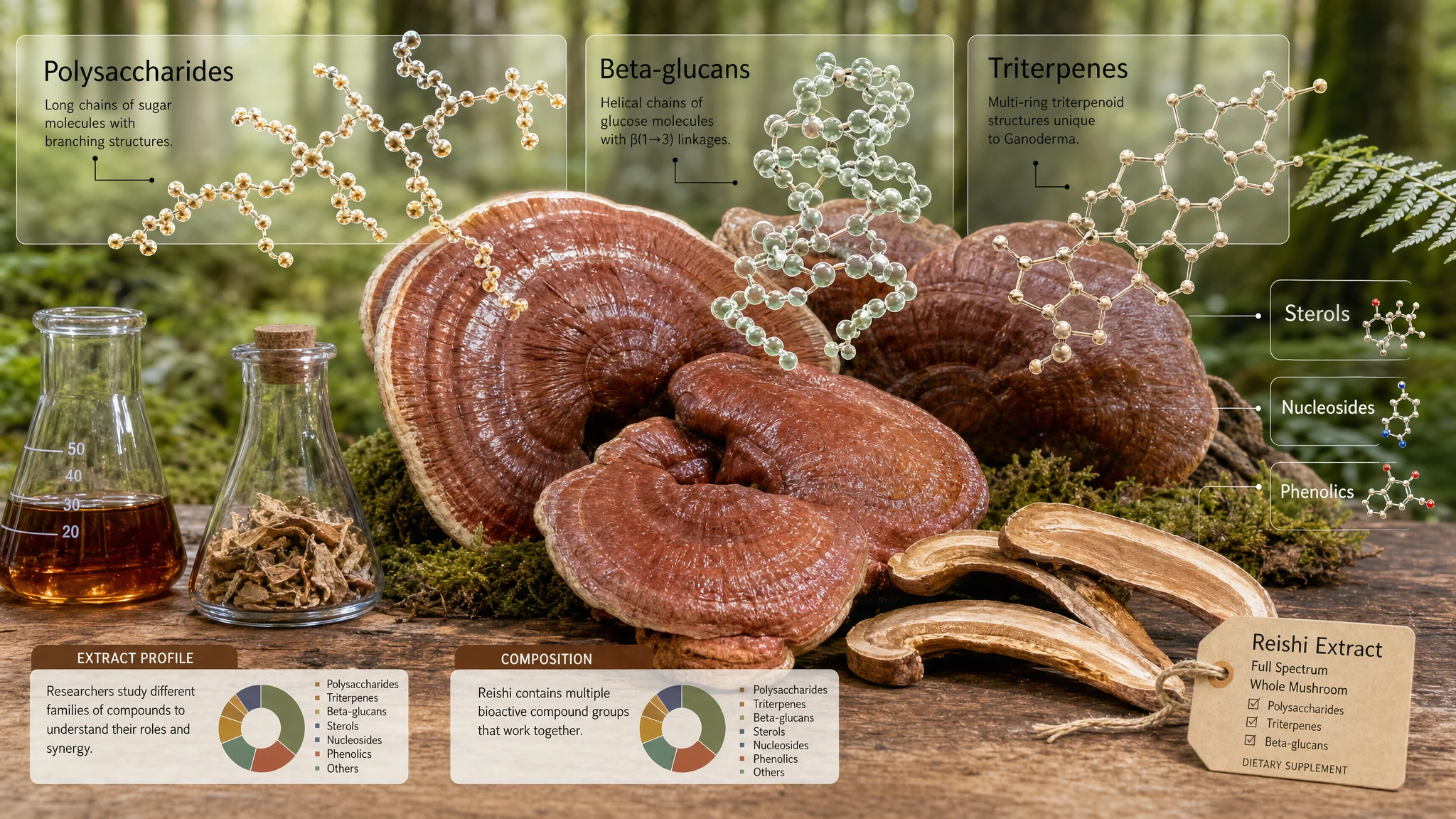
In Reishi, bioactive compounds are not just a single molecule. The term refers to various chemical families studied for their action on biological systems. The best known are Reishi polysaccharides, Reishi beta-glucans, and Reishi triterpenes. These groups frequently appear in analyses and commercial products.
The mushroom also contains sterols, nucleosides, bioactive proteins, and phenolic compounds. All these substances form its chemical profile. To understand the studies, it is useful to separate the main families from the other constituents. The former groups are often used to describe the quality of an extract. The others help to better define the Ganoderma lucidum composition. The key points are as follows:
- Polysaccharides are the class most cited in study summaries.
- Beta-glucans are an important part of polysaccharides.
- Triterpenes include many molecules typical of the mushroom's chemical profile.
- Sterols and phenolic compounds make the analytical picture more complete.
Not all chemical classes of Reishi hold the same significance in studies. Some have become a cornerstone for research, while others complete the mushroom's profile and help describe it more accurately. The following three in-depth sections follow this order, from the core groups to the less frequently cited ones.
What are the main bioactive compounds in Reishi
The most frequently cited Reishi bioactive compounds are polysaccharides, beta-glucans, and triterpenes. These are followed by sterols, nucleosides, bioactive proteins, and phenolic compounds. This list shows which families appear most often in analyses of the mushroom. It also indicates which ones play a minor role in the overall chemical framework.
The term bioactive does not, by itself, prove a clinical effect in humans. Instead, it highlights the classes that research measures and compares most frequently. This distinction prevents assigning the same scientific weight to all substances present in the mushroom. Reviews (studies that summarize other research) confirm this framework. Those focusing on polysaccharides and the chemistry of Ganoderma lucidum place these molecules at the center. Triterpenes also remain among the most characteristic components [11] [12]. However, each family can include substances that differ in form, dose, and source. Therefore, products with similar names are not always easy to compare. A correct interpretation starts with the chemical class. Only then should one evaluate the individual extract or the specific preparation.
Why polysaccharides, beta-glucans, and triterpenes are the most cited
Reishi polysaccharides are large molecules formed by multiple sugars linked together. Reishi beta-glucans are a subset with specific bonds between the sugars. Reishi triterpenes, on the other hand, have a different structure and dissolve better in fats. These classes offer fairly clear chemical reference points.
Furthermore, many preparations contain doses that can be measured by analysis. They are therefore useful for describing the mushroom and comparing products and extracts. Their recurrence also allows for the organization of diverse chemical data into shared and recognizable categories. Two reviews show the weight of these classes in research. One concerns polysaccharides, while the other examines triterpenoids. The latter describes 83 ganoderic triterpenoids in a molecular synthesis [13] [14]. The data provides a clear picture of the variety present. However, similar names can indicate different structures with unequal chemical properties. These families therefore form a common language for studies. However, they do not describe the entire composition of the mushroom on their own.
What role do sterols, nucleosides, and phenolic compounds play in Reishi?
In the chemical profile of Reishi, sterols, nucleosides, and phenolic compounds do not take center stage like polysaccharides or triterpenes, but they are still part of its Ganoderma lucidum composition. They serve primarily as a reminder that the mushroom is not limited to just two families of substances. These compounds contribute to the overall picture and can influence the properties of the final extract.
From an analytical perspective, these molecules help to better describe the raw material and distinguish between different preparations, especially when the extract does not uniformly contain all the components of the fruiting body or mycelium. Their value lies in the completeness of the picture, not in their numerical weight: they are often less abundant or less studied, so comparisons between studies remain less consistent. In practice, these compounds are important for interpreting the composition realistically, but they do not replace the families most frequently measured in experimental research. Their presence also helps to assess the quality of a product and to understand whether an extract has been selectively purified.
Why the composition of Reishi varies between preparations
The profile of Reishi does not depend solely on the name on the label. The part of the mushroom used and how it is processed also matter. Powders, extracts, mycelium, fruiting bodies, and spores can therefore have very different profiles. Understanding these differences helps in evaluating the bioactive compounds, polysaccharides, beta-glucans, and triterpenes of Reishi.
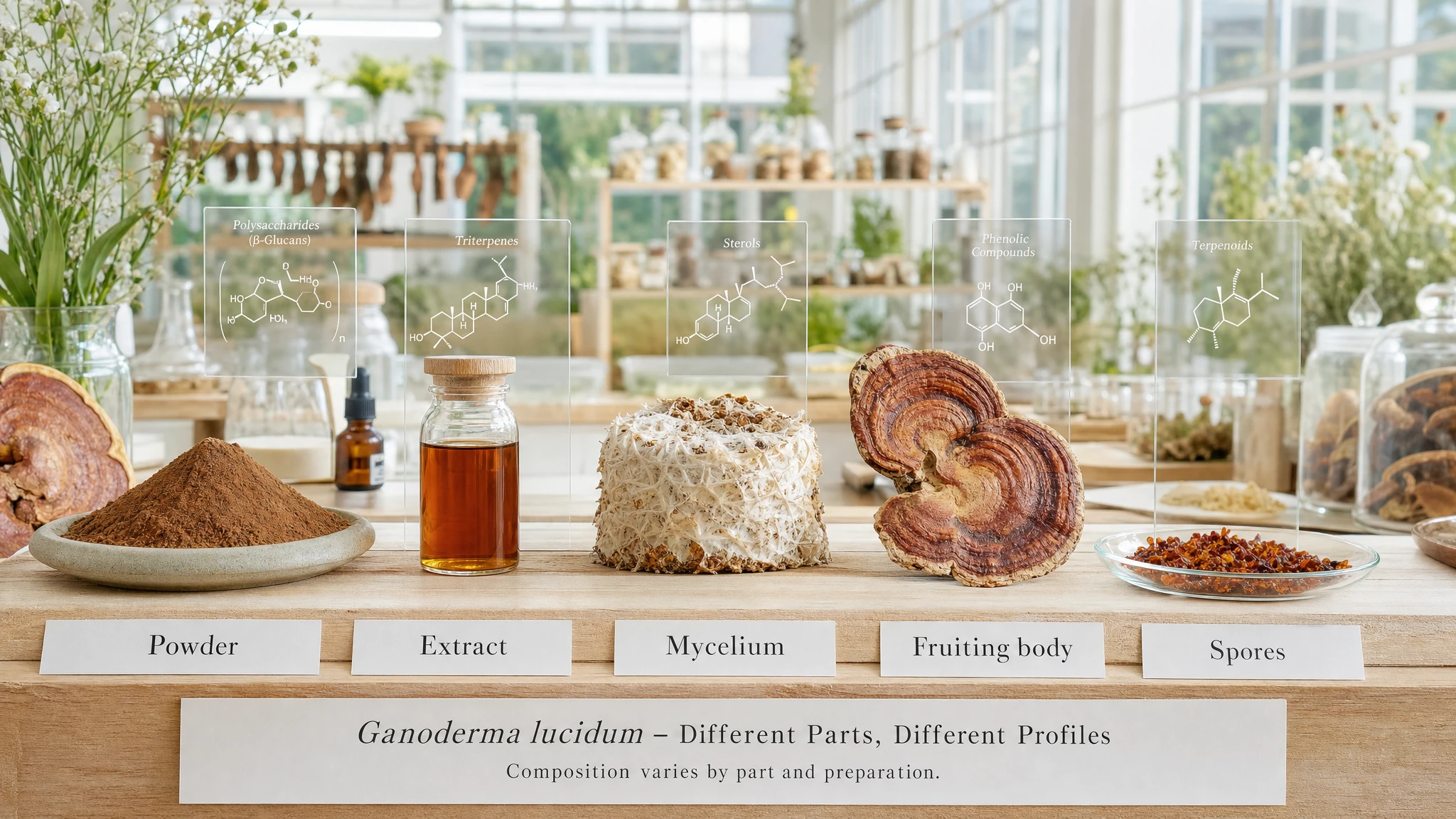
The composition of Ganoderma lucidum is not fixed, because the starting material and industrial processing are not identical from one product to another. In Reishi, different preparations can concentrate Reishi polysaccharides, Reishi beta-glucans, Reishi triterpenes, sterols (i.e., steroid lipids), and phenolic compounds (aromatic molecules with antioxidant activity) in different ways. In practice, a powder, an extract, or a product obtained from spores do not describe the same chemical reality. For this reason, when discussing Reishi bioactive compounds, the brand name alone is not enough to understand what is actually inside.
This variability is not just a technical detail, but the reason why two Reishi preparations should be compared with caution. A standardized product does not automatically coincide with a raw extract, and a powder is not equivalent to a concentrated formula. In practice, understanding what Reishi is today also means understanding which fraction was chosen and how much the process has modified the final content. In the following sections, you will first see the differences between the parts of the mushroom and then the effect of the extraction methods.
The differences become clear if you look at which part of the mushroom was used and how it was processed. Here are the points worth keeping in mind:
- The mycelium, the fruiting body, and the spores do not offer the same chemical profile.
- Extractions select different molecules and change the final result.
- Two products with similar labels may have non-overlapping contents.
- Acronyms on the packaging are not enough without data on the processing.
Reishi preparations vary primarily based on the raw material and the process used. Therefore, the same species can yield products with very different chemical profiles.
Mycelium, fruiting body, and spores: why they are not equivalent
In the medicinal Reishi mushroom, mycelium, fruiting body, and spores are distinct materials. They have different biological roles and, therefore, do not have the same composition. The mycelium is the network of filaments that grows in the material on which the mushroom lives. The fruiting body is the visible part, often harvested and used as a raw material. Spores, on the other hand, are the cells with which the mushroom reproduces.
Reishi bioactive compounds are not distributed in the same way across these three parts. When reading a study or a label, it is therefore necessary to understand which part was used. The species name alone is not enough to describe the product. A pilot study examined a specific preparation obtained from spores. The 48 patients took Ganoderma lucidum spore powder for 4 weeks. The study found a clear improvement in fatigue (intense and lasting tiredness) and well-being [15]. However, the result concerns that specific product and does not apply directly to the other parts. In fact, the composition, bioavailability (the portion absorbed by the body), and dose control can change. The data must therefore be interpreted based on the part of the mushroom actually used.
How extraction methods modify the chemical profile of Reishi
A Reishi extract is not the same as a powder, because the molecules are obtained in different ways. The method can make Reishi polysaccharides more available or increase the proportion of Reishi triterpenes. At the same time, it may leave sterols and phenolic compounds in the background. The process, therefore, does not simply concentrate the substances already present. It selects certain molecules and changes the chemical profile of the final product. In the composition of Ganoderma lucidum, both the presence of a substance and the way it is extracted matter. This step also changes the quantity that can be measured in the finished product.
Syntheses of studies show that solvent, purification, and final form can yield different results. Purification removes unwanted compounds and selects those of interest. However, there is no single chemical profile that is valid for all extracts. Two products with the same name may have different amounts of Reishi beta-glucans or other bioactive compounds. A comparison is therefore only useful if the processing method is described precisely.
Why two Reishi products can have similar labels but different compositions
Two Reishi products may seem equivalent because they carry the same name, but they can actually differ in terms of part of the mushroom, concentration, extraction, and standardization. A generic label does not state whether the content is derived from the fruiting body, the mycelium, or a mixture, nor does it clarify the extent to which Reishi polysaccharides, triterpenes, or other bioactive compounds are represented.
For this reason, in nutritional and scientific reading, the common name must always be accompanied by information on the actual formulation. Without these details, the composition remains only partially interpretable. More extensive reviews emphasize that the chemical profile of Reishi is also influenced by the regulation of secondary metabolism and the variability of the starting material [16] [10]. This means that products similar in appearance may have concrete differences in their content of Reishi triterpenes, sterols, and phenolic compounds. The limitation is that many commercial labels do not report comparable analytical standards, so the reader cannot automatically equate two preparations. Caution, in this case, is part of the correct interpretation of the data.
Summary of scientific evidence
This summary organizes the available sources on the composition of Reishi. It shows which data are most robust, which molecules recur, and where the evidence is less uniform.
| Publication year | Area studied | What the studies indicate |
|---|---|---|
| 2013 | Main bioactive families | evidence shows a profile rich in polysaccharides and triterpenoids [3] |
| 2019 | Ganoderic triterpenoids | results are not uniform, but studies describe many different triterpenic structures [14] |
| 2020 | Polysaccharide mechanisms | the signal is consistent with the strong focus that studies place on this chemical component [13] |
| 2022 | Phytochemical composition | evidence shows the presence of polysaccharides, triterpenoids, sterols, and phenolic compounds [4] |
| 2023 | Reishi polysaccharides | studies indicate a central role for polysaccharides in defining the mushroom's chemical profile [11] |
| 2024 | Ganoderic acids and triterpenes | data show that ganoderic acids are among the most abundant triterpenoids in the mushroom [9] |
| 2025 | Overall clinical evidence | evidence shows modest effects and very low overall quality [7] |
Editorial interpretation of the evidence
Reading the studies collected in this article, I found a rich but variable chemical profile. Polysaccharides and triterpenes are the classes of substances mentioned most often. The data agree on the importance of the species, the part of the mushroom, and the processing method. The evidence describes well which substances the examined material contains. It is, however, less robust in linking each substance to a consistent and repeatable effect.
The main limitations I encountered are the wide variety of products and the low number of large-scale trials. Furthermore, extracts, powders, and spores remain difficult to compare with one another. Many studies do not use entirely uniform analysis methods, so direct comparisons require caution. Even when biological signals are relevant, they are not enough to draw conclusions that apply to all products.
Conclusions and editorial summary
From this analysis, I have concluded that Reishi encompasses various preparations and does not always have a consistent composition. Studies describe a complex rich in polysaccharides (sugar chains), triterpenes, sterols, and other secondary metabolites. The latter are substances produced by the mushroom that are not directly required for its growth.
To understand the studies, it is therefore necessary to evaluate the part used and the processing method. The common name alone does not provide sufficient data to understand the product. From an editorial perspective, precision avoids misinterpretations or oversimplifications of the results. Nutrition, metabolism, and product quality are linked, so sources are not always easy to compare. For the reader, what matters most is knowing the true chemical profile of the preparation.
Final critical note
The picture provides useful data, but it stems more from reviews and chemical analyses than from homogeneous evidence. Therefore, it does not allow me to assign a unique and always comparable role to every part of Reishi. Moreover, products vary significantly, and studies often provide little explanation for these differences. It is therefore difficult to extend a result beyond the individual study or the preparation examined.
Even when signals are consistent, there is a lack of analytical standardization (the use of uniform measurement methods). This limitation reduces the strength of the conclusions that can be drawn from the data. The data therefore offer a map of the composition, not a final synthesis of the mushroom's biological functions.
References
[1] Dietary Supplement Fact Sheets
[2] Reishi Mushroom: Usefulness and Safety
[3] Probing Lingzhi or Reishi Medicinal Mushroom Ganoderma lucidum (Higher Basidiomycetes): A Bitter Mushroom with Amazing Health Benefits
[4] Antioxidant, antibacterial, antitumor, antifungal, antiviral, anti-inflammatory, and nevro-protective activity of Ganoderma lucidum: An overview
[5] A Review of Ganoderma lucidum Polysaccharide: Preparations, Structures, Physicochemical Properties and Application
[6] Ganoderma lucidum : a comprehensive review of phytochemistry, efficacy, safety and clinical study
[7] The Nutritional Significance of Ganoderma lucidum on Human Health: A GRADE ‐Assessed Systematic Review and Meta‐Analysis of Clinical Trials
[8] Therapeutic potential and nutritional significance of Ganoderma lucidum – a comprehensive review from 2010 to 2022
[9] Research Progress on the Biological Activity of Ganoderic Acids in Ganoderma lucidum over the Last Five Years
[10] A Comprehensive Review on the Chemical Composition, Pharmacology and Clinical Applications of Ganoderma
[11] A review of Ganoderma lucidum polysaccharides: Health benefit, structure–activity relationship, modification, and nanoparticle encapsulation
[12] Extraction, purification, structural characterization, biological activity, mechanism of action and application of polysaccharides from Ganoderma lucidum: A review
[13] Molecular mechanisms of bioactive polysaccharides from Ganoderma lucidum (Lingzhi), a review
[14] Review of the molecular mechanisms of Ganoderma lucidum triterpenoids: Ganoderic acids A, C2, D, F, DM, X and Y
[15] Spore Powder of Ganoderma lucidum Improves Cancer-Related Fatigue in Breast Cancer Patients Undergoing Endocrine Therapy: A Pilot Clinical Trial
Editorial note
Artificial Intelligence was used solely as a tool to support editorial and documentary work. All content, interpretations, bibliographic citations and conclusions have been verified, reviewed and approved by the author, who assumes full scientific responsibility for them.
The manuscript was also subject to independent peer review prior to publication.
To ensure maximum transparency, the article's complete history — including the dates of submission, review, acceptance and publication, as well as information on the peer review process — is available on the dedicated Article History page.